
Table of Contents
ToggleBLOOD TYPING & CROSSMATCHING
BLOOD TYPING & CROSSMATCHING
EXPERIMENT : BLOOD TYPING
This experiment is a collection of measurements routinely carried out in hospital laboratories. The method chosen in the hospital will be a compromise between available instruments and wanted accuracy. Here we want you to get familiar with some of the most commonly used methods in this country.
At the end of the experiment, you should be able to:
- Identify the different equipment and reagents used in this experiment stating the relevance of each.
- Define the terms blood “groups” and “blood types”, and name the various blood grouping systems.
- Describe the physiological basis of blood grouping and state its clinical significance.
- Explain the basis of the terms “universal donor” and “universal recipient”.
- Describe the significance of Rh factor determination.
- Determine blood groups by using commercially available anti-sera, and precautions to be observed.
- Explain how blood is screened and stored in blood banks, and outline the changes that occur when blood is stored.
- List the indications for blood transfusion.
- Explain the relevance of matching donor and recipient blood groups before transfusion.
Blood Groups / Types
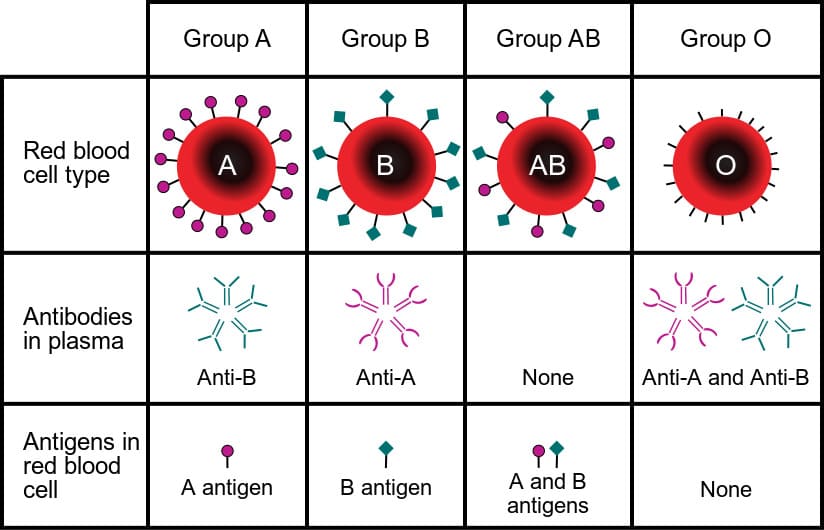
The membrane of each red blood cell contains millions of antigens that are ignored by the immune system. However, when patients receive blood transfusions, their immune systems will attack any donor red blood cells that contain antigens that differ from their self-antigens. Therefore, ensuring that the antigens of transfused red blood cells match those of the patient’s red blood cells is essential for a safe blood transfusion.
The most common and relevant of these antigens are the 3 antigens that form the ABO blood group system and Rhesus antigens that make up the Rhesus blood group. The presence of the three ABO agglutinogens (determined by three allelic genes) residing on the surface of red blood cells and the presence in the serum of three specific antibodies (agglutinins) to these genetically determined antigens is responsible for the major blood group antigen-antibody reactions, which may occur as a result of blood transfusions.
Genotypes & Phenotypes
Six genotypes in the ABO blood grouping system may exist:
Group O
Group A
Group B
Group AB
Note: A and B are dominant over the gene O. Therefore, genotype BO cannot be serologically distinguished from BB, and AO cannot be serologically distinguished from AA.
In addition, there exists other less common blood grouping systems like: the Duffy, Kell, Diego, Kidd, and MNS blood groups among others. This practical session however will focus on the ABO and Rhesus blood grouping systems since they are the most assessed clinically in hospital, and contribute the major bulk of blood transfusion reactions.
Landsteiner’s Law
States that if a particular antigen is present in the red blood cells, the corresponding antibody must be absent in the serum. If the particular antigen is absent in the red blood cells the corresponding antibody must be present in the serum.
Blood typing is performed on the basis of agglutination. Agglutination occurs if an antigen is mixed with its corresponding antibody.
Instructions
The normal procedure is to mix the unknown cells with two known sera containing A or B agglutinogens. You are provided with unknown red blood cells and a series of known sera samples.
Later in the practical, you will be required to obtain samples of your own (or your friends) blood by cleaning the fourth fingertip with alcohol and puncturing it with a sterile blood lancet. This has a shoulder that prevents too deep entry; therefore a sharp stab with the lancet gives a better blood supply, than a tiny prick.
Group Tasks:
- Typing of unknown red blood cells.
- Typing of own blood both ABO and Rh.
- Cross-matching of incompatible bloods.
Procedures
1. ABO Blood Grouping
- Label a series of grooves on a tile: Anti A, Anti B, Anti AB, and Control. Divide it into two halves with a grease pencil for blood sample X (known) and Y (unknown).
- Place one drop of serum in each groove with a glass rod. Repeat for each sample, taking care to wash and dry the rod between samples.
- Prepare a control groove using 0.9% saline instead of serum.
- Using one end of the glass rod mix the blood in the sera in each trough thoroughly for 30 seconds.
- Stir for 2 minutes and observe for agglutination.
- Record your findings and determine the group of the unknown blood and own blood used.
Observation: Agglutination may be visible to the naked eye as microscopic clumps like cayenne pepper grains or will be seen as smaller clumps under the microscope. The control will appear unaltered at the end of fifteen minutes when a final inspection should be made.
2. Rh Blood Grouping
- Follow steps 1-6 of the ABO system above using the Anti-D sera.
- Examine for evidence of agglutination.
- If agglutination did not occur within 2 minutes, record the blood as Rh negative.
- If agglutination occurred within 2 minutes, record the blood as Rh positive.
OBSERVATIONS
| Name/ID | Anti-A | Anti-B | Anti-AB | Rh (Anti-D) | Blood Group |
|---|---|---|---|---|---|
| Sample X | |||||
| Sample Y | |||||
| Own Blood |
Note: Mark (+) for agglutination and (-) for no agglutination.
EXPERIMENT : CROSS-MATCHING
This experiment is designed to imitate the conditions appertaining to a transfusion of incompatible blood. Re-group partners so that incompatible bloods work together. Call one the ‘donor’ and the other the ‘recipient’.
Principle
- The Reaction: Place on a slide one drop of a 1/10 dilution of ‘donor’ blood in citrate-saline. Add 1 drop of undiluted ‘recipient’ blood and mix immediately.
- Observation: The donor’s cells are outnumbered ten to one by the recipient’s but are observed clumped together in small groups. The recipient’s cells float freely in the plasma in which the donor’s agglutinins are diluted twenty times.
- Universal Donor Concept: That such a dilution of agglutinins fails to affect the recipient’s cells is the basis for the use of Group O blood for transfusion into any recipient in an emergency. Group O is thus sometimes called the ‘universal donor’.
Apparatus
- Blood slide
- Citrate saline (3.8%)
- Watch glasses
- White tile
- White cell pipette
- Cotton wool
- Blood Samples (X & Y)
Procedure
- Preparation: Mark watch glasses X and another C for citrate saline.
- Dispense Fluids: Pipette blood from container X and put a drop on the watch glass marked X. Pour citrate saline in the watch glass marked C.
- Pipetting Blood: Using the white blood cell pipette, pipette blood up to the 1 mark from the watch glass (X).
- Dilution: Dilute it with citrate saline up to the 11 mark from the citrate saline watch glass and mix.
- Transfer Diluted Sample: Empty the diluted sample X from the white blood cell pipette into the trough of the white tile.
- Add Recipient Blood: Add one drop of blood sample from the container bottle marked Y using a glass rod into the trough containing the diluted blood X.
- Mixing: Wipe the glass rod and mix undiluted using a tooth pick for seconds.
- Observation: Observe the reactions and record your results.
DISCUSSION
What is Landsteiner’s law and what are the exceptions to this law?
What do you mean by a universal donor and a universal recipient?
Explain the need for direct testing (cross-matching) before blood transfusion.
What are the physiological changes that occur to RBC during storage?
Describe the importance of grouping the blood of pregnant women.
Describe the use of blood groups in medico-legal procedures.
Blood Group Steeplechase
ABO & Rhesus Grouping Experiment
Exam Strategy:
- Clumps = Positive: If it clumps in 'A', it is 'A'.
- No Clumps = O: If nothing clumps (except maybe Rh), it is 'O'.
- Reagent Colors: Blue is A, Yellow is B.
- Genetics: Know who can donate to whom.
Exam Completed!
Results for .
Score
0/0
Accuracy
0%
Processing images and generating PDF...