
Table of Contents
ToggleIschemic Heart Disease & Pharmacology
Ischemic heart disease (IHD), commonly known as Coronary Artery Disease (CAD) or coronary heart disease, is a condition in which the heart muscle (myocardium) does not receive enough oxygen-rich blood. This is usually because the coronary arteries—the blood vessels that supply the heart—are narrowed or blocked.
To truly understand how cardiovascular drugs work, you must first understand the delicate balance of Myocardial Oxygen Supply and Demand.
- Oxygen Supply: The heart receives its blood supply exclusively through the coronary arteries. Unlike the rest of the body, the heart is perfused (receives blood) only during diastole (when the heart is resting/relaxing). If the heart beats too fast, diastole is shortened, and the heart gets less blood.
- Oxygen Demand: This is how much oxygen the heart is using. It is determined by four main factors:
- Heart Rate (HR): Faster beating requires more energy/oxygen.
- Contractility: A harder squeeze requires more energy.
- Preload: The amount of blood stretching the heart chambers just before it beats (venous return). More stretch = more work required to pump it out.
- Afterload: The resistance the heart must pump against (blood pressure in the arteries). Higher resistance = harder work.
Ischemia occurs when Demand > Supply. Every drug we use will aim to either increase supply or, more commonly, decrease demand!
Pathophysiology: How Does Ischemia Happen?
The basic sequence of ischemic heart disease development is a progressive cascade:
Risk factors → Endothelial injury → Atherosclerosis → Coronary artery narrowing → Reduced myocardial blood flow → Myocardial ischemia.
- When myocardial oxygen demand exceeds oxygen supply, ischemia (cellular starvation) occurs.
- If the reduction in blood flow is severe or prolonged, myocardial cells begin to die (necrosis), resulting in a Myocardial Infarction (MI), commonly known as a heart attack.
Major Causes of Ischemic Heart Disease
The most common cause by far is Atherosclerosis, a process involving the deposition of cholesterol, fat, and inflammatory cells within the coronary artery walls, forming a plaque that narrows the vessel.
Other causes include:
- Coronary artery spasm: Sudden, temporary tightening of the muscle in the artery wall (Prinzmetal's angina).
- Coronary thrombosis: A blood clot forming directly on a ruptured atherosclerotic plaque.
- Coronary embolism: A clot traveling from elsewhere and lodging in a coronary artery.
- Severe anemia or hypoxia: The blood vessels are open, but the blood itself lacks enough oxygen or red blood cells.
- Severe hypotension: Blood pressure is too low to drive blood into the coronary arteries.
- Increased myocardial oxygen demand: Such as during marked tachycardia (extremely fast heart rate) where the heart works too hard and starves itself.
Risk Factors for IHD
Factors you cannot change:
- Increasing age
- Family history of premature coronary disease (e.g., father having a heart attack before 55).
- Genetic predisposition
Factors that can be treated or changed:
- Hypertension (High blood pressure damages the endothelium)
- Smoking (Toxins cause endothelial injury)
- Diabetes mellitus
- Hyperlipidemia (High cholesterol)
- Obesity & Physical inactivity
- Unhealthy diet & Chronic stress
Clinical Manifestations
IHD can present in several distinct ways across a spectrum of severity:
- Chest discomfort, heaviness, or pressure.
- Predictable: usually brought on by exertion or physical stress (when demand goes up).
- Reliably relieved by rest or taking nitroglycerin.
- New, worsening, or occurring-at-rest chest pain.
- Represents an Acute Coronary Syndrome (ACS) (a plaque has likely ruptured).
- Requires urgent medical assessment as it may progress to an MI.
- Prolonged myocardial ischemia causing irreversible myocardial cell death.
- Presents with severe chest pressure, sweating, nausea, breathlessness, or pain radiating to the arm, shoulder, neck, jaw, or back.
- Ischemia occurs without obvious chest pain or typical symptoms.
- Much more common in populations with diabetes due to autonomic neuropathy (nerve damage masking the pain).
Ischemia ≠ Infarction
- Ischemia: Inadequate oxygen supply, which is potentially reversible if blood flow is restored quickly.
- Infarction: Prolonged ischemia causing irreversible myocardial cell death (necrosis). Once dead, heart tissue does not regenerate; it becomes a scar.
Complications of untreated IHD: Myocardial infarction, Heart failure, Cardiac arrhythmias, Cardiogenic shock, and Sudden cardiac death.
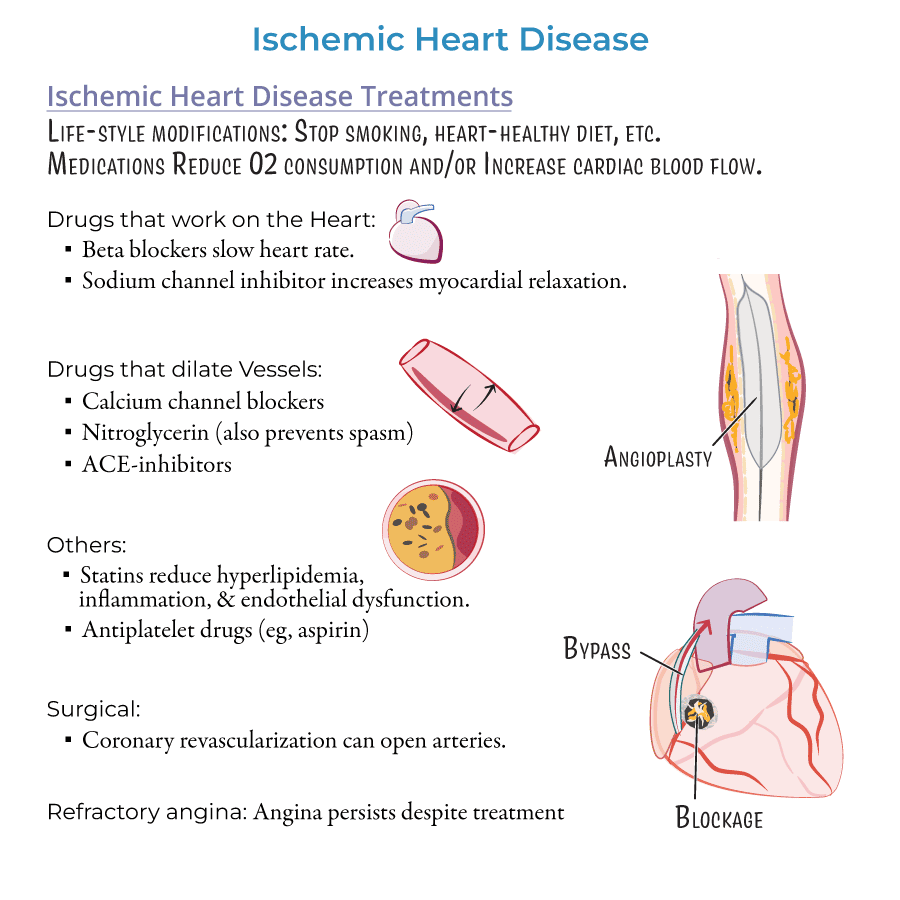
Pharmacology of Drugs for Ischemic Heart Disease
The pharmacological management of IHD has two major aims:
- Relieve myocardial ischemia and angina (Improve quality of life).
- Prevent myocardial infarction and cardiovascular death (Increase lifespan).
The major drug groups are Nitrates, Beta-blockers, Calcium-channel blockers, Antiplatelet drugs, Statins, ACE inhibitors/ARBs, and selected anti-anginal agents (like Ranolazine).
1. Nitrates
Examples: Nitroglycerin (glyceryl trinitrate), isosorbide dinitrate, isosorbide mononitrate.
Nitrates enter the vascular smooth muscle and release/increase Nitric Oxide (NO). NO activates the enzyme guanylyl cyclase, which increases cyclic GMP (cGMP). cGMP causes vascular smooth muscle relaxation.
While they dilate all blood vessels, their predominant effect is VENODILATION (dilating the veins). Why does this help the heart?
- Veins are capacitance vessels (they hold blood). Dilating them pools blood in the legs/body.
- This leads to ↓ Venous Return (less blood returning to the heart).
- This causes ↓ Ventricular Preload (the heart is stretched less).
- Less stretch means ↓ Myocardial Wall Stress.
- Result: ↓ Myocardial Oxygen Demand. (The heart doesn't have to work as hard).
Secondary effect: They also directly dilate the coronary arteries, relieving coronary vasospasm and mildly increasing oxygen supply.
- Uses: Acute relief of angina (sublingual nitroglycerin acts in minutes), prevention of exertional angina (long-acting patches/pills), and in selected patients with Acute Coronary Syndromes.
- Adverse Effects:
- Headache & Flushing: Due to dilation of meningeal and facial blood vessels.
- Dizziness & Hypotension: Due to pooling of blood.
- Reflex Tachycardia: The body senses the drop in blood pressure and reflexively speeds up the heart (which is bad for ischemia!).
- Tolerance: With continuous 24/7 exposure, the vessels stop responding. Patients must have a "nitrate-free interval" (e.g., taking the patch off at night) to allow enzymes to recover.
2. β-Adrenergic Blockers (Beta-Blockers)
Examples: Metoprolol, bisoprolol, atenolol (Cardioselective agents).
They block the β₁ receptors located on the heart muscle and pacemaker cells. The sympathetic nervous system (adrenaline) usually hits these receptors to stimulate the heart.
- β₁ blockade → ↓ Heart rate + ↓ Myocardial contractility + ↓ Blood pressure.
- This massively results in ↓ Myocardial Oxygen Demand.
- Crucial Physiology: By lowering the heart rate, they prolong diastole (the resting phase). Because the coronary arteries only fill during diastole, a longer diastole means improved coronary perfusion (increased oxygen supply).
- Uses: Chronic stable angina, secondary prevention after MI (they reduce mortality!), IHD associated with hypertension or tachyarrhythmia, and heart failure (with specific agents). They are particularly useful when angina is associated with an increased heart rate.
- Adverse Effects:
- Bradycardia (heart beats too slow).
- Hypotension & Fatigue (feeling sluggish because the heart is blocked from speeding up during exercise).
- AV conduction abnormalities (heart block).
- Bronchospasm: The lungs have β₂ receptors that keep airways open. If you use a non-selective beta-blocker (like propranolol), it blocks β₂ as well, triggering severe asthma attacks.
3. Calcium-Channel Blockers (CCBs)
Muscle contraction requires calcium to enter the cells. By blocking L-type calcium channels, these drugs relax muscle. There are two completely different classes based on where they like to work.
A. Dihydropyridines (The "Vessel" CCBs)
- Examples: Amlodipine, nifedipine (Notice the "-dipine" suffix).
- Mechanism: They predominantly target smooth muscle in blood vessels causing arteriolar vasodilation.
- Dilating arteries → ↓ Afterload (less resistance for the heart to pump against).
- Result → ↓ Myocardial Oxygen Demand.
- Uses: Particularly useful when angina occurs with hypertension or coronary vasospasm (Prinzmetal's angina).
- Adverse Effects: Ankle edema (fluid leaking from dilated capillaries), flushing, headache, dizziness. Note: Because they drop blood pressure, the brain may trigger a reflex tachycardia (which increases O2 demand).
B. Non-Dihydropyridines (The "Heart" CCBs)
- Examples: Verapamil, diltiazem.
- Mechanism: They target the calcium channels directly in the cardiac pacemaker cells (SA/AV node) and cardiac muscle.
- ↓ Heart rate and ↓ Myocardial contractility.
- Slow AV conduction (acts like a brake on electrical signals).
- Also cause mild coronary vasodilation.
- Result → ↓ Myocardial Oxygen Demand.
- Adverse Effects: Bradycardia, AV block, hypotension. Constipation is notoriously common, particularly with verapamil (due to blocking calcium in GI smooth muscle).
4. Antiplatelet Drugs
When an atherosclerotic plaque ruptures in an artery, it exposes collagen. Platelets view this as a "cut" and immediately stick to it, activating and calling more platelets to form a plug (Coronary Thrombosis), blocking the artery. Antiplatelets stop this.
- Mechanism: Irreversibly inhibits the COX-1 enzyme in platelets. This leads to ↓ Thromboxane A₂ (a potent platelet activator), resulting in ↓ Platelet aggregation. Because platelets have no nucleus, they cannot make new COX-1; they are deactivated for their entire 7-10 day lifespan.
- Uses: Secondary prevention of MI, Acute coronary syndromes, prevention of recurrent events.
- Adverse Effects: Gastric irritation, Gastrointestinal bleeding (because COX-1 also protects the stomach lining), hypersensitivity reactions.
- Mechanism: Blocks the platelet P2Y12 ADP receptor. ADP is another chemical signal platelets use to call for backup. Blocking it inhibits activation and aggregation.
- Uses: Used when a patient is allergic/unsuitable for aspirin. Also heavily used in combination with aspirin—known as Dual Antiplatelet Therapy (DAPT)—in Acute Coronary Syndromes and specifically in patients who just received a coronary stent (to stop a clot from forming on the foreign metal).
5. Anticoagulants
While antiplatelets stop the "platelet plug" (white clot), anticoagulants stop the coagulation cascade from weaving the fibrin web (red clot) that cements the blockage.
- Examples: Unfractionated heparin (UFH), Low-molecular-weight heparin (LMWH, e.g., enoxaparin), Fondaparinux.
- Role: Particularly important in the acute setting (Acute Coronary Syndromes/hospitalization) when active thrombosis is occurring. They inhibit coagulation factors (like Thrombin and Factor Xa) to reduce further thrombus formation.
- Major Adverse Effect: Bleeding (spontaneous or prolonged).
6. Statins (Lipid-Lowering Agents)
Examples: Atorvastatin, rosuvastatin, simvastatin.
Statins inhibit HMG-CoA reductase, the rate-limiting enzyme the liver uses to synthesize cholesterol.
↓ Hepatic cholesterol synthesis → The liver panics and needs cholesterol, so it upregulates (increases) Hepatic LDL receptors on its surface → These receptors pull LDL ("bad cholesterol") out of the blood → ↓ Plasma LDL cholesterol.
Beyond Cholesterol: Statins have "pleiotropic" (additional) benefits. They decrease inflammation and cause stabilization of atherosclerotic plaques (making the fibrous cap thicker so it is less likely to rupture and cause an MI). They actively reduce cardiovascular events and mortality.
- Uses: Long-term management of atherosclerotic disease, secondary prevention after MI, primary prevention in high-risk patients.
- Adverse Effects: Muscle-related symptoms (myalgia/muscle pain), increased liver enzymes (hepatotoxicity). Rarely, they can cause severe muscle injury (Rhabdomyolysis) leading to kidney failure.
7. ACE Inhibitors and ARBs
Examples: ACE Inhibitors (-prils): Enalapril, lisinopril. ARBs (-sartans): Losartan, valsartan.
- Context: These are not primarily "anti-anginal" drugs (they don't stop chest pain acutely), but they are heavily indicated in patients with IHD who have comorbidities like hypertension, diabetes, left ventricular dysfunction, or heart failure.
- Mechanism (ACE Inhibitors): Inhibit the Angiotensin-Converting Enzyme (ACE) → ↓ Angiotensin II (a potent vasoconstrictor). This leads to:
- Vasodilation → ↓ Afterload (less work for the heart).
- Prevention of Cardiovascular Remodeling: Angiotensin II normally tells the heart to grow thick and stiffen (hypertrophy) after an injury like an MI. Blocking it preserves heart shape and function over time.
- Adverse Effects: Hypotension, Hyperkalemia (high potassium, because aldosterone is also inhibited), Renal dysfunction (in specific settings like bilateral renal artery stenosis).
- Specific to ACE Inhibitors: Persistent dry cough (because ACE normally breaks down bradykinin in the lungs; without ACE, bradykinin builds up and irritates the airway) and rarely, Angioedema (life-threatening facial/airway swelling). If these occur, patients are switched to ARBs.
8. Other Anti-Anginal Drugs: Ranolazine
During ischemia, cardiac cells lose energy and struggle to pump out Sodium (Na+). This late Na+ buildup reverses the Sodium-Calcium exchanger, dragging massive amounts of Calcium (Ca2+) into the cell. This calcium overload causes the heart muscle to stay stiff and clamped down, increasing wall tension and crushing its own blood vessels.
- Mechanism: Ranolazine specifically blocks/reduces this late sodium current in cardiac myocytes. This reduces intracellular sodium, which prevents the secondary calcium overload.
- Effect: Decreases myocardial wall tension and oxygen demand without substantially reducing heart rate or blood pressure (unlike Beta-blockers or CCBs).
- Uses: Additional treatment for chronic angina in selected patients when conventional therapy is inadequate, unsuitable, or causing unbearable side effects (like severe bradycardia).
- Adverse Effects: Dizziness, constipation, and possible QT prolongation on an ECG (which increases the risk for arrhythmias).
Summary: Pharmacological Action & Major Use
| Drug Class | Main Pharmacological Action | Major Use / Main Role |
|---|---|---|
| Nitrates (Nitroglycerin, isosorbide mononitrate) | ↓ Preload (venodilation) and ↓ myocardial O₂ demand. | Acute and chronic angina relief/prevention. |
| β-blockers (Metoprolol, bisoprolol) | ↓ Heart Rate, ↓ contractility and ↓ O₂ demand. Prolongs diastole. | Stable angina; post-MI (reduces mortality); reduces HR. |
| CCBs (Amlodipine, diltiazem, verapamil) | Vasodilation (↓ Afterload) ± ↓ HR/contractility. | Angina, hypertension, vasospasm (Prinzmetal's). |
| Aspirin | Irreversibly inhibits COX-1 to prevent platelet aggregation. | Secondary prevention, ACS; prevent platelet thrombosis. |
| Clopidogrel | P2Y12 ADP receptor blockade. | ACS, alternative/add-on antiplatelet (DAPT). |
| Heparins | Inhibit coagulation cascade. | Acute coronary syndromes (ACS). |
| Statins (Atorvastatin, rosuvastatin) | Inhibit HMG-CoA reductase (↓ LDL cholesterol, stabilizes plaque). | Long-term prevention; reduce cardiovascular risk. |
| ACEI/ARBs (Enalapril, losartan) | ↓ Angiotensin II → ↓ afterload and prevents cardiac remodeling. | IHD with appropriate comorbidities (HTN, Diabetes, LV dysfunction). |
| Ranolazine | ↓ late Na⁺ current (prevents Ca2+ overload). | Chronic angina (add-on therapy). |
| Ivabradine | ↓ SA-node firing (Funny current, If). | Selected chronic stable angina (lowers HR without dropping BP). |
References & Further Reading
- Brunton, L. L., Hilal-Dandan, R., & Knollmann, B. C. (2017). Goodman and Gilman's The Pharmacological Basis of Therapeutics (13th ed.). McGraw-Hill Education. (Mechanisms of Nitrates, Beta-blockers, and Calcium Channel Blockers).
- Katzung, B. G. (2018). Basic & Clinical Pharmacology (14th ed.). McGraw-Hill Education. (Pharmacodynamics of Anti-anginal drugs and Ranolazine).
- Lilly, L. S. (2015). Pathophysiology of Heart Disease (6th ed.). Wolters Kluwer. (Physiology of myocardial oxygen supply/demand and Atherosclerosis).
- Collet, J. P., et al. (2020). 2020 ESC Guidelines for the management of acute coronary syndromes in patients presenting without persistent ST-segment elevation. European Heart Journal. (Use of DAPT, Statins, and Anticoagulants in ACS).
Quick Quiz
Ischemic Heart Disease Pharmacology Quiz
Pharmacology - mobile-friendly and focused practice.
Privacy: Your details are used only for quiz tracking and certificates.
Ischemic Heart Disease Pharmacology Quiz
Pharmacology
Preparing questions...
Choose your answer and keep your streak alive.
Great effort.
Here is your quick performance summary.