
Day 9 CN/CM 1.1 UHPAB Preparation
DAY 9
📅 Nov 18 (Mon)
🛡️ Lymphatic System
CN-1102: Immunity Basics
- Lymphatic Vessels & Nodes
- Lymphoid Organs (Spleen, Thymus, Tonsils)
- Functions of Lymphatic System
🛡️ REMEMBER: Lymph nodes filter lymph & produce lymphocytes. Swollen = infection!
🦠 KEY POINT: Spleen = largest lymphoid organ, filters blood, stores platelets
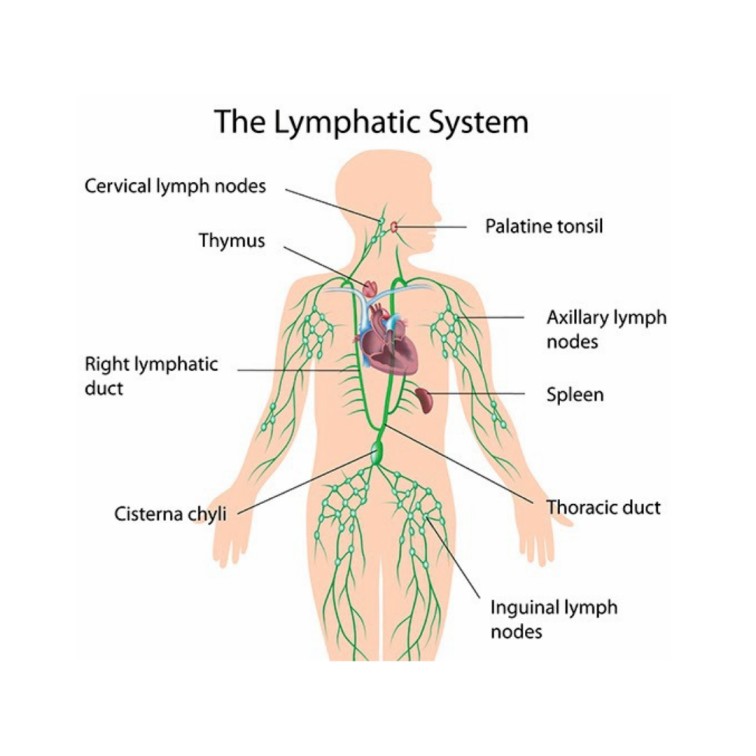
🎯 1. INTRODUCTION TO LYMPHATIC SYSTEM
LYMPHATIC SYSTEM: A one-way network of vessels, nodes, and organs that transports lymph (excess tissue fluid) back to the bloodstream and plays a critical role in immunity and fluid balance.
LYMPH: Clear, pale yellow fluid derived from interstitial fluid. Contains water, dissolved substances, lymphocytes, and sometimes macrophages.
INTERSTITIAL FLUID: Fluid that bathes body cells, formed from plasma leaking out of capillaries. When this fluid enters lymphatic vessels, it's called LYMPH.
⚠️ EXAM TIP: Remember the relationship: Plasma → Interstitial Fluid → Lymph. This is a favorite MCQ trap! Lymph IS interstitial fluid once it's inside lymphatic vessels.

🔄 2. LYMPHATIC VESSELS
TYPES & CHARACTERISTICS:
LYMPHATIC CAPILLARIES: Blind-ended tubes found in most tissues (except CNS, cornea, bones). More permeable than blood capillaries, allowing large molecules (proteins, bacteria) to enter.
LYMPHATIC COLLECTING VESSELS: Formed from merged capillaries. Contain VALVES to prevent backflow of lymph (similar to veins).
LYMPHATIC TRUNKS: Larger vessels draining major body regions:
- Lumbar trunks - drain lower limbs & pelvis
- Intestinal trunk - drains digestive organs
- Bronchomediastinal trunks - drain thorax
- Subclavian trunks - drain upper limbs
- Jugular trunks - drain head & neck
LYMPHATIC DUCTS: Two main ducts return lymph to venous circulation:
- THORACIC DUCT: Drains 3/4 of body (everything except right upper quadrant). Empties into LEFT SUBCLAVIAN VEIN.
- RIGHT LYMPHATIC DUCT: Drains right upper quadrant (right head, neck, thorax, upper limb). Empties into RIGHT SUBCLAVIAN VEIN.
🧠 MNEMONIC: "L-TREE"
Lymphatic capillaries → Trunks → Right duct/Thoracic duct → Empties into Esubclavian veins
Lymphatic capillaries → Trunks → Right duct/Thoracic duct → Empties into Esubclavian veins
"Your lymphatic system is like a silent guardian, working 24/7 to keep you healthy. Master it, and you'll understand immunity!"
"The Lord will keep you from all harm." - Psalm 121:7
Page 1 of 3 | Day 9: Lymphatic System
DAY 9 (Cont'd)
📅 Nov 18 (Mon)
🎪 3. LYMPH NODES (THE FILTERS)
🔍 REMEMBER: Lymph nodes are like "security checkpoints" where lymph is filtered and immune cells are activated!
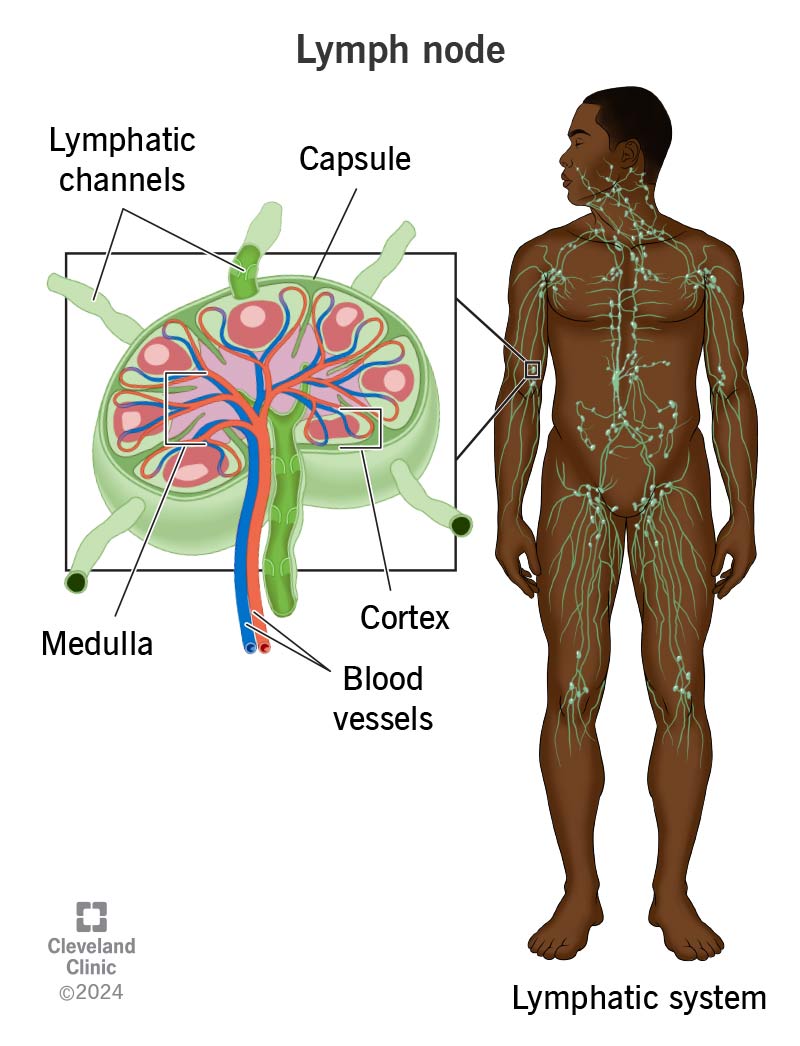
STRUCTURE:
CAPSULE: Fibrous outer covering
CORTEX: Outer region containing B-lymphocytes (follicles) and macrophages
MEDULLA: Inner region containing T-lymphocytes and plasma cells
AFFERENT LYMPHATIC VESSELS: Bring lymph INTO node (multiple)
EFFERENT LYMPHATIC VESSELS: Carry lymph OUT of node (single)
MAJOR LYMPH NODE GROUPS (CRITICAL FOR EXAMS!):
🧠 MNEMONIC: "Cervical nodes head the patrol, Axillary guard the arm whole, Inguinal protect the leg goal"
CERVICAL LYMPH NODES: Drain head & neck. Swelling = infections (tonsillitis, pharyngitis), TB, or metastatic cancer.
AXILLARY LYMPH NODES: Drain breast, upper limb, chest wall. Swelling = breast cancer, arm infections, cat-scratch disease.
INGUINAL LYMPH NODES: Drain lower limb, external genitalia, lower abdominal wall. Swelling = STIs, leg infections, filariasis.
MEDIASTINAL LYMPH NODES: In chest, drain thoracic organs. Swelling = lung TB, lymphoma.
ABDOMINAL & PELVIC LYMPH NODES: Drain digestive & urinary organs. Swelling = GI cancers, pelvic infections.
⚠️ CERTIFICATE LEVEL: In Uganda, swollen cervical nodes are most common. Always assess for TB and HIV. Axillary node swelling - think breast exam. Inguinal nodes - ask about STI history. This is clinical gold!
🏥 4. LYMPHOID ORGANS
SPLEEN (Largest Lymphoid Organ):
- Location: Left upper quadrant, under rib cage
- Functions:
- Filters blood (removes old RBCs, bacteria)
- Stores platelets and blood
- Produces lymphocytes
- Hematopoiesis in fetus
- Clinical: Splenomegaly (enlarged spleen) = malaria, typhoid, EBV, leukemia
THYMUS:
- Location: Upper mediastinum, behind sternum
- Function: Maturation of T-lymphocytes (T-cells)
- Important: Large in childhood, atrophies after puberty
TONSILS & ADENOIDS:
- Location: Throat (palatine, pharyngeal, lingual)
- Function: Trap pathogens entering via mouth/nose
- Clinical: Tonsillitis common in children
PEYER'S PATCHES: Lymphoid tissue in small intestine wall. Protect against intestinal pathogens.
VERMIFORM APPENDIX: Contains lymphoid tissue. May serve immune function in gut.
🧠 MNEMONIC: "Spleen is King - Stores, Filters, Protects"
Stores blood • Filters blood • Protects against infection
Stores blood • Filters blood • Protects against infection
Page 2 of 3 | Day 9: Lymphatic System
DAY 9 (Cont'd)
📅 Nov 18 (Mon)
⚙️ 5. FUNCTIONS OF LYMPHATIC SYSTEM
🧠 MNEMONIC: "FLUID IMMUNITY"
Fluid balance • Lipid absorption • Unzaps immunity • Immune response • Defense
Fluid balance • Lipid absorption • Unzaps immunity • Immune response • Defense
1. FLUID RETURN: Returns 2-3 liters/day of interstitial fluid to bloodstream. Prevents edema.
2. FAT ABSORPTION: Lacteals (special lymph capillaries) in small intestine absorb dietary lipids and fat-soluble vitamins (A, D, E, K). Transported as chylomicrons.
3. IMMUNITY:
- Filters lymph and blood removing pathogens
- Houses lymphocytes (B-cells, T-cells)
- Activates immune response
- Produces antibodies
4. DETOXIFICATION: Removes toxins, waste products, and cellular debris.
🚨 6. CLINICAL SIGNIFICANCE
⚠️ COMMON UGANDA CONDITIONS: Filariasis (elephantiasis), TB lymphadenitis, HIV-related lymphadenopathy, and malnutrition-related edema.
LYMPHEDEMA: Swelling due to blocked lymph drainage. Causes: filariasis (Wuchereria bancrofti), surgery, radiation, tumors.
LYMPHADENITIS: Inflamed lymph nodes (tender, swollen). Usually due to bacterial/viral infection.
LYMPHADENOPATHY: Abnormal nodes (enlarged, hard). May indicate cancer, TB, HIV.
SPLENOMEGALY: Enlarged spleen. In Uganda, think Malaria, Typhoid, EBV, Kala-azar.
⚠️ EXAM FAVORITE: When assessing swollen nodes, remember: TENDER = INFLAMMATION (infection), NON-TENDER = CANCER/TB. Hard, fixed nodes are RED FLAG for malignancy.
📝 LIKELY EXAM QUESTIONS FOR DAY 9
📚 PRACTICE QUESTIONS
1. FILL-IN-THE-BLANK (2 marks)
The largest lymphoid organ in the body is the _______________.
The largest lymphoid organ in the body is the _______________.
Answer: Spleen
2. FILL-IN-THE-BLANK (2 marks)
Lymph is interstitial fluid that has entered _______________ vessels.
Lymph is interstitial fluid that has entered _______________ vessels.
Answer: Lymphatic
3. MULTIPLE CHOICE (3 marks)
Which lymphoid organ is responsible for maturation of T-lymphocytes?
A) Spleen
B) Tonsils
C) Thymus ⭐CORRECT
D) Peyer's patches
Which lymphoid organ is responsible for maturation of T-lymphocytes?
A) Spleen
B) Tonsils
C) Thymus ⭐CORRECT
D) Peyer's patches
4. MULTIPLE CHOICE (3 marks)
Swollen cervical lymph nodes in Uganda most commonly indicate:
A) Breast cancer
B) Lower limb infection
C) TB or HIV infection ⭐CORRECT
D) Appendicitis
Swollen cervical lymph nodes in Uganda most commonly indicate:
A) Breast cancer
B) Lower limb infection
C) TB or HIV infection ⭐CORRECT
D) Appendicitis
5. SHORT ANSWER (5 marks)
Explain the functions of the lymphatic system
Explain the functions of the lymphatic system
Answer Guide: Mention 1) Fluid return/prevention of edema, 2) Fat absorption via lacteals, 3) Immunity (filtration, lymphocyte production, pathogen removal), 4) Detoxification. Give brief explanation for each.
6. PRACTICAL SCENARIO (10 marks)
A 25-year-old patient comes to your health center with swollen, painful inguinal lymph nodes. Outline your assessment and nursing care.
A 25-year-old patient comes to your health center with swollen, painful inguinal lymph nodes. Outline your assessment and nursing care.
Answer Guide:
• Assessment: History (STI risk, leg infection), palpate nodes (size, tenderness, mobility), check for fever, examine genital area/legs
• Differential: STI (syphilis, chancroid), cellulitis, filariasis
• Nursing care: Refer for lab tests, provide STI counseling, educate on safe practices, administer prescribed antibiotics, monitor swelling, document findings
• Key: Maintain confidentiality (Article 30), provide non-judgmental care
• Assessment: History (STI risk, leg infection), palpate nodes (size, tenderness, mobility), check for fever, examine genital area/legs
• Differential: STI (syphilis, chancroid), cellulitis, filariasis
• Nursing care: Refer for lab tests, provide STI counseling, educate on safe practices, administer prescribed antibiotics, monitor swelling, document findings
• Key: Maintain confidentiality (Article 30), provide non-judgmental care
7. LIST QUESTION (6 marks)
List three major groups of lymph nodes and what each drains.
List three major groups of lymph nodes and what each drains.
Answer Guide:
• Cervical - head & neck
• Axillary - breast & upper limb
• Inguinal - lower limb & genitalia
• Cervical - head & neck
• Axillary - breast & upper limb
• Inguinal - lower limb & genitalia
📊 STATISTICS: This topic appears in 70% of UHPAB exams, especially functions and clinical applications. Node locations and spleen functions are HIGHLY examinable!
"Every lymph node you study is a potential life you can save. Your knowledge is your patients' shield!"
Page 3 of 3 | Day 9: Lymphatic System Complete