
Table of Contents
TogglePharmacotherapy of COPD and Asthma
I. Introduction to Obstructive Airway Diseases
Before diving into the medications, it is crucial to understand what we are treating. Pharmacology is much easier to grasp when you understand the underlying pathophysiology. Both Asthma and Chronic Obstructive Pulmonary Disease (COPD) are Obstructive Lung Diseases. This means air can get into the lungs relatively easily, but it is hard to get the air out (exhalation is obstructed).
COPD is an umbrella term for conditions characterized by an airflow limitation that is not fully reversible and is usually progressive. It is associated with an abnormal inflammatory response of the lungs to noxious substances (primarily tobacco smoke, occupational dusts, or biomass fuels). COPD is a mixture of two distinct pathological processes:
- Emphysema: The destruction of the gas-exchanging surfaces (alveoli). The lungs lose their elastic recoil, becoming like a stretched-out rubber band that can't snap back.
- Chronic Bronchitis: Clinically defined as a productive cough with sputum for at least 3 months in each of two consecutive years. It involves inflammation and excess mucus production in the airways.
Asthma is a chronic inflammatory disorder of the airways. Unlike COPD, the airflow limitation in asthma is largely reversible (either spontaneously or with medication). It is characterized by hyper-responsiveness to triggers (allergens, cold air, exercise), leading to sudden bronchospasm, mucosal edema, and thick mucus production.
Asthma vs. COPD: The Key Differences
Understanding the difference in cellular inflammation explains why some drugs work better for asthma and others for COPD.
| Feature | Asthma | COPD |
|---|---|---|
| Age of Onset | Often early in life (childhood). | Mid-life or older. |
| Primary Inflammation | Eosinophilic inflammation, driven by CD4+ T-cells (Th2). | Neutrophilic inflammation, driven by Macrophages and CD8+ T-cells. |
| Key Mediators | Histamine, Leukotrienes, IL-4, IL-5. | IL-8, TNF-alpha. |
| Airflow Limitation | Largely reversible (varies from day to day). | Largely irreversible (slowly progressive). |
| Response to Steroids | Excellent response to inhaled steroids. | Poor response to steroids. |
II. Pulmonary Function Testing & GOLD Staging
To diagnose and stage these diseases, we use Spirometry. The two most important values are:
- FEV1 (Forced Expiratory Volume in 1 second): The volume of air exhaled forcefully in the first second. (This is low in obstructive diseases).
- FVC (Forced Vital Capacity): The total volume of air exhaled forcefully and completely.
- FEV1/FVC Ratio: A ratio less than 0.70 (70%) confirms the presence of airflow obstruction.
GOLD Report COPD Staging System
Once an obstruction is confirmed (FEV1/FVC < 0.70), we look at the FEV1 percentage to determine the severity (GOLD Stage):
| Stage / Severity | Post-bronchodilator FEV1 Criteria | Clinical Characteristics |
|---|---|---|
| Stage I (Mild) | FEV1 ≥ 80% of predicted | Chronic cough and sputum may be present, but not always. Patient may not realize lung function is abnormal. |
| Stage II (Moderate) | 50% ≤ FEV1 < 80% of predicted | Shortness of breath typically developing on exertion. Cough/sputum often present. |
| Stage III (Severe) | 30% ≤ FEV1 < 50% of predicted | Greater shortness of breath, reduced exercise capacity, fatigue, repeated exacerbations impacting quality of life. |
| Stage IV (Very Severe) | FEV1 < 30% predicted (or FEV1 < 50% + chronic respiratory failure) | Quality of life is heavily impaired. Exacerbations may be life-threatening. Chronic respiratory failure (PaO2 < 60 mmHg). |
III. The Autonomic Control of Lungs (The "Why" Behind the Drugs)
To master respiratory pharmacology, you must understand how the nervous system controls the airways. The smooth muscles wrapping the bronchioles are controlled by two opposing systems:
When you are running from a lion, you need maximum oxygen. Your body releases adrenaline, which binds to Beta-2 (β2) Receptors in the lungs. This triggers an increase in the second messenger cAMP, resulting in Bronchodilation (opening of airways).
Pharmacology approach: We give Beta-2 Agonists to mimic this effect.
When you are resting, you don't need huge airways. The vagus nerve releases Acetylcholine (ACh), which binds to Muscarinic (M3) Receptors. This creates cGMP, causing Bronchoconstriction and mucus secretion.
Pharmacology approach: We give Antimuscarinics (Anticholinergics) to block this effect.
IV. Bronchodilators (The "Relievers")
Bronchodilators are central to symptom management in COPD and asthma. Inhaled therapy is preferred because it delivers the drug directly to the target tissue, minimizing systemic side effects.
1. Beta-2 Adrenoceptor Agonists
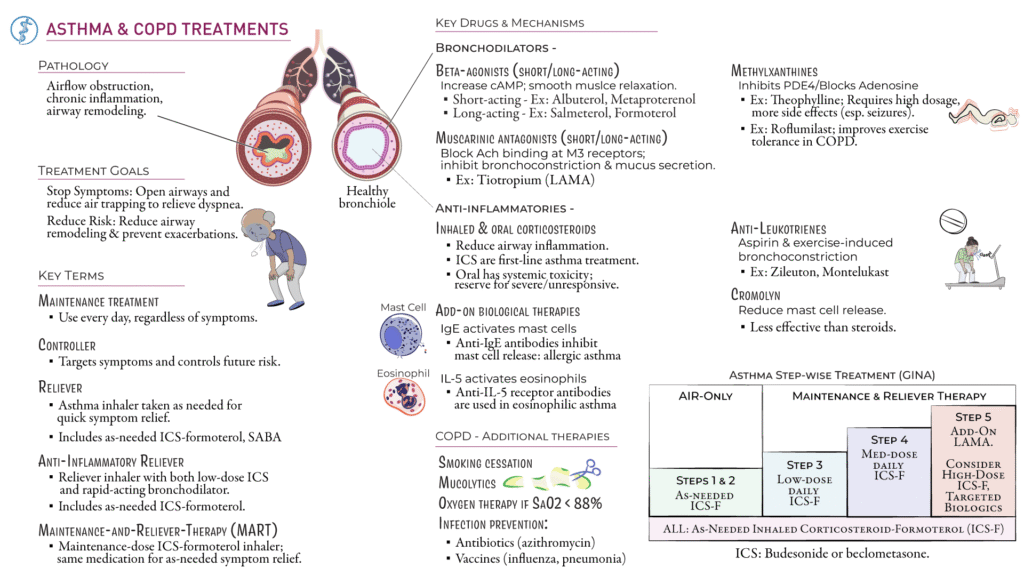
These drugs stimulate β2 receptors in the smooth muscle of the lung, promoting bronchodilation. They are divided into Short-Acting (SABAs) for immediate relief, and Long-Acting (LABAs) for maintenance.
| Type / Drug Name | Formulation | Adult Dosage | Child Dosage |
|---|---|---|---|
| Short-Acting Beta-2 Agonists (SABAs) - Relievers | |||
| Salbutamol (Albuterol) | Oral tablet (Controlled Release) | 8 mg twice daily | 4 mg twice daily |
| Inhaler (MDI), 100mcg/dose | 100-200 mcg up to 3-4 times daily | Same as adult | |
| Syrup (2mg/5ml) | 4 mg 3-4 times daily | 1-2 mg 3-4 times daily (≥2 yr) | |
| Terbutaline | Oral tablet (Sustained Release) | 5-7.5 mg twice daily | - |
| Inhaler (Turbuhaler, 500mcg/dose) | 500 mcg up to 4 times daily | - | |
| Inhaler (MDI, 250mcg/dose) | 250-500 mcg up to 3-4 times daily | Same as adult | |
| Long-Acting Beta-2 Agonists (LABAs) - Preventers | |||
| Formoterol | Inhaler (Turbuhaler, 4.5mcg/dose) | 4.5-9 mcg once or twice daily | Same as adult |
| Inhaler (Turbuhaler, 9mcg/dose) | - | - | |
| Salmeterol | Inhaler (MDI, 25mcg/dose) | 50-100 mcg twice daily | Same as adult |
| Accuhaler (50mcg/dose) | 50 mcg twice daily | Same as adult | |
- Adverse Effects: Since these drugs mimic adrenaline, side effects include tachycardia, palpitations, headache, and fine muscle tremor (especially hands).
- Spacing: When 2 or more puffs are needed, inform the patient that at least 1 minute should be allowed between puffs to allow the first dose to open the airway for the second dose.
- Schedule: LABAs (Salmeterol, Formoterol) and oral β2-agonists should be taken on a fixed schedule, not strictly PRN (as needed).
- Cardiac Monitoring: Instruct patients to report chest pain or rapid heart rates. Contact physician if nervousness, insomnia, or tremors become severe.
Note on other Adrenoceptor Agonists: Drugs like Ephedrine (Oral: 15-60mg TID) and Adrenaline (Epinephrine) are non-selective. They stimulate the heart (Beta-1) just as much as the lungs (Beta-2). They are less safe for standard bronchodilation due to arrhythmias, but Adrenaline injection is lifesaving in acute allergic and anaphylactic reactions.
2. Antimuscarinic Bronchodilators (Anticholinergics)
These drugs block the action of acetylcholine at the muscarinic receptors in bronchial smooth muscle. By doing so, they reduce intracellular cGMP (a bronchoconstrictive substance), leading to bronchodilation. They are heavily used for maintenance therapy in COPD.
| Drug Name | Type | Formulation | Adult Dosage | Child Dosage |
|---|---|---|---|---|
| Ipratropium | SAMA (Short-Acting) | Inhaler (MDI, 20mcg/dose) | 20-80 mcg 3-4 times a day | 20-40 mcg 3-4 times a day (≥6yrs) |
| Tiotropium | LAMA (Long-Acting) | Inhaler (18mcg/dose) | 18 mcg daily | Not recommended in children/adolescents |
Adverse Effects: Think of the "drying out" effects of blocking the parasympathetic system: Dry mouth, Nausea, Constipation, and Headache.
3. Xanthine Derivatives (Methylxanthines)
The main drug in this class is Theophylline (oral) and its IV counterpart Aminophylline.
Theophylline acts by inhibiting the enzyme Phosphodiesterase (PDE 3,4,7). Normally, PDE breaks down cAMP. By inhibiting PDE, cAMP levels rise, which directly leads to profound bronchodilation. It also acts as an Adenosine antagonist (adenosine normally triggers histamine release and bronchoconstriction).
| Drug Name | Formulation | Adult Dosage | Child Dosage |
|---|---|---|---|
| Theophylline | Tablet (Sustained Release, 200/300mg) | 200–300 mg twice daily | 10 mg/kg (≥2yrs) twice daily |
| Capsule (Slow release, 50/100mg) | 7-12 mg/kg/day in 2 divided doses | 10-16 mg/kg/day (9–16yrs) 13-20 mg/kg/day (30mo–8yrs) |
|
| Syrup (80mg/15ml) | 25 ml q6h | 1 ml/kg (Max 25 ml) q6h (≥2yrs) | |
| Aminophylline | IV Injection (25mg/ml, 10ml) | 500 mcg/kg/hr IV infusion | 1 mg/kg/hr (6mo–9yrs) 800 mcg/kg/hr (10–16 yrs) |
Theophylline has a incredibly narrow therapeutic index. Plasma levels must be monitored.
- 5-15 µg/ml: Normal Therapeutic Range.
- 20-25 µg/ml: Mild Toxicity (Nausea, vomiting, diarrhea, insomnia, restlessness).
- >30 µg/ml: Severe/Fatal Toxicity (Cardiac dysrhythmias, convulsions, cardiovascular collapse, death).
Patient Instructions:
- If a dose is missed, do not double the following dose.
- Sustained-release formulations must be swallowed intact (not crushed or chewed).
- Avoid Caffeine: Caffeine is also a methylxanthine. It can intensify adverse effects (cardiac & CNS) and competitively decrease the metabolism of theophylline, causing toxic build-up!
V. Anti-Inflammatory Agents (The "Preventers")
1. Corticosteroids
Corticosteroids are the gold standard for the prophylaxis (prevention) of chronic asthma. Their effects in COPD are much less dramatic, and their long-term use in stable COPD is not generally recommended due to lack of benefit and risk of severe side effects. However, a short 2-week oral course can be used to identify COPD patients who might respond to steroids, and inhaled steroids are used in late-stage COPD (Stage III/IV) to prevent exacerbations.
Steroids suppress inflammation by:
- Decreasing the synthesis and release of inflammatory mediators.
- Decreasing infiltration and activity of inflammatory cells (eosinophils, macrophages).
- Decreasing edema of the airway mucosa and reducing mucus production.
- Sensitization: They increase the number of bronchial β2 receptors and restore their responsiveness to β2 agonists.
| Drug Name | Formulation | Adult Dosage | Child Dosage |
|---|---|---|---|
| Beclomethasone | Inhaler (MDI, 50mcg/dose) | 200 mcg twice daily (Up to 800 mcg/day) | 50–100 mcg 2-4 times daily |
| Inhaler (MDI, 250mcg/dose) | 500 mcg twice daily / 250 mcg 4x daily | Not recommended | |
| Budesonide | Inhaler (MDI, 50mcg/dose) | 200 mcg twice daily (Up to 1.6 mg/day) | 50–400 mcg twice daily (Up to 800 mcg) |
| Inhaler (MDI, 200mcg/dose) | 200-800 mcg once daily in evening or Up to 1.6 mg daily in two divided doses |
200-800 mcg daily in two divided doses or 200-400 mcg once daily in evening (<12 yrs) |
|
| Inhaler (Turbuhaler, 100/200/400mcg) | |||
| Fluticasone | MDI or Accuhaler (25/50/100/125/250mcg) | 100–1000 mcg twice daily | 50-100 mcg twice daily (4-16 yrs) |
- Oral Candidiasis (Thrush): Fungal infection of mouth/throat. Patient must rinse mouth after inhaler use!
- Hoarseness (Dysphonia): Due to local vocal cord myopathy.
- Can slow growth velocity in children (though usually temporary).
- Adrenal Suppression: May occur in long-term, high-dose therapy.
- Increases the risk of cataracts and osteoporosis in the elderly.
2. Combination Products (The "Two-in-One" Inhalers)
Because asthma and COPD often require multiple mechanisms to control (e.g., stopping inflammation and relaxing smooth muscle), pharmaceutical companies have combined drugs into single inhalers. This is highly appropriate for patients who are stabilized on individual components in the same proportions.
Combination inhalers massively improve patient compliance (remembering to take one inhaler instead of two). Furthermore, corticosteroids actually up-regulate (increase the number of) Beta-2 receptors in the lungs, making the LABA component work even better. It is a perfect synergistic relationship!
| Combination Type | Brand Name | Components & Dosages |
|---|---|---|
| Muscarinic Antagonist + β2 Agonist (SAMA + SABA) |
Combivent | 20 mcg Ipratropium (SAMA) & 100 mcg Salbutamol (SABA) per dose via MDI. Excellent for COPD symptom relief. |
| Corticosteroid + β2 Agonist (ICS + LABA) |
Symbicort | 160 mcg Budesonide (ICS) & 4.5 mcg Formoterol (LABA) per dose via Turbuhaler. |
| Seretide | Salmeterol (LABA) + Fluticasone (ICS). Available as an MDI (in Lite, Medium, Forte preparations) & Accuhaler. |
3. Cromoglycates (Mast Cell Stabilizers)
These drugs act on a very specific immune cell called the Mast Cell. They are indicated only for the prophylaxis (prevention) of acute asthma attacks and have no place in treating an attack that has already started.
Imagine a mast cell as a water balloon filled with inflammatory chemicals (histamine, leukotrienes). When an allergen (like dust or pollen) enters the lungs, antibodies attach to the mast cell, causing an influx of calcium ions. This calcium causes the "balloon" to burst (degranulation), releasing chemicals that cause sudden bronchoconstriction.
Cromoglycates freeze the surface of the balloon. They prevent the transmembrane influx of calcium ions, effectively stabilizing the mast cell membrane so it cannot degranulate, even when confronted with allergens.
| Drug Name | Formulation | Adult Dosage | Child Dosage |
|---|---|---|---|
| Cromoglycate Na (Sodium Cromoglycate) | Inhaler (1 mg & 5mg/dose) | 10 mg four times daily; may be increased to 6-8 times daily | Same as adult |
| Nebuliser solution (10 mg/ml, 2 ml) | 20 mg four times daily; may be increased to 6 times daily | Same as adult | |
| Nedocromil Sodium | Inhaler (2 mg/dose MDI) | 4 mg two to four times daily | Same as adult (>6 yrs) |
- Paradoxical Bronchospasm: The dry powder or the cold propellant from the inhaler can occasionally irritate the airway and trigger a transient bronchospasm. Action: A selective β2 agonist (like salbutamol) may be inhaled a few minutes beforehand to open the airway and prevent this.
- Other Side Effects: Coughing and throat irritation are common. Again, rinsing the mouth or drinking water after use helps.
4. Leukotriene Receptor Antagonists (LTRAs)
Leukotrienes are potent inflammatory mediators synthesized by the immune system from arachidonic acid. They are roughly 1,000 times more potent than histamine in causing bronchoconstriction, and they also promote eosinophil infiltration, massive mucus production, and airway mucosal edema.
Unlike most asthma medications which are inhaled, LTRAs are taken orally as a tablet. This makes them fantastic for young children or patients who struggle with inhaler coordination. They help prevent acute asthma attacks induced by allergens, exercise, and cold air.
- Drug Name: Montelukast (available in 5 mg & 10 mg tablets).
- Adult Dosage: 10 mg daily at bedtime. (Taken at bedtime because asthma symptoms and leukotriene levels naturally peak in the early morning hours).
- Child Dosage:
- (2-5 yrs): 4 mg daily at bedtime (often as a chewable tablet or granules).
- (6-14 yrs): 5 mg daily at bedtime.
- Gastrointestinal disturbances (nausea, dyspepsia).
- Hypersensitivity reactions.
- Restlessness, insomnia, and headache. (Note: There are recent FDA black box warnings regarding neuropsychiatric events like agitation, vivid dreams, and depression with Montelukast).
- Upper respiratory tract infections.
- Pregnancy/Breastfeeding: The manufacturer advises avoiding these drugs during pregnancy and breast-feeding unless absolutely essential.
VI. Stepwise Management Guidelines
Asthma and COPD are dynamic diseases. The severity changes over time, meaning the medication regimen must step up when symptoms worsen and step down when control is achieved.
1. Management of Chronic Asthma (Adults & Schoolchildren >5yrs)
The goal is to maintain control using the lowest possible dose of medication.
Mild Intermittent
Occasional relief needed. Use a short-acting β2 agonist (SABA like Salbutamol) PRN (as needed). If using more than twice a week, move to Step 2.
Regular Preventer
Add regular preventer therapy. Specifically, a Standard-dose Inhaled Corticosteroid (ICS) taken daily.
Add LABA
Add a long-acting inhaled β2 agonist (LABA like Salmeterol). The dose of the inhaled corticosteroid may also be increased if needed.
High-Dose ICS
Increase to a High dose of Inhaled Corticosteroids, continuing the LABA. May consider adding a Leukotriene receptor antagonist.
Oral Steroids
Severe persistent asthma. Add a regular oral corticosteroid (e.g., Prednisolone) at the lowest effective dose. Refer to a specialist.
Treatment should be reviewed every 3 months. If symptoms are well-controlled, initiate a stepwise reduction (step down) to minimize drug side effects.
Protocol: Use the lowest possible dose of oral corticosteroid. Gradually reduce the dose of inhaled corticosteroid to the absolute minimum dose that keeps the asthma controlled.
2. European Respiratory Society (ERS) Algorithm for COPD
In patients with COPD who are highly symptomatic (CAT score ≥ 10) AND have frequent exacerbations (>1 exacerbation per year), physicians must determine if there is an overlapping asthma component (eosinophilic inflammation).
- Pathway A (Asthma-COPD overlap or Blood Eosinophils ≥ 300/µL):
- Because eosinophils are present, the patient will respond to steroids.
- First Line: ICS / LAMA combination OR ICS / LABA combination.
- Second Line: Triple therapy (ICS / LAMA / LABA).
- Pathway B (No Asthma & Blood Eosinophils < 300/µL):
- Pure neutrophilic COPD. Steroids will cause more harm (pneumonia risk) than good.
- First Line: LAMA alone OR LAMA / LABA combination.
VII. Acute vs. Chronic Bronchitis Pharmacotherapy
Bronchitis management depends entirely on whether it is an acute infectious/irritative process or the chronic structural disease seen in COPD.
| Management Aspect | Acute Bronchitis | Chronic Bronchitis (COPD) |
|---|---|---|
| First-Line General Care | Plenty of fluids (to thin mucus), absolutely no smoking, and bed rest. | LAMA (Long-Acting Muscarinic Antagonist, e.g., Tiotropium) is the foundation of therapy to keep airways open. |
| Cough Management & Bronchodilation | Productive cough should NOT be suppressed. Give mucolytics, mucokinetics, or expectorants to help clear the chest. Antitussives (cough suppressants) are strictly for dry, irritating, exhausting coughs that prevent sleep. | LABA (Long-Acting Beta Agonist) can be added to the regimen if the patient has a sub-optimal outcome after LAMA alone (forming a LAMA/LABA combo). |
| Escalation Therapy | Analgesics & Antipyretics (Paracetamol/Ibuprofen) for fever and chest wall pain from coughing. | Theophylline can be added in case of sub-optimal outcome after LAMA & LABA. |
| Severe/Refractory Cases | Antibiotics: Only indicated if there is clear evidence of a secondary bacterial infection (purulent green/yellow sputum, high prolonged fever). | ICS (Inhaled Corticosteroid or short oral Prednisone burst) can be added in case of sub-optimal outcome and frequent exacerbations despite LAMA & LABA. |
Quick Quiz
Pharmacotherapy of COPD and Asthma Quiz
Pharmacology - mobile-friendly and focused practice.
Privacy: Your details are used only for quiz tracking and certificates.
Pharmacotherapy of COPD and Asthma Quiz
Pharmacology
Preparing questions...
Choose your answer and keep your streak alive.
Great effort.
Here is your quick performance summary.