
Table of Contents
ToggleDrugs for Asthma, Cough, and Mucus Management
Pharmacology can often feel overwhelming due to the vast number of drug names and mechanisms. The key to mastering respiratory pharmacology is to first understand the normal physiology and the pathology of the respiratory system. Once you understand how the body works and what goes wrong in disease, the drugs simply act as tools to fix those specific errors.
Part 1: The Physiology of Cough & Airway Clearance
Coughing is a protective, natural reflex. Its primary purpose is to clear the airways of environmental irritants (dust, smoke) and accumulated secretions (mucus). The reflex works via a specific neural loop:
- Receptors: Irritant receptors in the airway mucosa are triggered.
- Afferent Pathway: Signals travel via the Vagus nerve (Cranial Nerve X) to the brain.
- Cough Center: Located in the Medulla Oblongata of the brainstem, it processes the signal.
- Efferent Pathway: Motor nerves signal the diaphragm and intercostal muscles to violently expel air.
Types of Cough
Before prescribing a medication, a clinician must determine the type of cough, as the treatment strategy differs completely:
- Productive Cough (Wet Cough): Produces mucus/sputum. It helps clear the airway. Rule of thumb: Suppression of a productive cough is harmful and may lead to severe bacterial infections (pneumonia) because the mucus sits and breeds bacteria.
- Non-Productive Cough (Dry Cough): Useless, exhausting, and often painful. This type of cough should be suppressed.
Drugs for Cough Management
We classify cough drugs into four main categories based on where they act in the cough sequence.
Cough Center Suppressants
Used strictly for dry, non-productive coughs. They work in the brain (medulla) to raise the threshold of the cough center, making it less responsive to irritation.
- Codeine
- Pholcodeine
- Noscapine
- Dextromethorphan
- Antihistamines
- Benzonatate
Soothing Agents
Used when the cough arises from irritation above the larynx (e.g., sore throat).
- Lozenges
- Syrups & Linctuses
- Liquorice
Mucokinetics
Used for chronic, productive coughs to increase the volume of bronchial secretions, making the cough less tiring and more productive.
- Sodium & Potassium Citrate
- Potassium Iodide
- Guaifenesin
- Ammonium Chloride
Mucus Breakers
Used to break down thick, tenacious (sticky) sputum, making it easier to expel.
- Bromhexine
- Acetylcysteine
- Carbocisteine
- Ambroxol
Detailed Look: Antitussives (Cough Suppressants)
1. Opioid & Opioid-Derivatives
- Codeine: An opioid analgesic. It has strong cough center suppressant effects but causes mild CNS depression.
- Side Effects: Constipation (by decreasing intestinal peristaltic movements) and mild addiction potential.
- Contraindications: Should be avoided in children and asthmatics (can suppress breathing drive and dry out secretions, worsening asthma). Administered orally.
- Pholcodeine: Similar mechanism to codeine but has no analgesic (pain-killing) effect and no addiction liability. Administered orally and has a long duration of action.
- Noscapine: An opium alkaloid, but it is not a narcotic. It has potent antitussive effects and is especially useful in spasmodic cough. It has no analgesic effect, does not cause constipation, CNS depression, or addiction. Side effects: Nausea and headache.
- Dextromethorphan (DXM): A centrally acting synthetic antitussive. It has no analgesic property, does not cause constipation or addiction, and importantly, mucociliary function is not affected (the tiny hairs in the lungs keep sweeping mucus up normally).
2. Antihistamines
Examples include Diphenhydramine, Chlorpheniramine, and Promethazine.
Why are they useful in cough?
- They possess sedative, anti-allergic, and strong anticholinergic (drying) effects.
- They produce symptomatic relief in cold and cough associated with allergic conditions of the respiratory tract (e.g., post-nasal drip triggering a cough).
3. Peripherally Acting Agents
Benzonatate: Unlike the others that act in the brain, benzonatate acts in the lungs. It is chemically related to the local anesthetic procaine. It acts by numbing the pulmonary stretch receptors in the lungs, stopping the cough signal before it even reaches the brain.
Detailed Look: Pharyngeal Demulcents
These are used when a cough arises purely due to irritation above the larynx (e.g., a "tickle" in the throat). They work by increasing salivation and producing a protective, soothing effect on the inflamed pharyngeal mucosa. Examples: Syrups, Lozenges, Linctuses, Liquorice.
Detailed Look: Expectorants (Mucokinetics)
These drugs act to increase the volume of bronchial secretions and reduce the viscosity (thickness) of the sputum. By making the mucus more watery, the cough becomes less tiring and more productive. They are highly useful in chronic coughs (like in COPD). Examples include: Iodides, Chlorides, Bicarbonates, Acetates, Volatile oils, and Guaifenesin.
Detailed Look: Mucolytics
These agents chemically alter the structure of mucus to break down thick, tenacious sputum, lowering its viscosity so it comes out easily with less effort.
- Bromhexine (and Ambroxol): It acts by liberating lysosomal enzymes within the mucus cells, which digest mucopolysaccharides in the sputum, making it thinner. Side effects: Rhinorrhoea (runny nose) and lacrimation (tearing).
- Acetylcysteine & Carbocisteine:
- Mechanism: Normal mucus is thick because of strong chemical bridges called "disulphide bonds" between mucoprotein molecules. These drugs physically open/break these disulphide bonds, turning thick mucus into a watery liquid.
- Administration: Acetylcysteine is often used as an aerosol (nebulized) or orally. Carbocisteine is administered orally.
- Side effects: Nausea, vomiting, and potential bronchospasm (must be used with caution in asthmatics).
Part 2: Bronchial Asthma (Pathology & Physiology)
Bronchial asthma is a chronic inflammatory disease of the airways. It is characterized by two major problems that obstruct airflow:
1. Bronchospasm: The smooth muscles wrapping the bronchioles constrict (tighten) inappropriately.
2. Inflammation & Mucus: The lining of the airway swells (mucosal edema) and produces thick, excessive mucus, plugging the airway.
Trigger Factors: Allergens (dust, pollen), infections, cold air, exercise, and psychological factors (stress).
The Cellular Mechanism: The airway obstruction is driven by the release of powerful chemical mediators from sensitized mast cells in the lungs. When an allergen binds to IgE antibodies on the mast cell surface, the cell "degranulates" (bursts), releasing:
- Histamine: Causes immediate bronchoconstriction and vessel leakage (swelling).
- 5-HT (Serotonin): Contributes to bronchospasm.
- Prostaglandins (PGs): Cause inflammation and pain.
- Leukotrienes (LTC4 & LTD4): The most powerful bronchoconstrictors in the body (1000x more potent than histamine).
- Protease & Platelet Activating Factor (PAF): Perpetuate long-term inflammation.
Clinical Classification of Asthma:
- Acute Asthma: Sudden episodic attacks of breathlessness and wheezing.
- Chronic Asthma: Persistent symptoms requiring daily maintenance therapy.
- Status Asthmaticus (Acute Severe Asthma): A life-threatening, prolonged asthma attack that does not respond to standard initial treatments.
Part 3: Classification of Anti-Asthmatic Drugs
Based on the pathology described above, we either need drugs to relax the smooth muscle (Bronchodilators) or drugs to stop the inflammation and mediators (Anti-inflammatories).
| Class | Sub-Category | Key Drugs |
|---|---|---|
| 1. Bronchodilators | Sympathomimetics (B2 Agonists) | Salbutamol, Terbutaline, Salmeterol, Formoterol, Adrenaline |
| Methylxanthines | Theophylline, Aminophylline, Etophylline | |
| Anticholinergics | Ipratropium bromide, Tiotropium bromide | |
| 2. Leukotriene Antagonists | LT-Receptor Blockers | Zafirlukast, Montelukast |
| 3. Mast Cell Stabilizers | Degranulation Inhibitors | Sodium cromoglycate, Nedocromil sodium, Ketotifen |
| 4. Glucocorticoids | Inhaled (ICS) | Beclomethasone, Budesonide, Fluticasone |
| Systemic (Oral/IV) | Hydrocortisone, Prednisolone, Methylprednisolone | |
| 5. Anti-IgE Antibodies | Biologics | Omalizumab |
1. Bronchodilators: Sympathomimetics (β2 Agonists)
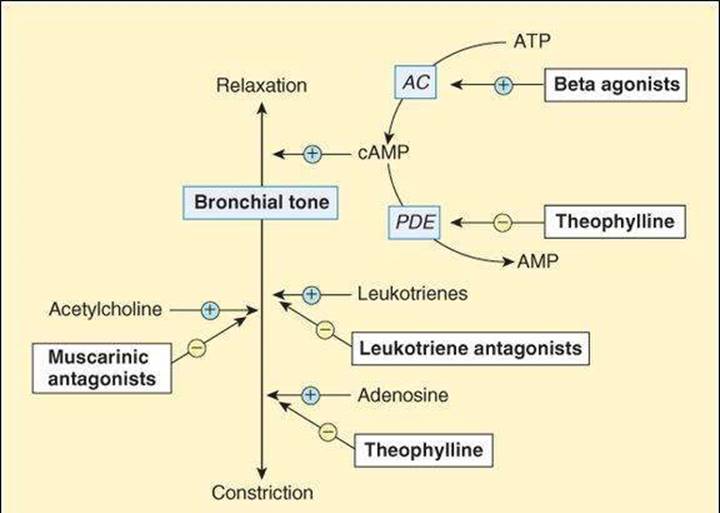
The sympathetic nervous system ("fight or flight") normally dilates airways to let in more oxygen. It does this via β2-adrenergic receptors on the lung smooth muscle. Stimulating these receptors increases intracellular cAMP, which relaxes the muscle and promotes mucociliary clearance while inhibiting mast cell mediator release.
- Adrenaline (Epinephrine): A non-selective agonist. Produces prompt and powerful bronchodilation. It was historically used for acute attacks (0.2-0.5 ml of 1:1000 given S.C.), but its use has declined due to serious cardiac side effects (it also stimulates β1 receptors in the heart, causing extreme tachycardia and arrhythmias).
- Selective β2-Adrenergic Agonists: The first line of drugs for asthma. Well-tolerated when inhaled.
- Short-Acting (SABA): Salbutamol and Terbutaline. They have a rapid onset (within 1–5 mins) and short duration. They are the preferred "rescue inhalers" to terminate an acute asthma attack. Given via Metered Dose Inhaler (MDI) (100-200 mcg every 6 hours).
- Long-Acting (LABA): Salmeterol and Formoterol. Have a long duration of action (12 hours). Preferred for maintenance and prophylaxis (preventing attacks), especially nocturnal asthma. Not suitable for acute attacks (except formoterol which has a rapid onset). Dose: 12-50 mcg twice daily.
- Adverse Effects (at high doses): Tremors (due to skeletal muscle β2 stimulation), tachycardia, palpitations, and hypokalaemia (drives potassium into cells).
2. Bronchodilators: Methylxanthines
Drugs: Theophylline, Aminophylline, Etophylline.
Mechanism of Action: They inhibit Phosphodiesterase (PDE), the enzyme that normally breaks down cAMP. This leads to an accumulation of cAMP, causing bronchodilation, inhibiting histamine release from mast cells, and improving mucociliary clearance.
Their use has markedly reduced because they have a narrow therapeutic index (the toxic dose is very close to the effective dose) and safer alternatives now exist. They are now 3rd or 4th line drugs.
- Pharmacokinetics: Well absorbed orally/parenterally. Food delays absorption. They cross the placenta and Blood-Brain Barrier (BBB), are metabolized in the liver, and excreted in urine.
- Theophylline: Poorly water-soluble (only oral).
- Aminophylline: Water-soluble but highly irritant. Given orally or by very slow I.V. injection (rapid I.V. causes fatal arrhythmias).
- Adverse Effects:
- CNS: Restlessness, insomnia, headache, tremors, convulsions.
- GI: Nausea, vomiting, severe gastritis (aggravates peptic ulcers).
- Renal: Diuresis.
- Cardiac: Tachycardia, hypotension, palpitations, and sudden death due to cardiac arrhythmias.
- Drug Interactions (Crucial):
- Enzyme Inducers (Phenytoin, Rifampicin, Phenobarbitone) speed up theophylline metabolism, reducing its effectiveness.
- Enzyme Inhibitors (Cimetidine, Ciprofloxacin, Erythromycin) block its metabolism, leading to dangerous theophylline toxicity.
3. Bronchodilators: Anticholinergics
Drugs: Ipratropium bromide and Tiotropium bromide (Atropine substitutes).
Mechanism: The parasympathetic nervous system (via the Vagus nerve and Acetylcholine) causes bronchoconstriction. These drugs selectively block Acetylcholine at muscarinic receptors in bronchial smooth muscle, causing passive bronchodilation.
- They have a slow onset of action and are generally less effective than β2 agonists for asthma.
- Primary Use: They are the drugs of choice for COPD (Chronic Obstructive Pulmonary Disease).
- Administered via inhalation. Often combined with β2-agonists for a synergistic effect.
4. Leukotriene Antagonists
Drugs: Montelukast, Zafirlukast.
Mechanism: They competitively block the cysteinyl leukotriene receptors (LT1-receptors) which normally respond to LTC4, LTD4, and LTE4. By blocking these receptors, they reverse the massive bronchoconstriction, suppress bronchial inflammation, and decrease airway hyper-reactivity.
- Pharmacokinetics: Well absorbed orally, highly bound to plasma proteins.
- Clinical Use: Highly effective in the prophylactic treatment of mild asthma (preventing attacks, not stopping an active one). Very well tolerated with few side effects.
5. Mast Cell Stabilizers
Drugs: Sodium cromoglycate, Nedocromil sodium, Ketotifen.
Mechanism: These are not bronchodilators. They act by stabilizing the mast cell membrane, preventing it from degranulating and releasing mediators (histamine, leukotrienes, PGs) when exposed to an allergen.
- Sodium Cromoglycate & Nedocromil: Used strictly as prophylactic agents to prevent bronchospasm induced by allergens. Not effective orally (poor gut absorption); given via inhalation. Also used topically for allergic conjunctivitis and allergic rhinitis.
- Ketotifen: Has a similar mechanism but also possesses H1-antihistamine blocking effects. It is orally effective but has a slow onset of action.
6. Glucocorticoids (Steroids)
The most powerful anti-inflammatory drugs available for asthma.
Mechanism: Glucocorticoids cross the cell membrane, enter the nucleus, and stimulate the production of a protein called Lipocortin. Lipocortin powerfully inhibits Phospholipase A2, which is the very first enzyme in the inflammatory cascade. By shutting this off, steroids prevent the formation of ALL downstream mediators (both Prostaglandins and Leukotrienes). They suppress the immune response, decrease mucosal edema, and importantly, upregulate (increase the sensitivity of) β2 receptors.
Local Control
Beclomethasone, Budesonide, Fluticasone.
Delivered directly to lungs to minimize systemic absorption. They do not dilate airways immediately but suppress inflammation long-term. Side effect: Oral candidiasis (thrush) - patients must rinse mouth after use.
Severe Cases
Hydrocortisone, Prednisolone, Methylprednisolone.
Used for acute severe asthma (I.V.) or severe chronic asthma (oral). Systemic adverse effects: Gastric irritation, Na+ and water retention, hypertension, muscle weakness, osteoporosis, and HPA-axis (adrenal) suppression.
Synergy: Combination therapies of Inhaled Corticosteroids (ICS) + Long-Acting β2 Agonists (LABA) are highly effective (e.g., Fluticasone + Salmeterol, Budesonide + Formoterol) for both asthma and COPD.
7. Anti-IgE Monoclonal Antibodies
Drug: Omalizumab.
Mechanism: It is an engineered antibody that binds specifically to free IgE circulating in the blood, preventing IgE from attaching to mast cells. Without IgE on the mast cell, allergens cannot cause degranulation.
- Note: It has no effect on IgE that is already bound to mast cells.
- Administered parenterally (subcutaneously).
- Use: Reserved for moderate to severe, persistent allergic asthma (and severe food/nasal allergies) in patients over 12 years of age whose symptoms are not controlled by high-dose steroids.
Part 4: Clinical Application & Management
Inhalational Devices
Getting the drug directly into the lungs minimizes systemic side effects and provides rapid onset.
- Metered Dose Inhalers (MDI): Standard "puff" inhalers. Best used with a spacer device to ensure the drug reaches the lungs rather than hitting the back of the throat.
- Dry Powder Inhalers (DPI): E.g., Spinhaler and Rotahaler. Requires the patient to take a deep, forceful breath in.
- Nebulizers: Turn liquid medicine into a fine mist breathed in through a mask. Highly useful in acute severe asthma, COPD exacerbations, and in young children or elderly who cannot coordinate an MDI.
Treatment of Acute Severe Asthma (Status Asthmaticus)
This is a medical emergency. The patient is fighting for breath, hypoxic, and unresponsive to their normal MDI inhaler. The treatment protocol is aggressive:
- Humidified Oxygen: To correct severe hypoxia.
- Nebulized Bronchodilators: High-dose nebulized β2-agonist (e.g., Salbutamol 5mg or Terbutaline 10mg) + Anticholinergic (Ipratropium bromide 0.5mg). Why nebulized? Because the patient is too breathless to use an MDI properly, and the continuous mist ensures deep penetration of the drug.
- Systemic Glucocorticoids: I.V. Hydrocortisone 200 mg stat (immediately), followed by oral Prednisolone 30-60 mg/day. This takes several hours to work but is crucial to stop the massive inflammatory cascade.
- I.V. Fluids: To correct dehydration caused by rapid breathing (tachypnea) and poor fluid intake.
- Electrolyte/Base Correction: Potassium (K+) supplements (because high-dose salbutamol drives K+ into cells, causing hypokalemia) and Sodium Bicarbonate (to correct respiratory acidosis if present).
- Antibiotics: ONLY if there is evidence of a concurrent bacterial respiratory infection triggering the attack.
Drugs to Avoid in Asthma
- NSAIDs (e.g., Aspirin, Ibuprofen): They block the COX pathway. This shifts all arachidonic acid metabolism down the LOX pathway, producing massive amounts of Leukotrienes, triggering severe bronchospasm (Aspirin-induced asthma).
- β-Adrenergic Blockers (e.g., Propranolol): They block the β2 receptors in the lungs, preventing sympathetic bronchodilation and causing massive, potentially fatal bronchospasm.
- Cholinergic Agents (e.g., Pilocarpine, Neostigmine): They stimulate the parasympathetic nervous system, inducing heavy bronchial secretions and smooth muscle constriction.
References & Further Reading
- Katzung, B. G. (2018). Basic & Clinical Pharmacology (14th ed.). McGraw-Hill Education. (Chapters on Pulmonary Pharmacology and Autonomic Nervous System).
- Ritter, J. M., Flower, R., Henderson, G., Loke, Y. K., MacEwan, D., & Rang, H. P. (2019). Rang & Dale's Pharmacology (9th ed.). Elsevier. (Excellent breakdown of the inflammatory cascade and leukotriene pathways).
- Global Initiative for Asthma (GINA). (2023). Global Strategy for Asthma Management and Prevention. (Clinical guidelines for the stepwise treatment of asthma and status asthmaticus).
- Brunton, L. L., Hilal-Dandan, R., & Knollmann, B. C. (2017). Goodman & Gilman's: The Pharmacological Basis of Therapeutics (13th ed.). McGraw-Hill. (Detailed pharmacokinetics of Methylxanthines and Glucocorticoids).
Quick Quiz
Bronchial Asthma Quiz
Pharmacology - mobile-friendly and focused practice.
Privacy: Your details are used only for quiz tracking and certificates.
Bronchial Asthma Quiz
Pharmacology
Preparing questions...
Choose your answer and keep your streak alive.
Great effort.
Here is your quick performance summary.