
Table of Contents
TogglePharmacology of the Renal System: Diuretics
I. Introduction: The Kidneys and the Nephron
Pharmacology can seem intimidating, but it becomes beautiful once you understand the underlying physiology. Before we memorize drugs, we must understand the organ they target: The Kidneys.
The main function of the kidneys is to maintain the constancy of the body's "interior environment." They do this by:
- Eliminating metabolic waste products.
- Strictly regulating fluid volume, electrolyte content, and blood pH, regardless of dietary intake or environmental demands.
- Acting as the primary organ by which drugs and their metabolites are eliminated from the body. Because of this, if a patient has renal failure, the dosing regimens of many drugs must be drastically adapted to prevent toxic buildup.
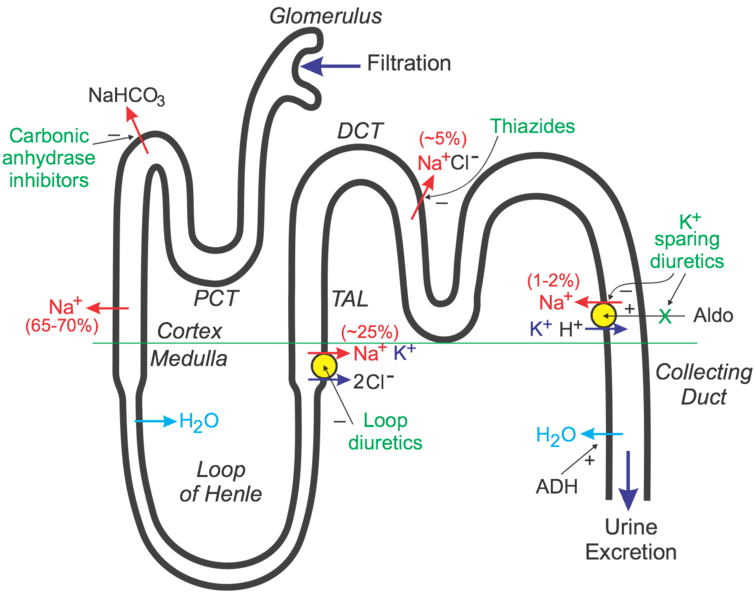
The functional unit of the kidney is the Nephron. Its job is to filter the blood and form a protein-free plasma filtrate (Ultrafiltration). The nephron is a tubular structure consisting of specific segments, each with unique transport mechanisms:
- Renal Corpuscle (Glomerulus + Bowman's Capsule): Where filtration begins.
- Proximal Convoluted Tubule (PCT): The heavy worker, reabsorbing the bulk of water and solutes.
- Loop of Henle (Descending and Ascending limbs): Creates the concentration gradient.
- Distal Convoluted Tubule (DCT): Fine-tunes the filtrate.
- Collecting Duct: The final arbiter of water and potassium balance.
II. Clinical Case Study: The Presentation of Fluid Overload
Let us anchor our pharmacological knowledge to a real patient presentation.
Patient: A 65-year-old man comes to the ER with severe shortness of breath. His wife reports he has long-standing hypertension but refused medications because he "felt fine."
Presentation: Over the last month, he noted increasing ankle edema, reduced exercise tolerance, and difficulty sleeping while lying flat (orthopnea). He now has pitting edema up to his knees and is acutely uncomfortable lying down. He denies chest pain.
Vitals & Exam: Blood pressure is 190/140 mm Hg, pulse 120 bpm, respiratory rate 20/min. Chest auscultation reveals loud rhonchi (fluid in the lungs). ECG shows Left Ventricular Hypertrophy (LVH).
1. What is the diagnosis?
Acute Pulmonary Edema secondary to Congestive Heart Failure (CHF). His untreated chronic hypertension severely increased the heart's workload (afterload), causing LVH and eventual left ventricular failure. Fluid has backed up into his lungs and systemic circulation.
2. What diuretic is most appropriate?
A Loop Diuretic (like Furosemide). He requires rapid, massive mobilization of fluid from his lungs and systemic circulation to save his life.
3. What are the possible toxicities?
Hypokalemia, severe dehydration, hypotension, ototoxicity (deafness), and hyperuricemia.
III. Diuretics: General Principles & Cardiovascular Effects
Diuretics are crucial for the management of Cardiovascular (CVS) diseases. By definition, diuretics are drugs that block renal ionic transport (specifically the reabsorption of Na+ and Cl-). This blockade causes diuresis (an increase in urine volume), which is almost always associated with natriuresis (an increase in Na+ excretion).
- The 1% Rule: The increase in urine flow is directly related to the amount of Na+/Cl- reabsorption blocked. If a drug blocks just 1% of normal solute reabsorption, urine output will increase by a massive 1.8 Liters per day!
How Diuretics Help the Heart (CVS Effects)
You might wonder, why do we use kidney drugs for heart problems? Here is the physiological chain reaction:
- Diuretics decrease Na+ and water balance, leading to a decrease in total blood volume and venous pressure.
- This directly decreases the preload (the volume of blood filling the heart), which drops ventricular stroke volume and cardiac output, safely lowering arterial blood pressure.
- The decrease in venous pressure reduces capillary hydrostatic pressure. This stops fluid from leaking out of the vessels and promotes fluid reabsorption back into the blood, effectively reducing edema (swelling).
- Long-term Effect: Prolonged use of diuretics results in a fall in systemic vascular resistance (by mechanisms still somewhat unknown), which helps sustain long-term reductions in blood pressure.
Mechanisms of Action
Diuretics force the body to lose water through four main pathways:
Directly plugging the channels that reabsorb ions. Includes Loop Diuretics and Thiazides.
Blocking the receptors for hormones that tell the kidney to save water. Includes Potassium-Sparing Diuretics (Aldosterone antagonists).
Creating a heavy, sugary pull inside the urine tube that traps water and prevents it from leaving. Includes Osmotic Diuretics.
Blocking the chemical reactions needed to reabsorb bicarbonate. Includes Carbonic Anhydrase Inhibitors.
IV. Loop Diuretics (High-Ceiling Diuretics)
Examples: Furosemide (Lasix - Prototype), Bumetanide, Torsemide, Ethacrynic acid.
These are the most powerful and effective diuretics available. They produce a greater loss of fluids and electrolytes than any other class.
- Site of Action: They act specifically on the Thick Ascending Limb (TAL) of Henle's loop.
- Mechanism of Action: They directly block the Na+/K+/2Cl- co-transporter on the luminal membrane. Normally, this massive pump reabsorbs 25% of all filtered NaCl. By blocking it, a massive amount of sodium (and therefore water) stays in the urine. They also induce the renal synthesis of prostaglandins, which vasodilates renal blood vessels.
1. Pharmacokinetics
- Oral Administration: Diuresis begins in 60 minutes and persists for about 8 hours.
- Intravenous (IV) Admin: Diuresis begins in 2 minutes and persists for 2 hours (perfect for the emergency room).
- Undergoes hepatic metabolism and active renal excretion (secreted into the proximal tubule).
2. Therapeutic Uses
Used strictly for patients requiring rapid or massive mobilization of fluids:
- Acute Pulmonary Edema: This is their major use.
- Congestive Heart Failure (CHF): When severe diminution of Extracellular Fluid (ECF) volume is required to minimize venous and pulmonary congestion.
- Cirrhosis of the liver complicated by ascites (fluid in the abdomen).
- Severe edema of Nephrotic Syndrome or Renal Failure.
- Severe Hypertension: Used when BP is uncontrolled by other diuretics. (Note: their short half-life makes them less useful than thiazides for standard, mild hypertension).
- Hypercalcemia: Because they force calcium out in the urine.
3. Adverse Drug Reactions (ADRs)
Because they are so powerful, their side effects are severe derivations of electrolyte loss:
- Hyponatremia (low sodium) and Hypochloremia (low chloride).
- Hypocalcemia (low calcium) and Hypomagnesemia (low magnesium).
- Hypokalemia (Low Potassium): By blocking Na+ in the loop, a massive wave of unabsorbed Na+ reaches the distal tubule. The distal tubule frantically tries to save this Na+, but to do so, it must trade and throw away K+ and H+. This massive loss of K+ is highly dangerous and causes arrhythmias. The loss of H+ leads to Metabolic Alkalosis.
Loop diuretics can strangely cause Hyperglycemia (high blood sugar) in diabetic patients. Why? It all connects to cell membrane potentials.
- As the diuretic forces Potassium (K+) out of the body, extracellular fluid K+ drops.
- This increases the concentration gradient across cell membranes, causing K+ to aggressively diffuse out of cells, removing positive charges from the inside.
- The Resting Membrane Potential (RMP) becomes excessively negative (Hyperpolarized).
- Now, it is much harder for the cell to reach the threshold voltage required to open Voltage-Gated Calcium (Ca2+) channels.
- In the Pancreatic β-cells, calcium influx is what triggers the release of insulin. Because the channels won't open, insulin secretion is drastically reduced, leading to high blood sugar!
- Dehydration (Hypovolemia): Leading to severe hypotension and fainting.
- Uric Acid Effects:
- Acute Admin: Hypouricemia (increases uric acid excretion).
- Chronic Admin: Hyperuricemia and Gout. Dehydration causes the proximal tubule to hyper-absorb. Also, the diuretic competes with uric acid for the organic secretory pump in the proximal tubule. The diuretic wins, leaving uric acid trapped in the blood, settling into joints to cause painful Gout.
- Metabolic: Hypercholesterolemia, hypertriglyceridemia, increased LDL.
- Ototoxicity: Dose-related tinnitus (ringing), hearing impairment, deafness, vertigo, and a sense of fullness in the ears. The inner ear uses similar electrolyte transport mechanisms, which the drug accidentally blocks.
- Others: Rashes, photosensitivity, paresthesias, bone marrow depression, and GI disturbances.
4. Drug Interactions
- Digitalis: Hypokalemia vastly potentiates digitalis toxicity (fatal arrhythmias).
- NSAIDs (Ibuprofen): Reduces the diuretic efficacy! NSAIDs block prostaglandin (PGE2) synthesis. Without PGE2, Na+ reabsorption is favored, fighting the diuretic.
- Aminoglycosides & Cisplatin: Highly enhances the risk of permanent ototoxicity and nephrotoxicity.
- Antiarrhythmics (Quinidine): A potentially lethal interaction. Quinidine prolongs the QT interval. Loop-induced hypokalemia wildly increases the risk of Torsades de pointes (a fatal polymorphic ventricular tachycardia) triggered by early after-depolarizations.
- Lithium: Causes Lithium toxicity due to decreased renal elimination.
- Thiazides: Synergism! Combining them leads to profound, dangerous diuresis.
- Corticosteroids / Amphotericin B: Intensify the dangerous loss of potassium.
V. Thiazide Diuretics and Related Drugs
Examples: Hydrochlorothiazide (Prototype), Bendroflumethiazide, Chlorothiazide. Related: Metolazone, Chlorthalidone, Indapamide.
These are the most commonly used diuretics globally. They are weak diuretics but also possess mild intrinsic vasodilator properties, making them exceptional for blood pressure control.
- Site & Mechanism of Action: They act on the Distal Convoluted Tubule (DCT). They physically block the Na+/Cl- co-transporter, preventing sodium and chloride reabsorption, forcing water to follow it into the urine.
- Kidney Dependency: They are significantly less powerful than loop diuretics. Crucially, their action heavily depends on adequate kidney function; they are ineffective when GFR is low (unlike loop diuretics, which still work in renal failure).
While Loop diuretics force calcium out of the body, Thiazides force the body to retain calcium.
- Blocking the Na+/Cl- pump drops intracellular sodium levels in the DCT.
- This creates a strong gradient, pulling Na+ into the cell from the basolateral (blood) side via the Na+/Ca2+ exchanger.
- As Na+ rushes in, Calcium is rapidly pumped out into the blood.
- This drops intracellular Calcium, which pulls more Calcium out of the urine filtrate. Thus, Thiazides elevate serum Ca2+ (Hypercalcemia) and decrease urine calcium.
1. Pharmacokinetics
- Taken orally, usually once a day.
- Onset is 2 hours after administration. Peaks at 4-6 hours and persists for up to 12 hours.
2. Therapeutic Uses
- Hypertension: The absolute preferred first-line agent in uncomplicated hypertension. They are better tolerated than loops and clinical trials prove they reduce the risk of stroke and heart attacks.
- Mild/Moderate Edema: Used in mild CHF (though loops are preferred for severe cases).
- Severe Resistant Edema: Metolazone is famous for being used synergistically with loop diuretics to break stubborn edema.
- Idiopathic Hypercalciuria: Because they pull calcium out of the urine, they are given to prevent recurrent calcium kidney stone formation.
- Nephrogenic Diabetes Insipidus: Paradoxically, they reduce urine volume by up to 50% in this disease, though the exact mechanism remains mysterious.
3. Adverse Drug Reactions (ADRs)
Many ADRs are identical to Loop diuretics, but with a few key differences:
- Electrolytes: Hypokalemia, Hyponatremia, Hypochloremia, Hypomagnesemia. Metabolic alkalosis. Unlike Loops, they cause Hypercalcemia.
- Metabolic: Hyperuricemia (chronic use = Gout), Hyperglycemia (in diabetics), Hypercholesterolemia, hypertriglyceridemia, increased LDL.
- Azotemia: Toxic buildup of nitrogenous waste in patients with pre-existing renal disease.
- Male Impotence: The reduced blood volume and arterial pressure cause massive activation of the RAAS system. This leads to systemic vasoconstriction, severely impacting erectile function.
- Idiosyncratic: Rashes, and blood dyscrasias like thrombocytopenia (low platelets).
4. Interactions
Similar to Loops: Hypokalemia potentiates Digitalis toxicity and quinidine-induced Torsades de pointes. NSAIDs reduce their efficacy. Bile acid sequestrants reduce their absorption from the gut. Corticosteroids worsen hypokalemia. They diminish the effect of insulin/sulfonylureas. They induce Lithium toxicity.
VI. Potassium-Sparing Diuretics
These are very weak diuretics. They are rarely used alone. Their entire purpose is to be used in conjunction with loop and thiazide diuretics. They provide two useful responses: a modest increase in urine, and a substantial decrease in K+ excretion, acting as a shield against the fatal hypokalemia caused by the stronger drugs.
They are divided into two subcategories based on exactly how they work in the collecting duct.
Spironolactone (Aldactone) & Eplerenone
Aldosterone is a hormone released by the adrenal cortex (stimulated by Angiotensin II). It acts on the genetics of the kidney cell to express apical Na+ channels, causing the body to retain Na+ and throw away K+ and H+.
- Mechanism: Spironolactone is a steroid hormone analogue. It competitively binds and blocks the aldosterone receptor in the distal nephron. This prevents the expression of those channels, causing the exact opposite effect: Retention of K+ and excretion of Na+.
- Kinetics: Well absorbed from the gut. Because it works on cellular genetics (making/destroying proteins), its onset is very slow (taking 48 hours to work). Spironolactone's active metabolite is Canrenone (t½ 16 hrs). Eplerenone has a shorter half-life and no active metabolites. Taken orally once daily.
Triamterene & Amiloride
These drugs do not care about the aldosterone receptor or genetics.
- Mechanism: They physically bind to and block the apical Na+ channel (ENaC) in the distal tubule and collecting duct. By plugging the hole, they stop the Na+/K+ exchange entirely, immediately inhibiting K+ loss.
- They produce only a very modest diuresis.
Uses & Adverse Effects of Potassium-Sparing Diuretics
- Uses (Spironolactone): Added to K+-losing diuretics to prevent dangerous hypokalemia (especially in patients on digoxin or amiodarone). It is the diuretic of choice for hepatic cirrhosis and nephrotic syndrome. Added to heart failure therapy to prevent fibrotic remodeling of the heart. Used to treat Primary (Conn's Syndrome) and Secondary hyperaldosteronism.
- Dangerous ADR: Hyperkalemia. Retaining too much potassium is just as fatal as losing it. This can stop the heart.
- Endocrine ADRs (Spironolactone only): Because spironolactone is a steroid, it accidentally acts on progesterone and androgen receptors throughout the body. This results in Gynecomastia (male breast tissue growth), menstrual disorders, and testicular atrophy.
- Contraindications: Absolutely contraindicated in patients who already have hyperkalemia, or patients at high risk (renal failure, patients on ACE inhibitors, or taking K+ supplements).
VII. Osmotic Diuretics
Examples: Mannitol (Osmitrol, mostly IV), Urea (IV), Glycerin (oral), Isosorbide (oral).
These drugs act completely differently from the others. Mannitol is simply a sugar molecule. It acts like a molecular "sponge" moving through the blood and kidneys.
- Mechanism of Action: Mannitol is freely filtered in the glomerulus. It undergoes minimal reabsorption, is not metabolized, and is pharmacologically inert. Once inside the lumen of the nephron, it creates a massive osmotic force. It literally holds onto water, inhibiting passive reabsorption, thereby wildly increasing urine flow. It has no significant direct effect on the excretion of K+ or other electrolytes.
- Kinetics: Very poorly absorbed by the GIT. If you drink it, it stays in the gut and pulls water into the intestines, causing osmotic diarrhea. Therefore, for systemic effects on the kidneys or brain, it must be given IV. Distributes entirely into extracellular water. Diuresis begins in 30-60 mins and lasts 6 hours.
Therapeutic Uses & Severe Warnings
- Uses: Prophylaxis of acute renal failure (to forcefully maintain urine flow and wash out debris).
Brain & Eye: In the brain, its hyperosmotic presence in the blood draws water out of the swollen brain tissue, reducing Intracranial Pressure (ICP). It works the exact same way in the eye, pulling out intraocular fluid to reduce Intraocular Pressure (IOP). - Adverse Effects: Transient expansion of ECF volume. Before mannitol gets filtered by the kidneys, it sits in the blood and pulls water out of the body's tissues into the vascular system. This suddenly expands blood volume, carrying a massive risk of causing Left Ventricular Failure (Pulmonary Edema) in a weak heart.
- Also causes dilutional hyponatremia, leading to headache, nausea, and vomiting.
VIII. Carbonic Anhydrase Inhibitors (CAIs)
Examples: Acetazolamide (Diamox, Glaumox), Dichlorphenamide (Daranide), Methazolamide (Glauctabs).
These are very weak diuretics and are rarely used to mobilize fluid. Their value lies in their ability to manipulate body pH and specific fluid pressures.
In the Proximal Tubule, the body wants to save Bicarbonate (HCO3-) to keep the blood alkaline. However, bicarbonate cannot cross the cell membrane directly.
- In the urine, HCO3- binds with H+ to form H2CO3.
- The enzyme Carbonic Anhydrase breaks this into H2O and CO2.
- These gases easily diffuse into the cell. Inside the cell, Carbonic Anhydrase stitches them back together into HCO3-, which is then pumped back into the blood.
The Drugs: CAIs block this enzyme. Bicarbonate is trapped in the urine. Therefore, they increase the excretion of Bicarbonate, along with accompanying Na+, K+, and water. This results in the flow of a highly alkaline urine, while the blood becomes acidic.
Therapeutic Uses
- Glaucoma: Carbonic anhydrase is present in extrarenal tissues. In the ciliary processes of the eye, it mediates the formation of large amounts of bicarbonate into aqueous humor. Inhibiting it drops the formation of eye fluid, reducing IOP. Used in Open-angle and secondary/pre-operative acute angle-closure glaucoma.
- Acute Altitude Sickness: In the erythrocytes, CAIs interfere with CO2 transport. This effectively increases CO2 in peripheral tissues and drops it in expired gas. This mild induced acidosis stimulates the brain to breathe deeper and faster, treating altitude sickness. (More effective if given prophylactically).
- Infantile Epilepsy: Acetazolamide creates a mild metabolic acidosis which has a direct anticonvulsant action in the CNS (though rapid tolerance limits usefulness).
- Correcting Alkalosis: Specifically metabolic alkalosis caused by severe diuretic-induced H+ excretion.
- Sulfonamide Allergy: They are sulfa-derivatives. They can cause bone marrow depression, severe skin toxicity, renal lesions, and allergic reactions.
- CNS: Large doses cause drowsiness, paresthesias (tingling), and somnolence.
- Hepatic Encephalopathy Risk: Because the urine becomes alkaline, ammonia (NH3) from the kidney is not trapped as ammonium in the urine. It is diverted back into the systemic circulation. This can travel to the brain and worsen hepatic encephalopathy. Absolutely contraindicated in hepatic cirrhosis!
- Kidney Stones: Precipitation of calcium phosphate salts in the alkaline urine causes calculus formation and ureteral colic.
- Acidosis Risk: Worsens metabolic/respiratory acidosis. Contraindicated in hyperchloremic acidosis or severe COPD.
- Reduces the urinary excretion of weak organic bases.
IX. Summary: General Indications for Diuretics
Urinary output will increase, flushing excess, pooled fluid out of the body tissues (Loop diuretics primarily).
The aggressive sodium loss in the kidney is directly associated with water loss, reducing the preload crushing the failing heart.
Diuretics (Thiazides primarily) decrease total blood volume, serum sodium, and eventually systemic vascular resistance.
Osmotic diuretics provide a physical osmotic pull to remove fluid, while CAIs stop the chemical formation of aqueous humor to decrease IOP.
Quick Quiz
Diuretics Pharmacology Quiz
Pharmacology
Privacy: Your details are used only for quiz tracking and certificates.
Diuretics Pharmacology Quiz
Pharmacology
Preparing questions...
Choose your answer and keep your streak alive.
Great effort.
Here is your quick performance summary.