
Table of Contents
TogglePharmacology of the Thyroid and Antithyroid Drugs
I. Introduction and Clinical Case Study
Pharmacology is best understood when applied to real clinical scenarios. Let us examine a comprehensive case study to introduce thyroid pathology.
Patient Presentation: An 11-year-old female with no significant past medical history presented with symptoms of weight loss and heat intolerance. She has also experienced a decline in grades at school. Her family history is significant for thyroid disease in both grandmothers (both are currently on thyroid replacement therapies).
Laboratory Investigations & Results: The clinician ordered comprehensive thyroid function tests:
- Free Thyroxine (FT4): 2.87 ng/dL (High; Prepubertal ref: 0.73-1.77 / Pubertal-Adult ref: 0.73-1.84)
- Total Triiodothyronine (T3): 374.00 ng/dL (High; Pediatric ref: 123-211)
- Thyroid-Stimulating Hormone (TSH): <0.018 uU/ml (Suppressed)
- Thyroxine (T4): 18.2 ug/dL (High; Ref: 5.0-12.0)
- Antithyroglobulin antibodies: >3000 IU/ml (Strongly Positive; Negative is <60, Equivocal 60-100, Positive >100 IU/mL)
- Antithyroid peroxidase (Anti-TPO) antibodies: 2667 IU/mL (Positive; Ref: <60)
- Anti-TSH receptor antibodies: 69.6% Inhibition (Positive; Ref: <=16.0%)
Questions & Clinical Reasoning:
- What is the diagnosis? Hyperthyroidism secondary to Graves' disease. The elevated T3/T4 and suppressed TSH indicate primary hyperthyroidism. The presence of Anti-TSH receptor antibodies confirms the autoimmune etiology (Graves' disease).
- How should this patient be managed? Medical management with Antithyroid drugs (Thioamides like Methimazole) and Beta-blockers for symptomatic control, as radioiodine or surgery is generally reserved or delayed in young children.
II. Basic Thyroid Gland Physiology & Functions
The thyroid is a bilobed gland located in the neck, sitting below the thyroid cartilage and in front of the cricoid cartilage and trachea. It contains large stores of thyroid hormone bound in the form of thyroglobulin. These massive stores maintain systemic concentrations of thyroid hormone despite daily variations in dietary iodine availability and nutritional intake.
1. The Hormones Produced
The thyroid gland is the source of two fundamentally different types of hormones:
- Thyroid Follicles: Produce the iodothyronine hormones: Tetraiodothyronine / Thyroxine (T4) and 3,5,3-triiodothyronine (T3).
- Parafollicular Cells (C-cells): Produce Calcitonin, a hormone directly involved in the control of plasma Calcium (Ca2+) and bone health.
2. Systemic Functions of Thyroid Hormones
Thyroid hormones are essential for normal growth, development, and maintaining metabolic homeostasis. They influence the function of virtually all organ systems:
Essential for normal development of the Central Nervous System (CNS). In a healthy brain, it promotes neurogenesis, glucose metabolism, synaptic transmission, structural spine formation, and cell migration/proliferation.
Neurological Disorders linked to dysfunction: Alzheimer's disease, Depression, and Autism spectrum disorder.
- Metabolism: Mitochondrial biogenesis, increased basal metabolism, and metabolism of proteins, carbohydrates, and lipids.
- Cardiovascular: Regulates heart function and contractions.
- Other systems: Regulates digestion, bone formation and health, and kidney clearance rates.
3. The Hypothalamic-Pituitary-Thyroid Axis
The secretion of thyroid hormones is controlled by a delicate negative feedback loop:
- Hypothalamus: Releases Thyrotrophin-releasing hormone (TRH) in response to stimuli. Note: Acute psychosis, severe stress, or circadian/pulsatile rhythms (prolonged exposure to cold) activate this axis.
- Anterior Pituitary: TRH stimulates the release of Thyroid-stimulating hormone (TSH). Note: Somatostatin, Corticoids, and Dopamine directly inhibit TSH release.
- Thyroid Gland: TSH stimulates T4 and T3 synthesis and release.
- Negative Feedback: Circulating T3 and T4 in turn inhibit both TRH and TSH synthesis and release to maintain balance.
III. Synthesis, Storage, Release & Metabolism of T3 and T4
Small amounts of iodide are absolutely necessary for hormone production, but interestingly, large amounts of endogenous or exogenous iodide actively inhibit T3 and T4 production and release. The synthesis involves five highly specific main steps:
- Trapping (Uptake): Uptake of plasma iodide (I-) by the follicle cells via the Sodium-Iodide Symporter (NIS). Pharmacology: Ionic inhibitors block this step 1.
- Oxidation: Oxidation of iodide to iodine by the enzyme Thyroidal Peroxidase (TPO). Pharmacology: Thioamides (Propylthiouracil and Carbimazole) inhibit step 2.
- Organification: Iodination of tyrosine residues on the thyroglobulin molecule. Pendrin assists in moving iodine into the colloid. This forms Monoiodotyrosine (MIT) and Diiodotyrosine (DIT).
- Coupling: MIT + DIT = T3. DIT + DIT = T4.
- Secretion (Proteolysis): Endocytosis of the colloid back into the cell, where lysosomes cause proteolysis of thyroglobulin, releasing free T3 and T4 into the blood. Pharmacology: Excess Iodine interferes with steps 1, 2, 3, and 5. Propylthiouracil (PTU) also blocks peripheral conversion (step 6).
Peripheral Metabolism of Thyroxine
T4 is released into the peripheral blood where it undergoes metabolism inside cells:
- Activation: Deiodination of T4 yields 3,5,3'-Triiodothyronine (Active T3).
- Inactivation: Deiodination can also yield 3,3',5'-Triiodothyronine (Reverse T3), which is inactive. Further inactivation occurs via Deamination, Decarboxylation, and Conjugation (glucuronide or sulfate) in the liver.
Summary of Thyroid Hormone Kinetics
| Variable | Thyroxine (T4) | Triiodothyronine (T3) |
|---|---|---|
| Volume of Distribution | 10 L | 40 L |
| Extrathyroidal Pool | 800 mcg | 54 mcg |
| Daily Production | 75 mcg | 25 mcg |
| Fractional Turnover per day | 10% | 60% |
| Metabolic Clearance per day | 1.1 L | 24 L |
| Half-life (Biologic) | 7 Days | 1 Day |
| Serum Levels (Total) | 4.8 - 10.4 mcg/dL | 60 - 181 ng/dL |
| Serum Levels (Free) | 0.8 - 2.7 ng/dL | 230 - 420 pg/dL |
| Amount Bound to Protein | 99.96% | 99.6% |
| Biologic Potency | 1 | 4 (Four times more potent) |
| Oral Absorption | 80% | 95% |
IV. Disorders of the Thyroid Gland
Thyroid problems are very common and consist of two general presentations:
- Changes in size or shape of the gland: Nodules and Goiter. A Simple non-toxic goitre is usually caused by dietary iodine deficiency and typically presents with normal thyroid function.
- Changes in the secretion of hormones: Overt hyperthyroidism or hypothyroidism. These present the clinician with dramatic clinical manifestations. Note: If the thyroid can no longer produce T3 and T4, there is no negative feedback to the hypothalamus and anterior pituitary, causing TSH to skyrocket.
V. Hypothyroidism
Hyposecretion of T3 and T4 leads to a massive reduction in the body's metabolic rate.
1. Clinical Presentations
- Cretinism (Infants): The most prevalent endocrine disorder in the newborn. Caused by congenital absence or incomplete development of the thyroid. Characterized by gross retardation of physical growth and profound mental deficiency.
- Myxoedema (Adults): Severe cases in adults. Manifestations include a low metabolic rate, slow speech, deep hoarse voice, lethargy, bradycardia, sensitivity to cold, and mental impairment. Patients develop a characteristic thickening of the skin (puffy appearance, non-pitting edema), which gives myxoedema its name.
2. Causes of Hypothyroidism
- Hashimoto's Thyroiditis: A chronic autoimmune disease where an immune reaction destroys thyroglobulin or other components of thyroid tissue.
- Iatrogenic: Therapy of thyroid tumors with surgery or radioiodine.
- Hypopituitarism: Lack of TSH from the pituitary gland.
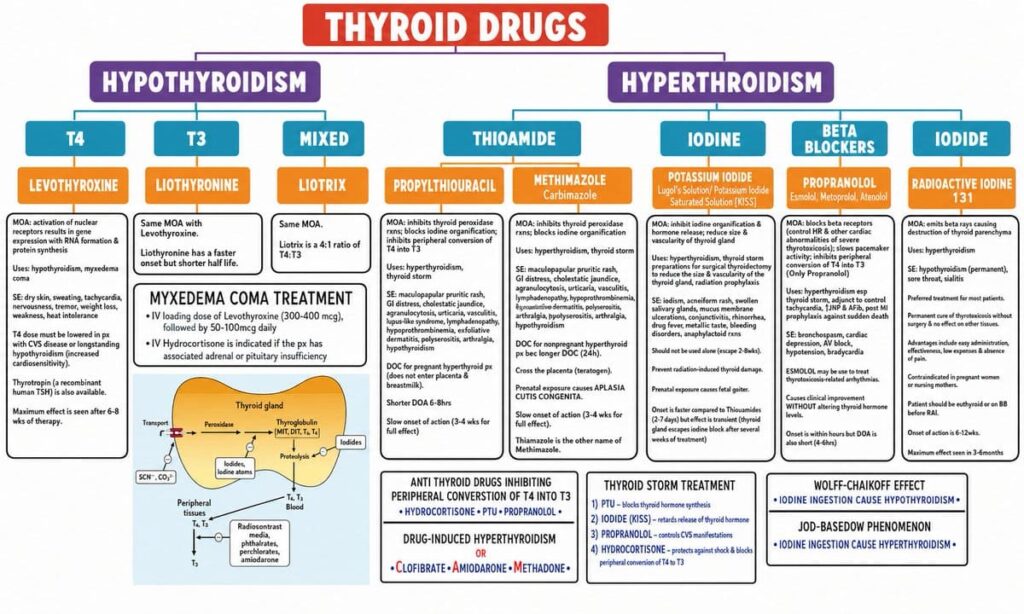
3. Pharmacological Management: Thyroid Hormones
Used to treat myxoedema, diffuse non-toxic goitre, Hashimoto's thyroiditis, thyroid carcinoma, and neonatal hypothyroidism (which requires prompt treatment for normal development).
A. Levothyroxine Sodium (Synthetic T4)
- Why it is the Treatment of Choice: Used for maintenance therapy because of its stability, content uniformity, low cost, lack of allergenic foreign protein, easy laboratory measurement of serum levels, and a long half-life (7 days) which permits convenient once-daily administration.
- Mechanism: It acts as a pro-hormone. T4 is naturally converted to T3 intracellularly; thus, giving T4 effectively produces both hormones in the body.
- Administration Rules:
- Orally administered once daily on an empty stomach, 30 minutes to 1 hour before breakfast.
- Avoid taking with other medications.
- Always check the patient's pulse before administration.
- Dosing & Onset: Daily dose is 50-200 mcg/day. It takes 4-6 weeks to reach steady-state concentration (SSC).
- Note: Used to treat an underactive thyroid (occurring naturally, injured by radiation, or removed by surgery). It is also used to treat certain goiters and thyroid cancer. It should not be used to treat infertility unless the infertility is specifically caused by low thyroid hormone levels.
- Contraindication: Thyrotoxicosis.
B. Liothyronine Sodium (Synthetic T3)
- Pharmacokinetics: Taken by mouth (with or without food, usually once daily at the same time each day to keep levels constant). It is 3 to 4 times more potent, more rapidly metabolized, and has a much more rapid effect than levothyroxine. Peak activity is reached within 24 hours. The biologic half-life is 24 hours (two days or less).
- Disadvantages for Routine Use: It is NOT recommended for routine replacement therapy because its shorter half-life requires multiple daily doses, it has a higher cost, and there is a greater difficulty in monitoring the adequacy of replacement using conventional lab tests.
- Cardiotoxicity Risk: Because of its greater hormone activity and consequent greater risk of cardiotoxicity, it should be strictly avoided in patients with cardiac disease.
- Specific Indications: Best used for short-term suppression of TSH, or in severe hypothyroid states where a rapid response is desired. Its rapid action makes it highly useful given intramuscularly (IM) for treating Myxoedema Coma while simultaneously starting maintenance therapy with oral thyroxine.
- Drug Interactions: Certain medications drastically decrease the absorption of liothyronine. These include: products containing aluminum or magnesium, antacids, sucralfate, calcium supplements, iron, bile acid-binding resins (such as cholestyramine, colestipol, colesevelam), simethicone, sevelamer, and sodium polystyrene sulfonate, among others.
- Contraindication: Thyrotoxicosis.
C. Other Formulations
- Liotrix: A synthetic combination of T4 and T3 in a specific 4:1 ratio.
- Thyroid desiccated: Natural preparations derived from animal thyroids. (Largely replaced by synthetics).
Hypothyroidism sometimes coexists with Addison's disease (both share an autoimmune aetiology). When treating a patient for myxoedema coma (especially if hypopituitarism is suspected), Glucocorticosteroid (hydrocortisone) replacement MUST be started first empirically. If you administer thyroid hormones and rapidly increase the metabolic rate without providing corticosteroids, an Acute Adrenal Insufficiency will be precipitated, which can be fatal.
VI. Hyperthyroidism (Thyrotoxicosis)
In thyrotoxicosis, there is excessive, uncontrolled activity of the thyroid hormones, leading to a hypermetabolic state that affects nearly every organ system.
1. Clinical Presentation
Symptoms include a remarkably high basal metabolic rate, an increase in skin temperature, warm moist skin, sweating, marked intolerance to heat, nervousness, irritability, insomnia, depression, tremor (shaking hands), tachycardia, arrhythmias (specifically atrial fibrillation), high blood pressure, muscle cramps, muscle weakness (proximal myopathy), and increased appetite strangely associated with a loss of weight and a strong feeling of hunger. Other signs include frequent diarrhea, fragile fingernails (Plummer's nails), broken hair/hair loss, menstrual cycle disorders (amenorrhea or oligomenorrhea), and finger clubbing (thyroid acropachy).
2. Types and Causes
There are several types, but only two are extremely common:
- Graves' Disease (Diffuse Toxic Goitre / Exophthalmic Goitre): The most common cause. An autoimmune disorder where thyroid-stimulating immunoglobulins (TSI) act as antibodies that stimulate the TSH receptor, causing the thyroid to overproduce hormones. Frequently accompanied by exophthalmos (bulging eyes) and pretibial myxedema.
- Toxic Nodular Goitre (Plummer's Disease): One or more adenomatous nodules grow on the thyroid and independently increase hormone production, escaping the normal pituitary feedback loop.
- Thyroiditis: Inflammation of the thyroid which causes a "leak" of stored hormones into the blood. Arrives in three different ways: subacute (De Quervain's), postpartum, and silent.
- Increased Thyroid Hormone Medicine: Iatrogenic hyperthyroidism occurring in patients being treated to correct hypothyroidism or those taking suppressive therapy for thyroid cancer.
- Secondary Hyperthyroidism: A rare condition caused by a TSH-secreting pituitary adenoma, where the pituitary drives the thyroid to overwork despite high hormone levels.
VII. Pharmacological Management: Antithyroid Drugs
1. Thioamides (Thioureylenes)
Includes Carbimazole, Methimazole, and Propylthiouracil (PTU). Given orally, they are quickly absorbed, widely distributed in the body, enter breast milk, and cross the placenta. They are metabolized in the liver and excreted in the urine primarily as metabolites. All are concentrated in the thyroid (intrathyroid t½ is longer, so the effect of a single dose lasts longer than the plasma t½ would suggest).
- Mechanism of Action: They prevent hormone synthesis by inhibiting the thyroid peroxidase-catalyzed reactions. This blocks iodine organification (reducing iodination of tyrosine residues on thyroglobulin) and blocks the coupling of the iodotyrosines (MIT and DIT).
- Uses: Used for hyperthyroidism either to medically prepare patients for a thyroidectomy (surgery) to achieve a euthyroid state, as an adjunct to radioactive iodine, or for long-term clinical management (remission therapy).
- Carbimazole: This is a prodrug that is converted to the active metabolite methimazole in vivo. It is widely used in the UK. It is longer acting than propylthiouracil.
| Feature | Propylthiouracil (PTU) | Carbimazole / Methimazole |
|---|---|---|
| Potency | Less potent (Methimazole is about 10x more potent). | About 5x more potent than PTU (Carbimazole). Methimazole is 10x more. |
| Dosing | Multiple (2-3) daily doses needed. | Mostly single daily dose. |
| Plasma Protein Binding | Highly plasma protein bound (~75%). | Less bound (virtually unbound). |
| Placenta & Milk Transfer | Less transferred across the placenta and in milk (because of high protein binding). | Larger amounts cross to the fetus and appear in breast milk. |
| Kinetics | Plasma t½ 1-2 hours. Single dose acts for 4-8 hours. No active metabolite. | Single dose acts for 12-24 hours. Produces active metabolite (methimazole). |
| Peripheral Action | Inhibits peripheral conversion of T4 to T3. (via 5'-deiodinase inhibition). | Does NOT inhibit T4 to T3 conversion. |
| Hepatotoxicity | Higher risk of severe liver failure (Black Box Warning). | Lower risk, but can cause cholestatic jaundice. |
- Cross-Sensitivity: About 50% of patients show cross-sensitivity; however, Propylthiouracil may be cautiously used in patients who suffer mild sensitivity reactions to carbimazole.
- Pregnancy Caution: PTU is generally preferred in the first trimester (due to methimazole-associated embryopathy like aplasia cutis). Carbimazole/Methimazole is preferred in the 2nd and 3rd trimesters to reduce PTU-induced liver risk.
- Agranulocytosis: This is the most serious ADR. Patients must be warned to report a sore throat, fever, or mouth ulcers immediately for a White Blood Cell (WBC) count.
- Adverse Drug Reactions (ADRs): Nausea, mild GI disturbances, headache, rashes and pruritus, arthralgia. Rarely causes myopathy, alopecia, bone marrow suppression (including pancytopenia and agranulocytosis), and jaundice.
Advantages vs. Disadvantages of Antithyroid Drugs (Over Surgery/131I)
- Advantages: No surgical risk, no scar, no chances of injury to parathyroid glands or the recurrent laryngeal nerve. If hypothyroidism is induced, it is completely reversible by dose adjustment. Can be safely used even in children, young adults, and during pregnancy.
- Disadvantages: Prolonged (often 12-18 months) treatment is needed because the relapse rate is high (approx. 50% after cessation). Not practicable in uncooperative or unintelligent patients. High risk of drug toxicity requiring frequent blood monitoring.
2. Radioactive Iodine (131I)
Radioiodine is a first-line treatment for hyperthyroidism, particularly in the USA and for recurrent Graves' disease. 131I is the treatment of choice after 25 years of age and if Congestive Heart Failure (CHF), angina, or any other absolute contraindication to surgery is present.
- Mechanism of Action: The only isotope used is 131I (usually given orally as the sodium salt). It is taken up and processed by the thyroid in the exact same way as stable iodide, eventually becoming incorporated into thyroglobulin.
- Cytotoxic Action: The isotope emits both β radiation (short range: 0.5–2 mm) and γ rays. The γ rays pass through the tissue and are used for scanning, but the β particles are absorbed locally. They exert a powerful, precise cytotoxic action affecting only the thyroid follicle cells, resulting in pyknosis and necrosis of the tissue without damaging neighboring structures like the parathyroids.
- Kinetics: It has a physical T1/2 of 8 days. Given as one single dose, its cytotoxic effect on the gland is delayed for 1-2 months and does not reach its maximum for a further 2-4 months.
- Advantages: Treatment is simple, inexpensive, and conveniently given on an outpatient basis. There is no surgical risk, scar, or injury to parathyroid glands or recurrent laryngeal nerves. Once hyperthyroidism is controlled, the cure is permanent.
- Disadvantages & Contraindications: Hypothyroidism is the most common outcome (seen in 5-10% of patients in the first year and 3% per year thereafter). There is a long latent period of response requiring thioamides in the interim. It may worsen Graves' ophthalmopathy.
Absolute Contraindication: Pregnant women or nursing mothers, since it freely crosses the placenta to completely destroy the fetal thyroid gland and is excreted in breast milk.
3. Ionic Inhibitors (Iodine/Iodide)
Iodine is converted in vivo to iodide (I-). It is given orally in high doses in a solution with potassium iodide (known as 'Lugol's iodine') or as Potassium Iodide (SSKI).
- Mechanism of Action: High doses transiently inhibit the release of thyroid hormones (the Wolff-Chaikoff effect) and powerfully decrease the size and vascularity of the gland.
- Indications: Used for Thyrotoxicosis strictly pre-operatively (to shrink the gland to make surgery safer/less bloody) and as part of the emergency treatment of severe thyrotoxic crisis (thyroid storm). Also used to protect the thyroid from accidental radiation exposure.
- Limit of Use: The effect is transient; the thyroid "escapes" from the inhibitory effect after 10–14 days, leading to a rebound of symptoms if used alone.
- Allergic Reactions (Iodism): Can cause angio-oedema, rashes, drug fever, lacrimation, conjunctivitis, pain in the salivary glands, and a characteristic metallic taste or "cold-like" syndrome.
4. Adrenoceptor Blockers (Beta-Blockers)
Beta-blockers like Propranolol, Atenolol, or Metoprolol are used as adjuvant therapy.
- Role: They do not affect the thyroid gland directly but rapidly control the "sympathetic" symptoms of hyperthyroidism: tachycardia, palpitations, tremor, and anxiety.
- Peripheral Effect: High-dose Propranolol also helps by slightly inhibiting the peripheral conversion of T4 to T3.
- Use Case: Essential for rapid symptom relief while waiting for thioamides or radioiodine to take effect.
4. Other Drugs Used (Adjuvants)
- β-blockers (e.g., Propranolol): Extremely useful for rapidly decreasing many of the signs and symptoms of hyperthyroidism (tachycardia, dysrhythmias, tremor, and agitation). They are used during the preparation of thyrotoxic patients for surgery, in most patients during the initial treatment period while thioamides or radioiodine take effect, and as part of the treatment for an acute hyperthyroid crisis.
- Guanethidine: A noradrenergic-blocking agent used in eye drops to ameliorate the exophthalmos of hyperthyroidism.
- Glucocorticoids (e.g., Prednisolone): May be needed to mitigate severe, vision-threatening exophthalmia in Graves' disease.
VIII. Comprehensive Systemic Manifestations: Thyrotoxicosis vs. Hypothyroidism
To accurately diagnose and monitor treatment, one must master the systemic differences between hormone excess and deficiency.
| System | Thyrotoxicosis (Excess T3/T4) | Hypothyroidism (Deficient T3/T4) |
|---|---|---|
| Skin and appendages | Warm, moist skin; sweating; heat intolerance; fine, thin hair; Plummer's nails; pretibial dermopathy (Graves' disease). | Pale, cool, puffy skin; dry and brittle hair; brittle nails. |
| Eyes, face | Retraction of upper lid with wide stare; periorbital edema; exophthalmos; diplopia (Graves' disease). | Drooping of eyelids; periorbital edema; loss of temporal aspects of eyebrows; puffy, nonpitting facies; large tongue. |
| Cardiovascular system | Decreased peripheral vascular resistance; increased heart rate, stroke volume, cardiac output, pulse pressure; high-output heart failure; increased inotropic and chronotropic effects; arrhythmias; angina. | Increased peripheral vascular resistance; decreased heart rate, stroke volume, cardiac output, pulse pressure; low-output heart failure; ECG: bradycardia, prolonged PR interval, flat T wave, low voltage; pericardial effusion. |
| Respiratory system | Dyspnea; decreased vital capacity. | Pleural effusions; hypoventilation and CO2 retention. |
| Gastrointestinal system | Increased appetite; increased frequency of bowel movements; hypoproteinemia. | Decreased appetite; decreased frequency of bowel movements; ascites. |
| Central nervous system | Nervousness; hyperkinesia; emotional lability. | Lethargy; general slowing of mental processes; neuropathies. |
| Musculoskeletal system | Weakness and muscle fatigue; increased deep tendon reflexes; hypercalcemia; osteoporosis. | Stiffness and muscle fatigue; decreased deep tendon reflexes; increased alkaline phosphatase, LDH, AST. |
| Renal system | Mild polyuria; increased renal blood flow; increased glomerular filtration rate. | Impaired water excretion; decreased renal blood flow; decreased glomerular filtration rate. |
| Hematopoietic system | Increased erythropoiesis; anemia (usually normochromic and caused by increased red blood cell turnover). | Decreased erythropoiesis; anemia (can be normochromic, hyperchromic, or hypochromic due to decreased production rate, decreased iron/folic acid absorption, or autoimmune pernicious anemia). |
| Reproductive system | Menstrual irregularities; decreased fertility; increased gonadal steroid metabolism. | Hypermenorrhea; infertility; decreased libido; impotence; oligospermia; decreased gonadal steroid metabolism. |
| Metabolic system | Increased basal metabolic rate; negative nitrogen balance; hyperglycemia; increased free fatty acids; decreased cholesterol and triglycerides; increased hormone degradation; increased requirements for fat- and water-soluble vitamins; increased drug metabolism; decreased warfarin requirement. | Decreased basal metabolic rate; slight positive nitrogen balance; delayed degradation of insulin with increased sensitivity; increased cholesterol and triglycerides; decreased hormone degradation; decreased requirements for fat- and water-soluble vitamins; decreased drug metabolism; increased warfarin requirement. |
*Note on Hematopoiesis/Enzymes: LDH = lactic dehydrogenase; AST = aspartate aminotransferase.
IX. Bibliography / Iodine Food Sources
- Goodman and Gilman’s. The Pharmacological Basis of Therapeutics (12th edition).
- Katzung, Bertram G. Basic and Clinical Pharmacology.
- Rang and Dale’s. Pharmacology (6th edition).
- Lippincott’s. Pharmacology (9th edition).
- Dietary Notes: Iodine rich foods include garlic, salt, seafish, cheese, and onions. National iodized refined salt is used to prevent endemic goitre in regions where the diet is inherently iodine-deficient.
Quick Quiz
Thyroid and Antithyroid Drugs Quiz
Pharmacology
Privacy: Your details are used only for quiz tracking and certificates.
Thyroid and Antithyroid Drugs Quiz
Pharmacology
Preparing questions...
Choose your answer and keep your streak alive.
Great effort.
Here is your quick performance summary.