
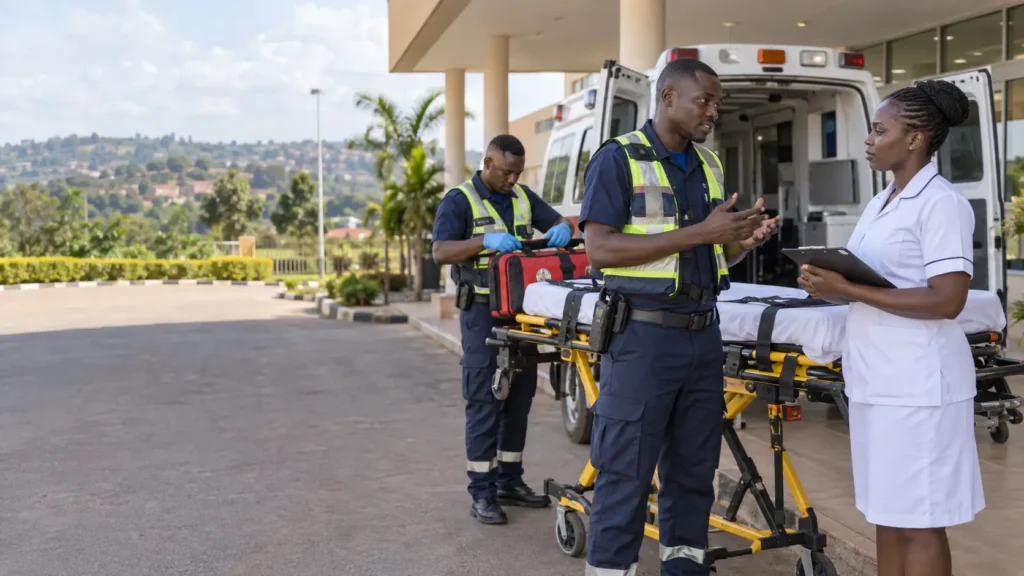
Emergency Medical Services (EMS) in Uganda are developing as an organised part of health care that connects a person in an emergency to timely assessment, treatment, transport, referral and definitive care. The subject is not simply about ambulances. It is about a coordinated system: a bystander recognises an emergency, the right help is activated, responders give safe care, the patient is transferred to an appropriate facility and the handover continues without losing vital information.
For an Emergency Medical Technician (EMT), understanding this background is important. It explains why pre-hospital care, communication, documentation, teamwork and referral decisions matter in daily practice. It also helps the EMT work realistically within Uganda's health system while advocating for safer and faster emergency care.
By the end of this lesson, the learner should be able to:
- Explain why organised EMS is needed in Uganda.
- Describe the historical context and development of national EMS policy and coordination.
- Outline the major components of an effective EMS system in Uganda.
- Relate the work of an EMT to the referral pathway from scene to definitive care.
- Identify practical challenges affecting emergency care and safe patient transfer.
- Meaning of EMS in Uganda
- Why Uganda Needs Organised EMS
- Development of National EMS
- Building Blocks of the System
- The Emergency-Care Continuum
- What This Means for the EMT
- Exam Focus and Self-Assessment
EMS is the coordinated response to acute illness, injury and other time-sensitive emergencies before and during transfer to a health facility. It includes care at the scene, care during transport and communication with the receiving facility. The Ministry of Health National Emergency Medical Services Policy presents emergency care as a system rather than an isolated ambulance service.
| Term | Meaning in practice |
|---|---|
| Pre-hospital care | Emergency assessment, stabilisation and treatment before the patient reaches a hospital or health centre. |
| Patient transport | Moving a patient safely. Transport becomes EMS only when it is appropriately equipped, staffed, communicated and linked to care. |
| Referral | Transferring responsibility to a facility with the capacity needed for the patient's condition, with a clear handover and documentation. |
| Definitive care | The treatment that finally addresses the life-threatening problem, for example surgery, blood transfusion, emergency obstetric care or advanced medical management. |
A good EMS system therefore links communities, dispatch or communication centres, first responders, ambulances, emergency units, health facilities and managers. Each part must know its role. If one link fails, the patient may experience delay, unsafe transfer, repeated assessment or arrival at a facility that cannot provide the required care.
Every country needs emergency care because serious illness and injury do not wait for appointment days. In Uganda, people may require urgent help after road traffic crashes, burns, drowning, assault, poisoning, severe malaria or sepsis, asthma, stroke-like symptoms, heart-related symptoms, convulsions, obstetric complications and newborn emergencies. A patient's outcome can depend on what happens in the first minutes and during the journey to care.
Patients may first seek help from a nearby community provider or lower-level facility. When the condition is beyond that facility's capacity, referral should be planned rather than improvised. The receiving facility should be chosen according to the patient's needs, travel time and available services. A rushed transfer without assessment, oxygen, monitoring, communication or a handover can worsen an otherwise manageable emergency.
| Uncoordinated response | Coordinated EMS response |
|---|---|
| Family or bystanders search for transport after an event. | Emergency is recognised, help is activated and responders are directed to the location. |
| Transport may begin without basic safety measures or patient assessment. | Trained personnel assess ABCDE priorities, provide indicated care and monitor the patient. |
| The destination is chosen only by convenience. | Destination is selected according to the patient's need and the facility's capability. |
| Receiving staff get little information. | Pre-arrival communication and a structured handover reduce loss of critical information. |
Organised EMS does not promise that every patient will have a fully equipped ambulance immediately. Its goal is more practical and more important: make the available response safer, faster, better coordinated and progressively stronger.
For many years, emergency response in Uganda was often provided through a mixture of hospitals, private providers, non-governmental organisations, security and rescue services, community initiatives and individual efforts. Ambulances existed in some places, but access, staffing, equipment, communication, response standards and coordination were variable. In many situations an ambulance functioned primarily as transport rather than as a mobile clinical environment.
As the need for structured emergency care became clearer, the Ministry of Health developed a national policy direction for EMS. The policy recognises gaps such as delayed response from the scene to accident-and-emergency units, limited coordination and non-functional or poorly equipped transport in some settings. It establishes a framework for a national emergency-care system that can be implemented and strengthened over time.
| Phase | Key idea | Practical implication |
|---|---|---|
| Earlier fragmented response | Emergency help depended heavily on what was locally available. | Care and transport varied widely between areas and providers. |
| Recognition of system gaps | Ambulances alone could not solve delays or poor outcomes. | Attention shifted to dispatch, trained teams, standards, facilities, referral and data. |
| National policy and planning | EMS became a health-system priority requiring coordination and governance. | Institutions can align equipment, workforce, communications, clinical pathways and quality improvement. |
| Progressive implementation | Systems improve in stages and must be adapted to available resources. | EMTs, facility teams and communities all contribute to safer care now while capacity grows. |
It is important not to describe this development as a single event. A national system is built through many connected actions: policies must be translated into protocols, training, equipment, financing, supervision, dispatch arrangements, facility readiness and performance review. Progress is strongest when leaders, clinicians, responders and communities use the same emergency-care language and share responsibility for the patient pathway.
Members of the public are frequently the first people at an emergency scene. They may recognise danger, call for help, protect the scene, start simple first aid or assist a patient to reach care. Community education should emphasise safety, early activation, basic first aid and avoiding harmful actions. A helper must not create a second victim by entering traffic, fire, violence, unsafe water or another dangerous scene without appropriate support.
A communication system receives information, identifies the location and nature of the emergency, gives appropriate pre-arrival advice where available and mobilises the closest suitable resource. Good call handling asks focused questions: What happened? Where exactly are you? How many patients? Is the scene safe? Is the patient conscious and breathing? What hazards are present?
Dispatch is not merely sending a vehicle. The dispatcher must match the response to the event, maintain contact when possible, coordinate with other agencies and alert the receiving facility for a critically ill patient. Accurate location details are especially important where landmarks, villages, road junctions or local contacts guide the response.
An EMS ambulance should be viewed as a mobile care area. It requires a safe vehicle, trained crew, communication, infection-prevention supplies, essential equipment, appropriate medicines under authorised protocols, oxygen capability where indicated, monitoring, documentation and regular maintenance. The exact level of equipment depends on the service level, but basic safety and clinical standards should never be ignored.
Before moving a patient, the EMT considers scene safety, urgent threats, spinal or trauma precautions when indicated, airway and breathing needs, haemorrhage control, glucose or seizure concerns, pregnancy-related issues, safe positioning, lifting and securing of the patient. The team should re-assess throughout transport; a patient who was stable at loading can deteriorate on the road.
Pre-hospital care has limited value if the patient arrives at an unprepared facility. Emergency units need triage, resuscitation capability, essential medicines and equipment, trained staff, referral links and access to services such as surgery, blood, imaging, maternity and newborn care according to their level. Receiving teams benefit from advance notice for conditions such as major trauma, severe bleeding, respiratory failure, prolonged convulsions or an obstetric emergency.
EMTs and other responders need defined scopes of practice, initial education, continuing training, clinical protocols, supportive supervision and a clear route for consultation. Protocols reduce unsafe variation: they guide assessment, treatment priorities, medicine use, referral thresholds and documentation. They do not replace clinical judgement; instead, they support disciplined judgement under pressure.
Every response produces useful information: time called, time dispatched, arrival time, patient condition, interventions, destination, handover and outcome where available. Such data can identify delays, high-risk locations, equipment gaps and training needs. Quality improvement should be non-punitive and practical: review cases, celebrate good practice, correct systems problems and update training.
The patient pathway can be understood as a connected continuum. The Star of Life later in this unit describes six classic functions: detection, reporting, response, on-scene care, care in transit and transfer to definitive care. These functions help the EMT see that transport is one part of a larger chain.
- Detection: someone recognises that an emergency is happening.
- Reporting: the correct service or facility is contacted with clear information.
- Response: suitable help is organised and reaches the scene as safely and quickly as possible.
- On-scene care: responders assess, stabilise and prepare the patient for transfer.
- Care in transit: the patient is monitored, treated according to protocol and protected during movement.
- Transfer to definitive care: receiving staff get a concise handover, records and responsibility for ongoing management.
A motorcyclist is found after a collision on a busy road. Bystanders have gathered and traffic is still moving. The EMT team first considers scene safety and requests support to control hazards. The patient is confused, has visible bleeding from the leg and is breathing rapidly. The crew applies a structured primary assessment, controls major bleeding, supports the airway and breathing as indicated, checks for other life threats, immobilises or positions the patient appropriately, documents findings and selects a suitable destination. During transfer, the team repeatedly reassesses the patient, communicates a pre-arrival alert and gives a structured handover on arrival.
The important lesson is that an ambulance ride alone is not the intervention. The intervention is the whole organised sequence of safety, assessment, treatment, transport, communication and handover.
The EMT is a visible part of EMS, but also a connector between community, dispatch and facility care. Professional conduct strengthens the entire system.
- Respond within scope of practice and follow authorised protocols.
- Put scene safety first and use standard precautions.
- Use ABCDE assessment and treat immediately life-threatening conditions first.
- Communicate calmly with patients, relatives, dispatch and receiving staff.
- Choose safe movement methods and secure the patient during transport.
- Document times, assessment findings, treatment, changes in condition and handover.
- Respect privacy, dignity, consent and cultural needs while acting in the patient's best interests in emergencies.
- Report equipment defects, stock gaps, safety concerns and system delays so they can be improved.
In resource-limited settings, professional practice does not mean pretending resources are unlimited. It means using what is available safely, escalating early, communicating honestly, preventing avoidable harm and making the best referral decision for the patient.
| Challenge | Safe professional response |
|---|---|
| Unclear scene location | Obtain landmarks, village, road direction, nearby facility, caller contact and safe meeting point. |
| Long transfer distance | Stabilise before departure, reassess frequently, communicate with receiving teams and plan for deterioration. |
| Multiple patients | Apply triage principles, request additional resources early and prioritise life-threatening needs. |
| Limited equipment | Use approved alternatives safely, avoid unsafe improvisation and report gaps through the service. |
| Family pressure to use an unsuitable destination | Explain the clinical reason for referral respectfully, involve senior support where needed and document key decisions. |
| Poor handover | Use a structured format such as ATMIST or SBAR, include vital signs, treatment, time course and concerns. |
- EMS is a coordinated system, not only an ambulance service.
- Uganda's EMS development addresses gaps in response, coordination, equipment, trained workforce and referral.
- The emergency-care continuum runs from recognition of an emergency to definitive care and handover.
- EMTs contribute through safe assessment, treatment, transport, communication, documentation and advocacy for quality improvement.
- A good referral considers the patient's need and the destination's capability, not only distance.
- Differentiate patient transport from a coordinated EMS response.
- State six building blocks of an effective EMS system.
- Explain why dispatch and communication are important before an ambulance reaches the scene.
- Describe the EMT's responsibilities during a referral transfer.
- Using a road traffic crash example, explain the emergency-care continuum from scene to facility handover.