
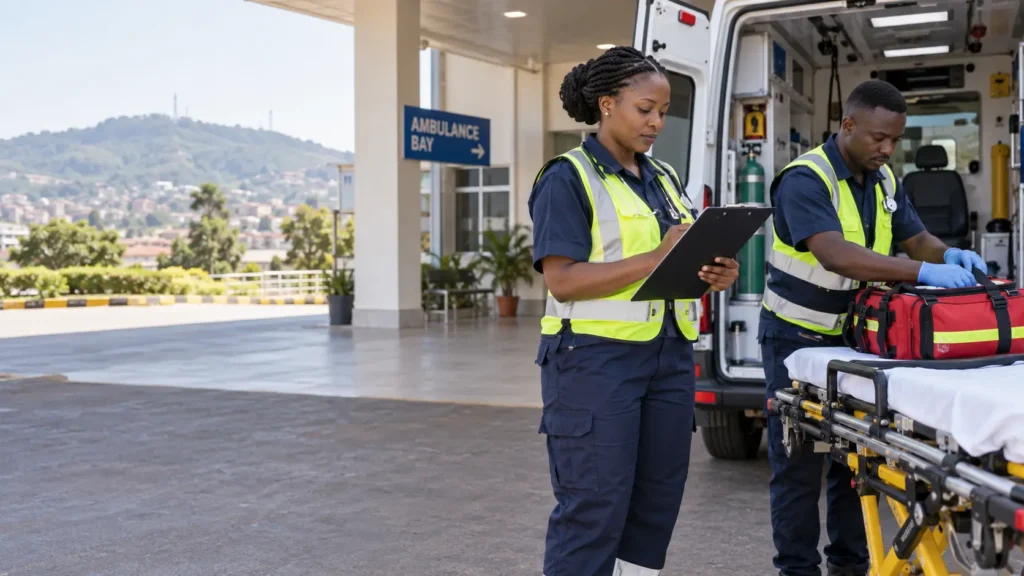
An Emergency Medical Technician (EMT) is a trained pre-hospital care provider who assesses, treats, monitors and transports people with illness or injury within an authorised scope of practice. The EMT links the community, emergency response and receiving health facility.
- Describe the core role of an EMT.
- Explain clinical, safety, communication and professional responsibilities.
- Apply EMT responsibilities to scene care, transport and handover.
The EMT is not simply a driver or a person who carries patients. The EMT brings organised emergency care to the patient, identifies immediate threats, starts indicated treatment, decides on safe transport and communicates essential information to the receiving team. The exact procedures permitted depend on national policy, service protocols, training level, equipment and medical direction.
| Area | EMT contribution |
|---|---|
| Community and scene | Respond safely, identify hazards, assess patients and provide initial care. |
| Patient care | Use a structured assessment, treat immediate life threats and reassess. |
| Transport | Move, position, secure and monitor the patient safely during transfer. |
| Communication | Coordinate with dispatch, team members, relatives and receiving facilities. |
| Quality and safety | Document care, check equipment and report hazards or service gaps. |
Before approaching, the EMT assesses traffic, fire, electricity, violence, unstable structures, hazardous materials, crowds and infection risk. Use personal protective equipment and request police, fire, rescue or additional clinical resources when needed. A rescuer who becomes injured cannot help the patient.
Use a systematic primary assessment such as ABCDE: airway, breathing, circulation, disability and exposure. Treat life-threatening problems first. A focused history, vital signs and secondary assessment follow when the patient is stable enough. Identify patients needing urgent transport and a specific facility.
Responsibilities include protocol-authorised care such as airway positioning, ventilation support, oxygen where indicated, bleeding control, shock management, glucose assessment, seizure protection, splinting, positioning and medicine administration only when trained and permitted. Never perform a procedure merely because it is requested or has been seen elsewhere.
Select safe lifting methods and equipment, protect the patient from falls, use stretcher straps and consider trauma, pregnancy and respiratory needs. During transport, reassess vital signs, continue treatment, record changes and balance speed with road safety.
Clear communication prevents dangerous delay. Report location and resource needs, explain care calmly to patients and relatives, alert a receiving facility for critical patients and give concise handover. ATMIST or SBAR can include the problem, history or mechanism, assessment, vital signs, treatment, response and concerns.
Every case record should include times, findings, vital signs, treatment, response, destination and handover. Before and after each shift, check vehicle safety, oxygen, suction, monitoring equipment, PPE, medicines, consumables, communication devices and stretcher function. Report defects and stock gaps promptly.
- Receive information and prepare the correct equipment.
- Approach only when the scene is safe.
- Identify and treat immediate life threats using ABCDE.
- Gather focused history and repeat vital signs.
- Decide destination and request additional help or early facility notification.
- Move and secure the patient safely.
- Continue care, reassessment and documentation during transport.
- Give structured handover and restock or report after the case.
An EMT team reaches a rider after a collision. Traffic is active and a crowd is gathering. The team first establishes a safe working area, uses PPE and requests traffic control. The patient has major leg bleeding and is confused. The EMT controls bleeding, assesses airway and breathing, checks circulation and consciousness, prepares the patient for safe transfer, communicates with the receiving facility and reassesses throughout transport. On arrival, the crew provides a structured handover.
- Work within training, scope of practice and service protocols.
- Respect patient dignity, privacy, culture and confidentiality.
- Seek consent when possible; act in the patient's best interests when emergency incapacity applies under authorised practice.
- Remain calm, honest and respectful; never promise outcomes that cannot be guaranteed.
- Do not abandon a patient after taking responsibility unless care is transferred appropriately.
- Avoid discrimination, unsafe driving and careless social-media use.
- Participate in debriefing, skills updates and quality-improvement review.
The EMT must recognise when a patient needs a higher level of care, more resources or medical consultation. Good practice includes requesting help early, communicating limitations, choosing an appropriate destination and documenting decisions. Working beyond scope or improvising unsafe care can harm the patient and the team.
- An EMT is a pre-hospital clinician, not only a transport worker.
- Scene safety comes before patient contact.
- ABCDE guides management of immediate life threats.
- Care continues during transport and ends after a safe handover.
- Scope, protocol, documentation and confidentiality are professional duties.
- List six responsibilities of an EMT at an emergency scene.
- Explain why care in transit is an EMT responsibility.
- Describe a structured clinical handover.
- State four professional limits or ethical duties of an EMT.
- Apply the EMT workflow to a road traffic crash.