
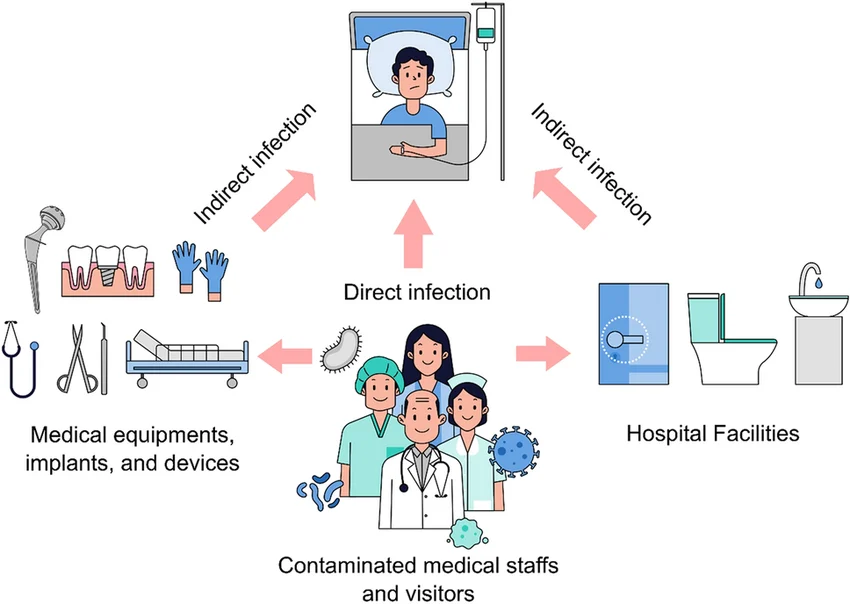
Why this matters: A patient may enter a facility for one condition and acquire another infection during care. Healthcare-associated infections are a patient-safety problem, a source of antimicrobial resistance and a major nursing responsibility. Many are preventable when every member of the team consistently applies infection-prevention practice.
- Define healthcare-acquired infection (HAI) and distinguish it from community-acquired infection, colonisation and contamination.
- Describe common types, sources, risk factors and consequences of HAIs.
- Explain how standard precautions, device care, environmental cleaning and surveillance prevent HAIs.
- Apply prevention principles to urinary catheters, intravenous lines, surgery and respiratory care.
Healthcare-acquired infection (HAI), also called nosocomial infection: an infection occurring during the process of care in a hospital or another healthcare setting that was not present or incubating at admission. It may become apparent during admission or after discharge, and occupational infections among staff are also included in the wider HAI concept.
HAIs can arise from the patient’s own flora (endogenous source) or from another person, equipment, food, water or the environment (exogenous source). An infection is not called an HAI simply because it is detected in hospital; timing, symptoms, incubation period, procedure history and clinical assessment matter.
| Term | Meaning | Example |
|---|---|---|
| Community-acquired infection | Present or incubating before care began. | A patient admitted with fever and pneumonia that started at home. |
| HAI | Develops during care or relates to a healthcare intervention. | Catheter-associated UTI after an unnecessary prolonged catheter. |
| Colonisation | Organisms present without symptoms or tissue disease. | Bacteria in a catheterised patient’s urine without dysuria, fever or systemic signs. |
| Contamination | Organisms accidentally introduced into a sample or item. | Skin flora in one blood culture after poor skin antisepsis. |
HAIs occur when an infectious agent has a reservoir, a portal of exit, a mode of transmission, a portal of entry and a susceptible host. In a facility, hands, gloves, shared equipment, invasive devices, procedures, water, waste and environmental surfaces can complete this chain when controls are weak.
- Sources/reservoirs: infected or colonised patients, staff, visitors, contaminated devices, sinks/water systems, linen, food, waste and environmental surfaces.
- Transmission: direct/indirect contact, droplets, airborne spread, blood-borne exposure or contaminated medicines/fluids.
- Susceptible hosts: neonates, older adults, patients with burns, malnutrition, diabetes, surgery, immunosuppression, prolonged admission and invasive devices.
| Type | Risk factors | Core prevention |
|---|---|---|
| Catheter-associated urinary tract infection (CAUTI) | Unnecessary catheter, non-sterile insertion, breaks in closed drainage, prolonged catheterisation. | Insert only for clear indication, aseptic insertion, maintain closed system, keep bag below bladder and remove promptly. |
| Central-line/IV-associated bloodstream infection | Poor hand hygiene, poor skin antisepsis, contaminated hub, unnecessary line or poor dressing care. | Hand hygiene, aseptic non-touch technique, skin preparation, scrub hubs, inspect daily and remove unnecessary lines. |
| Surgical site infection (SSI) | Inadequate preparation, poor sterile technique, hyperglycaemia, malnutrition, contaminated wound or poor post-operative care. | Correct pre-operative preparation, appropriate prophylaxis when prescribed, sterile technique, wound care and surveillance. |
| Healthcare-associated pneumonia | Aspiration risk, reduced consciousness, poor oral care, prolonged ventilation or unsafe respiratory equipment. | Hand hygiene, oral care, aspiration prevention, clean respiratory equipment and follow ventilator-care protocol where relevant. |
| Gastrointestinal infection/outbreak | Antibiotic disruption of gut flora, poor hand hygiene, contaminated food/water, poor sanitation and shared surfaces. | Safe water/sanitation, hand hygiene, environmental cleaning, correct waste handling and appropriate isolation precautions. |
Standard Precautions are used for the care of every patient, every time, because infection risk is not always known. They protect patients, workers and visitors by reducing transmission from recognised and unrecognised sources.
- Hand hygiene: before touching a patient, before clean/aseptic procedures, after body-fluid exposure risk, after touching a patient and after touching patient surroundings.
- Risk-based PPE: gloves, apron/gown, mask and eye/face protection selected according to anticipated exposure—not worn instead of hand hygiene.
- Safe injection and sharps practice: sterile single-use equipment, no unsafe re-use, immediate sharps disposal and urgent reporting of exposures.
- Cleaning and reprocessing: shared patient-care items cleaned/disinfected between patients; reusable equipment reprocessed at the correct level.
- Environmental hygiene: regular cleaning of high-touch surfaces, safe linen/waste management and spill management.
- Respiratory hygiene: early recognition, cough etiquette, source control and appropriate patient placement.
Urinary catheter care: use only when indicated; insert using aseptic technique; secure catheter; maintain unobstructed urine flow; keep bag below bladder and off the floor; avoid opening the closed system; perform daily review and document indication/removal plan.
IV/central line care: hand hygiene before handling; disinfect access hubs; use sterile supplies; inspect insertion site and dressing; administer fluids safely; document date/indication; remove promptly when no longer necessary.
Surgical wound care: explain procedure; perform hand hygiene; prepare clean/sterile field as appropriate; use aseptic non-touch technique; assess pain, redness, warmth, swelling, drainage, wound separation and fever; document and escalate concerns.
Environmental surfaces can become contaminated through hands, droplets, spills and equipment. Cleaning removes soil and organic material; disinfection reduces many microorganisms to a safer level. High-touch areas such as bed rails, call bells, door handles, locker surfaces, trolley handles and shared equipment need a planned cleaning schedule and clear responsibility. Waste must be segregated at the point of generation, contained safely and handled according to facility policy.
Antimicrobial stewardship supports HAI prevention. Unnecessary antibiotics disrupt flora, select resistant organisms and may mask diagnosis. Nurses contribute by obtaining cultures correctly before antibiotics when possible, checking allergies and timing, monitoring response/adverse effects, avoiding missed doses and educating patients not to self-medicate.
Early recognition prevents wider spread. New fever, rigors, unexplained deterioration, purulent drainage, new cough, diarrhoea, dysuria, line-site inflammation or a cluster of similar symptoms should trigger assessment and escalation. Do not wait for a laboratory result before beginning appropriate safety actions such as hand hygiene, PPE by risk assessment, patient placement and communication.
- Assess patient and vital signs; look for sepsis or deterioration.
- Inform the responsible clinician and follow facility escalation pathway.
- Collect indicated specimens using correct technique before antimicrobials where possible.
- Apply Standard Precautions and additional transmission-based precautions when indicated.
- Document onset, procedures/devices, observations and interventions.
- Notify IPC team/ward leader according to local policy, especially for clusters or outbreaks.
Scenario 1: Urinary catheter on day five. The patient no longer requires strict urine measurement. The best prevention action is not “wait for infection”: review the indication and remove the catheter using the local protocol, then monitor voiding and symptoms.
Scenario 2: IV line with pain and redness. Stop and assess the line, check observations, do not ignore local inflammation, escalate promptly and manage the device according to protocol. Hand hygiene and aseptic handling prevent cross-contamination during assessment.
Scenario 3: Two patients develop diarrhoea on one ward. Treat it as a potential cluster: strengthen hand hygiene and environmental cleaning, review food/water and shared equipment, use appropriate precautions, obtain samples as ordered and report to the ward/IPC team.
- Defining HAI only as infection “after 48 hours.” Time thresholds may help surveillance but clinical definition requires whether infection was present/incubating at admission and the care context.
- Listing PPE only. Include hand hygiene, device necessity, aseptic technique, cleaning and surveillance.
- Confusing colonisation with infection in catheterised patients.
- Forgetting staff and visitors can be part of the transmission chain.
- Giving antibiotics as the first answer without obtaining correct specimens and applying IPC measures.
- Define HAI and distinguish it from community-acquired infection.
- State four common HAIs and one prevention measure for each.
- Explain why an unnecessary urinary catheter increases infection risk.
- Outline the nurse’s response to a suspected ward outbreak of diarrhoea.
- Describe five Standard Precautions and state how they break the chain of infection.