
Why this matters: Sterilisation is essential when an item enters sterile tissue or the bloodstream. A single failure in cleaning, packaging, loading, cycle selection, monitoring or storage can place a patient at fatal risk of healthcare-associated infections (HAIs). This lesson explains the mechanics of sterilizers, standard methods, parameter monitoring, and safe handling in Central Sterile Services Departments (CSSD) and clinical practice.
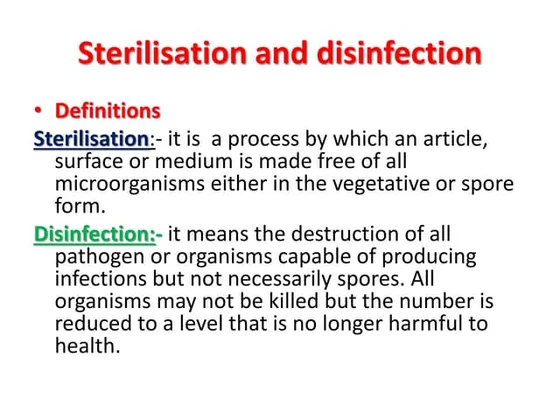
- Define sterilisation and distinguish it from cleaning and disinfection.
- Identify common physical and chemical sterilisation methods and their specific clinical uses.
- Differentiate between types of steam sterilizers (Gravity Displacement vs. Dynamic Air Removal).
- Describe the autoclave cycle phases, standard parameters, and correct loading procedures.
- Explain mechanical, chemical (including Bowie-Dick), and biological monitoring.
- Apply safe workflow from receipt of used instruments to event-related sterile storage.
| Level | What it achieves | Typical use |
|---|---|---|
| Cleaning | Physical removal of dirt/organic material (bioburden) and reduction of organisms. | Essential first step for all reusable equipment. Sterilisation fails if items aren't clean. |
| Disinfection | Destroys many pathogens but may not reliably destroy resistant bacterial spores. | Non-critical (BP cuffs) and selected semi-critical equipment (endoscopes). |
| Sterilisation | Absolute destruction of all microorganisms, including spores, viruses, and fungi. | Critical instruments (surgical tools, implants, cardiac catheters). |
| Method/Sterilizer | Principle of Destruction | Suitable items | Limitations/Safety |
|---|---|---|---|
| Steam under pressure (Autoclave) | Denaturation and coagulation of proteins. Saturated steam transfers heat efficiently; pressure allows temperatures to exceed boiling. | Heat/moisture-resistant stainless steel instruments, surgical drapes, dressings, and liquids. | Not for moisture/heat-sensitive materials, powders, or oils. Strict loading rules apply to ensure steam contact. |
| Dry heat (Hot-air oven) | Kills by oxidation and cellular desiccation over a long exposure time at high temperatures (e.g., 160°C for 2 hours). | Glassware, certain metals, anhydrous oils, and petroleum-based powders. | Very slow process. Destroys rubber, fabrics, and most plastics. Requires precise temperature/time control. |
| Ethylene Oxide (EtO) Gas | Alkylation of cellular DNA and proteins. Highly penetrative at low temperatures (37°C - 63°C). | Complex, heat-sensitive devices with long lumens (e.g., flexible endoscopes, plastics, electronics). | EtO is highly toxic, carcinogenic, and flammable. Requires 8-12 hours of mechanical aeration to remove toxic residues before use. |
| Hydrogen Peroxide Gas Plasma | Low-temperature oxidative process using hydrogen peroxide vapor and radiofrequency plasma to create free radicals. | Compatible heat-sensitive devices, cameras, rigid endoscopes. Fast cycle (45-75 mins). | Cannot process linens, liquids, or items containing cellulose (paper). Requires specific synthetic packaging. |
| Radiation (Gamma/Electron Beam) | Ionising radiation damages microbial DNA beyond repair. | Commercially prepared single-use items (sutures, syringes, IV sets). | Industrial use only. Not available for routine hospital reprocessing facilities. |
An autoclave uses saturated steam under pressure. Pressure itself does not sterilise; it merely allows the steam to reach temperatures required to kill spores (usually 121°C or 132°C). Because air is cooler and heavier than steam, all air must be completely removed from the chamber for sterilisation to occur. Autoclaves are classified by how they remove this air:
- Gravity Displacement Sterilizers: Steam is pumped into the top of the chamber, pushing the cooler, heavier air to the bottom and out through a drain valve. Standard cycle: 121°C (250°F) for 15-30 minutes. Best for simple, non-porous items.
- Dynamic Air Removal (Pre-Vacuum) Sterilizers: A mechanical vacuum pump pulls all air out of the chamber before steam is introduced, creating negative pressure that instantly sucks steam into all crevices and lumens. Standard cycle: 132°C (270°F) for 4 minutes. Best for wrapped, porous loads and cannulated instruments.
- Immediate-Use Steam Sterilization (IUSS/Flash): A fast, unwrapped cycle used only in emergencies (e.g., a dropped unique surgical instrument). It must never be used for convenience or to compensate for low instrument inventory.
A standard cycle goes through four phases: Conditioning (air removal and steam entry), Exposure (sterilizing temp held for specific time), Exhaust (steam released, pressure drops), and Drying (heat runs to dry packs).
- Clean, inspect, and completely dry instruments before packing. (Water left on tools creates cold spots).
- Open hinged instruments (scissors, hemostats); disassemble multi-part tools; protect sharp tips.
- Use approved permeable packaging (e.g., Tyvek for plasma, medical paper/cloth for steam) with internal and external indicators.
- Do not overload or compress packs. Place packs loosely, standing on their edge (like books on a shelf) to permit maximum steam circulation.
- Place concave items (bowls, basins) on their side to permit water drainage and drying.
- Allow the load to dry and cool completely inside the sterilizer before handling; wet packs are considered compromised because organisms from hands or air can instantly wick through damp packaging.
To guarantee that the sterilizer is functioning and the correct parameters were met inside the packs, three types of monitoring are mandatory:
| Monitoring type | What it checks | Examples / Specifics | Limitation |
|---|---|---|---|
| Mechanical/Physical | Real-time machine performance (Cycle parameters). | Gauges, digital displays, and printouts showing Time, Temperature, and Pressure. | Only shows parameters inside the chamber, not steam penetration inside every individual pack. |
| Chemical Indicators (CI) | Exposure to one or more process conditions (temp, steam). | External indicator tape; Internal integrating strips. Bowie-Dick Test: Run daily in pre-vac machines to check for air leaks. | A color change alone does not guarantee absolute sterility, only that the item was exposed to the process. |
| Biological Indicators (BI) | Proves actual lethality by attempting to kill highly resistant live spores. | Vials containing Geobacillus stearothermophilus (for steam) or Bacillus atrophaeus (for EtO). Run daily/weekly and with implantables. | Requires incubation time (though rapid readout BIs now take 1-3 hours). If it tests positive (spores lived), the load must be recalled. |
If a mechanical reading, chemical indicator, or biological test suggests failure, do not release the load. Quarantine items, label them clearly, inform the CSSD manager/infection control, and initiate a formal recall process for any released items.
A safe Central Sterile workflow is strictly unidirectional: moving from the decontamination zone, to assembly, to sterilisation, to sterile storage. Airflow is strictly controlled to prevent dirty air from entering clean zones.
- Point of use (Operating Theatre/Ward): Remove gross soil with sterile water (not saline, which causes pitting), separate sharps, spray with enzymatic gel to prevent drying, and transport in a closed, rigid, biohazard-labelled container.
- Decontamination area: Staff wear heavy-duty PPE. Items are manually brushed under the waterline, processed in ultrasonic cleaners (for fine crevices), and run through automated washer-disinfectors.
- Assembly and Packaging area: Staff use illuminated magnifiers to inspect for residual tissue, rust, or damage. Items are assembled, internal CIs are inserted, and items are wrapped using tamper-evident seals.
- Steriliser phase: Autoclave is loaded correctly without touching chamber walls, validated cycle selected, and mechanical prints are signed off.
- Release/storage: Items are left untouched until completely cool. Only satisfactory, dry, intact packs are released to sterile storage.
- Perform hand hygiene before handling any sterile packs.
- Follow Event-Related Sterility: An item is considered sterile indefinitely unless an "event" occurs (e.g., torn, wet, dropped, crushed, or degraded packaging). Time-related expiration is mostly for items with degrading seals (like tape).
- Check package integrity, dryness, label, and chemical indicator before opening on the sterile field.
- Do not use a wet, torn, punctured, dropped, or visibly soiled pack—even if dropped on a visibly "clean" floor.
- Store at least 25 cm (10 inches) off the floor, 45 cm (18 inches) from the ceiling, and away from outside walls, sinks, and windows to prevent condensation.
- Transport sterile supplies in closed carts or bins to prevent environmental contamination during transit.
Scenario 1: A wrapped surgical tray is wet after autoclaving. Do not use it, even if the indicator tape changed color. Moisture acts as a highway for bacteria to wick through the packaging. Treat it as unsterile. Reprocess the instruments, use fresh wrapping, and investigate the autoclave for blocked drains or overloading.
Scenario 2: The daily Bowie-Dick test fails in the pre-vacuum sterilizer. This indicates an air leak or a failing vacuum pump. Do not process any loads. Shut down the machine, call biomedical engineering, and re-test until it passes.
Scenario 3: The surgeon drops a critical, one-of-a-kind instrument and asks you to "flash" sterilise it quickly. If allowed by policy, it must still be thoroughly cleaned of all blood first. It is then run on a specialized unwrapped Immediate Use Steam Sterilization (IUSS) cycle and must be transported immediately to the sterile field without storage.
- Saying “pressure sterilises.” Correction: Saturated steam/heat kills organisms; pressure merely allows steam to reach temperatures above 100°C.
- Confusing chemical indicator color change with proof of sterility. Correction: Chemical indicators only prove the item was exposed to heat/steam. Only Biological Indicators prove microbial kill.
- Forgetting the fundamental rule: "You cannot sterilise dirt." Bioburden blocks steam penetration.
- Misunderstanding Gravity vs. Pre-vacuum. Gravity relies on steam pushing air out; Pre-vac uses a mechanical pump to pull air out.
- Assuming an item is safe to use if dropped on a clean floor. The sudden compression pushes air and dust through the microscopic pores of the wrapper.
- Define sterilisation and explain why bacterial spores are used in biological monitoring.
- Compare the air removal mechanism in a gravity displacement autoclave versus a pre-vacuum autoclave.
- What is the purpose of the Bowie-Dick test, and how often is it run?
- Describe the four phases of a standard steam sterilisation cycle.
- Explain "event-related sterility" and list three "events" that would render a pack unsterile.