
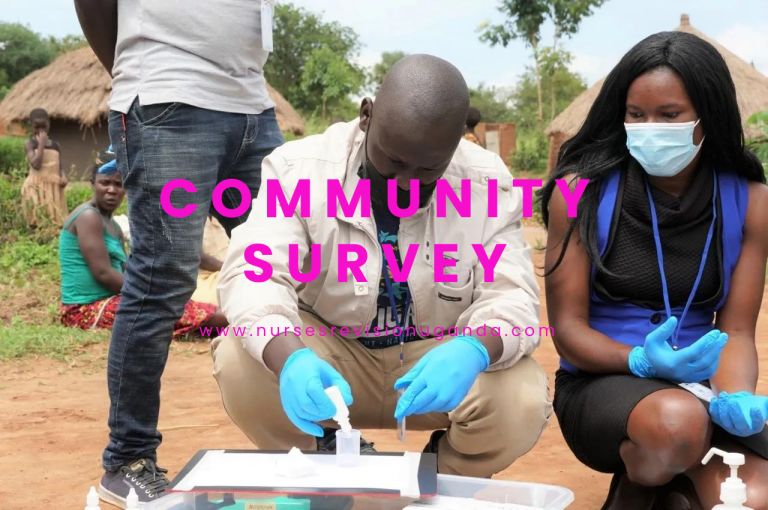
THE COMMUNITY HEALTH CHRONICLES: EPISODE 3
In Episode 2, Student Nurse Amina successfully entered Kiyunga Village, gaining the trust and blessing of the local leaders and residents. Now, the real work begins. Before she can suggest solutions or build programs, she needs to understand the exact landscape of Kiyunga's health. She needs hard facts, numbers, and direct feedback from the households. She cannot guess; she must investigate. It is time for Amina to initiate her Community Survey. Let's see how she systematically gathers this critical data.
A community survey is a study which aims at obtaining information and data on specific topics within a population or organization.
It is a compilation of survey questions sent out to a specific audience—particularly those of a common community—to learn more about them. Following Community Entry, the community survey is a method of gathering vital grassroots information. It is a way of finding out which problems in the community need to be explored in detail. It is the very first step in community diagnosis (finding a reason for data collection, analysis, and feedback).
- Identification of the community’s needs and problems: A community survey helps to systematically identify the specific needs, challenges, and issues faced by the community. It provides valuable data and insights that inform decision-making and resource allocation.
- Provision of data for planning, implementation, and evaluation: The data collected through a community survey serves as a foundation for planning, implementing, and evaluating community-based health and development programs. It ensures that interventions are evidence-based, targeted, and aligned with the community’s needs.
- Development and decision-making for community involvement: A community survey helps in developing strategies to involve the community actively in the planning and implementation of programs. It fosters participatory approaches, ownership, and empowerment within the community.
- Community self-awareness and problem-solving: By conducting a survey, the community becomes more conscious of its existing problems, challenges, and potential solutions. It creates an opportunity for the community to reflect on its own strengths and weaknesses and take collective action to address the identified issues.
- Matching project organization and services to community needs: The data from a community survey helps in aligning project organizations and services with the specific needs and priorities of the community. It ensures that resources and interventions are tailored to the unique characteristics of the community.
- Understanding social, cultural, and environmental characteristics: A community survey provides insights into the social, cultural, and environmental aspects of the community. It helps in understanding the way in which interventions will be implemented and tailoring strategies to the community’s specific characteristics.
- Creating opportunities for inter-sectoral collaboration: A community survey facilitates the identification of opportunities for collaboration among different sectors, such as healthcare, education, social services, and environmental agencies. It promotes coordination among stakeholders to address the multifaceted needs of the community.
Timing and readiness are crucial for accurate data collection. A survey should be conducted:
- Team members trained in surveying.
- Survey materials (forms, pens, devices).
- Adequate time to do the job properly.
- The ability and funding to work with the community in response to the needs discovered.
| Type | Description & Application |
|---|---|
| Comprehensive Surveys | Every single home is visited, and questions are asked concerning all family members. Provides a complete census. |
| Sample Surveys | Some, but not all, households are visited. For instance, every tenth or fifth household may be chosen, or houses are selected completely at random. |
| Mixed Surveys | A hybrid approach. We may visit every house to record crucial quick info (like child weight or MUAC - Mid-Upper Arm Circumference) but only select a sample of houses to record lengthy socio-economic details. |
| Pilot Surveys | Small-scale surveys carried out at the start of a project to estimate needs, obtain an approximate census, or pre-test a surveying technique before a massive rollout. |
| Prevalence (Cross-sectional) Survey | Involves questioning and examining a sample of the population at one specific point in a given time. Formula: PR = (Number of cases at one point / Total population) X 100 |
| Incidence (Longitudinal) Survey | Collects information about all new cases of a disease or event over a period of time (e.g., a month or a year). Formula: IR = (No. of new cases detected per given time / Total population) X 100 |
| KAP Survey | Knowledge, Attitude, and Practice. Concerned with people's attitudes toward certain health problems and practices (e.g., family planning, nutrition, STIs). |
The type of information collected depends on the survey's objectives. However, a comprehensive community health assessment generally gathers the following facts and profiles:
- Population Size: Total number of individuals. Implications for planning/resource allocation.
- Demographics: Age, gender, education levels, and literacy rates.
- Ethnicity & Religion: Major ethnic groups and religious affiliations. Important for cultural sensitivity and equitable service provision.
- Location: Geographical boundaries mapping.
- Climate Conditions: Temperature, rainfall, prevailing weather (impacts agriculture and disease vectors).
- Physical Environment: Housing conditions, sanitation, and access to safe drinking water.
- Economic Status & Standard of Living: Income levels, poverty rates, overall quality of life, access to basic needs.
- Occupation: Types of employment and labor markets.
- Community Resources: Social and economic resources, community organizations, support groups.
- Health Status & Behavior: Prevalence of diseases, common health problems, risk factors, and lifestyle behaviors.
- Access to Health Services: Availability and utilization, types of services offered, distance to facilities, and cost of care.
- Health Care Providers & Financing: Number/distribution of providers, their qualifications. Sources of financing (out-of-pocket, insurance, government subsidies).
To extract meaningful data, the survey should seek answers to the following operational questions:
- What are the major problems or challenges faced by the community?
- How well is the existing health facility addressing these problems?
- What are the strengths, weaknesses, perceived problems, and needs of the health workers?
- Are community members satisfied with the quality and accessibility of healthcare?
- What are the barriers (financial, geographic, cultural) to accessing healthcare?
- Are there specific prevalent diseases that need urgent attention?
- Are community members aware of preventive measures and health promotion?
- Which specific marginalized groups require targeted interventions?
- Are there existing community-based initiatives, and how effective are they?
- How does the community perceive the affordability and attitude of healthcare providers?
- Questionnaires: Distributing structured questions to individuals or households to gather information about health status, access, and behaviors.
- Interviews: Engaging individuals or groups in face-to-face discussions for deeper insights.
- Focus Group Discussions: Bringing together a small group of people to discuss a particular issue and gain insight into community beliefs and attitudes.
- Observation: Systematically observing the physical environment, health practices, and service delivery (e.g., watching hygiene practices at a water source).
- Health Records Review: Reviewing existing medical records and documents to gauge disease trends and service quality.
- Key Informant Interviews: Interviewing knowledgeable individuals like health workers, local leaders, and traditional healers.
- Paper or Online Forms: Standardized questionnaires.
- Structured/Semi-structured Interview Guides: Used over phone, video, or in-person.
- Surveys via Mobile Phones: Respondents use text messages or mobile applications (great for rapid data).
- Social Media Monitoring: Monitoring platforms to gather opinions, attitudes, and behaviors related to the topic.
- Document Review: Analyzing existing reports, publications, and national statistics.
- Identify the target population: Determine the population of interest and identify the characteristics that define this population.
- Develop the survey instrument: Develop a survey instrument that includes questions that are relevant to the population of interest. The survey instrument should be easy to understand, concise, and unbiased.
- Select the sample: Select a representative sample of the population of interest. This can be done through random sampling or by identifying a specific group of people who are most likely to provide accurate information.
- Administer the survey: Administer the survey to the selected sample, either through online surveys, phone interviews, mail surveys or face-to-face interviews.
- Analyze the data: Once the survey has been completed, analyze the data collected to determine the needs and resources of the community.
- Report the findings: Report the findings of the survey to stakeholders, including community members, policymakers, and health professionals, to inform decision making and develop interventions that are tailored to the community's specific needs.
Conducting a survey involves a systematic, multi-phase approach.
- Identify the target population: Determine the population of interest and identify their defining characteristics.
- Define Objectives: Clearly define the purpose. Consult individuals with expertise.
- Develop the survey instrument: Design questions relevant to the population. Ensure the tool is easy to understand, concise, and unbiased. Finalize format and presentation.
- Select the sample: Select a representative sample (via random sampling or specific targeting).
- Allocate Resources: Secure personnel, equipment, funding, and determine when, where, and how data will be collected and analyzed.
- Community Cooperation: Obtain involvement from local members who can assist in organizing.
- Recruit & Train: Train survey staff and volunteers on how to administer the tool ethically and accurately.
- Logistics: Arrange lab facilities if needed, prepare survey materials, and develop a detailed timeline outlining tasks and responsibilities.
- Administer the survey: Deploy the tool to the selected sample through face-to-face interviews, mobile devices, etc.
- Supervise: Provide strict supervision to staff. Coordinate with senior community members.
- Quality Control: Monitor data collection to maintain high data quality and accuracy, ensuring participants are treated respectfully.
- Analyze the data: Use appropriate statistical methods to determine the actual needs and resources.
- Discuss & Interpret: Discuss results with medical staff and community members to gain perspective.
- Report the findings: Prepare a brief report with recommendations. Share findings with stakeholders, policymakers, and health professionals to inform decision-making.
- Community Feedback: Provide feedback directly to the community, sharing the results and engaging in dialogue about next steps.
| No. | Role | Description of Activities |
|---|---|---|
| 1 | Planning and Design | Uses clinical expertise to identify relevant health indicators, design appropriate health-related questions, and ensure the instrument captures vital medical data. |
| 2 | Data Collection | Actively administers surveys, conducts interviews, and gathers accurate health info in an ethical and culturally sensitive manner. |
| 3 | Health Assessment | Assesses individuals/families during the survey (e.g., conducting physical assessments, taking vital signs, MUAC screening, identifying prevalent conditions on the spot). |
| 4 | Health Education & Promotion | Provides on-the-spot health education, disseminating information on preventive measures and available services while interacting with households. |
| 5 | Collaboration and Networking | Works closely with local leaders, VHTs, and other professionals to ensure smooth survey execution and establish immediate referral pathways for severe cases identified. |
| 6 | Data Analysis and Interpretation | Applies clinical knowledge to make sense of the raw health data, identifying epidemiological patterns, trends, and drawing meaningful conclusions. |
| 7 | Reporting and Documentation | Documents findings accurately and prepares reports summarizing the health needs, ensuring this data is communicated effectively to stakeholders. |
EPISODE 3 WRAP-UP
Equipped with questionnaires and accompanied by her trusted VHT guides, Amina has spent the last week walking from household to household in Kiyunga. She measured MUACs for toddlers, asked mothers about their nearest water sources, and recorded the incidence of malaria. She has successfully completed her Community Survey!
Now, Amina is sitting at her desk with a mountain of forms, numbers, and interview notes. What does it all mean? How does she translate "30% of households lack latrines" into a concrete healthcare plan? She must now analyze this data to identify the true health status of Kiyunga. Get ready for Episode 4: Community Assessment, where Amina turns raw data into a clear picture of community health!
Quick Quiz
Community Survey Quiz
Community
Privacy: Your details are used only for quiz tracking and certificates.
Community Survey Quiz
Community
Preparing questions...
Choose your answer and keep your streak alive.
Great effort.
Here is your quick performance summary.
Very relevant information,, nice and clear, thanks
Welcome, anything you wish we can improve?
Very good and precise notes given . Thnxs
Good work
Good work
Thanks for the data.
I wish you could have a quiz at the end
Wonderful
Types of survey
It was relevant
commendable initiative for teaching purpose include types of surveys
Very relevant for all categories of students
Nice 👍 work,good ,precise and understandable.