
- Introduction to Ethics in Nursing
- Importance of Ethics in Nursing
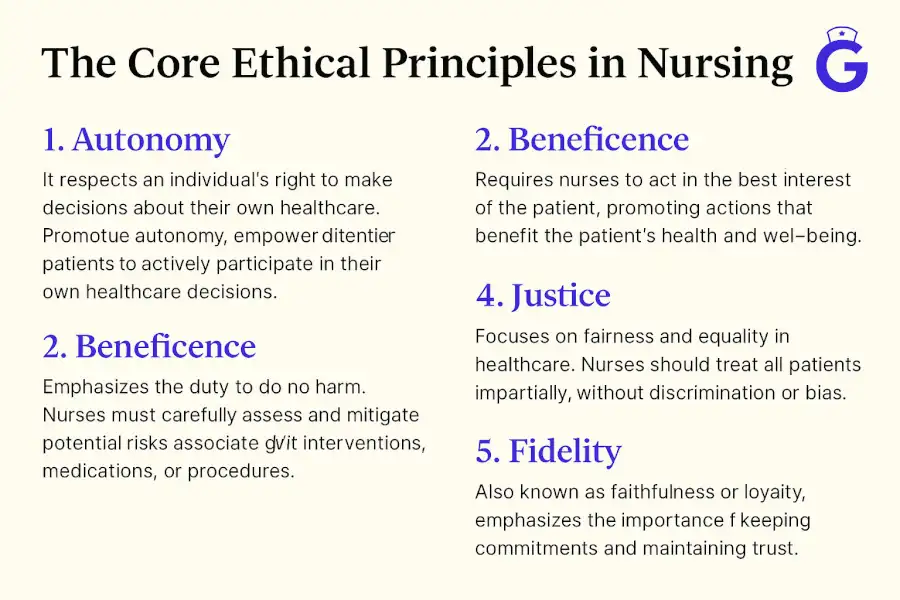
- The Major Principles of Healthcare Ethics
- Comparison of the Major Ethical Principles
Nursing ethics refers to the principles, values, and standards that guide nurses in making morally appropriate decisions and providing safe, respectful, and professional care to patients.
Nursing is not merely a series of technical tasks; it is a profoundly moral profession. Nurses frequently encounter complex, high-stakes situations where they must decide what is right, fair, safe, and respectful for the patient. Ethical principles serve as a compass, helping nurses navigate these difficult decisions while strictly protecting the patient's rights, dignity, and overall well-being.
Adhering to a strong ethical framework is the bedrock of professional nursing. Ethical nursing practice helps to:
- Protect patients' rights and dignity: Ensuring that vulnerable individuals are treated as human beings, not just medical cases.
- Promote safe and quality nursing care: Ethical guidelines require nurses to maintain competence and prioritize patient safety above all else.
- Maintain trust between nurses and patients: Trust is essential for healing. Patients must believe their nurse has their best interests at heart.
- Guide nurses when faced with difficult clinical decisions: Providing a clear framework for navigating moral distress or conflicting obligations.
- Promote respect for patient choices: Honoring the patient's voice in their own care plan.
- Prevent harm to patients: Actively anticipating risks and mitigating them before injury occurs.
- Maintain confidentiality and privacy: Creating a safe space where patients feel comfortable sharing sensitive health information.
- Promote professional accountability: Encouraging nurses to take ownership of both their successes and their errors.
- Guide relationships: Establishing professional boundaries between nurses, patients, relatives, and other multidisciplinary health professionals.
- Maintain the reputation and integrity of the nursing profession: Ensuring the public continues to view nursing as the most trusted profession.
Autonomy is the patient's right and ability to make informed decisions about their own health care without unnecessary coercion, pressure, or interference.
In simple terms: Autonomy means respecting the patient's right to choose.
A competent adult patient has the fundamental legal and ethical right to accept or refuse treatment, even when the healthcare professional strongly believes another option would be better or life-saving.
For a patient's decision to be genuinely autonomous, the nurse must ensure that the patient:
- Has adequate and accurate information regarding their diagnosis and treatment options.
- Fully understands the information provided (using interpreters or simplified language if necessary).
- Has the cognitive and legal capacity to make the decision (e.g., is not severely intoxicated, delirious, or a minor without a guardian).
- Is completely free from coercion, manipulation, or undue pressure from family members or medical staff.
- Is able to clearly communicate their decision.
- Obtain informed consent before any procedure.
- Provide understandable, jargon-free information.
- Allow patients ample time to ask questions.
- Respect treatment decisions, even if you disagree.
- Avoid threatening, guilting, or forcing patients into compliance.
- Support patients in expressing their preferences to the wider medical team.
- Provide information about viable alternatives where appropriate.
Clinical Example: A competent patient refuses to take their newly prescribed blood pressure medication because they are afraid of the side effects. Instead of sneaking the medication into their food (which violates autonomy), the nurse should explore the reason for refusal, provide appropriate education about the drug's actual side effects, document the refusal in the chart, and notify the prescribing physician to discuss alternative options.
Beneficence means acting for the benefit or welfare of the patient.
In simple terms: Beneficence means doing good for the patient.
The nurse should proactively take actions that promote the patient's health, comfort, safety, and overall well-being. It requires taking positive action to help others, not just avoiding harm.
- Relieving pain and suffering promptly.
- Providing appropriate, evidence-based treatment.
- Preventing clinical complications (e.g., turning a bedridden patient to prevent bedsores).
- Educating patients on disease management and healthy lifestyles.
- Promoting adequate nutrition and hydration.
- Providing deep emotional support and a listening ear.
- Preventing falls and injuries (e.g., putting up bed rails, ensuring the floor is dry).
- Referring patients to specialists or social workers when necessary.
- Advocating fiercely for patients' needs.
Clinical Example: A post-operative patient is experiencing severe, rating 9/10 pain. The nurse quickly assesses the pain, checks the orders, and administers the prescribed analgesic appropriately, then returns in 30 minutes to check if the pain has subsided. This demonstrates beneficence because the nurse took positive action to relieve suffering and improve the patient's condition.
Non-maleficence means the obligation to avoid causing harm to the patient.
In simple terms: Non-maleficence means "do no harm."
The nurse should avoid actions or omissions that could unnecessarily cause injury, suffering, complications, or death. While beneficence dictates taking action to help, non-maleficence dictates avoiding actions that hurt.
Clinical Example: Infection Prevention. A nurse rigorously performs hand hygiene before and after every single patient contact, and strictly adheres to sterile technique when inserting a urinary catheter. By doing this, the nurse prevents the transmission of healthcare-associated infections (HAIs), actively avoiding causing harm to the patient.
Fidelity means being faithful, trustworthy, and keeping legitimate professional commitments made to patients.
In simple terms: Fidelity means keeping your promises and being trustworthy.
A nurse should fulfill professional responsibilities and commitments to patients unless circumstances make this absolutely impossible or unsafe. Trust is the foundation of the nurse-patient relationship.
- Keeping professional promises.
- Being honest in your intentions.
- Being reliable and consistent.
- Maintaining trust over time.
- Following through with promised responsibilities.
- Maintaining professional commitments to your employer and colleagues.
Clinical Example: A nurse agrees to assist a patient with mobilization out of bed after a complex procedure, telling the patient, "I will be back in 15 minutes to help you walk." The nurse must remember this commitment and return exactly when promised, or, if an emergency arises, ensure another appropriate colleague provides the assistance and informs the patient.
Veracity means telling the truth and providing accurate, honest information to patients.
In simple terms: Veracity = Truthfulness.
Nurses should not deliberately deceive, lie to, or withhold relevant health information from patients.
Veracity does not mean giving information that is:
- Outside the nurse's scope of practice (e.g., a nurse should not give an official medical diagnosis of cancer; that is the physician's role).
- Confidential information about another person (e.g., telling a patient why their roommate is in the hospital).
- Inappropriate for the patient's immediate clinical or psychological situation (though truth must not be permanently withheld, timing and delivery matter).
Clinical Example: A patient nervously asks, "What procedure am I going to have today?" The nurse should provide accurate, clear information about the nursing care and general nature of the procedure within the nurse's professional scope. If the patient asks highly complex surgical questions or demands a diagnosis, the nurse should refer those questions requiring medical clarification to the appropriate physician, saying, "I will have your surgeon come speak with you regarding those specific details."
Justice means fairness and equitable treatment of all patients.
In simple terms: Justice = Treat people fairly.
It does not necessarily mean giving every patient exactly the same thing (e.g., not everyone gets an ICU bed). It means making fair, unbiased decisions based on relevant clinical needs, urgency, and ethical considerations, rather than personal prejudice.
Clinical Example: A nurse working in a busy emergency department must provide respectful, high-quality care to all patients regardless of their social status, economic circumstances, gender, age, disability, race, or background. Triage is a form of justice—treating the person with the most critical clinical need first, regardless of who arrived first or who has more money.
Confidentiality is the strict professional obligation to protect information obtained about a patient and prevent unauthorized disclosure.
In simple terms: Confidentiality means keeping the patient's information private.
- Name, address, and identifying details.
- Medical Diagnosis.
- Medical and surgical history.
- Laboratory and imaging results.
- HIV status or STI history.
- Sexual and reproductive health information.
- Medication history.
- Mental health information and psychiatric history.
- Family information and dynamics.
- Photographs of the patient or their body parts.
- Nursing notes and all medical records.
Clinical Example: A nurse should never leave a patient's physical or electronic file open on a desk or screen where unauthorized people (visitors, other patients, unassigned staff) can read it. Furthermore, nurses must never discuss patient details in public areas like hospital cafeterias or elevators.
Accountability means being responsible for one's professional actions, decisions, omissions, and their ultimate consequences.
Nurses must own their practice. This means standing behind your good work, and taking immediate responsibility when you make a mistake.
Clinical Example: Managing a Medication Error. A nurse realizes they have just administered the wrong medication to a patient. The accountable nurse should immediately:
- Assess the patient's current condition and vital signs.
- Take immediate appropriate action to stabilize the patient if needed.
- Inform the appropriate healthcare professional (the attending physician) immediately to get counteractive orders.
- Report the incident to the charge nurse according to institutional policy (filling out an incident report).
- Document the event and the patient's response truthfully in the medical record.
- Participate in root-cause analysis measures to prevent recurrence.
| Principle | Meaning | Simple Phrase | Nursing Example |
|---|---|---|---|
| Autonomy | Respect the patient's right to choose | Let the patient choose | Respect an informed refusal of treatment. |
| Beneficence | Promote the patient's welfare | Do good | Relieve pain by giving ordered analgesics. |
| Non-maleficence | Avoid causing harm | Do no harm | Check patient allergies rigorously before giving medication. |
| Fidelity | Keep commitments and maintain trust | Keep your promises | Return exactly as promised to reassess a patient's condition. |
| Veracity | Tell the truth | Be truthful | Give accurate, honest information regarding a procedure. |
| Confidentiality | Protect patient information | Keep information private | Do not disclose a diagnosis to unauthorized persons or family without consent. |
| Justice | Treat people fairly | Be fair | Prioritize care in the ER according to clinical need, not wealth. |
| Accountability | Accept responsibility | Own your actions | Truthfully report and manage a medication error immediately. |
A-B-N-F-V-C-J-A
- A – Autonomy: Patient chooses.
- B – Beneficence: Do good.
- N – Non-maleficence: Do no harm.
- F – Fidelity: Keep promises.
- V – Veracity: Tell the truth.
- C – Confidentiality: Keep information private.
- J – Justice: Treat fairly.
- A – Accountability: Take responsibility.
The ethical nurse should aim to:
Respect the patient's choices (autonomy), do good (beneficence), avoid harm (non-maleficence), keep promises (fidelity), tell the truth (veracity), protect information (confidentiality), treat people fairly (justice), preserve dignity, remain accountable, and advocate appropriately for patients.
These principles are particularly important and constantly utilized in daily clinical practice, especially during: obtaining informed consent, safe medication administration, maintaining record confidentiality, conducting patient education, navigating end-of-life care decisions, handling a patient's refusal of treatment, conducting medical research, adhering to infection prevention protocols, delegating tasks to unlicensed staff, completing accurate documentation, and making complex clinical decisions.