
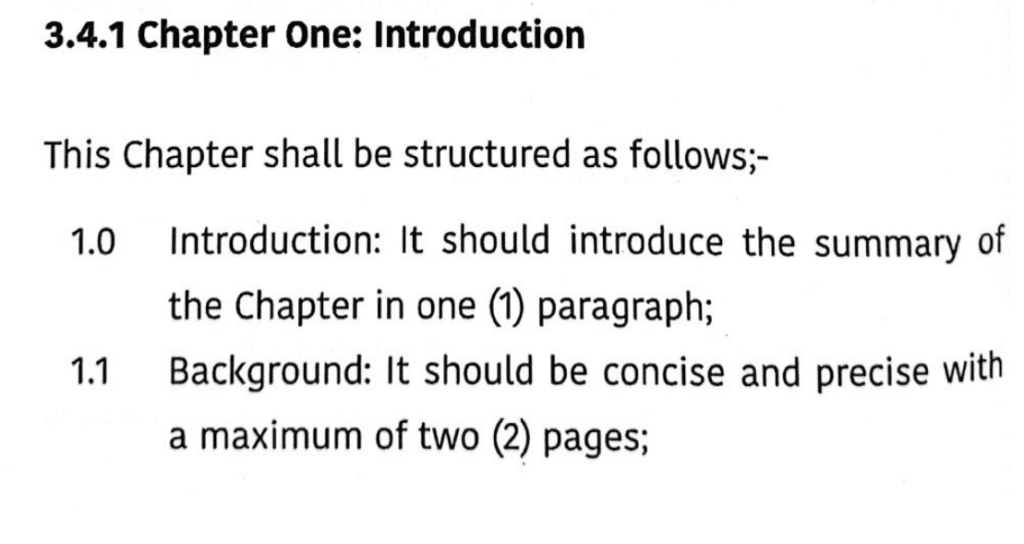
CHAPTER ONE- Introduction. This tells us in detail what your study is all about. It intends to introduce the topic to the readers interested in your research. Should never exceed 5 pages.
- 1.0 Introduction of the chapter
- 1.1 Background of the study
- 1.2 Problem statement
- 1.3 Purpose of the study
- 1.4 Specific objectives
- 1.5 Research questions
- 1.6 Justification of the study
- 1.7 Significance of the study
KNOWLEDGE, ATTITUDE AND PRACTICES TOWARDS BIRTH PREPAREDNESS AMONG PREGNANT MOTHERS IN GOMA HEALTH CENTRE III, MUKONO DISTRICT.
- It sets the stage for the entire research study and introduces the reader to the content they can expect in this chapter.
This chapter presents the background of the study, problem statement, purpose of the study, objectives of the study, research questions, the justification of the study and significance of the study.
- First step is to define the research Problem, as defined by Well established respected Health Organizations like UNICEF, UNHCR, WHO, FDA, CDC, WFO. i.e Describe your topic i.e. describe your dependent variable (define it & link it to the independent variables where possible).
- Provide evidence of existing problems from universal view to local (global, continental, regions, countries) highlighting the gaps. This can be described as using an inverted pyramid.
- Use APA (American psychological Association) for in-text referencing.
- Introduction should not exceed 2 pages.
Narrate the problem from the wide to the narrow range. How big the problem is on each scale, Globally to Study area.
Globally
↓
Africa
↓
Sub Saharan
↓
East Africa
↓
Uganda
↓
Study Area
- The problem statement identifies and articulates the specific issue or challenge that the research aims to address.
- It explains why the problem is significant and why it requires investigation.
- The study area is the preamble of the Problem statement i.e The problem statement focuses on your study area.
- It should be concise and clear; not more than 1 page.
- What is the extent-of the problem (statically)?
- What is the problem like in your country?
- How it progresses with years, e.g. in 2021, in. 2022 etc (You can quote studies).
- What is the effect of the problem on the target population?
- What has been done to address the problem? e.g by Ministry, organization etc.
- What is the gap? (E.g. despite... ", comparing the magnitude of problem ...")
- What is the way forward? (e.g. Therefore I need to conduct study, So it is upon this …….)
- This section clearly states the main goal or objective of the research.
- It outlines the broader aim of the study and what the researcher intends to achieve.
The study will aim at determining the knowledge, attitude and practices towards birth preparedness among pregnant mothers in Goma Health Centre III, Mukono District.
- Specific objectives break down the main goal into smaller, measurable, and achievable components.
- They provide a roadmap for the study, detailing what the researcher aims to accomplish step by step.
- Not more than 4, not less than 2, Average 3 specific objects in number.
- Objectives must be SMART
- S - Specific (to one thing)
- M - Measurable: do not use words like to study, understand, and know. Use words like Evaluate, Assess, Examine, Establish, Investigate, Determine, Extent, and Magnitude.
- A - Achievable (Time frame and cost).
- R - Realistic (address a topic at hand) and Relevant to a particular study.
- T - Time bound. Directly related to the problem (Every objective should be answering a title/ topic).
- Appropriately worded (Objectives must be complete)
1) To assess the knowledge towards birth preparedness among pregnant mothers in Goma Health Centre III, Mukono District.
2) To establish the attitude towards birth preparedness among pregnant mothers in Goma Health Centre III, Mukono District.
3) To identify the practices of birth preparedness among pregnant mothers in Goma Health Centre III, Mukono District.
- Research questions are inquiries that the study seeks to answer.
- They help focus the research by guiding the investigation toward specific aspects of the topic.
- Research questions are like specific objectives but with question Marks (?)
1) What is the knowledge towards birth preparedness among pregnant mothers in Goma Health Centre III, Mukono District?
2) What is the attitude towards birth preparedness among pregnant mothers in Goma Health Centre III, Mukono District?
3) What is the practice towards birth preparedness among pregnant mothers in Goma Health Centre III, Mukono District?
- The justification explains why the research is essential and why it's worth conducting. (Will the world collapse if this research is not done?).
- It outlines the potential benefits and contributions of the study to existing knowledge or practical applications.
- Why do you want to study in that particular part of the world?
- Usefulness of your research to different stakeholders (policy makers, government, M.OH, hospital, health workers, community, researcher, school) e.t.c.
This study is significant because it will generate locally relevant evidence to improve maternal health outcomes related to septic abortion at Anaka General Hospital and potentially beyond. The findings will:
To increase the levels of birth preparedness among pregnant mothers thereby reducing maternal morbidity and mortality, to increase the levels of early detection towards birth related complications.
The study findings will help health workers to come up with sensitization and health education programs to encourage mothers to attend ANC regularly, emphasising birth preparedness among pregnant mothers.
The study results may also assist the health planners and policy makers at Mukono district as well the Ministry of Health to identify areas which require policy improvements and funding for programs dedicated to promoting birth preparedness awareness among pregnant mothers.
The study findings will provide a valuable point of reference for future researchers who may wish to conduct similar studies thus building valuable body of literature.
The study will help the researcher in accomplishing Diploma in Midwifery as it’s a partial requirement to be fulfilled for the award of a Diploma in Midwifery by Uganda Nurses and Midwives examinations Board.
33. (a) Describe five (5) sections that should be included in chapter one of a research proposal. (10 marks)
(b) Describe five (5) differences between quantitative and qualitative research designs. (10 marks)
UGANDA NURSES AND MIDWIVES EXAMINATIONS BOARD
DIPLOMA LEVEL NURSING RESEARCH
MARKING GUIDE FOR RESEARCH REPORT
| AREAS OF ASSESSMENT | MARKS | SCORE | COMMENTS |
|---|---|---|---|
| 1. Preliminary pages | |||
| a) Title page –standard and relevant to the study | 01 | ||
| b) Table of content consistent with page numbers | 01 | ||
| c) List of tables consistent with page numbers | 01 | ||
| d) List of figures consistent with page numbers | 01 | ||
| e) Definition of key operational terms | 01 | ||
| f) List of acronyms /abbreviations | 01 | ||
| g) Abstract with correct subheadings & content | 04 | ||
| Subtotal | 10 | ||
| 2. Introduction | |||
| a) Background of the study relevant to the study | 04 | ||
| b) Problem statement | 04 | ||
| c) Purpose of study | 01 | ||
| d) Objectives related to title of the study | 03 | ||
| e) Research questions related to objectives | 01 | ||
| f) Justification | 02 | ||
| g) Significance | 01 | ||
| Subtotal | 16 | ||
| 3. Literature review | |||
| a) Relevant Literature according to the objectives | 06 | ||
| b) Well organised Literature according to the objectives | 03 | ||
| c) Proper citation using APA style | 03 | ||
| Subtotal | 12 | ||
| 4. Methodology | |||
| a) Description of study design ( include rationale) | 03 | ||
| b) Description of study setting (include rationale ) | 02 | ||
| c) Description of study population | 01 | ||
| d) Inclusions criteria | 01 | ||
| e) Exclusion criteria | 01 | ||
| f) Justified Samples size determination | 02 | ||
| g) Clear sampling procedure | 02 | ||
| h) Clearly defined study variables | 02 | ||
| i) Relevant research instruments/tools | 01 | ||
| j) Quality Assurance | 02 | ||
| k) Description of Data management and analysis | 02 | ||
| l) Ethical considerations | 02 | ||
| m) Plan for Dissemination of study findings | 01 | ||
| n) Study Limitations | 01 | ||
| Subtotal | 23 | ||
| 5. Results/ findings | |||
| a) Appropriate tables and figures related to study objectives | 08 | ||
| b) Correct interpretation and comments for results | 04 | ||
| Subtotal | 12 | ||
| 6. Discussion, Conclusion, Recommendations and implications to Nursing practice | |||
| a) Discussion of results or findings in relation to study objectives | 06 | ||
| b) Comparison with supporting or contradicting findings from reviewed literature | 03 | ||
| c) Relating findings to research problem, and purpose of the study | 03 | ||
| d) Conclusion related to study objectives | 03 | ||
| e) Recommendations | 02 | ||
| f) Implications to Nursing practice | 02 | ||
| Subtotal | 19 | ||
| List of References at least 20 | 02 | ||
| 7. Appendices | |||
| a) Applied APA format in the report | 02 | ||
| b) Research instruments copies | 01 | ||
| c) Consent form | 01 | ||
| d) Introduction letter for conducting research | 01 | ||
| e) Approval letter from IRC | 01 | ||
| SUBTOTAL | 08 | ||
| GRAND TOTAL | 100% | ||
- American Psychological Association, (2010). Publication Manual (6th Ed.) Washington DC.
- Uganda Nurses and Midwives Examinations Board (2023). Academic Research Guidelines for Diploma Nursing Programs
- Uganda Nurses and Midwives Examinations Board (2023). Regulation for the Conduct and Supervision of Nursing and Midwifery Examinations in Uganda.
- American Psychological Association. (2020). APA style. https://apastyle.apa.org/
- Quinn, S., Brown, L., Coleman, C., Edahl, C., & Grulick, C. (Eds.). (2020). Reading & Writing handbook for the college student (2nd ed.). Hawkes Learning/Quant Systems