
CHAPTER ONE - Introduction This tells us in detail what your study is all about. It intends to introduce the topic to the readers interested in your research.
- 1.0 Introduction
- 1.1 Background to the Study
- 1.2 Statement of the Problem
- 1.3 Research Objectives
- 1.3.1 Purpose of the Study or General Objective
- 1.3.2 Specific Objectives
- 1.3.3 Research Questions
- 1.4 Justification of the Study
- 1.5 Significance of the Study
- 1.6 Scope of the Study
FACTORS ASSOCIATED WITH UPTAKE OF MALARIA VACCINE AMONG CARETAKERS OF CHILDREN BELOW ONE YEAR IN BUTEEBO VILLAGE KAMPALA DISTRICT – UGANDA
- It sets the stage for the entire research study and introduces the reader to the content they can expect in this chapter.
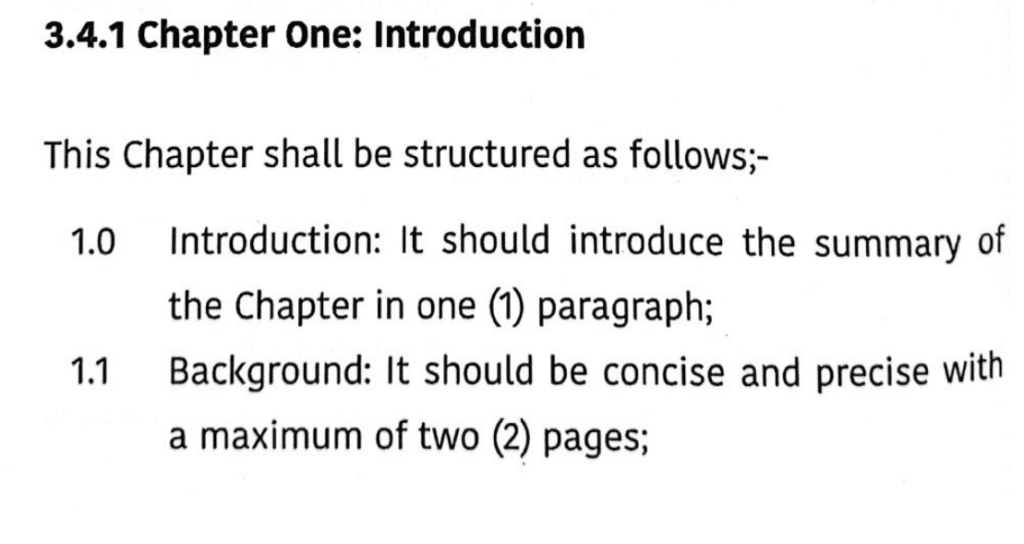
- As per the UHPAB guidelines, it must introduce the summary of the chapter in exactly one (1) paragraph.
This chapter presents the background to the study, statement of the problem, research objectives (which include the general objective, specific objectives, and research questions), justification of the study, significance of the study, and the scope of the study.
- This section provides an in-depth understanding of the research problem that the trainee is trying to address.
- First, describe the topic and define your dependent variable (e.g., Malaria Vaccine Uptake) using definitions from well-established organizations like the WHO. Link it to the independent variables where possible.
- State the origin of the problem and provide evidence of the existing problem using the Inverted Pyramid structure (moving from wide/global perspectives down to the local study area).
- Use APA (7th Edition) for in-text referencing to support statements. Do not make an extensive literature review at this stage.
- The background must have a maximum of two (2) pages.
Narrate the magnitude of the problem from the wide range to the narrow range, showing why the issue is of such significance to warrant research.
Global (Worldwide perspective)
↓
Continental (e.g., Africa)
↓
Regional (e.g., East Africa)
↓
National (e.g., Uganda)
↓
Local Region/Area (e.g., Buteebo Village)
- The problem statement identifies and articulates the specific issue or challenge that the research aims to address.
- It should be concise and precise; strictly half (1/2) a page in length.
- The candidate should start with what is ideal, followed by what is on the ground currently (current situation).
- The nature of the problem and its magnitude should be clearly stated. Any statistical information or citation must be brief and specific.
- Remember to state the consequences if the problem is not addressed, or if it is addressed.
- What is ideal? (What should the situation be like?)
- What is the current situation? (What is happening on the ground in your country/study area?)
- What is the magnitude? (Support with brief, specific statistics).
- What has been done to address it? (Are there gaps in previous interventions?)
- What are the consequences? (What happens if this problem is left unsolved?)
- What is the way forward? (Why is this study necessary to provide a theoretical or practical solution?)
This section is divided into three critical decimal subsections that must be formulated clearly:
- 1.3.1 Purpose of the Study or General Objective: This is the overall aim of the research. It should clearly indicate the dependent & independent variables under the study, study population, and geographical area of the study.
- 1.3.2 Specific Objectives: These break down the main goal into 2 to 3 SMART objectives. They must be formulated using action words (e.g., To determine, establish, find out, assess, explore, evaluate, examine, investigate).
- 1.3.3 Research Questions: Questions that the study aims to answer, written in line with the specific objectives. You can have one general research question generated from the broad objective.
- S - Specific: Focused on one clear variable or outcome.
- M - Measurable: Do not use passive verbs like "to study", "understand", or "know". Use active, measurable verbs like Evaluate, Assess, Establish, Determine.
- A - Attainable/Achievable: Feasible within the limits of time and budget.
- R - Realistic: Addressing a topic and variables at hand.
- T - Time-bound: Directly related to the study period and target timeline.
The justification explains why the research is essential and why it's worth conducting. (Will the world collapse if this research is not done?).
It outlines the potential benefits and contributions of the study to existing knowledge or practical applications.
Why do you want to study in that particular part of the world?
Usefulness of your research to different stakeholders (policy makers, government, M.OH, hospital, health workers, community, researcher, school) e.t.c.
- States the rationale for conducting the study.
- It explicitly states the reason(s) why a researcher chooses to focus on the topic and geographical area in question.
- This explains the importance or contribution of the research to academic knowledge or practical use.
- It highlights who benefits from the research findings (e.g., Ministry of Health, Health workers, Trainees, Future researchers) and exactly how they benefit.
- This provides for the boundary or limits of the research in terms of content, geographical area, and time span of the research.
CHAPTER ONE: INTRODUCTION
1.0 Introduction
This chapter introduces the overview of the study, capturing the background to the study, the statement of the problem, the research objectives (including both general and specific objectives), the research questions, justification, significance, and the scope of the study.
1.1 Background to the Study
Malaria remains a major public health concern globally... [The student continues background details here for a maximum of 2 pages, covering the global, continental, regional, national, and local perspectives of the problem].
1.2 Statement of the Problem
Immunization against malaria is ideal for reducing under-five mortality. However, the uptake of malaria vaccine on the ground is low. Statistics show... [The student explains ideal vs. actual situation, effects, and gaps, keeping this section strictly to half a page].
1.3 Research Objectives
1.3.1 Purpose of the Study or General Objective
To determine the factors associated with the uptake of malaria vaccine among children below five years of age in Kawempe parish Kampala district.
1.3.2 Specific Objectives
1) To assess the caretaker-related factors associated with the uptake of malaria vaccine in Kawempe parish, Kampala district.
2) To establish the health facility-related factors associated with the uptake of malaria vaccine in Kawempe parish, Kampala district.
3) To evaluate the community-based factors associated with the uptake of malaria vaccine in Kawempe parish, Kampala district.
1.3.3 Research Questions
What are the factors associated with the uptake of malaria vaccine among children below five years of age in Kawempe parish Kampala district?
1.4 Justification of the Study
Despite immunization efforts, malaria continues to claim lives in Kawempe parish. It is upon this background that the researcher chose this area to investigate the root causes behind low vaccination rates and suggest practical local interventions.
1.5 Significance of the Study
The findings of this study will help health workers at Kawempe parish plan targeted health sensitizations. Additionally, the study results may assist District Health Planners to allocate vaccine resources better, and will serve as reference literature for future trainees.
1.6 Scope of the Study
Geographically, this study is restricted to Kawempe parish, Kampala District. In content, it strictly focuses on the caretaker, health-facility, and community factors influencing vaccine uptake, and is scheduled to be conducted between June and August 2025.
33. (a) Describe five (5) sections that should be included in chapter one of a research proposal. (10 marks)
(b) Describe five (5) differences between quantitative and qualitative research designs. (10 marks)
- American Psychological Association, (2010). Publication Manual (6th Ed.) Washington DC.
- Uganda Nurses and Midwives Examinations Board (2023). Academic Research Guidelines for Diploma Nursing Programs
- Uganda Nurses and Midwives Examinations Board (2023). Regulation for the Conduct and Supervision of Nursing and Midwifery Examinations in Uganda.
- American Psychological Association. (2020). APA style. https://apastyle.apa.org/
- Quinn, S., Brown, L., Coleman, C., Edahl, C., & Grulick, C. (Eds.). (2020). Reading & Writing handbook for the college student (2nd ed.). Hawkes Learning/Quant Systems
Quick Quiz
Chapter 1 Quiz
Research
Privacy: Your details are used only for quiz tracking and certificates.
Chapter 1 Quiz
Research
Preparing questions...
Choose your answer and keep your streak alive.
Great effort.
Here is your quick performance summary.
its good