
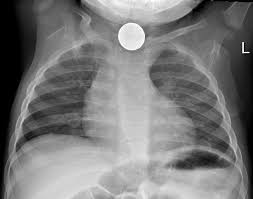
A foreign body in the throat refers to any unswallowable or non-respiratory object—whether food or non-food—that becomes lodged in the aerodigestive tract (pharynx, larynx, trachea, bronchi, or esophagus) rather than passing smoothly into the stomach or being cleared by natural mechanisms. This can cause partial or complete obstruction of the airway or digestive tract, leading to an immediate medical emergency requiring prompt intervention.
- In Adults: Meat boluses, fish bones, chicken bones, poorly chewed food, and occasionally dental appliances (dentures).
- In Infants and Children: Coins, small toys, button (disc) batteries, marbles, peanuts, grapes, hard candies, safety pins, and toe rings.
- Initial phase: choking, coughing, wheezing, gagging
- Asymptomatic phase: due to mucosal adaptation
- Late phase: Laryngeal / Tracheal / Bronchial
- Complication phase: pneumonia, emphysema, lung abscess, atelectasis
- a. Laryngeal: partial or total airway obstruction, hoarseness, aphonia, hemoptysis
- b. Tracheal: airway obstruction, hemoptysis, wheezing, palpatory thud, auscultatory slap
- c. Bronchial: cough, ipsilateral wheezing, ipsilateral decreased breath sounds
- Bypass valve & Stop valve effect
- Partial Obstruction: Wheezing
- Total Obstruction: Late Atelectasis
- Check valve effect
- No Expiration: Emphysema
- No Inspiration: Early Atelectasis
- Hoarseness / aphonia
- Respiratory distress
- No chest movement
- No air exchange at nose / mouth.
- Cyanosis.
Note: Radio-opaque F.B. Bronchus can be visualized on X-ray. (Radiological imaging demonstrates radio-opaque foreign body in the bronchus).
- Patient placed in supine position
- Open airway + mouth to mouth ventilation
- Correct airway obstruction
- Head-tilt: Extension of neck by backward pressure on forehead
- Head-tilt, chin-lift: Extension of neck by backward pressure on forehead + lift pt’s chin keeping mouth open.
- Head-tilt, neck-lift: Lift pt’s neck while pushing down on forehead. Prevents falling back of tongue.
- Modified jaw-thrust: For pt with neck / spinal injuries. Push patient’s jaw forward by applying pressure at angle of mandible. Avoid head tilt.
- Back blows
- Abdominal thrusts
- Chest thrusts (for pregnancy, age < 8 yrs)
- All 3 raise subglottic pressure, to dislodge out FB
- Open pt’s mouth
- Blind finger sweeps in mouth
- Back blows: Place pt in lateral position, supporting pt’s chest against your knees. Use free hand to deliver five rapid blows to spinal Area b/w scapulae, to dislodge F.B.
- Abdominal thrusts: Straddle supine pt at his hip. Place your hand heel b/w pt’s umbilicus & ribcage, in midline. Hold that hand with your other hand & apply 5 rapid, inward + upward thrusts, to dislodge FB.
- Chest thrusts: Kneel beside supine pt at chest level. Place hand heel on centre of pt’s sternum. Lock hands. Apply 5 rapid downward thrusts. Only 2 fingers used for a small child.
- Tongue-jaw lift technique: Hold pt’s tongue + lower jaw b/w your thumb & fingers. Lift pt’s tongue to move it away from pharyngeal wall.
- Crossed-finger technique: Cross your thumb under your index finger. Place your thumb against pt’s lower lip & index finger against his upper teeth. Uncross your fingers to open pt’s mouth.
- Open pt’s mouth. Insert index finger of free hand into pt’s mouth, along pt’s cheek, till tongue base. Use it as a hook to roll out FB.
- Avoid pushing FB further back. Avoid blind sweeps in a child.
- Attempt to remove visible FB only.
5 Back blows ➔ (or ⇓) failure ➔ 5 Abdominal thrusts Or 5 Chest thrusts ➔ (or ⇓) failure ➔ Open pt’s mouth + blind finger sweeps.
Continue this sequence till FB is removed or pt is ready to be shifted to operation theatre.
- If patient can speak, cough, or breathe: Do not interfere. Patient to be examined by an ENT specialist as soon as possible.
- If the patient cannot speak, cough, or breathe: Begin treatment for obstructed airway.
Sequence: 5 Back blows ➔ (or ⇓) failure ➔ 5 Abdominal thrusts (Heimlich maneuver) Or 5 Chest thrusts (for pregnancy, age < 8 yrs).
Continue this sequence till FB is removed or pt becomes unconscious.
- Back blows: Place pt in sitting / standing position. Support pt’s chest while bending pt at the waist. Use your free hand to deliver 5 rapid blows to spinal area b/w two scapulae.
- Heimlich Maneuver (Abdominal thrusts): Stand behind sitting / standing pt & pass your arms around pt’s waist. Hold your fist against pt’s abdomen b/w umbilicus & ribcage. Lock hands & apply 5 rapid, inward + upward thrusts to dislodge FB.
- Chest thrusts: Stand behind standing pt & pass your arms around pt’s chest. Hold your fist against pt’s sternum in its centre. Lock hands & apply 5 rapid, back-ward thrusts to dislodge FB.
Sequence: 5 Back blows ➔ (or ⇓) failure ➔ 5 Chest thrusts.
Continue this sequence till FB is removed or pt is ready to be shifted to operation theatre.
- Back blows in an infant: Straddle infant face down, head lower than trunk, over your forearm, supported on your thigh. Deliver five rapid back blows, with heel of other hand b/w shoulder blades.
- Chest thrusts in an infant: Supporting pt’s head, keep infant supine b/w your hands, with head lower than trunk. Using 2 fingers, deliver 5 rapid backward thrusts on sternum.
- Cricothyrotomy
- Emergency Tracheostomy
- Direct Laryngoscopy
- Rigid Bronchoscopy
- Thoracotomy & Bronchotomy
- Adults:
- Cut food into small pieces
- Chew food slowly & thoroughly
- Avoid laughing / talking during eating
- Avoid excess alcohol with / before meals
- Infants & Children:
- Keep small objects away from children
- Avoid playing with food or toys in mouth
- Plain X-ray (PA & Lateral): soft tissue neck, chest, abdomen ➔ for radio-opaque FB
- Fluoroscopy with Barium soaked cotton pledget: ➔ for radiolucent FB
- Barium Swallow
- Flexible Oesophagoscopy
- Coin in cricopharynx
- Toe ring in cricopharynx
- Open safety pin
- Common sites: tonsil, pyriform fossa, vallecula, base tongue
- Diagnosis confirmed by indirect laryngoscopy
- Usually removed in OPD but may require removal by Hypo-pharyngoscopy ➔ (or ↓) GA
- Common sites: cricopharynx, aortic indentation & cardiac end
- Usually removed by rigid oesophagoscopy ➔ (or ↓) GA
- Advancement into stomach is safe in difficult FB
- Oesophagotomy rarely required for impacted FB
- FB reaching stomach, usually passes out in stool
- Emetic & Cathartic agents are contraindicated
- Associated respiratory obstruction
- Total oesophageal obstruction
- Disc battery (perforation occurs in 8-12 hrs)
- Sharp, impacted foreign body
- Gastro-intestinal FB > 5 cm in a child < 2 yr
- Gastro-intestinal FB with acute abdominal pain
- No progress of FB in serial X-ray after 24 hr
- Gastric FB with pyloric stenosis
- Oesophageal ulceration & stricture
- Oesophageal perforation ➔ mediastinitis
- Peri-oesophageal cellulitis
- Retro-pharyngeal abscess
- Respiratory obstruction due to:
- tracheal compression
- laryngeal oedema
- Infant is placed face down on rescuer's forearm with head down 60 degrees and stabilized.
- Four back blows are administered rapidly with heel of hand high between shoulder blades.
- If obstruction is not relieved, infant is turned supine on firm surface and four rapid chest thrusts are administered over sternum using two fingers.
- If breathing is not resumed, tongue-jaw lift is performed and mouth examined for foreign body. Visualized foreign body may be removed by finger sweep.
- If no spontaneous breathing occurs, ventilation is attempted with two breaths by mouth-to-mouth or mouth-to-nose technique.
- Steps 1 to 5 are repeated as needed.
- Child is placed on firm surface. With rescuer kneeling at child's feet, abdominal thrusts are performed with heel of one hand in midline between navel and rib cage, and second hand on top of first and pressed into abdomen with upward thrust. Six to ten abdominal thrusts are performed until the foreign body is expelled.
- If obstruction is not relieved, tongue-jaw lift is performed and mouth examined for foreign body. Visualized foreign body may be removed by finger sweep.
- If no spontaneous breathing occurs, ventilation is attempted with two breaths by mouth-to-mouth or mouth-to-nose technique.
- Steps 1 to 3 are repeated as needed.
- Treat as an adult, with abdominal thrusts performed in standing, sitting, or supine position.
Quick Quiz
ENT Tumors Quiz
Medical Nursing
Privacy: Your details are used only for quiz tracking and certificates.
ENT Tumors Quiz
Medical Nursing
Preparing questions...
Choose your answer and keep your streak alive.
Great effort.
Here is your quick performance summary.