
Table of Contents
TogglePharmacology of Antifungal Agents
I. Foundational Concepts: Understanding the Enemy
Before memorizing any antifungal drugs, you must understand the target. Why can't we just use normal antibiotics like Penicillin to kill fungi? Because bacteria are prokaryotes, while fungi are eukaryotes (just like human cells). This structural similarity makes finding drugs with "selective toxicity" (killing the fungus without killing the human) incredibly difficult.
To selectively kill fungi, our drugs exploit three unique features of the fungal cell:
- The Cell Membrane (Ergosterol): Human cell membranes use Cholesterol for stability. Fungal cell membranes use Ergosterol. Most antifungal drugs target the synthesis or the structure of Ergosterol.
- The Cell Wall (Beta-Glucan): Humans do not have cell walls. Fungi have a rigid cell wall composed of chitin and β-glucan. Destroying this causes the fungal cell to burst (lysis).
- Fungal Enzymes: Fungi possess unique enzymes (like cytosine deaminase) that human cells lack, which can be exploited to turn harmless prodrugs into toxic fungal killers.
1. Classification of Fungi (Morphology)
Fungi are classified based on how they grow and look under a microscope:
They grow as single round cells and divide by budding. Examples include:
- Candida albicans (Causes thrush/vaginal candidiasis).
- Cryptococcus neoformans (Has a thick capsule; causes severe meningitis).
- Trichosporon & Rhodotorula.
They grow in long, branching thread-like structures called hyphae.
- Septate Hyphae (Have cross-walls dividing cells): Aspergillus, Scedosporium, Fusarium (Opportunists) and Trichophyton, Microsporum (Dermatophytes).
- Aseptate/Coenocytic Hyphae (Lack cross-walls/membranes between cells): Zygomycetes like Rhizopus and Mucor.
These shape-shifters act like Moulds in the cold (25°C environment) and Yeasts in the heat (37°C human body).
- Histoplasma capsulatum
- Blastomyces dermatitidis
- Coccidioides immitis
- Paracoccidioides brasiliensis
2. Clinical Classification of Fungal Infections (Mycoses)
- Superficial: Surface of hair/skin (e.g., Tinea versicolor, Tinea nigra, Piedra).
- Cutaneous (Dermatophytosis): Deep epidermis, hair, nails (e.g., Tinea pedis [athlete's foot], Tinea cruris [jock itch], Tinea unguium/Onychomycosis [nails], Tinea capitis [scalp], Tinea barbae [beard]).
- Subcutaneous: Muscle/fascia via puncture wounds (e.g., Sporotrichosis, Chromoblastomycosis, Mycetoma).
- Systemic: Deep organ infections, often fatal (e.g., Cryptococcosis, Histoplasmosis, Coccidioidomycosis, Blastomycosis, and systemic Candidiasis).
II. Mechanism of Action Overview: The 6 Classes of Antifungals
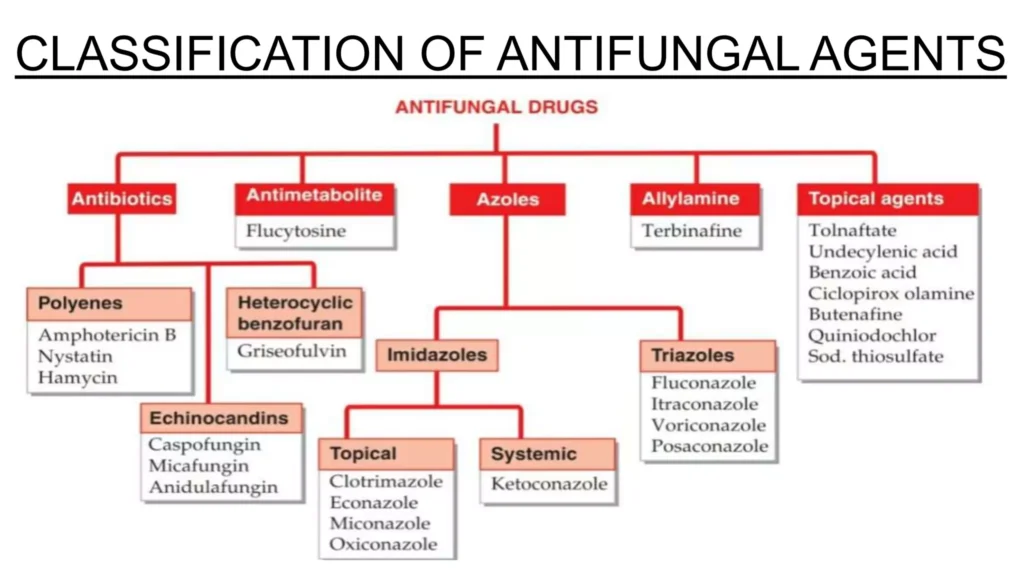
Antifungal drugs are divided into six distinct classes based on their structure and exactly where they attack the fungal cell.
| Drug Class | Key Examples | Target Mechanism |
|---|---|---|
| 1. Polyenes | Amphotericin B, Nystatin | Physically bind to Ergosterol in the membrane, tearing open pores. |
| 2. Antimetabolites | Flucytosine (5-FC) | Inhibits fungal DNA/RNA synthesis from the inside. |
| 3. Azoles | Fluconazole, Ketoconazole, Itraconazole | Inhibits 14-α-demethylase, stopping the synthesis of Ergosterol. |
| 4. Echinocandins | Caspofungin, Micafungin | Inhibits β-glucan synthase, destroying the fungal cell wall. |
| 5. Allylamines | Terbinafine, Naftifine | Inhibits squalene epoxidase, causing toxic squalene buildup. |
| 6. Mitotic Inhibitors | Griseofulvin | Binds to keratin and disrupts fungal microtubule formation. |
III. The Polyene Antibiotics (Amphotericin B & Nystatin)
Polyenes are naturally occurring antifungal antibiotics isolated from Streptomyces soil bacteria. Chemically, they are "macrolides" (containing a large lactone ring) with "polyene" characteristics (containing many double bonds). Amphotericin A exists but is not used clinically. We exclusively use Amphotericin B (Amp B).
1. Amphotericin B (The "Heavy Artillery")
- Mechanism of Action (MOA): Amphotericin B is an amphoteric compound (meaning it has both highly polar and nonpolar structural components). It inserts itself directly into the fungal cell membrane and physically binds to Ergosterol. Multiple Amp B molecules group together to form artificial "pores" or channels. This disrupts membrane permeability, causing vital intracellular ions (like Potassium) to leak out, resulting in rapid fungal cell death (Fungicidal).
- Spectrum of Activity: It has an extremely broad spectrum. It remains the Drug of Choice (DOC) or co-DOC for severe, life-threatening systemic infections caused by:
- Most Candida spp. and Cryptococcus.
- Most Aspergillus spp. and Mucorales (Mucor, Rhizopus).
- Endemic Dimorphic fungi (Histoplasma, Blastomyces, Coccidioides).
- Mechanisms of Resistance: Fungi become resistant to Amp B by preventing the drug from binding to the membrane. They do this by either:
- Decreasing the total concentration of ergosterol in their membrane.
- Modifying the chemical structure of the sterol target molecule so the drug cannot attach.
Amphotericin B is a massive, bulky molecule. Understanding its PK is vital for exams:
- Poor Oral Absorption: It is not absorbed from the GI tract. Oral forms are only effective for localized GI fungal infections.
- Systemic Route: MUST be given as a Slow I.V. Infusion.
- Distribution: Highly bound to plasma proteins. It has a massive half-life of 15 days. It crosses the Blood-Brain Barrier (BBB) very poorly.
- Special Routes:
- Intrathecal: Injected directly into the spinal canal for severe CNS fungal infections.
- Topical drops/Subconjunctival: For mycotic corneal ulcers/keratitis.
- Local injection: Directly into joints for fungal arthritis.
- Bladder irrigation: For severe Candiduria.
- Clearance: Slowly metabolized by the liver and excreted unchanged in the urine over several days.
The Notorious Toxicity of Amphotericin B ("Ampho-Terrible")
Because human cholesterol is somewhat structurally similar to fungal ergosterol, Amp B causes significant collateral damage to human cell membranes, limiting its use to severe, life-threatening infections.
Upon IV administration, the drug triggers massive histamine release from mast cells.
- Symptoms: Severe fever, chills, muscle rigors/spasms, vomiting, headache, and hypotension.
- Prevention/Management:
- Give a small "Test Dose" first.
- Slow down the IV infusion.
- Pre-medicate the patient with antipyretics (acetaminophen), NSAIDs, antihistamines, meperidine (for rigors), or adrenal corticosteroids.
Amp B is directly toxic to the renal tubules and aggressively constricts renal arteries.
- Symptoms: Drastically decreased GFR, renal tubular acidosis, and severe loss of electrolytes (↓ K+ and ↓ Mg2+).
- Anemia: Kidney damage reduces the production of erythropoietin (EPO), leading to a reversible normocytic anemia.
- Prevention: Protect the kidneys with aggressive Na+ (Saline) loading/hydration prior to infusion.
The Solution: Liposomal Amphotericin B. To reduce toxicity, scientists packaged the drug inside a lipid delivery system (a microscopic fat bubble). This formulation preferentially binds to the fungal cell membrane rather than the human kidney cell membrane. It vastly reduces nephrotoxicity and infusion reactions, and is highly effective, but it is much more expensive.
2. Nystatin (The Topical Cousin)
- Structure & MOA: A polyene macrolide structurally and mechanistically identical to Amphotericin B.
- Toxicity: It is far too toxic for systemic IV use. It would destroy human kidneys.
- Clinical Uses: Because it is not significantly absorbed from the skin, mucous membranes, or the GIT, it is used exclusively topically.
- Formulated as creams, ointments, oral suspensions ("swish and swallow"), and vaginal suppositories.
- Used to prevent or treat superficial candidiasis of the mouth (oral thrush), esophagus, intestinal tract, and vaginal candidiasis.
- Can be safely combined with antibacterial agents and corticosteroids.
IV. The Antimetabolites: Flucytosine (5-FC)
Flucytosine is a synthetic pyrimidine antimetabolite. It is essentially a chemotherapeutic (cytotoxic) drug that has been weaponized specifically against fungi. It acts as a systemic fungistatic agent.
- Mechanism of Action (The Trojan Horse): Flucytosine (5-FC) enters the fungal cell via an enzyme called cytosine permease. Once inside, a uniquely fungal enzyme called Cytosine Deaminase converts 5-FC into 5-Fluorouracil (5-FU), a highly toxic anticancer drug. Human cells lack cytosine deaminase, so they do not convert the drug themselves.
- The 5-FU is triphosphorylated and incorporated into fungal RNA, causing faulty protein synthesis.
- 5-FU is also converted to 5-fluorodeoxyuridine monophosphate (5-Fd-UMP), which powerfully inhibits Thymidylate Synthase. This halts the production of thymine, shutting down fungal DNA synthesis.
- The Synergy Rule: Flucytosine is almost never used alone because resistance emerges extremely rapidly. It is used in combination with Amphotericin B. Amphotericin B tears holes in the fungal membrane, which massively increases cell permeability, allowing vast amounts of 5-FC to flood into the cell. They are highly synergistic.
- Pharmacokinetics: Unlike Ampho B, Flucytosine is rapidly and well absorbed orally. It is widely distributed throughout the body and has excellent penetration into the CSF. It is excreted mainly unchanged through the kidneys with a half-life of 3-6 hours.
- Clinical Uses: Severe, deep fungal infections. The most highly tested use is in combination with Amphotericin B for the treatment of Cryptococcal meningitis in AIDS patients (due to its excellent CSF penetration).
If human cells can't convert 5-FC to the toxic 5-FU, why is this drug toxic? Because intestinal bacteria (gut flora) DO possess cytosine deaminase! They convert the drug to toxic 5-FU right inside the gut, which is then absorbed into the human bloodstream.
- Gastrointestinal Toxicity: Nausea, vomiting, diarrhea, and potentially severe, life-threatening enterocolitis.
- Bone Marrow Depression: The 5-FU damages rapidly dividing cells in the bone marrow, causing reversible neutropenia and thrombocytopenia.
- Other: Reversible alopecia (hair loss) and elevated hepatic enzymes.
V. The Azoles (Synthetic Fungistatic Agents)
The Azoles are a massive group of synthetic, broad-spectrum antifungal agents. Fascinatingly, they also possess mild antibacterial, antiprotozoal, and anthelminthic (anti-worm) properties. They are broadly divided into two chemical groups: the older, less selective Imidazoles and the newer, highly selective Triazoles.
Azoles act primarily by starving the fungal cell of its vital membrane component, ergosterol, while simultaneously poisoning it from within:
- Inhibition of 14-α-demethylase: This is a specific fungal cytochrome P450 enzyme. It is responsible for converting lanosterol to ergosterol. By blocking this enzyme, the fungal cell membrane loses its structural integrity.
- Mitochondrial Cytochrome Oxidase Inhibition: This blockade leads to a massive accumulation of toxic peroxides inside the cell, causing autodigestion of the fungus.
- Nucleic Acid Alteration: Imidazoles specifically may also alter fungal RNA and DNA metabolism.
Mechanism of Resistance: Fungi become resistant primarily via efflux pumps, leading to decreased intracellular accumulation of the azole.
1. The Imidazoles: Ketoconazole, Miconazole, Clotrimazole
The Imidazoles were the first breakthrough oral antifungals, but they share a massive pharmacological flaw: They lack selectivity. Not only do they inhibit the fungal cytochrome P450 enzyme, but they also severely inhibit Human P450 hepatic enzymes.
Because Ketoconazole strongly inhibits human P450 enzymes involved in gonadal and adrenal steroid synthesis, it drastically decreases the production of Testosterone and Cortisol. This leads to highly testable side effects:
- In Males: Gynaecomastia (breast development), loss of libido, and impotence.
- In Females: Menstrual irregularities.
- Clinical Hack: While a terrible side effect for a fungal infection, this exact mechanism makes Ketoconazole occasionally useful as an off-label treatment for Prostate Cancer (which relies on testosterone to grow).
Ketoconazole: Pharmacokinetics & Uses
- Absorption Rules: Ketoconazole is well-absorbed orally, but it requires a highly acidic stomach environment to dissolve. Its bioavailability is severely decreased if the patient takes antacids, H2 blockers, or Proton Pump Inhibitors (PPIs). Exam tip: Giving patients acidic Cola drinks dramatically improves absorption, especially in patients with achlorhydria (lack of stomach acid).
- Metabolism & Distribution: Inactivated in the liver and excreted in bile (feces) and urine. It does not cross the blood-brain barrier (BBB). Its half-life increases with the dose (typically 7-8 hours).
- Clinical Uses: Used for oral/vaginal candidiasis, dermatophytosis, and mucocutaneous candidiasis. It is the Co-DOC for Paracoccidioides and acts as a backup for Blastomyces and Histoplasma. Systemic use is now uncommon due to liver toxicity.
- Contraindications: Absolutely contraindicated in pregnancy (highly teratogenic), lactation, and hepatic dysfunction.
2. The Triazoles: Fluconazole, Itraconazole, Voriconazole, Posaconazole
Triazoles were developed to fix the problems of Imidazoles. They are highly selective for fungal enzymes, resistant to degradation, and cause far less endocrine disturbance.
The most commonly used, versatile azole.
- PK: Highly water-soluble. Excellent oral bioavailability that is NOT affected by food or gastric pH. The plasma concentration is identical whether given orally or IV. Excreted mainly unchanged through the kidneys (Half-life 25-30 hrs). Has the least effect on human hepatic microsomal enzymes.
- Distribution: Penetrates the BBB beautifully.
- Uses: The absolute Drug of Choice (DOC) for Cryptococcal meningitis (treatment, prophylaxis, and suppression). DOC for esophageal and invasive candidiasis. Safely used to reduce fungal infections in bone marrow transplant patients.
- Limitations: Not effective against Aspergillosis.
- Unique Side Effect: Reversible alopecia (hair loss).
The lipophilic alternative.
- PK: Given orally & IV. Unlike Fluconazole, food significantly INCREASES its absorption. It is highly lipid-soluble, distributing well into bone, sputum, and adipose tissue, but it cannot cross the BBB. Metabolized in the liver. Half-life 30-40 hours.
- Uses: DOC for blastomycosis, sporotrichosis, and non-CNS histoplasmosis (including AIDS-associated). Very effective for dermatophytosis and onychomycoses.
- Toxicity & Warnings: Causes nausea, hypokalemia, hypertension, and edema. It strongly inhibits the metabolism of oral anticoagulants. Strictly contraindicated in patients with ventricular dysfunction (heart failure). Hepatic function must be evaluated.
The Aspergillus killer.
- PK: High oral bioavailability, given oral/IV. Penetrates tissues incredibly well, including the CSF.
- Uses: The undisputed DOC for invasive Aspergillosis and severe infections.
- Unique Side Effects: Neurotoxicity and reversible visual disturbances (flashes of light, color vision changes), alongside severe photosensitivity.
The niche saver.
- Use: It is the only azole with clinical activity against Mucorales (Mucormycosis / "Black Fungus" infections, which cause severe rhinocerebral and pulmonary necrosis).
- Hepatotoxicity: Elevated LFTs are common to all azoles.
- Teratogenicity: Highly teratogenic; strictly avoid in pregnancy.
- Massive Drug-Drug Interactions: Because they inhibit human CYP450 to varying degrees, they violently interact with and increase the blood levels of Warfarin, Rifampin, and Anti-seizure medications.
VI. The Echinocandins (The "Penicillins" of Antifungals)
Examples: Caspofungin, Micafungin, Anidulafungin.
Echinocandins are large, complex cyclic hexapeptides. Because they target the fungal cell wall (a structure humans do not possess), they are highly selective and generally well-tolerated.
- Mechanism of Action: They specifically inhibit β(1,3)-D-glucan synthase. This halts the production of beta-glucan, a critical structural component of the fungal cell wall. The weakened wall ruptures, leading to cell lysis and death.
- They are Fungicidal against Candida spp.
- They are Fungistatic against Aspergillus.
- Pharmacokinetics: Due to their large peptide structure, they have poor oral bioavailability and must be given exclusively via IV route. They are highly bound to plasma proteins with a half-life of 9-11 hours. They are slowly metabolized by hydrolysis and N-acetylation, and elimination is split equally between urine and feces.
- Clinical Uses: Second-line "salvage" therapy for invasive Aspergillus and severe Candida infections in patients who have failed or cannot tolerate Amphotericin B or Itraconazole.
- Adverse Effects: Very expensive. Causes nausea, vomiting, and characteristic Flushing (due to rapid histamine release from mast cells during infusion). Liver function must be monitored.
VII. Mitotic Inhibitors: Griseofulvin
Griseofulvin is an old, narrow-spectrum, fungistatic drug derived from Penicillium griseofulvum.
- Mechanism of Action: It enters the fungal cell and binds to tubulin, inhibiting fungal mitosis by disrupting microtubule assembly and function.
- Pharmacokinetics & Tissue Targeting: Given orally. Its absorption is heavily increased if taken with a high-fat meal. It has a unique distribution: it is taken up selectively by newly formed skin cells and concentrates heavily in keratin.
- Clinical Uses: Active only against dermatophytes (ringworm of the skin, hair, and nails, including severe athlete's foot). It is ineffective topically and completely useless against subcutaneous/deep systemic mycoses or Candida.
- The Time Factor: Because it binds only to new keratin, the patient must take it for 2 to 6 weeks (or months for nails) to allow the infected, old keratin to grow out and be physically replaced by the new, resistant keratin structure.
- Adverse Effects: Peripheral neuritis, mental confusion, fatigue, vertigo, blurred vision, and GIT upset.
- Drug Interactions: It is a strong Cytochrome P450 enzyme inducer (will speed up the breakdown of other drugs). It also increases alcohol intoxication, causing a severe Disulfiram-like reaction if the patient drinks alcohol.
VIII. The Allylamine Derivatives
Examples: Terbinafine, Naftifine, Butenafine.
The Allylamines are a powerful, modern class of drugs used primarily to eradicate superficial dermatophyte infections, particularly in the nails.
They act one step earlier in the ergosterol pathway than the Azoles. They inhibit the fungal enzyme Squalene Epoxidase. This has a dual lethal effect:
- It decreases the synthesis of ergosterol (starving the membrane).
- It causes a massive intracellular accumulation of squalene, which is highly toxic to the organism, causing rapid fungal cell death. Therefore, these drugs are Fungicidal.
1. Terbinafine (The Nail Champion)
- Uses: The absolute Drug of Choice (DOC) for treating severe dermatophytes (Onychomycoses/nail infections). Its fungicidal activity is limited to Candida albicans and dermatophytes. It is much better tolerated than Griseofulvin and requires a shorter duration of therapy: 6 weeks for fingernail infections, and 12 weeks for toenail infections.
- Pharmacokinetics: Well absorbed orally, but bioavailability decreases due to heavy first-pass metabolism in the liver. Highly protein-bound. It accumulates massively in the skin, nails, and fat tissue.
- Severe Toxicities: Severely Hepatotoxic. Can cause acute liver failure and even death. Liver enzymes must be checked before and during therapy. It accumulates in breast milk and should not be given to nursing mothers. Also causes severe GIT upset (diarrhea, dyspepsia), and uniquely alters taste and visual disturbances.
2. Naftifine
A topical broad-spectrum fungicidal agent available as a cream or gel. Uniquely, it possesses additional antibacterial and anti-inflammatory properties. Highly effective for the treatment of Tinea cruris (jock itch).
IX. Topical Antifungal Agents
Topical therapy is used exclusively for superficial fungal infections (Dermatophytosis/ringworm, cutaneous candidiasis, and fungal keratitis). They are completely ineffective against mycoses of the nails, hair, or deep subcutaneous tissues because the drug cannot penetrate deep enough. The preferred formulation is a cream or solution.
| Agent | Class / Characteristics | Clinical Uses & Side Effects |
|---|---|---|
| Clotrimazole & Miconazole | Topical Azoles: Available as vaginal creams, suppositories, and tablets (given once daily). Systemic absorption is very low (<0.5% from intact skin, 3-10% from the vagina). Vaginal activity remarkably persists for up to 3 days post-application. | Used for dermatophytes, cutaneous candidiasis, and vulvovaginal candidiasis. SE: Local erythema (redness), edema, urticaria, and a mild vaginal burning sensation. |
| Nystatin & Amphotericin | Polyenes: Discussed extensively in Part 1. Highly toxic systemically, so restricted entirely to topical/oral-swish use. | Oral thrush, superficial mucocutaneous candidiasis. |
| Tolnaftate | Thiocarbamate: MOA is likely identical to Allylamines (inhibits squalene epoxidase). Applied twice daily as a cream, gel, powder, or solution. | Highly effective for most cutaneous mycoses (achieves an 80% cure rate in Tinea pedis/athlete's foot). High Yield Note: It is completely ineffective against Candida. |
| Terbinafine & Naftifine | Topical Allylamines: Highly fungicidal topically against dermatophytes. | Tinea corporis, tinea cruris, tinea pedis. |
Quick Quiz
Antifungal Agents BNS Quiz
Pharmacology - mobile-friendly and focused practice.
Privacy: Your details are used only for quiz tracking and certificates.
Antifungal Agents BNS Quiz
Pharmacology
Preparing questions...
Choose your answer and keep your streak alive.
Great effort.
Here is your quick performance summary.