
Why this matters: Infection prevention is not simply memorising a list of diseases. A nurse or EMT must be able to follow how an organism moves from its source to a person who can become infected, then select the practical action that breaks that movement. This lesson explains the chain of infection, the major modes of transmission and the precautions used in clinical and community practice.
By the end of this lesson, the learner should be able to:
- Define the transmission cycle, chain of infection, reservoir, portal of exit, portal of entry and susceptible host.
- Describe the six links in the chain of infection and explain how each link can be interrupted.
- Differentiate direct contact, indirect contact, droplet, airborne, vehicle-borne and vector-borne transmission.
- Apply Standard Precautions and appropriate additional precautions in common care situations.
- Use a transmission-cycle approach to reason through clinical scenarios, including respiratory illness, diarrhoea, wound care and sharps injuries.
Transmission cycle: the sequence by which an infectious agent leaves its usual source, reaches another person and enters a body site where it may establish infection.
Chain of infection: a teaching model that divides this sequence into six linked stages: infectious agent, reservoir, portal of exit, mode of transmission, portal of entry and susceptible host.
Mode of transmission: the mechanism by which the agent is transferred, for example hands, a contaminated object, droplets, air, food, water, blood or an insect vector.
Infection requires more than the mere presence of a micro-organism. The organism must be capable of causing disease, leave or be carried from a source, survive long enough to reach a new host, enter through a suitable portal and overcome that person's defences. The chain model is useful because breaking one link can stop transmission.
- Contamination means an organism is present on a surface, item, food, water, skin or specimen. It may not be multiplying or causing harm.
- Colonisation means organisms live and multiply on or in the body without tissue invasion or symptoms. Normal flora commonly colonise skin, mouth, bowel and vagina.
- Infection occurs when organisms invade or multiply in tissues and trigger local or systemic disease.
- Infectious disease is infection that can be transmitted directly or indirectly to another person; not every infection is readily transmissible between people.
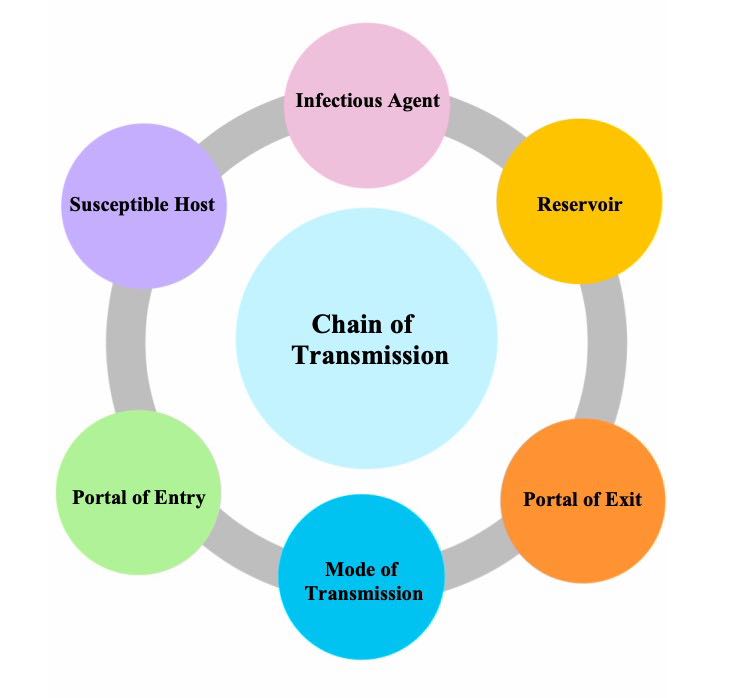
| Link | What it means | Examples | How to break the link |
|---|---|---|---|
| 1. Infectious agent | A microorganism capable of causing disease. | Bacteria, viruses, fungi, protozoa, helminths; sometimes toxins produced by microbes. | Accurate diagnosis, targeted antimicrobial treatment when indicated, sterilisation/disinfection and antimicrobial stewardship. |
| 2. Reservoir | The usual habitat in which the agent lives, grows or persists. | Humans, animals, water, soil, food, equipment or a health-care environment. | Case management, cleaning, safe waste disposal, vector control, food and water safety. |
| 3. Portal of exit | The route by which the agent leaves the reservoir. | Cough droplets, sputum, blood, faeces, urine, wound drainage, genital secretions, placental/umbilical blood. | Respiratory hygiene, wound dressings, safe injection practice, covering containers and proper linen/waste handling. |
| 4. Mode of transmission | How the agent travels to another person. | Hands, equipment, droplets, air, food, water, needles, transfusion, mosquitoes or flies. | Hand hygiene, PPE, cleaning, safe food/water, sharps safety and transmission-based precautions. |
| 5. Portal of entry | The route by which the agent enters the new host. | Respiratory tract, mouth, gastrointestinal tract, broken skin, eyes, nose, genital tract, bloodstream. | Aseptic technique, wound care, PPE, safe devices, condoms where appropriate, vaccination and post-exposure procedures. |
| 6. Susceptible host | A person whose defences are insufficient to prevent infection. | Newborns, older adults, malnourished people, pregnant women, patients with chronic disease, burns or immunosuppression. | Immunisation, nutrition, chronic-disease care, prophylaxis when prescribed and early recognition/treatment. |
The infectious agent may be a bacterium, virus, fungus, protozoan or helminth. Its ability to cause disease depends on properties such as infectious dose, virulence, ability to attach to cells, toxin production, resistance to drying or disinfectants, and ability to evade immune responses. For example, a small number of some organisms may be enough to initiate infection, while others require a large inoculum.
A reservoir is the natural place where an agent normally survives or multiplies. A human reservoir can be a symptomatic patient, a person in the incubation period, a person with a mild infection, or an asymptomatic carrier. Animals may be reservoirs for zoonotic infections. Environmental reservoirs include contaminated water, damp equipment, soil and improperly stored food.
- Human reservoir: respiratory secretions, skin lesions, blood, bowel, urinary and genital tract.
- Environmental reservoir: water systems, sinks, poorly disinfected equipment, contaminated linen, food-preparation surfaces and waste.
- Animal/vector reservoir: animals or arthropods that maintain an organism in nature; this differs from a simple mechanical carrier.
Organisms leave a reservoir through a body fluid or route. The important question is not only “what disease is this?” but also “what material can carry the organism out?” Respiratory organisms may leave in secretions generated by coughing, sneezing, talking or procedures. Enteric organisms leave in faeces or vomitus. Blood-borne organisms leave in blood and can be transferred by needles, unsafe injections or transfusion. A wound with drainage can be a portal of exit when the drainage contaminates hands, linen or equipment.
The mode of transmission is the link nurses most often interrupt directly. A single infection can have more than one possible route; the dominant route determines the most useful precaution.
Contact transmission is transfer through physical touch. It is the commonest mechanism for many health-care-associated infections.
| Type | How it occurs | Examples and prevention |
|---|---|---|
| Direct contact | Immediate person-to-person transfer through touching skin, mucosa or body fluids. | Touching an infected wound without gloves; intimate/sexual contact; exposure to drainage. Use hand hygiene, gloves when exposure is anticipated, dressings and safe care of lesions. |
| Indirect contact | Transfer through an intermediate contaminated object, often called a fomite. | Hands move organisms from one patient to another; a stethoscope, bed rail, thermometer, dressing trolley, linen or phone becomes contaminated. Clean equipment between patients and perform hand hygiene at the correct moments. |
A frequent error is to think gloves replace hand hygiene. Gloves can become contaminated; hands may become contaminated during removal, and gloves may spread organisms from a “dirty” task to a clean task. Clean hands before putting on gloves and immediately after taking them off.
Droplet transmission occurs when relatively large respiratory particles are propelled a short distance and land on another person's mouth, nose or eyes, or on nearby surfaces. Coughing, sneezing, shouting and some clinical procedures increase respiratory secretion exposure. The key prevention approach is source control, spatial separation, hand hygiene, eye/face protection according to risk and appropriate masking as indicated by the clinical situation and local policy.
Airborne transmission involves very small particles or droplet nuclei that remain suspended in air for longer periods and may be inhaled by susceptible persons. Controls rely on reducing exposure to contaminated air: early recognition, prompt placement according to facility capacity, good ventilation, limiting unnecessary movement, respiratory protection where required and following the facility’s tuberculosis/COVID-19/other respiratory infection policy. Opening windows alone is not a complete plan; patient placement, airflow, duration of exposure and PPE must be considered together.
A vehicle is a non-living medium that carries an agent to many people. Common vehicles include food, water, medications, blood, intravenous fluids, improperly processed milk and contaminated medical products. This route can produce clusters because several people share the same vehicle.
- Food/water: prevent through safe sourcing, cooking, storage, handwashing, latrine use and protecting water from faecal contamination.
- Blood and blood products: screen donors, use sterile single-use equipment, maintain cold chain/quality systems and follow transfusion safety procedures.
- Medicines/fluids: prepare aseptically, label correctly, avoid using contaminated multi-dose containers unsafely and maintain equipment.
A vector is a living carrier, usually an arthropod. Biological transmission occurs when the organism develops or multiplies inside the vector before transfer. Mechanical transmission occurs when an insect simply carries organisms on its body from contaminated material to food or a surface. Malaria is a familiar example of biological vector-borne transmission via infected female Anopheles mosquitoes. Prevention includes environmental control, eliminating breeding sites where feasible, insecticide-treated nets, protective clothing, early diagnosis and community measures directed by public-health programmes.
Blood-borne transmission occurs when infectious blood or selected body fluids enter the bloodstream or contact non-intact skin or mucous membranes. It may occur through a needlestick injury, cuts from contaminated sharps, unsafe injections, unsafe transfusion, re-use of equipment or occupational exposure. Iatrogenic transmission means transmission related to medical care or procedures.
The same route may be both a portal of exit for one person and an entry portal for another. Common portals of entry include:
- Respiratory tract: inhalation of droplets or airborne particles.
- Gastrointestinal tract: ingestion through contaminated fingers, food, water or utensils.
- Genitourinary tract: sexual contact or instrumentation.
- Broken skin: wounds, burns, ulcers, dermatitis, invasive lines and injection sites.
- Mucous membranes: eyes, nose and mouth exposed to splashes.
- Placenta/vertical pathway: transmission from mother to baby before, during or shortly after birth for some infections.
Host susceptibility changes with age, nutritional status, pregnancy, vaccination history, chronic illness, use of immunosuppressive therapy, skin integrity, invasive devices and dose of exposure. In clinical practice, prevention is particularly important for neonates, people with burns, surgical patients, patients living with HIV or receiving cancer therapy, and frail older adults.
| Where action is aimed | Practical measures | Why it works |
|---|---|---|
| Agent/reservoir | Early assessment, testing as ordered, appropriate treatment, cleaning/disinfection, safe disposal of excreta and waste. | Reduces the organism at its source or prevents its persistence in the environment. |
| Portal of exit | Respiratory hygiene, tissues/masks where indicated, covering draining wounds, closed drainage systems, containing spills. | Prevents infectious material reaching hands, surfaces or air. |
| Mode of transmission | Hand hygiene; cleaning shared equipment; safe food/water; PPE; ventilation; safe injections; environmental and vector control. | Stops transfer between the source and another person. |
| Portal of entry | Aseptic technique, skin preparation, device care, wound protection, eye/face protection when splash risk exists. | Protects vulnerable body sites from inoculation. |
| Susceptible host | Vaccination, nutrition, prevention/treatment of chronic disease, prescribed prophylaxis and patient education. | Strengthens defences or reduces the likelihood of severe disease. |
Standard Precautions are the minimum infection-prevention practices used for the care of every patient, regardless of known or suspected infection status. They include hand hygiene; risk-based use of gloves, gown, mask and eye/face protection; respiratory hygiene; safe injection and sharps practice; cleaning and disinfection of equipment and environment; safe handling of linen, waste and specimens; and appropriate placement of patients. They are based on the principle that blood, body fluids, secretions, excretions, non-intact skin and mucous membranes may carry infectious organisms.
When a disease is known or suspected to spread by a particular route, additional contact, droplet or airborne precautions may be required on top of Standard Precautions. The exact arrangement depends on the patient condition, facility capacity and national/facility guidance. Nurses should identify the suspected route early, communicate it during handover, post appropriate signage where used locally and avoid moving the patient unnecessarily.
Scenario 1: Coughing patient in triage. A patient arrives coughing and febrile in a crowded waiting area. Respiratory secretions are the portal of exit; droplets or, for selected diseases, airborne particles may be the mode; eyes, nose and mouth are portals of entry for staff and other patients. Priorities are rapid screening, respiratory hygiene/source control, spacing or placement as available, hand hygiene, appropriate PPE and communication with the receiving team.
Scenario 2: Dressing a heavily draining wound. Drainage is the portal of exit. Unclean hands, a reused dressing trolley or improperly cleaned equipment can become the transmission mode. Protect the wound, prepare clean supplies, use gloves and other PPE according to splash risk, avoid touching clean items with contaminated gloves, clean the environment/equipment and perform hand hygiene after glove removal.
Scenario 3: Diarrhoea outbreak on a ward. Faeces are the portal of exit and the mouth is the portal of entry. Hands, food, water, shared toilets and surfaces may act as vehicles/fomites. Strengthen handwashing with soap and water where appropriate, safe disposal of excreta, cleaning of high-touch surfaces, safe food/water, patient placement and rapid reporting according to facility procedures.
Scenario 4: Used needle after injection. Blood is the reservoir material and portal of exit; the hollow needle can inoculate blood through broken skin, creating a portal of entry. Do not recap. Place it immediately in a sharps container. If an exposure occurs, wash the area without squeezing aggressively, report at once and follow the occupational exposure/post-exposure protocol without delay.
- Perform hand hygiene at the correct moments and before moving from a contaminated task to a clean task on the same patient.
- Assess the likely transmission route from symptoms, diagnosis, procedures and body-fluid exposure—not from appearance alone.
- Select PPE by risk assessment: what splash, contact or respiratory exposure is likely?
- Use aseptic non-touch technique for invasive procedures, dressing changes and preparation of sterile items.
- Clean shared equipment between patients and ensure reusable items are reprocessed correctly.
- Use safe sharps practice and report occupational exposures immediately.
- Educate patients and caregivers about hand hygiene, cough etiquette, safe food/water, wound care and when to seek help.
- Document and communicate isolation/precaution needs at transfer and handover while maintaining confidentiality and dignity.
- Writing that airborne and droplet transmission are identical. State the difference in particle behaviour and control measures.
- Calling every object a reservoir. An object may be a contaminated fomite; a reservoir is the habitat in which the agent normally survives or multiplies.
- Listing PPE without explaining which link it interrupts. Link each item to portal of exit, mode of transmission or portal of entry.
- Forgetting that an asymptomatic carrier may be a human reservoir.
- Writing “use gloves” as the only answer. Include hand hygiene, correct removal, cleaning and safe workflow.
- Assuming antibiotics break every chain. They do not treat viral infections and misuse contributes to resistance.
- Name the six links in the chain of infection in the correct order.
- Differentiate a reservoir, a portal of exit and a vehicle using an example of diarrhoeal disease.
- Give three actions that break contact transmission in a busy outpatient department.
- Why are hand hygiene and equipment cleaning both necessary when gloves have been used?
- Explain how a needlestick injury can complete the transmission cycle.
- A patient is coughing in triage. Identify the likely portal of exit, possible modes of transmission and three immediate nursing actions.
- Modes of Transmission – SlideShare learning resource
- CDC: Transmission-Based Precautions
- WHO: Infection prevention and control guidance
- Uganda Ministry of Health: Infection prevention and control resources