
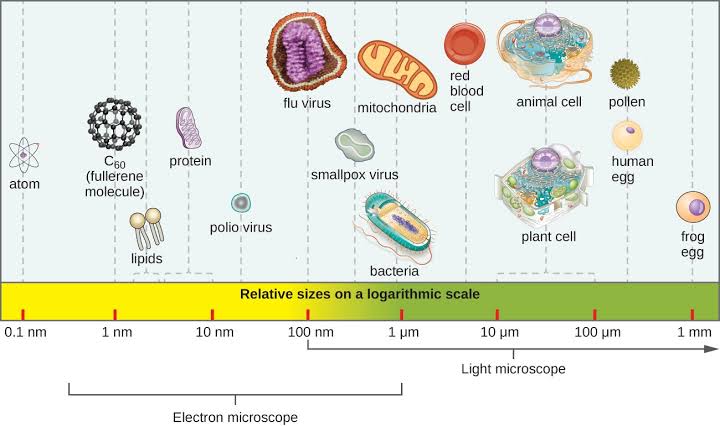
Micro-organisms differ in size, cellular organisation, shape, habitat, nutrition, metabolism, environmental requirements, growth, reproduction and capacity to cause disease. These features help the nurse and laboratory worker predict where a microbe survives, how it spreads, what specimen to collect and which infection-prevention measures are important.
- Describe the major characteristics used to classify and identify micro-organisms.
- Explain how nutrients, oxygen, temperature, pH and water affect microbial growth.
- Differentiate major forms of microbial reproduction and growth.
- Relate microbial characteristics to virulence, resistance and infection prevention.
| Characteristic | Question answered | Clinical or laboratory importance |
|---|---|---|
| Cellular organisation | Prokaryotic, eukaryotic or acellular? | Bacteria are prokaryotic; fungi/protozoa are eukaryotic; viruses are acellular. |
| Morphology | What is the size, shape and arrangement? | Cocci, bacilli, vibrios, yeasts, mould hyphae and viral shape give early clues. |
| Staining reaction | How does it behave with stains? | Gram-positive, Gram-negative and acid-fast findings guide early assessment. |
| Metabolism | How does it obtain energy and nutrients? | Fermentation and enzyme tests give biochemical identification clues. |
| Environmental needs | What oxygen, temperature, pH, moisture or salt level supports growth? | Determines specimen transport, culture method, food safety and survival. |
| Reproduction / life cycle | How does it multiply, persist and spread? | Binary fission, budding, cysts, spores and host-cell viral replication. |
| Genetic and antigenic features | What genes or surface antigens are present? | Useful in PCR, strain typing, outbreak investigation and resistance testing. |
| Virulence | How does it cause or worsen disease? | Capsules, toxins, enzymes, adhesins and biofilm formation can increase pathogenicity. |
Size is measured in micrometres (µm) or nanometres (nm). A typical bacterium is around 1 µm, while many viruses are around 100 nm. Fungi and protozoa are often larger than bacteria, but detailed identification still needs microscopy.
- Bacteria: cocci, bacilli, coccobacilli, vibrios, spirilla/spirochaetes and branching filamentous forms.
- Arrangement: pairs, chains, clusters, tetrads and packets result from the plane of cell division and whether cells stay attached.
- Fungi: unicellular yeasts, multicellular moulds with hyphae, and dimorphic forms.
- Protozoa: may move by pseudopodia, flagella or cilia; many have trophozoite and cyst stages.
- Viruses: helical, icosahedral, complex, enveloped or non-enveloped.
| Group | Key characteristic | Why it matters |
|---|---|---|
| Bacteria | Prokaryotic; no true nucleus; 70S ribosomes; usually peptidoglycan cell wall. | Can be stained, cultured and tested for antimicrobial susceptibility. |
| Fungi | Eukaryotic; chitin/glucan wall and ergosterol-containing membrane. | Structural differences provide antifungal drug targets. |
| Protozoa | Single-celled eukaryotes with a nucleus and specialised feeding/movement structures. | Correct timing and preservation of blood, stool or other specimens is important. |
| Viruses | Acellular DNA or RNA genome in capsid, with or without envelope. | Need host cells or antigen/molecular testing; ordinary bacterial culture media will not grow them. |
Gram staining separates bacteria by cell-envelope structure. Gram-positive bacteria retain crystal violet and appear purple because of a thick peptidoglycan wall. Gram-negative bacteria have thin peptidoglycan plus an outer membrane and appear pink/red after counterstaining.
A habitat is where an organism normally lives, grows or persists. Microbes occur in soil, water, food, sewage, plants, animals, skin, mucous membranes and healthcare environments. Their habitat depends on nutrients, moisture, temperature, pH, oxygen and suitable surfaces.
- Free-living organisms survive independently in the environment.
- Commensals live on or in the body without causing disease in their normal site.
- Mutualists benefit both microbe and host.
- Parasites benefit at the host's expense.
- Opportunists cause disease when immunity is low, barriers are broken, normal flora is disturbed or devices are present.
A reservoir is the usual habitat in which an agent lives and multiplies. A source is the person, animal, object or substance from which a host acquires infection. Correctly identifying both is important during infection-prevention investigation.
Cellular microbes need energy, carbon, water and essential chemical elements. Their metabolic pattern helps classify and identify them. Catabolism breaks substances down to release energy; anabolism uses energy to build cellular material.
| Term | Meaning | Importance |
|---|---|---|
| Phototroph | Uses light as energy source. | Common among environmental microbes and algae. |
| Chemotroph | Uses chemical compounds as energy source. | Most medically important bacteria and fungi. |
| Autotroph | Uses carbon dioxide as major carbon source. | Important in environmental microbiology. |
| Heterotroph | Uses organic compounds for carbon. | Most human pathogens. |
| Fermentation | Energy production without oxygen as terminal electron acceptor. | Supports growth in low-oxygen environments and aids biochemical identification. |
Each microbe has minimum, optimum and maximum temperatures. Many human pathogens are mesophiles and grow best near body temperature. Cold slows growth of many microbes but does not sterilise food or equipment.
Most pathogens prefer near-neutral pH, while acidophiles prefer acidic conditions and alkaliphiles prefer alkaline conditions. Water is essential for metabolism. High salt or sugar lowers available water and inhibits many organisms, although some tolerate it well.
| Type | Oxygen relationship | Practical implication |
|---|---|---|
| Obligate aerobe | Requires oxygen. | Grows where oxygen is available. |
| Obligate anaerobe | Oxygen is harmful or lethal. | Needs oxygen-free specimen collection and transport. |
| Facultative anaerobe | Grows with or without oxygen, usually better with oxygen. | Common among human-associated bacteria. |
| Microaerophile | Requires low oxygen concentration. | Needs special culture conditions. |
| Aerotolerant anaerobe | Does not use oxygen but tolerates it. | Can survive in oxygenated environments while fermenting. |
Most bacteria multiply by binary fission: DNA replicates, the cell elongates, a septum forms and one cell divides into two daughter cells. The generation time is the time for a population to double under stated conditions.
- Lag phase: cells adapt, repair and synthesise enzymes; cell number changes little.
- Log/exponential phase: rapid division; many antimicrobials work best on actively dividing cells.
- Stationary phase: nutrient depletion and waste accumulation; growth rate equals death rate.
- Death phase: viable cells decline as conditions become unfavourable.
- Budding: common in yeasts.
- Fragmentation: occurs in filamentous forms.
- Cysts/endospores: enhance survival in different groups; bacterial endospores are survival structures, not reproductive structures.
- Viral replication: occurs only after a virus enters a compatible host cell.
A biofilm is a structured community of microbes attached to a surface and embedded in a self-produced matrix. Biofilms form on teeth, wounds, urinary catheters, vascular lines and other devices, and can make organisms more difficult to remove or treat.
- Adhesins and pili support attachment to tissue or devices.
- Capsules may reduce phagocytosis and promote persistence.
- Toxins and enzymes may damage tissue or help spread.
- Gene transfer can spread antimicrobial-resistance genes between bacteria.
- Antigenic variation helps some organisms avoid host immunity.
A contaminated deep wound with swelling and foul discharge may involve anaerobic organisms. Collect ordered specimens correctly, use appropriate transport, monitor for sepsis, practise standard precautions and escalate deterioration quickly.
Think about microbial adherence and biofilm. Do not break the closed system unnecessarily; collect urine from the sampling port using aseptic technique according to policy, review catheter need and report fever, flank pain, confusion or sepsis indicators promptly.
Food held in an unsafe temperature range may allow rapid growth of some bacteria. Safe food handling needs hygiene, thorough cooking, prompt refrigeration and prevention of cross-contamination.
- Equating every microbe with a pathogen.
- Confusing growth with increase in cell size only; it usually means increase in cell number.
- Calling all anaerobes unable to tolerate oxygen.
- Confusing bacterial endospores with reproduction.
- Assuming biofilms are only dental plaque.
- Forgetting that metabolic traits are used for laboratory identification.
- State eight characteristics used to classify or identify micro-organisms.
- Explain how temperature, pH, moisture and oxygen influence growth.
- Differentiate the five oxygen-requirement groups.
- Describe the four phases of the bacterial growth curve.
- Explain why biofilms matter in catheter and wound care.
- How can biochemical characteristics help laboratory identification?