
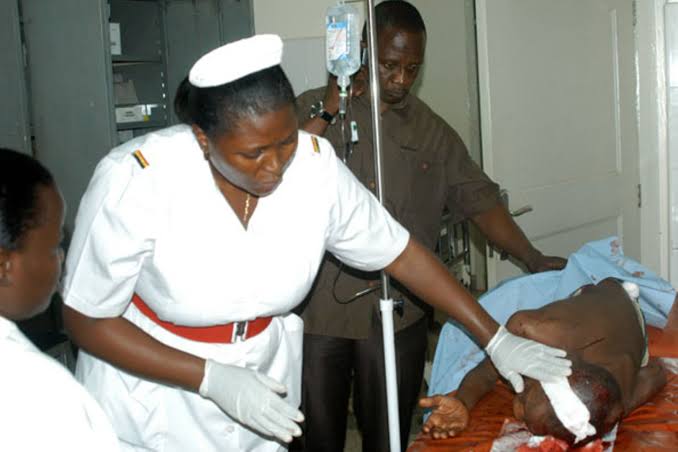
When a child arrives at the hospital after an accident, the nurse must perform a systematic assessment. Do NOT be distracted by obvious injuries (like a bleeding arm) and miss a hidden life-threatening problem (like internal bleeding or a tension pneumothorax).
Children are not just "small adults." Their anatomy makes them highly vulnerable during trauma. A child's airway is funnel-shaped (narrowest at the cricoid ring, unlike adults where it is the vocal cords), their tongue is disproportionately large, and their occiput (back of the head) is prominent, causing airway kinking if they are laid flat on a hard spine board without a shoulder roll.
| Letter | System | What to Assess | Red Flags (Danger Signs) |
|---|---|---|---|
| A | Airway | Is it open? Any obstruction? Blood, vomit, foreign body? | Gurgling sounds, stridor, inability to speak. |
| B | Breathing | Rate, depth, effort, oxygen saturation. | Fast breathing, chest retractions, cyanosis (blue lips), low SpO2. |
| C | Circulation | Pulse rate, blood pressure, capillary refill time, skin color. | Weak/fast pulse, low BP, CRT >2 seconds, pale/cold skin. |
| D | Disability | Level of consciousness (AVPU), pupil size and reaction. | Decreased consciousness, unequal pupils. |
| E | Exposure | Remove all clothes to examine fully. Prevent hypothermia. | Hidden injuries, bruising patterns, burns on back. |
"Always Be Careful — Don't Expose without covering!" Remember that children have a massive body surface area to mass ratio, meaning they lose heat rapidly. Hypothermia worsens bleeding by disrupting the coagulation cascade.
Normal vital signs in pediatrics are heavily age-dependent. Memorize these ranges:
| Age | Heart Rate (bpm) | Respiratory Rate (breaths/min) | Systolic BP (mmHg) |
|---|---|---|---|
| Newborn (0-1 month) | 100-160 | 30-60 | 60-90 |
| Infant (1-12 months) | 100-160 | 25-40 | 72-104 |
| Toddler (1-2 years) | 90-150 | 20-30 | 74-100 |
| Preschool (3-5 years) | 80-140 | 20-25 | 78-108 |
| School-age (6-12 years) | 70-120 | 16-22 | 82-118 |
| Adolescent (13-18 years) | 60-100 | 12-20 | 90-120 |
- Capillary Refill Time (CRT): Press on the child's fingernail or sternum for 5 seconds. Color should return in less than 2 seconds. If longer ➔ shock! (This indicates peripheral vasoconstriction as the body attempts to shunt blood to vital organs).
A child involved in an accident MUST be admitted to the hospital if ANY of the following apply:
- Loss of consciousness (even brief).
- Amnesia (cannot remember the accident).
- Seizure after injury.
- Persistent vomiting (A classic sign of rising Intracranial Pressure - ICP).
- Severe or worsening headache.
- Confusion, irritability, or unusual behavior.
- Signs of skull fracture: clear fluid from nose/ears (CSF leak), bruising behind ears (Battle's sign), or "raccoon eyes".
- High-risk mechanism (fall from height, high-speed Road Traffic Accident - RTA).
- Difficulty breathing or Chest pain.
- Abdominal pain or tenderness.
- Blood in vomit, urine, or stool.
- Signs of internal bleeding (pale, fast pulse, low BP, distended rigid abdomen). Children's abdominal organs (liver, spleen) are relatively larger and less protected by the rib cage than in adults, making them prone to rupture.
- Open fractures (bone protruding through skin) - high risk of osteomyelitis.
- Displaced fractures or Fractures near joints.
- Multiple fractures.
- Fractures with nerve or blood vessel damage (check pulse and sensation distal to the break).
- Burns >10% Total Body Surface Area (TBSA).
- Burns on face, hands, feet, genitals, or across joints (Due to severe functional impairment and scar contractures).
- Electrical burns (High risk of cardiac arrhythmias).
- Chemical burns.
- Inhalation injury (smoke inhalation) - airway can swell shut hours later.
- Burns in very young children (<2 years).
- Circumferential burns (burns that go all the way around a limb) - acts like a tourniquet and cuts off blood supply.
- ALL poisonings should be observed in the hospital!
- Even if the child seems fine, delayed effects can occur as the immature liver and kidneys struggle to process the toxin.
- Airway Management: Position child to maintain open airway (sniffing position). Suction secretions as needed. Administer oxygen if SpO2 <94%. Have suction and resuscitation equipment immediately at bedside.
- Breathing Support: Monitor respiratory rate and effort every 15-30 minutes initially. Give oxygen via nasal cannula or face mask. Watch for signs of respiratory distress: nasal flaring, grunting, chest retractions.
- Circulation Monitoring: Insert IV line for fluids and medications. Monitor heart rate, BP, and CRT. Watch for signs of shock:
- Tachycardia (fast heart rate): The earliest sign!
- Hypotension (low BP): A VERY late sign in children!
- Poor CRT and Decreased urine output.
Physiological Note: Children compensate well initially by clamping down blood vessels, maintaining their BP. When they exhaust this mechanism, they crash suddenly and irreversibly! - Neurological Monitoring: Assess level of consciousness using Glasgow Coma Scale (GCS) or AVPU. Check pupil size and reaction every 1-2 hours for head injuries. Watch for seizures.
- Pain Management: Assess pain using age-appropriate scales:
- Infants: FLACC scale (Face, Legs, Activity, Cry, Consolability).
- Older children: Faces pain scale or number scale (0-10).
- Give analgesics as prescribed (paracetamol, morphine for severe pain).
- Wound Care: Clean and dress wounds. Administer tetanus toxoid if needed. Give antibiotics for open wounds. Monitor for signs of infection: redness, swelling, pus, fever.
- Fluid and Nutrition: Calculate fluid requirements based on weight (e.g., Holliday-Segar method). For burns, use the Parkland formula (4mL × kg × %TBSA). NPO (nothing by mouth) if surgery is planned. Start feeding as soon as safe to prevent malnutrition.
- Emotional Support: Keep parents/caregivers with the child. Explain procedures in simple language. Reassure the child — fear increases pain and stress hormones, which raises intracranial pressure.
- Documentation: Record all vital signs, treatments, and observations. Document time of injury, first aid given, and transport details. This is legal evidence if needed.
Before sending a child home, the nurse must ensure:
- Medical clearance — doctor has reviewed and approved discharge.
- Wound care instructions given to parents (cleaning, dressing changes, signs of infection).
- Medications explained (dose, frequency, duration).
- Follow-up appointment scheduled.
- Tetanus immunization status confirmed.
- Home safety assessment discussed.
- Return precautions explained: When to come back immediately (Fever, Increased pain, Wound redness or pus, Vomiting, Loss of consciousness, Any new concerning symptoms).
| E | Meaning | What Mothers Can Do |
|---|---|---|
| Education | Teaching about dangers | Explain risks in simple language, use stories. |
| Environment | Making the home safe | Remove hazards, create safe play areas. |
| Enforcement | Rules and supervision | Set boundaries, watch children constantly. |
Why it matters: Falls are the #1 cause of injury in Ugandan children under 5. (Toddlers have disproportionately large heads, shifting their center of gravity up, making them top-heavy).
- Bunk beds: Install guard rails on top bunk. Do NOT let children under 6 sleep on the top bunk.
- Verandas and stairs: Install barriers/gates. Block access with furniture.
- Windows: Do not let children sit on sills. Install bars or keep locked.
- Trees: Teach children not to climb tall trees alone. Clear hard objects (stones, metal) from underneath.
- Baby walkers: These are highly dangerous — children can fall down stairs. Do NOT use them.
Simple Message: "If they can reach it, they will fall from it!"
Why it matters: Burns are the #2 cause of injury and cause permanent scarring and disability.
- Cooking area: Create a separate cooking space. Turn pot handles INWARD on the stove. Use back burners. Never leave cooking food unattended.
- Hot liquids: Do NOT carry hot tea/coffee while holding a baby. Place hot drinks in the CENTER of the table. Test bath water with your ELBOW (it's more sensitive to heat than calloused hands).
- Fire safety: Use a fixed cooking stove (jiko with walls) rather than open flames. Store kerosene/paraffin locked away.
- Electrical safety: Cover exposed sockets with tape. Raise wires out of reach.
Simple Message: "Hot things hurt — keep them high and away!"
- Medicines: Store ALL medicines in a locked box/high cupboard. Do NOT call medicine "candy" or "sweet". Dispose of expired meds safely.
- Chemicals: Store kerosene, pesticides, and cleaning products in original containers (never in soda bottles!). Do NOT store under the sink where toddlers explore.
- Plants: Remove poisonous plants. Teach children not to eat unknown berries.
Simple Message: "If it is not food, it is poison — lock it up!"
- Water containers: Empty buckets, basins, and drums immediately. A child can drown in just 5 cm of water!
- Wells and latrines: Cover all open wells and pit latrines securely.
- Bathing: Never leave a child alone in the bath, even for "just a minute."
Simple Message: "Water waits silently — never leave them alone near it!"
- Supervision: Children under 10 cannot judge traffic speed and distance (their peripheral vision and depth perception are not fully developed). Hold their hand.
- Visibility: Dress children in bright colors at dawn/dusk.
- Boda-boda safety: Children should wear helmets. Do NOT let children stand on motorcycles.
Simple Message: "Hold their hand until they can hold their own life!"
- Food: Cut into small pieces. Do NOT give hard candy, nuts, or popcorn to children under 4.
- Small objects: Keep coins, batteries (especially highly corrosive button batteries!), and beads out of reach.
- Eating habits: Make children sit while eating. Do not run or play with food in mouth.
Simple Message: "Small things in small mouths = big danger!"
- Store knives/pangas in high locked drawers. Clean up broken glass immediately. Check play areas for nails/wires.
Simple Message: "Sharp things cut — keep them up and locked!"
Supervision is the MOST IMPORTANT prevention strategy!
| Age Group | Supervision Needed |
|---|---|
| Under 1 year | Constant, within arm's reach |
| 1-3 years | Constant visual contact |
| 3-5 years | Close supervision, especially near hazards |
| 5-10 years | Regular checking, teach safety rules |
| Over 10 years | Supervise risky activities, set boundaries |
Important Notes for Mothers: Older siblings are NOT adequate supervisors (A 10-year-old cannot safely watch a baby). "I was just gone for a minute" — accidents happen in seconds.
In small/crowded homes, designate one safe corner. Use barriers (even a mat defines "safe space"). Provide age-appropriate toys with no small parts. Check the area daily for new hazards.
- Setting: A 2-year-old pulls a pot of hot porridge from the stove. Burns on face, chest, and right arm.
- Nurse Actions: Remove child from heat source. Cool burn with running water for 20 minutes (stops the burning process in deeper tissues). Remove wet clothing (if not stuck). Cover with clean plastic wrap. Calculate burn area (use palm method). Start IV fluids if >10% burned. Give pain relief. Administer Tetanus toxoid. Admit for observation and wound care.
- Setting: A 7-year-old falls from a mango tree. Complains of leg pain and headache.
- Nurse Actions: Primary survey — ABC. Immobilize leg with splint. Assess head injury (AVPU, pupils). Check for neck pain or spinal symptoms (immobilize c-spine if suspect). Transport to hospital. X-ray leg and possibly skull. Observe for 24 hours even if initial assessment is normal.
- Setting: A 3-year-old eating groundnuts suddenly cannot breathe, turns blue.
- Nurse Actions: Assess severity (severe choking = cannot cough). Because child is over 1 year: 5 back blows ➔ 5 abdominal thrusts (Heimlich) ➔ repeat. If unconscious: start CPR. Call for help. Even if object is expelled, observe in hospital for airway swelling.
- Setting: A 1-year-old found head-down in a bucket of water.
- Nurse Actions: Remove from water. Check breathing. If not breathing: 5 rescue breaths ➔ start CPR. If breathing: recovery position, keep warm. Transport to hospital — ALL near-drowning cases need observation. Monitor for secondary drowning (worsening breathing hours later due to pulmonary edema from aspirated water).
| Mnemonic | Meaning | Use |
|---|---|---|
| DRS ABCD | Danger, Response, Send for help, Airway, Breathing, CPR, Defibrillation | Primary survey for ALL emergencies |
| AVPU | Alert, Voice, Pain, Unresponsive | Quick consciousness check |
| COOL, COVER, CALL | Cool burn, Cover with clean dressing, Call for help | Burn first aid |
| RICE | Rest, Ice, Compression, Elevation | Soft tissue injuries (sprains) |
| SAMPLE | Signs/Symptoms, Allergies, Medications, Past history, Last meal, Events | History taking |
| VOMIT PUPILS | Vomiting, Obvious fluid, Mental changes, Irregular breathing, Thin pupils, Unequal pupils, Paralysis, Unconsciousness, Increased headache, Lethargy, Seizures | Serious head injury signs |
| Three E's | Education, Environment, Enforcement | Accident prevention framework |
- Children compensate for shock better than adults — they maintain blood pressure until very late. Tachycardia (fast heart rate) is the EARLY sign of shock in children, NOT low blood pressure.
- The most common cause of cardiac arrest in children is RESPIRATORY FAILURE, not a primary heart attack like in adults. Fix the breathing first!
- Never give aspirin to children — risk of Reye's syndrome (brain and liver damage).
- For choking infants under 1 year, use BACK BLOWS and CHEST THRUSTS — NEVER abdominal thrusts (Heimlich) as it can rupture their liver.
- For burns, cool with water for 20 minutes — this is the single most effective first aid measure and reduces burn depth.
- The child's palm (including fingers) = 1% of body surface area — easiest way to estimate burns in the field.
- All head injuries need observation — even if the child seems fine, deterioration can occur hours later (epidural hematoma).
- Tetanus immunization is needed for ALL open wounds and burns if not up to date.
- The home is the most dangerous place for children under 5 — not the road, not school.
- Supervision is the #1 prevention strategy — no safety device replaces a watchful adult.
- Q: A 3-year-old is brought in after falling from a veranda. He is crying but seems alert. What is your FIRST action?
A: Primary survey (DRS ABCD) — check for danger, response, airway, breathing, circulation. Do NOT be distracted by the crying. - Q: A mother brings a child with a burn on the hand. She applied raw egg and oil. What do you do?
A: Gently wash off the egg/oil with cool water. Explain to the mother that these trap heat and cause infection. Cool with water for 20 minutes, then cover. - Q: A 6-month-old is choking on a piece of banana. What is the correct sequence of actions?
A: Assess severity ➔ 5 back blows (baby face-down on forearm) ➔ check mouth ➔ 5 chest thrusts (two fingers on center of chest) ➔ repeat ➔ CPR if unconscious. - Q: Why is a child with a head injury admitted for 24 hours even if they seem fine?
A: Because of the risk of delayed intracranial hemorrhage (bleeding inside the skull). Symptoms like vomiting, confusion, or seizures may develop hours later due to slow bleeding.
Quick Quiz
Accidents Quiz
Paediatrics
Privacy: Your details are used only for quiz tracking and certificates.
Accidents Quiz
Paediatrics
Preparing questions...
Choose your answer and keep your streak alive.
Great effort.
Here is your quick performance summary.