
HIV (Human Immunodeficiency Virus) is a tiny germ (virus) that attacks the body's defense system. Think of your body like a house, and your immune system is the security guard. HIV specifically attacks the CD4 cells (also called T-helper cells) — these are like the "commander soldiers" of your immune system.
- HIV stands for Human Immunodeficiency Virus.
- It is NOT the same as AIDS (AIDS is the advanced stage when the immune system is very weak).
- HIV cannot survive outside the human body for long.
- It spreads through: unprotected sex, from mother to baby (vertical transmission), sharing sharp objects, and blood transfusions.
HIV has a specific glycoprotein on its surface called gp120. This protein fits perfectly like a lock-and-key into the CD4 receptor found on T-helper cells, macrophages, and dendritic cells. Without CD4 cells, the immune system cannot signal B-cells to make antibodies or Cytotoxic T-cells to kill infections. That is why HIV is so destructive—it takes out the generals of the immune army.
🧠 MNEMONIC: "HIV Hides In Villages"
- Hides in the body for years without symptoms (clinical latency period).
- Immune system is the target.
- Very sneaky — can be passed on before you know you have it.
If a person with HIV does NOT take ARVs:
- The virus keeps making copies of itself inside CD4 cells.
- CD4 cell count drops (normal is 500–1,500 cells/mm³).
- The body cannot fight infections anymore.
- Opportunistic Infections (OIs) attack — like TB, pneumonia, diarrhea, skin diseases.
- Eventually, the person develops AIDS (Acquired Immunodeficiency Syndrome).
❓ Clinical Scenario: Disease Progression
Case: A 32-year-old woman from a village in Uganda comes to the clinic with a cough that has lasted 3 months, weight loss, and night sweats. Her CD4 count is 180 cells/mm³. She has HIV that has progressed to AIDS because she never took ARVs.
Nursing Action: As a nurse, you must start her on ART immediately after ruling out or treating Opportunistic Infections (like TB and cryptococcal meningitis). Why? Starting ART while a severe OI is active can cause IRIS (Immune Reconstitution Inflammatory Syndrome), a dangerous overreaction of the newly "woken up" immune system!
ART (Antiretroviral Therapy) is the combination of ARV drugs used to treat HIV. It is NOT a cure, but it helps people live long, healthy lives.
- To reduce the amount of virus in the blood to undetectable levels.
- To increase CD4 cell count (immune reconstitution).
- To prevent transmission of HIV to others (U=U: Undetectable = Untransmittable).
- To prevent AIDS and death.
🧠 MNEMONIC: "ART Always Restores Tomorrow"
- Always take it daily.
- Restores the immune system.
- Tomorrow will be healthier.
Think of HIV like a factory that makes copies of itself. ARVs are like "factory workers" who go inside and break different machines in the factory so the virus cannot make new copies.
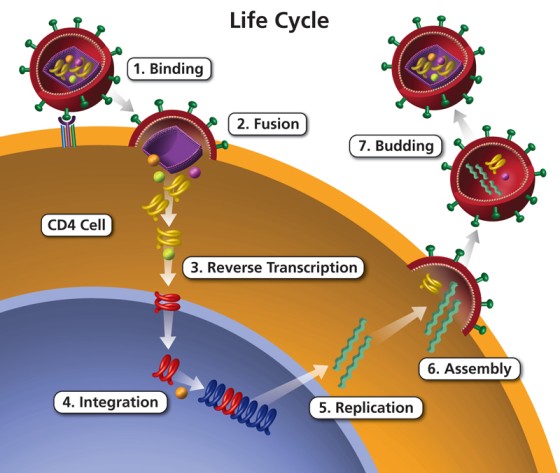
To understand ARVs, you must first understand how HIV reproduces:
- Attachment: HIV attaches to a CD4 cell (gp120 binds to the CD4 receptor and a co-receptor like CCR5).
- Fusion: HIV's viral envelope merges with the CD4 cell membrane, emptying its contents into the cell.
- Reverse Transcription: HIV is a retrovirus, meaning it carries RNA. It uses the enzyme Reverse Transcriptase to change its viral RNA (genetic material) into viral DNA.
- Integration: HIV DNA enters the cell's nucleus and uses the enzyme Integrase to mix (splice) itself permanently into the human DNA.
- Replication: The human cell is hijacked! It reads the viral DNA and starts making new HIV proteins and viral RNA.
- Assembly: New HIV parts come together near the cell surface.
- Budding: New HIV viruses push out (leave) the cell, wrapping themselves in the human cell's membrane to infect other cells. Protease enzyme cuts the proteins to mature the virus.
🧠 MNEMONIC: "A Fat Rabbit Is Really (bad)At Basketball" Each class of ARV attacks a different step in the HIV life cycle: Pronounced: "En-Ar-Tee-Eyes" NRTIs are "fake DNA building blocks." HIV needs real building blocks (nucleotides) to make its DNA. NRTIs pretend to be real building blocks, but when HIV tries to use them, the DNA chain stops growing. It's like giving a builder fake bricks — the wall cannot be completed. 🚨 NURSING ALERT: Lactic Acidosis ❓ Clinical Scenario: TDF Toxicity 🧠 MNEMONIC for NRTIs: "Tenofovir And Lamivudine Can Always Zap HIV" Pronounced: "En-En-Ar-Tee-Eyes" NNRTIs also attack the reverse transcriptase enzyme, but they work differently from NRTIs. They bind directly to the enzyme and change its shape, so it cannot work anymore. Think of it like putting a wrong key in a lock — the lock changes shape and the real key cannot fit anymore. 🚨 NURSING ALERT: Nevirapine Rash ❓ Clinical Scenario: Efavirenz & Pregnancy/CNS 🧠 MNEMONIC for NNRTIs: "Every Nurse Eats Red Delicious Oranges" Pronounced: "Pee-Eyes" PIs block the protease enzyme. After HIV makes new proteins inside the cell, protease is needed to cut these proteins into the right sizes so new viruses can be assembled. PIs stop this cutting process. Think of it like a pair of scissors — PIs take away the scissors, so the virus parts cannot be put together properly. 🚨 NURSING ALERT: PI and Drug Interactions ❓ Clinical Scenario: PI Side Effects 🧠 MNEMONIC for PIs: "Lions And Dragons Roar" Pronounced: "In-Stees" INSTIs are the newest and best class of ARVs. They block the integrase enzyme, which HIV uses to insert its DNA into the human cell's DNA. Think of it like a thief trying to break into a house — INSTIs lock the door so the thief cannot get inside. 🚨 NURSING ALERT: Weight Gain with DTG ❓ Clinical Scenario: DTG Side Effects 🧠 MNEMONIC for INSTIs: "Doctor Bic Rides Cars" What They Do: These drugs stop HIV from entering the CD4 cell in the first place. They are like guards at the gate who refuse to let HIV inside. Usage: These are NOT first-line drugs. They are used only in special salvage cases (third-line or heavy resistance). What They Are: These are NOT ARVs themselves. They are drugs that slow down the breakdown of other ARVs (especially PIs) in the liver, making them work longer and better. How They Work: The liver uses the CYP3A4 enzyme to destroy drugs. Boosters forcefully inhibit (block) this enzyme. As a result, the main ARV stays in the blood at high concentrations for 24 hours. This allows for lower doses of the main ARV and once-daily dosing! 🚨 NURSING ALERT: Ritonavir and Drug Interactions What is First-Line? First-line regimens are the FIRST combination of drugs given to a person newly diagnosed with HIV. Uganda follows WHO guidelines. TLD = TDF + 3TC + DTG Dosing Instructions: One tablet once daily, with or without food. Take at the SAME TIME every day. Crucial Clinical Rule: You MUST test for the HLA-B*5701 gene first! If the patient is positive, NEVER give ABC. It will trigger a massive Type IV Hypersensitivity reaction (fever, rash, respiratory failure) that is frequently fatal upon rechallenge! When Do We Switch to Second-Line? Principle of Switching: Note: DRV/r (Darunavir/Ritonavir) is the preferred PI in the 2026 WHO updates! Always use boosted PIs to ensure 24-hour coverage. When Do We Use Third-Line? Third-Line Options: ❓ Clinical Scenario: Treatment Failure & 3rd Line As a nurse, you must meticulously assess the patient BEFORE giving the first dose to prevent fatal complications (like IRIS - Immune Reconstitution Inflammatory Syndrome). As a nurse, teach EVERY patient the following: Clinical Monitoring (At Every Visit): Weight, Blood pressure, General health and well-being, Signs of opportunistic infections, Side effects of ARVs, Adherence assessment. 🧠 MNEMONIC for Monitoring: "Viral Counts Create Liver Laughter" Why Adherence is CRITICAL: Missing even a few doses drops the drug concentration in the blood. HIV rapidly mutates to survive this low drug level, leading to drug resistance. Once resistance develops, the drug may NEVER work again. Uganda has limited and expensive third-line options. What is Pharmacovigilance? It means "watching over drugs" — monitoring and reporting side effects to keep patients safe. In Uganda, ARVs are given to millions of people. New drugs (like DTG) need ongoing safety monitoring because rare side effects may only appear after long-term population use. Reporting via the "Yellow Card System" helps improve national guidelines. How to Report: Recognize → Document → Report (Yellow card) → Manage → Follow up. Case: John, 28 years old, is newly diagnosed with HIV. His CD4 is 320, viral load is 45,000. He has no TB symptoms. He is not pregnant. Answer: Start TLD (TDF + 3TC + DTG) same day. Counsel on adherence and side effects (insomnia, weight gain). Schedule viral load at 3 months. Provide condoms. Case: Mary, 24 years old, is 16 weeks pregnant and newly diagnosed with HIV. She has a cough and fever. Answer: Screen for TB immediately. If NO TB: Start TLD same day. If TB is found: Start TB treatment first, start ART after 2 weeks. Counsel on exclusive breastfeeding for 6 months and ensure baby gets NVP prophylaxis at birth. Case: Peter has been on TLD for 2 years. His viral load is 8,500 copies/mL. He says he takes his drugs every day. Answer: Do NOT switch immediately! Provide Intensive Adherence Counseling (IAC) for 3 months. Repeat viral load. If still not suppressed → switch to second-line (AZT + 3TC + ATV/r or LPV/r). Since he is on DTG, true resistance is rare — poor adherence is highly likely the real cause. Case: Grace, 35, on TLD for 6 months, complains she cannot sleep and has gained 7 kg. She wants to stop the drugs. Answer: Reassure her — do NOT stop ART. For Insomnia: Take DTG in the morning instead of evening. For Weight gain: Counsel on diet and brisk walking. Monitor weight monthly. 🏆 FINAL EXAM TIP for Pharmacology:
Attachment → Fusion → Reverse transcription → Integration → Replication → Assembly→Class What It Does Step Attacked NRTIs Fake building blocks that stop DNA building Reverse Transcription NNRTIs Block the reverse transcriptase enzyme directly Reverse Transcription PIs Block the protease enzyme (stops virus maturation) Assembly / Maturation INSTIs Block the integrase enzyme (stops HIV DNA mixing) Integration Entry Inhibitors Block HIV from entering the CD4 cell Attachment/Fusion PK Boosters Make other ARVs work better and longer Not an ARV itself Generic Name Abbreviation Brand Name Key Notes Tenofovir TDF or TAF Viread (TDF), Vemlidy (TAF) Backbone of most regimens. TAF is safer for bones/kidneys. Lamivudine 3TC Epivir Very well tolerated. Also treats Hep B. Emtricitabine FTC Emtriva Similar to 3TC. Can cause hyperpigmentation of palms/soles. Zidovudine AZT or ZDV Retrovir Can cause severe anemia and bone marrow suppression. Abacavir ABC Ziagen Must test for HLA-B*5701 gene to prevent fatal hypersensitivity. Stavudine d4T Zerit NO LONGER RECOMMENDED — causes severe lipoatrophy & neuropathy. Common Drugs Indications Standard Adult Dosages Contraindications Major Side Effects Tenofovir (TDF) HIV-1, Chronic Hepatitis B 300 mg once daily Severe renal impairment (CrCl < 30 mL/min) Nephrotoxicity, decreased bone mineral density. Lamivudine (3TC) HIV-1, Chronic Hepatitis B 300 mg once daily OR 150 mg twice daily Hypersensitivity Minimal; mild nausea, headache. Zidovudine (AZT) HIV-1, PMTCT, Post-exposure prophylaxis 300 mg twice daily Severe anemia, bone marrow suppression, neutropenia Macrocytic anemia, neutropenia, myopathy, hyperpigmentation. Abacavir (ABC) HIV-1 (often when TDF is contraindicated) 600 mg once daily OR 300 mg twice daily HLA-B*5701 positive (high risk of fatal hypersensitivity), severe hepatic impairment Hypersensitivity reaction (fever, rash, respiratory symptoms), possible increased CV risk.
Symptoms: Deep, rapid breathing (Kussmaul breathing), muscle pain, weakness, stomach pain, feeling cold.
This is a medical emergency! If a patient on NRTIs presents with these, STOP the drug and call the doctor immediately. Check ABGs and lactate levels.
Case: A 45-year-old man on TDF+3TC+DTG comes to the clinic complaining of severe bone pain and difficulty walking.
Nursing Action: As a nurse, you check his kidney function (creatinine) and bone density. You know that TDF can cause renal toxicity (which leaks phosphate) leading to bone weakening. The doctor may switch him to TAF (tenofovir alafenamide), which targets the HIV cell much more efficiently, meaning less drug floats in the blood to damage bones and kidneys.Generic Name Abbreviation Brand Name Key Notes Efavirenz EFV Sustiva, Stocrin Crosses blood-brain barrier. Causes vivid dreams, dizziness. Avoid in 1st trimester pregnancy. Nevirapine NVP Viramune High risk for severe liver rash (Stevens-Johnson syndrome). Requires 2-week dose lead-in. Etravirine ETR Intelence Second-line use. Works even against some NNRTI-resistant HIV. Rilpivirine RPV Edurant Must take with full meal. Absolutely AVOID proton pump inhibitors (omeprazole). Doravirine DOR Pifeltro Newer drug, fewer CNS side effects than Efavirenz. Common Drugs Indications Standard Adult Dosages Contraindications Major Side Effects Efavirenz (EFV) HIV-1 (First-line alternative) 400 mg or 600 mg once daily (at bedtime) Severe psychiatric disorders, 1st trimester pregnancy (historical caution) CNS effects (vivid dreams, dizziness, depression), rash, hepatotoxicity. Nevirapine (NVP) HIV-1, PMTCT (neonatal prophylaxis) 200 mg once daily for 14 days, then 200 mg twice daily High CD4 count in women (>250) or men (>400) due to fatal hepatotoxicity risk Severe hepatotoxicity, Stevens-Johnson syndrome (severe rash). Rilpivirine (RPV) HIV-1 (Viral load < 100,000) 25 mg once daily (with a full meal) Use with Proton Pump Inhibitors (PPIs) completely contraindicated Depression, insomnia, rash, QTc prolongation.
NVP rash can be mild or progress to a life-threatening skin peeling condition (Stevens-Johnson syndrome or TEN). If rash appears with a fever, blistering, or mouth sores → STOP THE DRUG IMMEDIATELY. Always start NVP at a lower dose for the first 2 weeks to let the liver adjust, then increase to normal dose.
Case: A 28-year-old woman on an EFV-based regimen tells you she is 8 weeks pregnant.
Nursing Action: EFV is known to be teratogenic (can cause neural tube birth defects) in the first trimester. Furthermore, it can cause severe psychiatric problems (depression, suicidal thoughts). As a nurse, you urgently inform the doctor to switch her to a DTG-based regimen (TDF+3TC+DTG), which is safe in pregnancy and lacks the CNS toxicity.Generic Name Abbreviation Brand Name Key Notes Lopinavir/Ritonavir LPV/r Kaletra Commonly used in children (available as liquid/pellets). Causes severe diarrhea. Atazanavir/Ritonavir ATV/r Reyataz + Norvir Can cause harmless but visible jaundice (yellow eyes) and kidney stones. Darunavir/Ritonavir DRV/r Prezista + Norvir Preferred PI in 2026 WHO guidelines due to high barrier to resistance. Ritonavir RTV Norvir Used strictly as a "booster," not alone for its antiviral effect. Common Drugs Indications Standard Adult Dosages Contraindications Major Side Effects Lopinavir/Ritonavir (LPV/r) HIV-1 (Second-line, Pediatric first-line) 400/100 mg twice daily Co-administration with amiodarone, simvastatin, rifampicin (without dose adjustment) Severe diarrhea, hyperlipidemia, insulin resistance, PR/QT prolongation. Atazanavir/Ritonavir (ATV/r) HIV-1 (Second-line alternative) 300/100 mg once daily Co-administration with PPIs (requires stomach acid for absorption) Indirect hyperbilirubinemia (jaundice), nephrolithiasis (kidney stones), cholelithiasis. Darunavir/Ritonavir (DRV/r) HIV-1 (Second/Third-line preference 2026) 800/100 mg once daily Severe hepatic impairment, sulfa allergy (caution) Hepatotoxicity, skin rash, hyperlipidemia.
PIs interact with MANY other drugs because they drastically affect the CYP3A4 enzyme system in the liver. Always check for drug interactions before prescribing! Common dangerous interactions include statins (cholesterol drugs - can cause severe muscle breakdown), erectile dysfunction drugs, and some TB drugs (rifampicin drops PI levels to zero!).
Case: A 50-year-old man on LPV/r comes to the clinic with severe diarrhea (5–6 watery stools per day) and high cholesterol.
Nursing Action: As a nurse, you educate him about taking his medication WITH food to significantly reduce stomach upset. You also advise him to reduce fatty foods and increase dietary fiber. The doctor may add a cholesterol-lowering drug (statin), but you must strictly check for interactions first (e.g., Atorvastatin dose must be lowered; Simvastatin is totally contraindicated!).Generic Name Abbreviation Brand Name Key Notes Dolutegravir DTG Tivicay Preferred first-line anchor drug in Uganda and globally. Bictegravir BIC Biktarvy Very effective, minimal side effects (co-formulated). Raltegravir RAL Isentress First INSTI approved. Dosed twice daily (less convenient). Cabotegravir CAB Vocabria Long-acting injectable (given every 2 months!). Common Drugs Indications Standard Adult Dosages Contraindications Major Side Effects Dolutegravir (DTG) HIV-1 (First-line preferred) 50 mg once daily Co-administration with dofetilide (antiarrhythmic) Insomnia, weight gain, headache, rare hepatic toxicity. Bictegravir (BIC) HIV-1 (Used in fixed-dose combo) 50 mg once daily Co-administration with dofetilide or rifampicin Weight gain, nausea, headache, diarrhea. Raltegravir (RAL) HIV-1 (Alternative/PEP) 400 mg twice daily OR 1200 mg once daily Hypersensitivity Myopathy, rhabdomyolysis, insomnia, rash.
Some patients gain significant weight (5-10 kg) on DTG. Monitor weight and BMI at every visit. Encourage a healthy diet and aerobic exercise. Do NOT stop the drug — this weight gain is manageable and is partly due to a "return to health" phenomenon as the virus stops burning the body's calories.
Case: A 35-year-old woman starts TDF+3TC+DTG (TLD). After 3 months, her viral load is completely undetectable, but she has gained 5 kg. She is very worried about her body image.
Nursing Action: As a nurse, you enthusiastically celebrate her undetectable viral load! Reassure her that weight gain is a known side effect of DTG and shows the medicine is working. You counsel her on portion control, reducing sugary drinks, and walking 30 minutes daily. You schedule her for weight monitoring every month.Common Drugs Indications Standard Adult Dosages Contraindications Major Side Effects Maraviroc (MVC) CCR5-tropic HIV-1 (Salvage therapy) 150, 300, or 600 mg twice daily (depends on interacting drugs) CXCR4-tropic HIV, severe renal impairment Hepatotoxicity (severe), upper respiratory infections, rash. Enfuvirtide (T-20) HIV-1 Treatment-experienced (Salvage) 90 mg subcutaneously twice daily Hypersensitivity Injection site reactions (98% of patients), bacterial pneumonia, hypersensitivity. Common Drugs Indications Standard Adult Dosages Contraindications Major Side Effects Ritonavir (RTV) Boosting agent for PIs (LPV, ATV, DRV) 100-200 mg per day alongside the primary PI Co-administration with amiodarone, simvastatin, rifampicin (massive CYP3A4 interactions) GI intolerance (nausea/diarrhea), lipid abnormalities, circumoral paresthesia (tingling around mouth). Cobicistat (COBI) Boosting agent for INSTIs (Elvitegravir) or PIs (DRV, ATV) 150 mg once daily alongside primary drug Co-administration with highly dependent CYP3A4 drugs Slight increase in serum creatinine (without actual renal failure), GI upset.
Because Ritonavir intentionally breaks the liver's drug-clearing enzyme, it interacts with ALMOST EVERYTHING. Always ask patients about ALL medications they take, including herbal remedies. Common dangerous interactions: TB drugs (rifampicin), hormonal contraceptives (makes them fail!), and statin cholesterol drugs.Alternative Regimen When to Use It (Clinical Rationale) TAF + FTC + DTG If the patient develops severe kidney disease or bone osteoporosis from TDF. TDF + 3TC + EFV 400mg If DTG is totally out of stock or specifically contraindicated. ABC + 3TC + DTG If TDF is contraindicated (e.g., existing kidney disease with GFR < 60 mL/min). If First-Line Was: Second-Line Becomes: TDF + 3TC + DTG/EFV AZT + 3TC + ATV/r or LPV/r AZT + 3TC + DTG/EFV TDF + 3TC + ATV/r or LPV/r
Case: A 42-year-old man has been on second-line AZT+3TC+LPV/r for 2 years. His viral load is 45,000 copies/mL. He swears he takes his medication daily.
Nursing Action: As a nurse, you know this is definitive treatment failure. The doctor orders a resistance test. The results show massive resistance to both NRTIs and PIs. The patient is switched to a highly complex third-line regimen with new drugs (e.g., DRV/r + RAL + ETR). You must provide intensive, empathetic adherence counseling because third-line options are limited—if this fails, he has no backup options left!Laboratory Test Frequency & Rationale Viral load At 3 months after starting, then every 6–12 months. (The absolute gold standard for measuring treatment success). CD4 count At baseline, then every 6–12 months (if available). (Measures immune recovery). Creatinine/eGFR Every 6 months (if on TDF). Liver function Every 6 months (if on NVP or EFV). Lipid profile Every 6–12 months (if on Protease Inhibitors). Hemoglobin Every 6 months (if on AZT). Side Effect Drug(s) Causing It Nursing Management Nausea/vomiting Most ARVs Take with food, small frequent meals, ginger tea. Diarrhea LPV/r, most ARVs Oral rehydration salts (ORS), increase fluids, low-fat diet. Headache & Insomnia EFV, DTG Paracetamol, rest, hydration. Take EFV at bedtime, avoid caffeine. Rash NVP, EFV Mild: antihistamines; Severe: stop drug, refer immediately. Weight gain DTG, TAF Diet counseling, exercise, monitor weight. Lipodystrophy d4T (old), PIs Switch drug if possible, exercise. Kidney & Bone problems TDF Monitor creatinine, calcium, vitamin D. Switch to TAF. Liver problems NVP, EFV, PIs Monitor LFTs, stop if severe. Toxicity Signs/Symptoms Common Causes Nursing Action Anemia Pale skin, fatigue, shortness of breath AZT Check hemoglobin, switch drug if severe. Liver toxicity Yellow eyes/skin, dark urine, abdominal pain NVP, EFV, PIs, TB drugs Stop drug, check LFTs. Kidney toxicity Swelling, reduced urine, fatigue TDF Check creatinine, switch to TAF. Lactic acidosis Deep breathing, muscle pain, weakness d4T, AZT EMERGENCY — stop NRTIs, refer. Hypersensitivity Fever, rash, muscle pain, flu-like ABC (if HLA-B*5701 positive) STOP immediately, never rechallenge! Psychiatric effects Depression, suicidal thoughts, vivid dreams EFV Switch to DTG. Key Fact Exam Answer Preferred first-line in Uganda (adults) TDF + 3TC + DTG (TLD) Preferred first-line in pregnancy TDF + 3TC + DTG Preferred first-line in children <3 years ABC + 3TC + LPV/r When to start ART SAME DAY as diagnosis (if no TB/crypto) Goal of ART Undetectable viral load What does U=U mean? Undetectable = Untransmittable Test before giving ABC HLA-B*5701 Most common side effect of LPV/r Diarrhea Most common side effect of EFV Vivid dreams, dizziness Drug to avoid in first trimester EFV
When answering pharmacology questions about ARVs, always structure your thought process: