
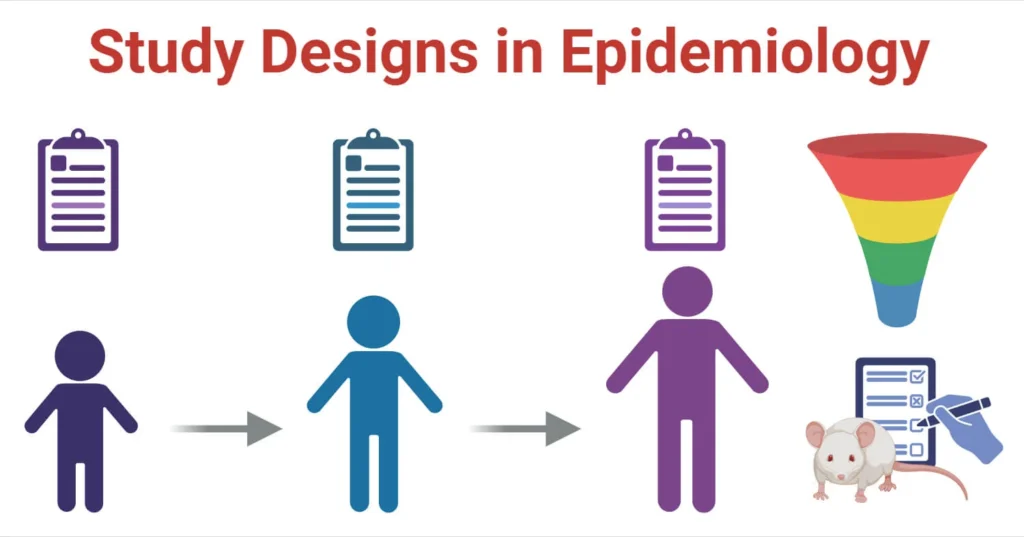
By the end of this session, you should be able to:
- Explain target, source, study, and sample populations.
- Distinguish reference population from study population.
- Describe cross-sectional, case-control, and cohort studies.
- Explain the basic logic of experimental studies and trials.
- Select a suitable design for a clear research question.
🎯 Core Message: A good study design starts with a clear population and a clear question.
| Step | Question | Action |
|---|---|---|
| Observation | Many children have fever. | Notice the pattern. |
| Question | Who, where, when, and why? | Formulate a precise question. |
| Population | Who should be studied? | Define who can answer the question. |
| Design | Which method fits? | Choose the study design that matches the question. |
💡 Key Principle: Design is not chosen because it is popular. It is chosen because it best answers the research question.
- Population tells us who the findings are about.
- It defines who can be included and who cannot.
- It helps us judge whether results can be applied elsewhere (generalisation).
- It prevents confusion between people available and people of interest.
| Level | Definition | Key Question | Example |
|---|---|---|---|
| Target Population | The broad group to whom the study should apply. Usually linked to the public-health problem. May be larger than what you can practically reach. | "Who do we want the findings to speak about?" | All children under five in Uganda during 2026. |
| Source Population | The accessible population from which participants can be selected. Shaped by geography, facilities, records, or community lists. | "From where can we realistically select participants?" | Children under five registered in selected health-centre catchment areas. |
| Study Population | The group that meets the study eligibility criteria (inclusion and exclusion). | "Who is actually eligible in our study?" | Children aged 0 to 59 months, living in the catchment area, whose caregiver provided consent. |
| Sample Population | The actual participants selected and studied. A good sample represents the study population. | "Who actually provided the data?" | 300 eligible children selected from the catchment-area list and surveyed. |
📝 Exam Tip: Always name your populations by person, place, and time. Vague terms like "community members" or "patients" lose marks. Be specific: "Children aged 6 to 59 months in Village X, July 2026."
| Type | Meaning | Example |
|---|---|---|
| Inclusion Criteria | Characteristics people must have to enter the study. | Aged 0 to 59 months; lives in catchment area; caregiver consents. |
| Exclusion Criteria | Reasons eligible people may still be left out for safety or validity. | Visitor from another district; older than five years; no consent provided; severe illness preventing interview. |
| Consistency | Apply the same rules before knowing the outcome. | Do not exclude a child because you suspect their data will weaken your hypothesis. |
⚠️ Critical Rule: Exclusion criteria must be applied consistently and before data collection. Changing rules mid-study introduces selection bias and destroys validity.
- Saying "community members" without naming place or time.
- Using facility attendees to represent people who never attend facilities.
- Changing eligibility rules during data collection.
- Ignoring non-response and missing records.
- Reporting sample findings as if they cover everyone.
Research Question: Is mosquito-net use associated with malaria fever among hostel students during July 2026?
| Population Level | Definition |
|---|---|
| Target Population | All nursing students at the school. |
| Source Population | Students living in the hostel during July (those accessible for study). |
| Study Population | Eligible hostel students who meet criteria (e.g., slept in the hostel ≥4 nights/week, not on antimalarial prophylaxis). |
| Sample | Selected eligible students who complete the survey (e.g., 120 students chosen by systematic random sampling). |
📝 Exam Tip: In a scenario question, always identify all four population levels explicitly. This shows you understand the hierarchy from broad interest to actual data.
The reference population answers: "To whom are we trying to generalise?"
- It is the group to which study findings are intended to apply.
- It is often similar to the target population.
- It should be named before the study starts — not invented afterwards to make the study sound more important.
- It helps readers judge whether results are relevant to their setting.
Example: "Mothers attending ANC in urban public facilities in Uganda." A study conducted at Mulago Hospital could reasonably generalise to this group. It could NOT generalise to rural mothers who never attend ANC.
The study population answers: "Who is actually eligible in our study?"
- It is the specific group from whom data are collected.
- It must be described by eligibility, setting, and time.
- It is usually narrower than the reference population.
- It determines internal validity (are the findings true for this group?) and practical feasibility (can we actually do this?).
Example: "ANC mothers attending Mulago outpatient ANC clinic from July to August 2026, who are ≥18 years old, speak English or Luganda, and provide written consent." This is precise, measurable, and reproducible.
| Feature | Reference Population | Study Population |
|---|---|---|
| Meaning | Broader group for applying findings. | Specific eligible group actually studied. |
| Scope | Usually wider. | Usually narrower. |
| Main Issue | Generalisability — can we apply these findings beyond the study? | Validity — are the findings true for the people we studied? |
| Example | All ANC mothers in Uganda. | ANC mothers in selected facilities who met eligibility criteria. |
These two concepts are the backbone of study quality. Every study must balance them.
| Type | Question | What Affects It? |
|---|---|---|
| Internal Validity | "Are the findings correct for the people studied?" | Selection bias, measurement error, confounding, information bias, how well the study was conducted. |
| External Validity | "Can the findings apply beyond the study population?" | Representativeness of the sample, similarity of settings, cultural context, how the study population compares to the reference population. |
🩺 The Situation: During outreach, nurses screen adults who attend a health camp. 18 of 80 have high blood pressure readings. Define the populations and discuss validity:
- Study population: Adults who attended and were screened at the health camp. This is precise and measurable.
- Reference population: May be "all adults in that community" — but this is a stretch.
- The problem: People who attend outreach may differ from those who stay home. Attendees may be:
- More health-conscious (they came for screening).
- Older or retired (they had time to attend).
- Living closer to the venue (better access).
- Female (more likely to seek preventive care in many cultures).
Interpretation must mention this limitation: "Our findings apply to adults who attended the health camp. They may not represent adults who never attend outreach, especially younger men and those living far from services."
⚠️ Exam Trap: Never claim your sample represents "the community" just because you did outreach. Always question: "Who did NOT come?" Those missing people may be the most important.
Research question: "Among children under five in Village A, is untreated drinking water associated with diarrhoea during July 2026?"
| Level | Your Answer |
|---|---|
| Reference population | All children under five in Village A (or all children under five in the district, if the study aims to inform district policy). |
| Source population | Children under five registered in the Village A community health worker (CHW) register or immunisation register — the list you can actually access. |
| Study population | Children under five in Village A who have lived there for at least one month, whose caregivers consent, and who are not currently on antibiotics (which might mask diarrhoea symptoms). |
| Sample | 120 eligible children selected by simple random sampling from the CHW register and interviewed in their homes. |
| One possible limitation | Children not registered with the CHW (e.g., recent arrivals, children of migrant workers) may be missed. If these children have different water sources, the sample is biased (selection bias). |
In observational studies, the researcher does not assign the exposure. Participants are observed as they naturally are. The researcher simply measures what already exists. These designs are essential when experiments are unethical, costly, or impractical.
📝 Key Idea: In observational studies, we observe exposure and outcome without controlling who receives the exposure. We cannot randomise people to "smoke" or "drink contaminated water" — that would be unethical. So we watch what happens naturally.
Definition: A cross-sectional study measures exposure and outcome at the same time — like a photograph. It provides a snapshot of a population at one point in time.
- Estimating prevalence — how common a disease or risk factor is right now.
- Describing the distribution of health problems by person, place, and time.
- Planning health services ("How many hypertensive patients do we have?").
- Generating hypotheses for future research.
Example: Survey students today to record net use and malaria fever history. You ask: "Do you sleep under a net?" AND "Have you had fever in the past 2 weeks?" Both questions are answered at the same time.
Past ➔ [MEASURE NOW] ➔ Future
Exposure and outcome are measured together in the same survey or short period.
| Strengths | Limitations |
|---|---|
| Relatively quick and inexpensive. | Cannot clearly prove cause and effect (temporal ambiguity). |
| Good for estimating prevalence. | Temporal order may be unclear — did the exposure cause the outcome, or did the outcome cause the exposure? |
| Can study many variables at once. | Not ideal for rare diseases (you may not find enough cases in one snapshot). |
| Useful for planning services and generating hypotheses. | Can be affected by response bias (sicker people may not respond). |
Definition: A case-control study begins with the outcome. You find people who HAVE the disease (cases) and people who DO NOT have the disease (controls), then look backward in time to compare their past exposures.
- Rare diseases — you do not need to follow thousands of people; you just find the few who already have the disease.
- Outbreak investigations — "What did the sick people eat that the healthy people did not?"
- Diseases with long latency — e.g., cancer (it would take decades to follow people in a cohort study).
- When you need quick answers with limited resources.
Example: Compare pupils with diarrhoea (cases) and pupils without diarrhoea (controls) by asking about their water-tank use in the past week. You start with the outcome (diarrhoea yes/no) and look back for the exposure (tank water yes/no).
[LOOK BACK] Compare previous exposure ➔ [START HERE] Cases (Outcome +) vs. Controls (Outcome −)
| Strengths | Limitations |
|---|---|
| Efficient for rare outcomes (you do not need a huge sample). | Can suffer from recall bias — cases may remember exposures differently than controls. |
| Useful in outbreaks (quick to conduct). | Selecting good controls is difficult — they must represent the population that produced the cases. |
| Can study many exposures at once. | Usually cannot measure incidence directly (you do not know how many people were at risk). |
| Less costly and faster than long-term follow-up. | Timing may depend on memory or incomplete records. |
📝 Exam Tip — Recall Bias: This is the biggest weakness of case-control studies. A mother whose child died from diarrhoea may remember every detail of what the child ate and drank. A mother whose child is healthy may not remember what her child ate last week. This differential memory creates a false association. Always mention recall bias when critiquing a case-control study.
Definition: A cohort study begins with exposure. You find people who ARE exposed and people who ARE NOT exposed, then follow them forward in time to see who develops the outcome. A "cohort" is simply a group of people who share a common characteristic.
- Prospective cohort: You identify exposed and unexposed people NOW and follow them INTO THE FUTURE to see who gets the disease. This is the "gold standard" of observational studies.
- Retrospective cohort: You look BACKWARD in time using existing records. You find people who were exposed or unexposed in the past and check whether they already developed the outcome. Faster than prospective, but depends on good records.
- Measuring incidence and risk — how many new cases occur over time.
- Establishing temporal sequence — exposure is measured before outcome, so causation is more plausible.
- Studying multiple outcomes from one exposure (e.g., smoking causes lung cancer, heart disease, COPD, and stroke).
- Studying the natural history of disease.
Example: Follow 100 students who sleep under nets (exposed) and 100 students who do not (unexposed) for one semester. Count how many in each group develop malaria. You start with exposure and move forward to outcome.
[START WITH EXPOSURE] Exposed vs. Unexposed ➔ [FOLLOW FORWARD] ➔ Outcome? YES / NO
| Strengths | Limitations |
|---|---|
| Measures incidence and risk directly. | Can take a long time and many resources (especially prospective). |
| Clearer timing — exposure is measured before outcome. | Loss to follow-up can bias results (people who drop out may be sicker or busier). |
| Can study several outcomes from one exposure. | Not efficient for very rare outcomes (you would need to follow millions of people). |
| Good for studying natural history of disease. | Requires careful tracking and data management. |
📝 Exam Tip — Loss to Follow-Up: This is the biggest weakness of cohort studies. If 30% of your exposed group drops out (because they got sick, moved away, or died), your results are biased. The people who remain may be healthier or more compliant than those who left. Always mention loss to follow-up when critiquing a cohort study.
Use this decision table to match your research question to the best design:
| Research Question | Best Design | Why It Fits |
|---|---|---|
| How common is hypertension today? | Cross-sectional | Measures prevalence at one point in time. |
| What exposure may explain this outbreak? | Case-control | Starts with outcome, looks back for exposure. Fast and efficient. |
| Does exposure lead to later disease? | Cohort | Follows exposed and unexposed forward. Establishes temporal sequence. |
| What is the incidence of malaria over one term? | Cohort | Measures new cases over time. Incidence requires follow-up. |
| What proportion of mothers use ANC? | Cross-sectional | Describes current behaviour and service use. |
Cross-sectional = Current snapshot.
Case-control = Checking back.
Cohort = Coming forward.
Three C's: Current, Checking back, Coming forward.
In experimental studies, the researcher assigns an intervention or exposure. This is the key difference from observational studies. The researcher actively manipulates the exposure and then compares outcomes between groups.
- The goal is to test whether an intervention causes an effect.
- Experimental designs provide the strongest evidence of causation.
- They are essential for evaluating new drugs, vaccines, health education programs, and clinical protocols.
- Ethics and safety are central. You cannot experiment on people without ethical approval, informed consent, and careful monitoring.
💡 Core Idea: Assign ➔ Compare ➔ Follow up ➔ Interpret.
The gold standard of experimental designs. Participants are randomly allocated to either the intervention group or the control group. Randomisation means chance decides group allocation — not the researcher's preference, not the patient's choice, and not convenience.
Eligible Participants ➔ [RANDOMISATION] ➔ Intervention Group & Control Group ➔ [FOLLOW UP] ➔ Measure Outcome ➔ [COMPARE] Is the difference statistically significant?
- It balances known confounders (age, sex, income) between groups.
- It also balances unknown confounders — factors you did not think to measure.
- It eliminates selection bias — the researcher cannot put sicker patients in the intervention group because they "need it more."
- It allows you to say: "Any difference in outcome is likely due to the intervention, not to pre-existing differences between the groups."
| Concept | What It Means | Why It Matters |
|---|---|---|
| Randomisation | Allocate participants fairly to groups using chance (coin flip, random number table, computer). | Balances confounders. Eliminates selection bias. Makes groups comparable at baseline. |
| Control Group | The group that does NOT receive the new intervention. They may receive usual care, a placebo, or delayed intervention. | Provides a comparison. Without a control, you cannot tell if the outcome improved because of the intervention or because of natural change. |
| Follow-up | Measure outcomes after the intervention, at defined time points. | Shows whether the effect is immediate, delayed, or sustained. Loss to follow-up weakens validity. |
| Blinding | Keeping participants, researchers, or outcome assessors unaware of which group participants are in. | Prevents placebo effect (participants feel better because they think they got treatment) and observer bias (researchers unconsciously rate outcomes differently). |
| Intention-to-Treat (ITT) | Analyse participants in the group they were originally randomised to, even if they did not complete the intervention. | Preserves the benefits of randomisation. Prevents bias from excluding non-compliant participants. |
📝 Exam Tip: When asked "Why is randomisation useful?" always mention: (1) it balances known confounders, (2) it balances unknown confounders, and (3) it eliminates selection bias. These three points earn full marks.
Not all interventions can be randomised. Quasi-experimental designs are used when randomisation is impossible, unethical, or impractical.
- An intervention is introduced, but participants are not randomly assigned.
- Common in service delivery and quality improvement settings.
- Examples: before-and-after studies (measure outcomes before and after an intervention in the same group) and controlled before-and-after studies (compare one group that got the intervention with another group that did not, measured at two time points).
- Interpretation challenge: Other changes may have occurred at the same time (e.g., a national health campaign, seasonal change). You cannot be sure the intervention alone caused the difference.
Example: Measure hand hygiene compliance before and after a ward training intervention. If compliance rises from 40% to 75%, was it the training? Or was it a new infection control policy announced at the same time? Or increased supervision? Quasi-experimental designs cannot fully separate these effects.
Experimental studies involve active manipulation of people's health. Ethics are not optional — they are mandatory.
- Informed consent: Participants must understand what the study involves, the risks, the benefits, and their right to withdraw. Consent must be voluntary — no coercion.
- Reasonable chance of benefit: The intervention should be based on prior evidence that it might work. You cannot test something that is known to be harmful or useless.
- Minimise risks: Risks must be as low as possible. Participants must be monitored for adverse effects.
- No denial of essential care: The control group cannot be denied care they would normally receive. If there is an effective treatment, the control group gets it (the new intervention is tested against standard care, not against nothing).
- Confidentiality and respectful care: Participant data must be protected. Identities must not be revealed. Participants must be treated with dignity.
- Ethical review: All experimental studies must be approved by an Institutional Review Board (IRB) or Ethics Committee before starting.
⚠️ Critical: You cannot randomise people to a harmful exposure (e.g., "smoking group" vs. "non-smoking group"). That would be unethical. For harmful exposures, use observational studies.
🩺 Research Question: "Does a handwashing education package reduce diarrhoea among pupils over one school term?"
| Element | Description |
|---|---|
| Population | Pupils in selected schools (e.g., 4 primary schools in one district). |
| Intervention | Handwashing education (daily demonstrations, posters, songs) + provision of soap and water stations. |
| Comparison | Usual hygiene education OR delayed intervention (the control schools get the program after the study ends). |
| Outcome | Number of diarrhoea episodes per pupil during the 12-week follow-up period, recorded by teachers and verified by parents. |
- Cluster RCT: Randomise entire schools (not individual pupils) to intervention or control. This prevents contamination — pupils in the intervention group might teach handwashing to control-group friends if they are in the same school.
- Quasi-experimental: If you cannot randomise schools, use a before-and-after design in the same schools, comparing diarrhoea rates in Term 1 (before) vs. Term 2 (after intervention).
| Strengths | Limitations |
|---|---|
| Strongest evidence of intervention effect | Can be expensive |
| Randomisation reduces selection bias | Requires ethical approval and monitoring |
| Clear timing: intervention before outcome | May not reflect routine practice (trials often have more resources) |
| Useful for policy decisions | Loss to follow-up can weaken results |
| Feature | Observational | Experimental |
|---|---|---|
| Exposure | Naturally occurring | Assigned by researcher |
| Main Purpose | Describe or study associations | Test intervention effect |
| Examples | Cross-sectional, case-control, cohort | RCT, field trial, quasi-experiment |
| Key Caution | Confounding and bias | Ethics, feasibility, adherence |
| Proving Causation? | Difficult — shows association | Strongest — supports causation |
| Cost & Time | Usually cheaper and faster | Usually expensive and lengthy |
💡 Key Principle: You cannot do an RCT for everything. You cannot randomise people to "smoking." For harmful exposures, use observational studies. For testing new treatments, use RCTs.
Use PICO to break down any research question:
| Letter | Meaning | Example |
|---|---|---|
| P | Population — Who is being studied? | Nursing students in the hostel. |
| I/E | Intervention / Exposure — What is being compared? | Sleeping under a mosquito net. |
| C | Comparison — What is the control? | Not sleeping under a net. |
| O | Outcome — What is measured? | Malaria fever during the term. |
💡 Mnemonic: "Please Identify Clear Outcomes" = PICO.
- Design: Cross-sectional.
- Reason: Measures prevalence at a single point in time.
- Limitation: Attendees may differ from non-attendees (selection bias).
- Design: Case-control.
- Reason: Starts with outcome (diarrhoea), looks back for exposure (tank water).
- Limitation: Recall bias — parents of sick children may remember water exposure differently.
- Design: Cohort.
- Reason: Starts with exposure (net use), follows forward to outcome (malaria).
- Limitation: Loss to follow-up; confounding (net users may be more health-conscious).
- Design: Cluster RCT.
- Reason: Tests an intervention; randomise by school to prevent contamination.
- Limitation: Expensive; Hawthorne effect (being observed changes behaviour).
- P: Mothers attending ANC.
- O: Knowledge of danger signs.
- Design: Cross-sectional survey.
- P: Mothers who delivered in the facility.
- E: Hand hygiene, instrument sterilisation, duration of labour.
- O: Wound infection.
- Design: Case-control (fast) or Cohort (measures incidence).
- P: Children in the affected community.
- E: Vaccination status.
- O: Measles infection.
- Design: Cohort (follows vax vs. unvax) or Case-control (compare vax status of cases vs. controls).
- P: Outpatients at the clinic.
- I: New triage system.
- C: Standard triage.
- O: Waiting time (minutes).
- Design: Quasi-experimental (before-and-after) or Cluster RCT if two similar clinics exist.
| Item | Group Answer |
|---|---|
| Research question | Write it clearly. |
| Population (P) | Who is being studied? |
| Exposure / Intervention (I/E) | What is being compared? |
| Comparison (C) | What is the control? |
| Outcome (O) | What is measured? |
| Best design | Cross-sectional, case-control, cohort, or trial? |
| Reason | Why does the design fit? |
| One strength | What does this design do well? |
| One limitation | What could go wrong? |
Target = broad group findings should apply to. Sample = actual participants studied. The sample is a subset of the study population, which is a subset of the source population, which is a subset of the target population.
Case-control starts with outcome and looks backward for exposure. Cohort starts with exposure and follows forward for outcome. Case-control is efficient for rare diseases; cohort measures incidence.
Cross-sectional. It takes a snapshot at one point in time.
The researcher assigns the exposure/intervention. This is the defining feature.
It distributes known and unknown confounders evenly between groups, reducing selection bias and strengthening causal inference.
Internal = Are findings correct for the people studied? External = Can findings apply to other settings?
Exposure and outcome are measured simultaneously — we cannot establish which came first.
Cases remember past exposures differently (often more accurately) than controls. Most affects case-control studies.
Participants drop out before outcome measurement. If dropouts differ systematically between groups, the comparison is biased. Most affects cohort studies and RCTs.
When randomisation is not feasible or ethical — e.g., ward-wide quality improvement, school-wide programs, or when you cannot deny an intervention to a control group.
A third factor associated with both exposure and outcome, creating a false association. Example: Coffee appears linked to lung cancer, but the confounder is smoking. Smokers drink more coffee AND have higher lung cancer risk.
- Gordis, L. (2013). Epidemiology (5th ed.). Saunders Elsevier.
- Webb, P., & Bain, C. (2010). Essential Epidemiology: An Introduction for Students and Health Professionals (2nd ed.). Cambridge University Press.
- Rothman, K. J., Greenland, S., & Lash, T. L. (2008). Modern Epidemiology (3rd ed.). Lippincott Williams & Wilkins.
- Hulley, S. B., Cummings, S. R., Browner, W. S., Grady, D. G., & Newman, T. B. (2013). Designing Clinical Research (4th ed.). Lippincott Williams & Wilkins.
Quick Quiz
Study Population and Design Quiz
Epidemiology and Biostatistics
Privacy: Your details are used only for quiz tracking and certificates.
Study Population and Design Quiz
Epidemiology and Biostatistics
Preparing questions...
Choose your answer and keep your streak alive.
Great effort.
Here is your quick performance summary.