
Goals are the things you want to achieve. They are like the destination of a journey.
- In curative medicine, the goal is often: "Cure the disease."
- In hospice care, the goals are different. The goals are about:
- Quality of life
- Comfort in the body
- Peace in the mind
- Love in relationships
- Meaning in the remaining time
- Dignity in death
The core goals of hospice can be remembered as "The Five C's":
- Comfort (Physical pain management)
- Compassion (Empathy in suffering)
- Communication (Honest, gentle truth-telling)
- Continuity (Care that doesn't abandon the patient)
- Closure (Helping resolve unfinished business)
Plus: Quality of life, Dignity, Family support, and Bereavement care.
Goal 1: Physical Comfort and Symptom Control
This is the first and most urgent goal. A person in severe pain cannot think about anything else.
- Assess pain at every visit using a scale (0 = no pain, 10 = worst pain imaginable).
- Believe the patient when they say they have pain. Pain is subjective; it is whatever the experiencing person says it is.
- Use the WHO analgesic ladder:
- Step 1: Mild pain — paracetamol, ibuprofen (Inhibits prostaglandins).
- Step 2: Moderate pain — codeine, tramadol (Weak mu-opioid receptor agonists).
- Step 3: Severe pain — morphine (Strong mu-opioid receptor agonist).
- Give medicine by the clock, not just when the patient asks. (Pharmacological Expansion: By-the-clock dosing maintains a steady therapeutic plasma concentration of the drug, preventing the pain from breaking through).
- Prevent pain, do not just treat it after it starts.
- Morphine always causes constipation — give laxatives with it. (Mechanism: Opioids bind to mu-receptors in the gut, freezing peristalsis and drying out stool).
- Morphine may cause nausea at first — this usually improves in 3-5 days. (Mechanism: It stimulates the Chemoreceptor Trigger Zone [CTZ] in the medulla).
- Morphine may cause drowsiness at first — this usually improves as tolerance to the sedative effect develops quickly.
| Symptom | Why It Matters | How Hospice Addresses It |
|---|---|---|
| Nausea and vomiting | Patient cannot eat or drink; becomes weak and dehydrated. | Anti-nausea medicines (metoclopramide, haloperidol), small frequent meals, avoiding strong smells. |
| Constipation | Caused by morphine, immobility, poor diet; causes pain and discomfort. | Laxatives (senna, lactulose), fluids, fiber, mobility. |
| Diarrhea | Causes dehydration, weakness, skin breakdown. | Loperamide, ORS, zinc, treat infection. |
| Shortness of breath | Terrifying feeling of suffocation; patient feels like they are drowning. | Morphine (decreases central air hunger), oxygen, positioning (sitting up), fan blowing on face, calm environment. |
| Cough | Exhausting, prevents sleep, causes pain. | Codeine linctus, antibiotics if infection, steroids. |
| Fatigue | Overwhelming tiredness; patient cannot do anything. | Treat anemia if present, gentle exercise, energy conservation, treat depression. |
| Insomnia | Cannot sleep; body cannot heal; mind becomes anxious. | Treat pain, treat anxiety, calm bedtime routine, avoid caffeine, medicine if needed. |
| Confusion | Frightening for patient and family; patient may become agitated. | Treat cause (infection, dehydration, medicine side effects), haloperidol, calm environment, family presence. |
| Itching | Distressing, prevents sleep, causes skin damage. | Antihistamines, moisturizers, treat cause (jaundice, kidney failure). |
| Bedsores | Painful, can become infected, smell bad. | Prevention (turning every 2 hours), special cushions, wound care, nutrition. |
| Mouth sores | Cannot eat, drink, or talk; risk of infection. | Mouth care, antifungals, local anesthetics, soft foods. |
- Cleanliness: Regular bathing, clean clothes, clean bedding.
- Positioning: Pillows for support, changing position to prevent stiffness and bedsores.
- Environment: Clean, quiet, well-ventilated room, familiar objects.
- Temperature: Not too hot, not too cold.
- Skin care: Moisturizing, preventing dryness and cracking.
- Oral care: Clean mouth prevents infection and improves appetite.
- Nutrition: Small, frequent, favorite foods; not forcing food when the patient is actively dying (as organs shut down, the body can no longer digest food, and forced feeding can cause aspiration or painful bloating).
Goal 2: Psychological Peace and Emotional Support
Psychological care is care for the mind and emotions. It is about helping the patient feel less afraid, less anxious, less depressed, more at peace, more in control, and more understood.
- A. Need for Honesty:
- Patients usually know more than we think they do. They sense when information is being hidden.
- Honesty builds trust. Honesty does not mean cruelty — it means kindness with truth.
- Example: Instead of saying "You will be fine" (when the patient will not), say "We are doing everything to keep you comfortable. We will not leave you."
- B. Need for Hope:
- Hope does NOT mean "you will be cured."
- Hope in hospice means: "We hope your pain will be controlled," "We hope you can see your daughter graduate," "We hope you can sit outside in the sun tomorrow," "We hope you can make peace with your brother," "We hope you can die peacefully."
- Help the patient find realistic, meaningful hopes.
- C. Need for Control:
- Illness takes away control over the body. Hospice gives back control through choices: What to wear, what to eat, when to bathe, who visits, what music plays, where to die.
- Even small choices restore dignity.
- D. Need for Completion:
- Many patients have "unfinished business": Reconciling with an estranged family member, writing a letter to a child, blessing their children, forgiving someone, asking for forgiveness, seeing a grandchild born, visiting their home village one last time.
- Hospice helps patients complete these tasks.
- E. Need for Legacy:
- Patients want to know they will be remembered. Hospice helps patients leave something positive: Recording their life story, writing letters, making a video message, giving advice to family, teaching a skill to a grandchild, creating something (a craft, a poem, a song).
Goal 3: Social Support and Practical Help
In Uganda, illness affects the whole family system. The patient cannot work ➔ family loses income. The caregiver cannot work ➔ further loss of income.
Children may drop out of school to care for the parent. The family may sell their land or animals to pay for medicine.
Neighbors may stop visiting because of stigma. The family may be isolated and ashamed.
- A. Maintain Family Connections: Encourage family members to visit, help family talk to each other, facilitate family meetings to discuss care, help children visit their dying parent safely, and support the spouse or partner.
- B. Reduce Stigma and Isolation: Educate the community about the illness (with permission), connect family to support groups, encourage neighbors to visit, and show that illness is not a curse or shame.
- C. Provide Practical Assistance: Help with transport to hospital/clinic, food/nutrition, school fees for children, legal matters (wills, property, guardianship), funeral planning, and connect to NGOs and government programs.
- D. Support Caregivers: The family caregiver (often a wife, daughter, or mother) is the unsung hero of hospice care. They need: Training in basic nursing skills, respite (a break from caregiving), emotional support, recognition, and health care for themselves (caregivers often get sick from exhaustion).
Goal 4: Spiritual Care and Peace
Spiritual care is care for the soul — the deepest part of a person. It is about meaning and purpose ("Why am I here?"), hope ("What can I hope for now?"), forgiveness ("Can I be forgiven?"), love ("Am I loved?"), transcendence ("Is there something beyond this life?"), belonging, and peace.
💡 Spiritual Care is NOT Just Religious Care
Religious care is PART of spiritual care (prayer, scripture, rituals). Spiritual care is broader — it includes anyone, even those who do not follow a religion. A patient may say "I am not religious, but I need to know my life had meaning." That is a deep spiritual need.
- A. Help the Patient Find Meaning: Ask: "What gives your life meaning?" "What are you most proud of?" "What do you want to be remembered for?" Help them see their life has value.
- B. Support Reconciliation: Make peace before they die: With God (confession, prayer), with family (healing old wounds), with themselves (letting go of guilt).
- C. Respect Religious Practices: For Christians (Prayer, Bible, Holy Communion, last rites). For Muslims (Salat, Quran reading, facing Mecca, body washing). For traditional believers (Respecting rituals, traditional healers). For all: Respect dietary laws and dress.
- D. Address Spiritual Distress:
- Signs: Anger at God, feeling punished ("I am sick because I sinned"), despair, fear of death, feeling meaningless.
- How to help: Listen without judgment. Do not offer easy answers ("Everything happens for a reason" can be hurtful). Acknowledge the struggle. Connect to spiritual leaders (pastor, imam, priest).
Goal 5: Family Support and Bereavement Care
- A. Education and Training: Teach family how to give medicines, turn patient every 2 hours, clean wounds, recognize danger signs, provide mouth care, and use a morphine bottle safely.
- B. Emotional Support: Listen to fears, acknowledge anticipatory grief (grieving before the person dies), provide counseling, and check on caregiver health.
- C. Respite Care: Arrange a volunteer or nurse to care for the patient so the family can sleep, work, or rest. Without respite, caregivers burn out.
- A. Immediate Support: Be present at death, notify family gently, allow time with the body, help with practical matters (calling relatives, transport).
- B. Early Bereavement (First Few Weeks): Home visits, phone calls, counseling, support for children, help with school fees or food.
- C. Ongoing Bereavement (Months to Years): Support groups for widows/orphans, memorial services, long-term counseling.
- D. Complicated Grief: When people get "stuck" and cannot move forward.
- Signs: Inability to function after many months, thoughts of suicide, severe depression, refusing to accept the death (keeping room exactly as it was, talking to them as if alive), complete social withdrawal.
- Management: Professional counseling, support groups, sometimes medication.
Case: The wife of a dying patient cries constantly and tells the nurse she doesn't know how she will live without him. Six months after his death, she still refuses to leave her home, has not touched his belongings, and has stopped eating, losing 10kg.
Analysis: Before the death, her crying was Anticipatory Grief (normal and expected). Six months later, her inability to function, severe weight loss, and social withdrawal indicate Complicated Grief (pathological) requiring professional psychiatric/counseling intervention.
Goal 6: Dignity and Respect
What is Dignity? Dignity means worth, honor, and self-respect. It means treating a person as valuable and important, no matter how sick, weak, or poor they are.
- A. Physical Dignity: Keeping the body clean, covering the patient during exams, using their preferred name/title, knocking before entering, asking permission to touch, dressing them in their own clothes.
- B. Emotional Dignity: Not talking about the patient as if they are not there, not showing disgust at wounds or smells, listening without interrupting, taking concerns seriously.
- C. Social Dignity: Not judging poverty or background, respecting cultural practices, maintaining confidentiality, not sharing diagnosis without permission.
- D. Dignity at Death: Clean body and clothes, peaceful environment, family present, religious rituals performed, no unnecessary procedures/tubes, pain controlled, body treated with respect after death.
Goal 7: Quality of Life
Quality of life means how good or comfortable a person's life feels. It is not about how long they live — it is about how well they live.
| Dimension | What It Means | How Hospice Improves It |
|---|---|---|
| Physical | Comfort, pain control, ability to move, sleep, eat | Pain medicine, symptom control, positioning, hygiene |
| Psychological | Emotional peace, lack of fear, sense of control | Counseling, honesty, choices, emotional support |
| Social | Connection to family and friends, belonging, love | Family visits, community support, reducing stigma |
| Spiritual | Peace with God, meaning, hope, forgiveness | Spiritual care, prayer, reconciliation, finding purpose |
| Functional | Ability to do daily activities, even small ones | Occupational therapy, adaptive equipment, energy conservation |
| Environmental | Clean, safe, comfortable home or care setting | Home care, clean bedding, familiar objects, quiet space |
Patient: A 70-year-old man with advanced prostate cancer, severe bone pain, living in a village in western Uganda.
Without hospice: Pain score 9/10 (screams when moved). Cannot sleep. Family exhausted/afraid. Feels like a burden. Too angry at God to pray. Isolated in a dark room. Quality of life: Very poor.
With hospice: Pain score 2/10 (morphine controls pain). Sleeps through the night. Family trained. Sits outside in the sun. Tells stories to grandchildren. Reconciles with estranged son. Prays with pastor. Dies peacefully holding his wife's hand. Quality of life: Good — even though he died, his last months were meaningful.
| Goal | What It Means | Key Actions |
|---|---|---|
| Physical comfort | Control pain and symptoms | Pain assessment, WHO analgesic ladder, morphine, symptom management |
| Psychological peace | Emotional support, honesty, hope | Counseling, listening, realistic hope, addressing fears |
| Social support | Family connections, practical help | Family education, community engagement, connecting to resources |
| Spiritual care | Meaning, forgiveness, peace with God | Prayer, spiritual assessment, reconciliation, respecting rituals |
| Family support | Help during illness and after death | Caregiver training, respite, bereavement counseling, orphan support |
| Dignity and respect | Treating the patient as valuable | Privacy, cleanliness, cultural respect, honoring wishes |
| Quality of life | Living well, not just living long | Holistic care, patient-centered choices, comfort in all dimensions |
Holistic comes from the word "whole." It means treating the entire person, not just the disease or the body part that is sick. It includes physical, psychological, social, spiritual, and cultural dimensions.
| Disease-Focused Care | Holistic Care |
|---|---|
| "The cancer is in the liver." | "The patient has cancer, but she is also a mother, a farmer, a Christian, and a grandmother." |
| "Give medicine for the tumor." | "Give medicine for the tumor, AND listen to her fears, AND help her children, AND pray with her." |
| "Treat the body." | "Treat the body, mind, heart, soul, family, and community." |
| "The patient is a case." | "The patient is a whole person with a name, a story, and a network of relationships." |
| "Success = tumor shrinks." | "Success = patient is comfortable, at peace, and surrounded by love." |
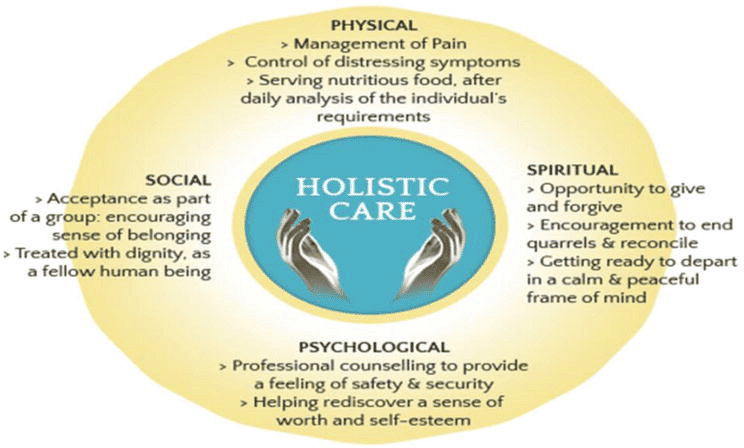
Imagine a person as a house with five pillars holding it up. If one pillar falls, the house becomes unstable. Holistic care strengthens all five pillars.
- What it includes: Pain management, symptom control, nutrition/hydration, mobility, hygiene, wound care, oral care, bowel/bladder care, sleep, preventing complications.
- Why it is important: If the body is in pain, the patient cannot think, pray, or love. Physical comfort is the foundation of all other care.
- What nurses do: Give medicine on time, turn patient every 2 hours, keep skin clean/dry, mouth care twice daily, help with eating, position for comfort, document everything.
- What it includes: Emotional support, active listening, addressing anxiety/depression, supporting through grief, maintaining hope, addressing body image changes, addressing confusion.
- Why it is important: Mind and body are deeply connected. Depression reduces appetite; anxiety intensifies physical pain.
- What nurses do: Sit and listen, ask open questions ("How are you feeling today?"), validate emotions, provide a calm environment, use appropriate touch, recognize depression.
- What it includes: Supporting family relationships, addressing financial/housing problems, children's education, reducing stigma, supporting the caregiver, planning for the family's future.
- Why it is important: In Uganda, the family is the primary caregiver. Social problems cause suffering just as much as physical problems (e.g., a dying mother worrying about school fees).
- What nurses do: Assess social situation, ask about outside worries, connect families to NGOs/churches, facilitate family meetings, teach caregiving skills, arrange respite care.
- What it includes: Supporting religious beliefs, helping find meaning, facilitating prayer, supporting forgiveness, addressing spiritual distress, respecting cultural beliefs.
- Why it is important: Faith is the center of life for many Ugandans. Spiritual peace reduces physical pain.
- What nurses do: Ask about spiritual needs, respect prayer times, arrange for religious leaders to visit, pray with patient if requested, listen without judgment.
- What it includes: Respecting tribal identity/language, understanding beliefs about illness/death, respecting gender roles, supporting traditional practices (that don't harm), respecting food preferences and mourning customs.
- Why it is important: Uganda has over 50 tribes. Cultural disrespect breaks trust.
- What nurses do: Learn key phrases in their language, ask about cultural beliefs regarding the illness, respect family decision-makers, do not judge beliefs about curses/witchcraft, respect food preferences.
The five dimensions are NOT separate. They are like a spider's web — touch one part, and the whole web moves.
- The Cycle of Suffering: Severe back pain (physical) ➔ prevents sleep (physical) ➔ irritability/depression (psychological) ➔ shouts at daughter (social) ➔ daughter stops visiting (social) ➔ feels abandoned by God (spiritual) ➔ distress amplifies physical pain.
- The Healing Connection: Volunteer visits lonely widow (social) ➔ brings food (physical/social) ➔ connects to support group (psychological) ➔ pastor visits (spiritual) ➔ patient begins to eat again (physical) and finds meaning (spiritual).
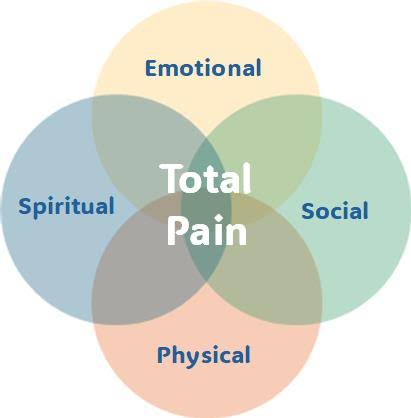
Introduced by Dame Cicely Saunders (the founder of the modern hospice movement), "Total Pain" states that pain has four interconnected parts:
- Physical pain: The hurting body (tumor pressing on bone, nerve damage).
- Emotional pain: The hurting heart (fear, sadness, anger, loneliness).
- Social pain: The hurting relationships (worry about family, money, stigma).
- Spiritual pain: The hurting soul (questioning God, fear of death, needing forgiveness).
Patient Grace (50yo, cervical cancer):
- Physical: Pain 8/10, burning.
- Emotional: Terrified of dying, feels like a "bad mother".
- Social: Husband left her, daughter dropped out of school to care for her, no money, stigma from neighbors.
- Spiritual: Believes God is punishing her for past sins, feels abandoned.
Holistic Care Plan: Morphine/positioning (Physical), Counseling regarding fears (Emotional), Connect to NGO for school fees and widows group (Social), Pastor visit/reconciliation (Spiritual). Result: Pain score drops to 3/10 because all dimensions were treated!
- Hospital: IV morphine, daily counseling, family meetings, chaplain visits, language interpreters.
- Home (Most Common in Uganda): Home visits, oral morphine, community volunteers, NGO assistance, home pastor visits.
- Day Care: Medical review, group discussions/peer support, lunch together, group prayer, cultural dances.
- Roadside Clinic: Quick assessment/dispensing, brief counseling, connecting to community resources, respecting local norms.
You Are the Coordinator: The nurse is often the only team member who sees the patient regularly across ALL dimensions. At every visit, assess ALL five dimensions using your holistic checklist.
| Dimension | Problem | Intervention |
|---|---|---|
| Physical | Pain score 7/10 | Increase morphine dose, add breakthrough dose, check constipation |
| Psychological | Patient is anxious and not sleeping | Counseling, relaxation techniques, treat pain (pain causes anxiety) |
| Social | Family has no money for food | Connect to NGO, church support, community food program |
| Spiritual | Patient feels God has abandoned them | Arrange pastor visit, pray with patient if requested, listen to spiritual struggles |
| Cultural | Patient speaks only Luo, nurse speaks only English | Arrange interpreter, use simple language, respect traditional beliefs |
- Mistake 1: Focusing Only on Physical Care. Giving morphine but never asking how they feel emotionally. Result: Patient is physically comfortable but emotionally suffering.
- Mistake 2: Ignoring Culture. Imposing your own religious beliefs or dismissing traditional healers. Result: Family loses trust and rejects care.
- Mistake 3: Forgetting the Family. Ignoring the exhausted caregiver. Result: Caregiver burns out, patient receives poor care at home.
- Mistake 4: Rushing. Giving medicine and leaving without listening. Result: Patient feels like a "task" rather than a person.
- Mistake 5: Imposing Your Own Values. Telling the patient they "should" pray or "should" accept death. Result: Patient feels judged and disrespected.
- Treating the whole person, not just the disease (body, mind, heart, soul, and culture).
- Understanding that all parts are connected. Pain is not just physical — it is emotional, social, and spiritual.
- Asking about everything: pain, fears, family, money, God, culture.
- Remembering that the patient is a person: they have a name, a story, a family, a faith, and a tribe.
- Being present: Sometimes the most holistic thing you can do is sit quietly and hold a hand.
- World Health Organization (WHO) Guidelines for the Pharmacological and Radiotherapeutic Management of Cancer Pain in Adults and Adolescents.
- Saunders, C. (1967). The Management of Terminal Disease (Concept of Total Pain).
- African Palliative Care Association (APCA) standards for providing holistic care.