
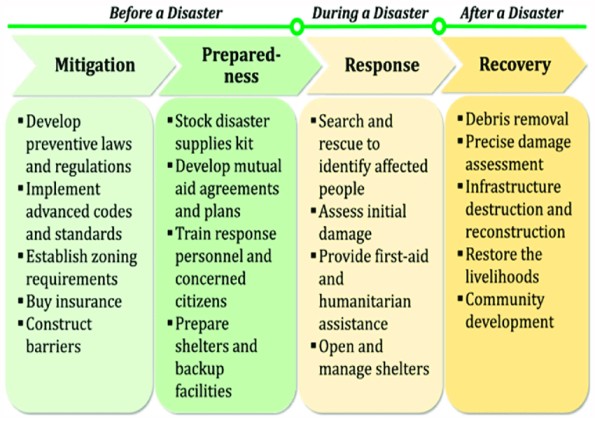
Definition: Disaster Management is a comprehensive range of activities, programs, and measures that are undertaken before, during, and after a disaster.
- Before the exam — You study, gather materials, and rest (preparation)
- During the exam — You write carefully, manage your time, and stay calm (response)
- After the exam — You review your performance and plan how to improve (recovery)
The primary purpose is to:
| Purpose | Simple Meaning |
|---|---|
| Prevent a disaster | Stop it from happening in the first place |
| Minimize impact | If it happens, reduce how bad it is |
| Facilitate recovery | Help people return to normal life after |
Disaster management never stops. Even when there is no disaster, communities must continue preparing for future ones.
Disaster management involves many different sectors working together:
- Health sector — Hospitals, clinics, community health workers
- Government — Office of the Prime Minister, local councils
- Non-Governmental Organizations (NGOs) — Red Cross, UNICEF, World Vision
- Community — Local leaders, religious institutions, families
- Private sector — Telecommunication companies, transport services
Many different professionals must work together:
- Nurses and doctors
- Engineers and architects
- Police and army
- Teachers and social workers
- Meteorologists and environmental scientists
The overall aim is to minimize:
- Loss of life — Prevent deaths
- Disability — Prevent permanent injury
- Suffering — Reduce pain and distress
- Damage — Protect property and infrastructure
There are five main objectives of disaster management. Nurses must understand each one because they play a role in all of them.
Definition: Efforts to prevent and decrease the likelihood of hazards occurring in the first place.
- Bududa landslides — Preventing settlement on steep slopes prevents deaths
- Kampala floods — Stopping construction in wetlands reduces flooding
- Karamoja drought — Planting drought-resistant crops reduces food insecurity
- Teach communities about risky behaviors
- Advocate for safe building practices
- Participate in vaccination campaigns to prevent disease outbreaks
Definition: Actions taken to lessen the effects of hazards on vulnerable populations and infrastructure.
| Prevention | Mitigation |
|---|---|
| Stops the hazard from happening | Reduces damage when hazard happens |
| Example: Banning building in floodplains | Example: Building houses on stilts in flood-prone areas |
- Building retaining walls on steep slopes in Mbale
- Installing lightning conductors on schools and hospitals
- Using fire-resistant materials in market construction
- Elevating water tanks so they survive floods
- Identify vulnerable groups in the community
- Support mitigation projects (e.g., tree planting)
- Ensure health facilities are built to withstand disasters
Definition: Preparing for potential disasters by developing response plans, training personnel, and stockpiling essential resources.
- Response plans — Written plans of what to do
- Training — Teaching people their roles
- Stockpiling — Keeping supplies ready
- Drills — Practicing what to do
- Know your hospital's disaster plan
- Maintain certification in first aid and CPR
- Participate in disaster drills
- Help prepare community emergency kits
Definition: Swift and efficient response to a disaster to mitigate its impact and provide immediate assistance to affected individuals.
- Quick activation of emergency teams
- Fast deployment of resources
- Immediate medical care
- Efficient coordination
- Triage victims quickly
- Provide first aid immediately
- Communicate clearly with team members
- Document injuries and treatments accurately
Definition: Implementation of programs and initiatives aimed at restoring the affected community and supporting the physical, emotional, and socio-economic recovery of disaster victims.
| Type | Focus | Example |
|---|---|---|
| Physical recovery | Health and body | Treating injuries, providing prosthetics |
| Emotional recovery | Mind and feelings | Counseling for trauma |
| Social recovery | Relationships and community | Rebuilding community groups |
| Economic recovery | Money and livelihood | Providing loans, restoring farms |
- Continue medical follow-up
- Provide psychological counseling
- Support rehabilitation programs
- Link victims to social services
| Objective | Key Action | Nursing Example |
|---|---|---|
| Risk Prevention | Stop hazards before they happen | Vaccination campaigns |
| Hazard Mitigation | Reduce damage from hazards | Advocating for safe housing |
| Emergency Preparedness | Be ready to respond | Stocking emergency supplies |
| Effective Response | Act quickly during disaster | Triage and first aid |
| Recovery & Rehabilitation | Restore community after disaster | Counseling and follow-up care |
Disaster management activities can be grouped into three main stages based on WHEN they happen.
| STAGES OF DISASTER MANAGEMENT | ||
|---|---|---|
| PRE-DISASTER (Before) | DURING DISASTER (During) | POST-DISASTER (After) |
|
|
|
Definition: The pre-disaster stage includes all proactive measures taken to minimize human and property losses caused by potential hazards.
- Awareness Campaigns: Teaching communities about disaster risks. Using radio, community meetings, and schools. Distributing educational materials in local languages.
- Strengthening Weak Structures: Reinforcing buildings in earthquake-prone areas. Building retaining walls on hillsides. Elevating houses in flood zones.
- Developing Disaster Management Plans:
- Household plans: Where to go, what to bring, how to communicate.
- Community plans: Evacuation routes, shelter locations, communication trees.
- Institutional plans: Hospital disaster plans, school emergency procedures.
- Mitigation Activities: Planting trees to prevent landslides. Digging drainage channels to prevent floods. Enforcing building codes.
- Preparedness Activities: Stockpiling food and water. Training first aid teams. Conducting evacuation drills.
- Educate communities about health risks and preparedness
- Identify vulnerable populations (elderly, pregnant women, disabled)
- Participate in planning at hospital and community level
- Stock medical supplies and check expiration dates
- Train community health workers in first aid
Definition: This stage focuses on addressing the immediate needs of the affected population and minimizing their suffering.
- Emergency Response Activities: Activating disaster response teams. Setting up emergency operations centers. Deploying search and rescue teams.
- Provision of Essential Services: Medical care for injured. Clean water and food distribution. Emergency shelter. Sanitation facilities.
- Rescue and Relief Efforts: Searching for trapped victims. Evacuating people from danger zones. Distributing emergency supplies. Providing psychological first aid.
- Speed — Help must arrive quickly
- Coordination — Agencies must work together, not duplicate efforts
- Prioritization — Most critical needs first
- Safety — Protect responders too
- Triage — Sort victims by severity
- First aid — Stop bleeding, open airways, treat shock
- Documentation — Record injuries and treatments
- Communication — Report needs to coordinators
- Emotional support — Calm frightened victims
Definition: Following a disaster, the emphasis shifts towards initiating recovery and rehabilitation measures for affected communities.
- Restore Essential Services: Repair roads, bridges, and communication lines. Restore water and electricity. Reopen schools and health facilities.
- Rebuild Infrastructure: Reconstruct damaged buildings. Build back better (more resilient structures). Repair homes and public buildings.
- Provide Medical Aid: Continue treating injuries. Manage chronic diseases disrupted by disaster. Mental health services for trauma.
- Facilitate Livelihood Restoration: Provide seeds and tools to farmers. Give loans to restart businesses. Create employment programs.
- Support Early Recovery and Long-Term Resilience: Help communities become stronger than before. Build early warning systems. Improve disaster preparedness for the future.
- Continue patient care — Follow up on injuries and illnesses
- Rehabilitation — Physiotherapy, prosthetic fitting
- Mental health support — Counseling, support groups
- Health education — Prevent disease in temporary shelters
- Immunization — Catch up on disrupted vaccination programs
- Empowerment — Teach communities to advocate for their needs
| Stage | When | Focus | Key Activities |
|---|---|---|---|
| Pre-Disaster | Before | Prevention & Preparedness | Awareness, planning, mitigation, stockpiling |
| Disaster Occurrence | During | Immediate Response | Rescue, relief, emergency medical care, evacuation |
| Post-Disaster | After | Recovery & Rehabilitation | Rebuilding, restoring services, counseling, economic recovery |
Disaster management requires many different people working together. No single person or profession can manage a disaster alone.
- Provide emergency medical care
- Admit mass casualties
- Perform emergency surgeries
- Serve as coordination centers for health response
- Identify dead bodies
- Determine cause of death
- Handle bodies respectfully and safely
- Issue death certificates
Psychiatrists, Psychologists, Psychiatric clinical officers, Counselors.
- Provide crisis counseling and long-term therapy
- Dispense emergency medications
- Provide first aid supplies
- Maintain stockpiles of essential drugs
- Ensure continuity of chronic disease medications
- Monitor disease outbreaks
- Coordinate vaccination campaigns
- Ensure water and food safety
- Conduct health surveillance
- Search and rescue teams
- Paramedics
- Ambulance drivers
- First responders
- Extinguish fires
- Rescue people from burning or collapsed buildings
- Provide emergency medical care
- Handle hazardous materials
Local council leaders (LC1, LC2, LC3, LC5), Office of the Prime Minister — Disaster Preparedness, Resident District Commissioners (RDCs).
- Coordinate resources and make policy decisions
Radio and TV stations, Newspapers and social media.
- Disseminate warnings and information
- Educate the public
- Important: Must report accurately to prevent panic
- Produce and distribute essential medical supplies
- Ensure availability of drugs, equipment, and PPE
- Maintain law and order
- Control traffic during evacuation
- Secure disaster scenes
- Prevent looting
- Assist with search and rescue
- Handle dead bodies safely
- Prevent disease spread from corpses
- Provide dignified burial or cremation
- Support grieving families
| Category | Personnel | Main Role in Disaster |
|---|---|---|
| Health Care | Hospitals | Emergency treatment, surgery, admission |
| Medical Examiners | Body identification, cause of death | |
| Mental Health Professionals | Crisis counseling, trauma therapy | |
| Pharmacies | Medication supply, first aid | |
| Public Health Departments | Disease surveillance, outbreak control | |
| Rescue Personnel | Search, rescue, first aid | |
| Non-Health Care | Firefighters | Fire control, rescue, hazmat |
| Government Officials | Coordination, policy, resource allocation | |
| Media | Information dissemination, public education | |
| Medical Supply Manufacturers | Production and distribution of supplies | |
| Police | Security, traffic control, scene safety | |
| Morticians/Funeral Directors | Safe body handling, dignified burial |
🔑 Exam Tip: "Disaster management is a TEAM SPORT. Nurses must know who their teammates are and how to work with them."

The Disaster Management Cycle is a continuous process that shows how disaster management activities flow from one phase to the next. It recognizes that disasters are recurring events, and communities must always be preparing for the next one.
- Phase 1: MITIGATION ➔ flows into ➔
- Phase 2: PREPAREDNESS ➔ flows into ➔
- Phase 3: RESPONSE ➔ flows into ➔
- Phase 4: RECOVERY ➔ loops back to ➔ MITIGATION
Note: The cycle is continuous. After Recovery, the community returns to Mitigation and Preparedness, hopefully stronger than before.
Definition: Mitigation refers to sustained actions that reduce or eliminate long-term risk to people and property from natural hazards and their effects.
- Eliminate the probability of disaster occurrence (where possible)
- Reduce the effects of unavoidable disasters
- Federal/National — Government policies, national building codes
- State/Regional — Regional land use plans
- Local — District and community projects
- Individual — Family decisions (where to build, how to build)
Definition: Structural mitigation involves constructing physical projects to reduce economic and social impacts of disasters.
| Project | Purpose | Ugandan Example |
|---|---|---|
| Dams and levees | Control floodwaters | Dams on the Nile |
| Retaining walls | Prevent landslides | Walls in Bududa |
| Earthquake-resistant buildings | Withstand ground shaking | Reinforced hospital in Kasese |
| Elevated houses | Survive floods | Houses on stilts in flood-prone areas |
| Lightning conductors | Protect from lightning strikes | Schools in Karamoja |
| Fire-resistant materials | Slow fire spread | Markets with concrete instead of wood |
| Strong bridges | Survive floods and earthquakes | Bridges in mountainous areas |
| Cyclone shelters | Safe buildings for evacuation | Community shelters in coastal areas |
Definition: Non-structural mitigation involves policies, awareness, and practices that reduce disaster impact without building physical structures.
| Activity | Purpose | Ugandan Example |
|---|---|---|
| Land use planning | Keep people away from danger zones | Zoning laws preventing building in wetlands |
| Building codes | Ensure safe construction | Enforcement of construction standards |
| Public education | Teach people how to protect themselves | Radio programs on landslide warning signs |
| Insurance | Financial protection after disaster | Crop insurance for farmers |
| Early warning systems | Alert people before disaster | Weather radios in Karamoja |
| Training programs | Teach skills to reduce risk | First aid training for community health workers |
- Promoting Sound Land Use Planning: Identify hazard-prone areas. Zone these areas for safe uses (parks, agriculture). Enforce zoning regulations.
- Relocating or Elevating Structures: Move houses out of floodplains. Raise buildings on pillars. Resettle communities.
- Installing Hurricane Straps: Metal straps attach roof to walls/foundation. Prevents roof blowing off.
- Buying Flood Insurance: Financial protection for belongings.
- Developing and Enforcing Building Codes: Laws specifying safe construction. Regular inspections.
- Engineering Roads and Bridges: Build to withstand earthquakes/floods. Do not block water flow.
- Using Fire-Retardant Materials: Concrete, brick, treated wood. Proper electrical wiring.
Essential supply kits prepared in advance for use during a disaster. Important because shops may be closed, roads blocked, or help delayed.
- Purpose: Personal hygiene and basic health needs
- Items: 1 hand towel, 1 washcloth, 1 bath-size bar of soap, 1 toothbrush, 1 large toothpaste, 6 adhesive bandages, 1 comb, 1 nail file/clipper.
- Packaging: Wrap in hand towel, tie with string, place inside a sealed 1-liter plastic bag.
- Purpose: Basic medical treatment for injuries and common illnesses
- Items: Sterile gauze pads, adhesive tape, triple antibiotic ointment, Aspirin, Ferrous sulfate tablets, Antacid, Mebendazole/Thiabendazole, Sulfamethoxazole/Trimethoprim, Tetmosol soap, ORS, Promethazine, Chlorhexidine, Rolled bandages.
- Purpose: Allow children to continue education
- Items: Blunt scissors, ruled paper pads, ruler, sharpener, unsharpened pencils, eraser, construction paper, crayons.
- Packaging: Prepare a cloth bag (12" x 14") with handles and closure.
- Purpose: Essential items for infants and babies
- Items: 6 cloth diapers, 2 shirts, 2 washcloths, 2 gowns, 2 diaper pins, 1 sweater, 2 receiving blankets.
- Packaging: Bundle inside one receiving blanket, secure with diaper pins.
- Purpose: Basic household items for displaced families
- Items: 2 flat double bed sheets, 2 pillow cases, 2 pillows. Additional sheets/towels/blankets as available.
- Purpose: Allow families to repair clothing
- Items: 3 uncut yards of cotton fabric, sewing scissors, needles, thread, 6 matching buttons.
- Purpose: Maintain hygiene and sanitation
- Items: 5-gallon bucket with lid, bleach, scouring pads, scrub brush, cleaning towels, sponges, laundry detergent, household cleaner, dish soap, clothespins, clothesline, dust masks, latex/work gloves, trash bags, insect repellent, air freshener.
- Personal Preparedness: Maintain good physical/psychological health, obtain first aid/CPR certification, keep family prepared.
- Professional Preparedness: Establish disaster team at work, know hospital disaster plan, participate in drills, develop educational materials.
- Community Involvement: Keep records of vulnerable populations, know community resources, promote collaboration.
- Public Education: Teach safety precautions, emergency supply storage, basic first aid.
Definition: Disaster preparedness encompasses a range of measures taken by governments, organizations, communities, and individuals to effectively respond to and cope with the aftermath of disasters.
Achieve a satisfactory level of readiness to: Save lives, Protect property, Respond effectively during emergency situations.
- Implementation and Operation: Establishing systems, ensuring resource availability, coordinating efforts.
- Early Warning Systems: Developing systems to provide timely alerts (radios, SMS, sirens).
- Preparedness Plans: Outlining specific actions, identifying roles, updating plans.
- Emergency Exercises: Conducting drills to test plans and train personnel.
- Emergency Communication Systems: Establishing robust communication networks.
- Public Education: Promoting knowledge and skills for emergency response.
- Principle 1: Risk Evaluation: Assess susceptibility to disasters. Ugandan Example: Karamoja is high risk for drought; Bududa is high risk for landslides.
- Principle 2: Standards and Regulations: Establish and enforce building codes and land-use practices.
- Principle 3: Coordination and Response Mechanisms: Organize effective coordination structures.
- Principle 4: Resource Availability: Allocate financial/logistical resources, maintain stockpiles.
- Principle 5: Public Education Programs: Inform the public about hazards, encourage personal responsibility.
- Principle 6: Disaster Simulation Exercises: Conduct regular drills to test response mechanisms.
| Characteristic | Explanation |
|---|---|
| Realistic and Simple | Practical and easy to understand; people can actually do it |
| Definite and Target-Oriented | Clear objectives and specific targets |
| Vividly Descriptive and Continuous | Activities clearly described and ongoing |
| Specified Responsibilities and Duties | Everyone knows their role |
| Aligned with Community Ideals | Reflects the values and goals of the community |
- Early Warning Systems: Multiple channels.
- Evacuation and Victim Support: Safe routes, transport for vulnerable, temporary shelters.
- Stockpiling Essential Supplies: Food, water, medicine, blankets.
- Disaster Drills and Exercises: Practice evacuations, test systems.
- Action Plans for Response and Recovery: Clear steps for immediate response and long-term recovery.
- Personal Protective Equipment (PPE): Gloves, masks, boots for responders.
- Environmental Controls: Prevent secondary disasters, protect water sources.
Members must know the plan, update it regularly, develop educational materials, organize drills, maintain records of vulnerable populations, know community resources, promote mitigation, and ensure public communication systems.
Definition: The disaster response phase focuses on providing immediate assistance to affected populations to preserve life, improve health, and boost morale.
| No. | Principle | Simple Meaning |
|---|---|---|
| 1 | Prevent the occurrence of disasters whenever possible | Stop it before it starts |
| 2 | Minimize casualties if the disaster cannot be averted | Save as many lives as possible |
| 3 | Prevent further casualties after the initial impact | Stop more people from getting hurt |
| 4 | Conduct rapid and minimal-damage rescues | Rescue quickly without causing more harm |
| 5 | Provide first aid using protected facilities | Treat victims in safe places |
| 6 | Assess the well-being of medical staff | Make sure nurses and doctors are okay |
| 7 | Deliver definitive medical care on-site and facilitate quick referrals | Treat seriously and send to hospital if needed |
| 8 | Support rehabilitation of severely injured victims | Help disabled victims recover function |
- Save and protect human life, relieve suffering.
- Contain and mitigate the emergency, provide warnings.
- Protect responding personnel, safeguard environment, protect property.
- Maintain critical activities, sustain normal services, promote self-help.
- Assist investigations, facilitate community recovery, evaluate response efforts.
Coordinated multi-agency response is crucial. Relief activities include: Rescue operations, relocation, food/water provision, emergency healthcare, disease prevention, repair vital services, and temporary shelter.
- Providing Accurate Information: Accurate information leads to efficient rescue.
- Assessment Reporting: Include geographical extent, population at risk, concurrent hazards, injuries/fatalities, shelter availability, sanitation, and healthcare status.
- Gathering Information: Via interviews, observations, physical exams, surveys, and record-keeping.
- Shelter Management: Utilize skills in health promotion, disease prevention, and emotional support.
| Action | Why It Helps |
|---|---|
| Listen attentively | Victims need to express their feelings |
| Encourage sharing of feelings | Talking helps process trauma |
| Assist in decision-making | Victims may feel overwhelmed; gentle guidance helps |
| Involve teenagers in tasks | Boredom worsens stress; tasks give purpose |
| Provide basic necessities | Food, water, and shelter reduce anxiety |
| Maintain privacy and dignity | Especially for bathing, toileting, and medical exams |
| Refer to specialists | Counselors, psychologists, psychiatrists, social workers |
Definition: The primary objective of recovery is to engage all agencies and resources to restore the economic and social life of the community.
- Continuous Threat of Communicable Diseases: Inadequate water/crowding creates risk. Nurses must teach hygiene and update immunizations.
- Worsening of Acute and Chronic Illnesses: Disrupted access to medication/care.
- Psychological Stress: Moving and cleanup cause grief. Mental health referrals are crucial.
Immediately follows the disaster; aims to meet basic needs (Food, Clothing, Security). Focus is on survival and immediate comfort. Nursing Role: Distribute supplies, basic medical care, monitor for outbreaks.
Focuses on restoring essential services to resume normal life (providing loans, social support, restoring utilities). Nursing Role: Medical follow-up, physiotherapy, social service connections.
Implementing a new phase of community organization and reducing vulnerability (Building back better, new livelihoods). Nursing Role: Educate on sanitation, maintain immunizations, support maternal/child health, family planning.
- Building temporary housing
- Providing public information
- Health and safety education
- Counseling programs
- Reconstruction of infrastructure (roads, bridges, hospitals)
- Economic impact studies and transition to sustainable development
- Q1: List and explain the five objectives of disaster management.
Answer: Risk prevention and reduction; hazard mitigation; emergency preparedness; effective and rapid response; recovery and rehabilitation. - Q2: Describe the three stages of disaster management activities.
Answer: Pre-disaster, Disaster occurrence, Post-disaster. - Q3: Differentiate between structural and non-structural mitigation. Give examples.
Answer: Structural involves physical construction (dams). Non-structural involves policies/awareness (zoning, education). - Q4: List the eight principles of disaster response (Red Cross).
Answer: Prevent occurrence, minimize casualties, prevent further casualties, rapid rescue, first aid in protected facilities, assess staff well-being, definitive care on-site, support rehabilitation. - Q5: What are the three phases of disaster recovery?
Answer: Relief, Rehabilitation, Reconstruction. - Q6: Why is community participation important?
Answer: Utilizes local knowledge/resources, ensures ownership, promotes self-sufficiency.
- Scenario A: Landslide in Bududa (Pre-Disaster Phase)
Focus: Mitigation (retaining walls), preparedness (drills), tool kits, coordinating with local leaders. - Scenario B: Flooding in Kasese (Response Phase)
Focus: Immediate priorities (triage, sanitation), assessment reporting, managing stressed victims, preventing diseases (cholera). - Scenario C: Post-Ebola Outbreak (Recovery Phase)
Focus: Trauma counseling, economic support, rebuilding health trust, environmental sanitation.
What’s Urgency needed for disaster preparedness
Thank you so much
thanks I need quiz for this topic