
The word hospice comes from two old words:
- "Hospes" in Greek — this means a stranger, guest, or host
- "Hospitium" in Latin — this means hospitality, a place of welcome, or shelter
In the old days, long before modern hospitals existed, a hospice was a place where tired travelers, poor people, sick people, and dying people could find:
- A safe place to sleep
- Food to eat
- Water to drink
- Clean clothes
- Kindness and welcome
These early hospices were usually run by religious orders — groups of nuns, monks, or priests who believed it was their duty to care for the suffering. They did not have strong medicines like we have today. They could not cure cancer or HIV. But they could offer something very powerful — love, dignity, and a peaceful place to rest.
| Old Hospices (Hundreds of Years Ago) | Modern Hospices (Today) |
|---|---|
| Run by religious groups | Run by medical professionals, nurses, and trained teams |
| Provided food, shelter, and basic kindness | Provide expert pain control, symptom management, and holistic care |
| Had little or no medical treatment | Use modern medicines like morphine, antibiotics, and advanced nursing care |
| Were places for the poor and dying with nowhere else to go | Are places (or philosophies) for anyone with a life-limiting illness |
| Focused on charity and religious duty | Focused on patient-centered care, dignity, and quality of life |
In the 1950s and 1960s, something terrible was happening in hospitals around the world, including in Europe and America. Doctors and nurses were very good at curing diseases. They had antibiotics for infections, surgeries for tumors, and medicines for many conditions. But when a patient had a disease that could not be cured, the hospital system did not know what to do with them.
These patients were often:
- Put in beds at the end of long corridors
- Ignored by busy doctors who felt like "failures" because they could not cure the patient
- Given very little pain medicine because doctors were afraid of addiction
- Left alone to suffer in silence
- Told to "go home and wait" with no support
- Separated from their families because hospitals had strict visiting hours
A British psychiatrist named Dr. John Hinton noticed this suffering in the 1960s. He wrote about how society was neglecting dying people. He showed that dying people had many needs — physical, emotional, social, and spiritual — that were not being met. He helped people understand that dying is a normal part of life, not something to be hidden away or ashamed of.
The modern hospice movement truly began because of one extraordinary woman: Dame Cicely Saunders. She was not just a nurse, or just a doctor, or just a social worker. She was all three, plus a writer. Her life story is important for you to understand because it shows why hospice care is so special.
- Step 1: She Became a Nurse
Cicely Saunders first trained as a nurse. She worked at the bedside of sick and dying patients. She saw with her own eyes how patients suffered. She saw:- Patients screaming in pain but receiving only small doses of pain medicine.
- Patients lying in dirty beds with no one to talk to.
- Patients afraid to ask questions about death.
- Families crying in hallways with no one to comfort them.
- Doctors walking past the rooms of dying patients because they felt uncomfortable.
- Step 2: She Became a Social Worker
After being a nurse, Cicely Saunders trained as a social worker. This gave her a new understanding. She now saw:- How families fell apart when someone was dying.
- How poverty made suffering worse (no money for transport, no food, children dropping out of school).
- How patients worried about what would happen to their loved ones after they died.
- How social problems like stigma, isolation, and shame added to the suffering.
- Step 3: She Became a Doctor
This was very unusual for a woman in those days. Most people thought women should be nurses, not doctors. But Cicely Saunders wanted to have the medical power to change things. As a doctor, she could:- Prescribe strong pain medicines herself.
- Prove that morphine does not kill patients when used correctly.
- Design medical systems for caring for the dying.
- Teach other doctors a new way of thinking.
- Step 4: She Became a Writer and Advocate
Cicely Saunders wrote books and articles. She gave speeches. She told the world that dying people deserve better. She introduced a powerful idea: "Total Pain." She said that pain is not just physical. It has four parts:- Physical pain — the hurting body
- Emotional pain — fear, sadness, anger
- Social pain — worrying about family, money, being a burden
- Spiritual pain — questioning God, fear of death, searching for meaning
From a modern physiological perspective, Dame Cicely Saunders was describing the Biopsychosocial Model of Pain (Gate Control Theory). Anxiety, fear, and spiritual distress actually cause the brain to lower its pain threshold, making physical nociception (nerve pain) feel physically worse. By treating emotional and social distress, you literally close the "pain gates" in the spinal cord, reducing physical agony without even adding more drugs!
In 1967, Dame Cicely Saunders oversaw the building of St. Christopher's Hospice in London, England. This was the first purpose-built modern hospice in the world. "Purpose-built" means it was designed from the very beginning to be a hospice — not a hospital that was changed into a hospice.
- A. It Was Designed for Comfort, Not Cures
- The rooms looked like bedrooms, not hospital wards
- There were gardens where patients could sit in the sun and smell flowers
- There were quiet rooms for prayer and reflection
- Families could visit anytime — there were no strict visiting hours
- Children were welcome to play and be with their parents
- There were spaces for families to sleep overnight
- B. It Had Expert Pain and Symptom Control
- Cicely Saunders introduced the idea of "regular pain medicine by the clock".
- Before this, nurses gave pain medicine only when the patient asked for it (PRN — "pro re nata" or "as needed"). This meant patients suffered between doses.
- At St. Christopher's, medicine was given every 4 hours by the clock, so pain was prevented, not just treated after it started.
- She used morphine bravely and wisely. She proved that morphine, when used correctly, does not kill patients and does not cause addiction in dying patients.
- C. It Included Families as Part of the Care Team
- Families were not just "visitors" — they were partners in care
- Family members could learn how to help with bathing, feeding, and comforting
- Bereavement support was offered after the patient died — counseling for grief
- D. It Addressed the Whole Person
- Doctors managed physical symptoms
- Nurses provided daily care and emotional support
- Social workers helped with family problems and money issues
- Chaplains (religious leaders) provided spiritual care for all faiths
- Volunteers offered companionship, reading, music, and practical help
The Hospice Movement Spreads: St. Christopher's became a model for the whole world. Soon, hospices were built in the United States, Canada, Australia, Europe, and eventually, Africa.
The hospice movement spread to Africa because African countries faced enormous suffering from:
- Cancer — often diagnosed very late, with terrible pain
- HIV/AIDS — causing severe symptoms, stigma, and millions of deaths
- Poverty — making it impossible for families to care for the sick properly
- Weak health systems — not enough hospitals, doctors, or medicines
African countries that developed hospice care early included:
- Zimbabwe — one of the first in Africa
- South Africa — developed strong hospice services, especially for cancer and HIV
- Kenya — established hospices and home-based care programs
- Uganda — became a leader in African palliative care
- The Beginning: Nsambya Hospital (1993)
In 1993, a doctor named Dr. Anne Merriman came to Uganda. She was working at Nsambya Hospital in Kampala. She saw something that broke her heart:- Ugandan patients with cancer and HIV were dying in terrible pain.
- Morphine was not available — the strong pain medicine that could help them was locked away by restrictive laws and fear.
- Families were helpless — they watched their loved ones suffer with no training and no support.
- There was no concept of palliative care or hospice in the Ugandan health system.
- Growth of Hospice Organizations in Uganda
After Nsambya, many organizations developed:- Hospice Africa Uganda (HAU): Became the leading palliative care organization in Uganda. Established three hospices: Kampala Hospice (main center), Mbale Hospice (eastern Uganda), and Mbarara Hospice (western Uganda). Provides inpatient care, home-based care, day care, training, and oral morphine production. Trains specialist nurses and clinical officers who then go to districts across Uganda.
- Mildmay Uganda: Originally focused on HIV/AIDS. Now provides comprehensive palliative care. Has a hospital and community programs. Provides training and research.
- Government and Other Organizations: Uganda Cancer Institute, Mulago Hospital palliative care services, various NGOs and community-based organizations, and Government health centers (Health Center IIIs and IVs) with trained staff.
- Change 1: From Cancer-Only to All Life-Limiting Diseases
- Originally (1960s–1970s): Hospices only accepted cancer patients. This was because cancer pain was well understood, cancer was the most feared disease, and funding often came from cancer charities.
- Now: Hospice and palliative care include all life-limiting diseases: Cancer (still most common), HIV/AIDS (extremely important in Uganda/Africa), Neurological disorders (stroke, Parkinson's, Alzheimer's, motor neuron disease, multiple sclerosis, severe cerebral palsy), Heart failure, Chronic lung disease (COPD, severe asthma), Liver disease, Kidney disease (end-stage renal failure), Severe childhood illnesses, and Dementia.
- Change 2: From a Building to a Philosophy (Most Important Change!)
- Originally: A hospice was a building — a place you went to die. This created fear, stigma, separation from family/community, and the idea that hospice = "the place where nothing more can be done".
- Now: Hospice is a philosophy of care — a way of thinking and acting. You can receive hospice care in: Your own home (home-based care), a hospital ward, a health center, under a tree in your village, a church hall, a community center, or a roadside clinic.
The building does not matter. The ATTITUDE matters. The attitude is: "We will care for you with dignity, control your pain, support your family, honor your wishes, and walk with you until the end — wherever you are."
- Change 3: From Inpatient-Only to Many Settings
- Originally: Only inpatient care (staying in the hospice building), isolated from mainstream hospitals.
- Now:
- Inpatient hospice care (for severe pain crises/respite).
- Home-based care (most common and preferred model in Uganda).
- Hospital-based teams (consulting on any ward).
- Community outreach (villages/churches).
- Day care (patients come for the day, go home at night).
- Outpatient clinics.
- Roadside clinics/stopovers (for remote areas).
| Fact | Detail |
|---|---|
| Word origin | "Hospes" (Greek) = guest/stranger; "Hospitium" (Latin) = hospitality |
| Early hospices | Run by religious orders for the dying poor — provided food, clothes, shelter, and love |
| Modern founder | Dame Cicely Saunders — nurse, social worker, doctor, writer |
| Key concept introduced | "Total Pain" = physical + emotional + social + spiritual pain |
| First modern hospice | St. Christopher's Hospice, London, England, 1967 |
| First hospice in Uganda | Nsambya Hospital, 1993, by Dr. Anne Merriman |
| Leading organization | Hospice Africa Uganda (HAU) |
| Major change | Hospice is no longer a building — it is a philosophy of care |
| Settings today | Home, hospital, health center, community, church, roadside |
A philosophy is a set of beliefs and values that guide how you think and act. It is like the foundation of a house — you cannot see it, but everything else is built on it. The philosophy of hospice is the set of beliefs that tells nurses, doctors, and caregivers: Why we care for dying patients, how we should treat them, what matters most in their final days, and what we should never do.
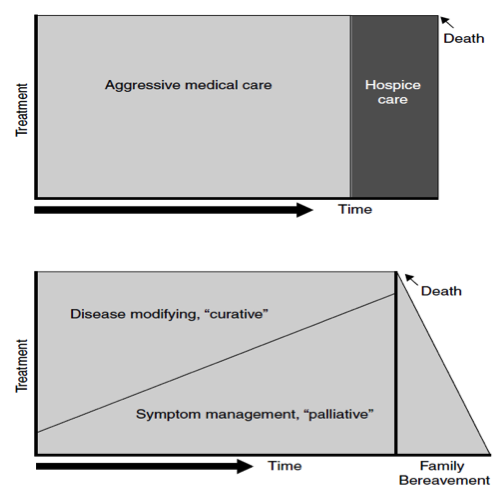
The philosophy of hospice is different from the philosophy of curative medicine (medicine that tries to cure disease).
| Curative Medicine Philosophy | Hospice Philosophy |
|---|---|
| The disease is the enemy | The suffering is the enemy |
| We fight to cure | We fight to comfort |
| The patient is a "case" or a "bed number" | The patient is a person with a name, a story, and a family |
| We focus on the body and organs | We focus on the whole person — body, mind, heart, and soul |
| Success = cure | Success = comfort, dignity, and peace |
| Death is a failure | Death is a natural part of life |
| We ask: "How long will they live?" | We ask: "How well can they live?" |
The philosophy of hospice is often called "Active Total Care." Let us break this down.
- "Active" — We Do Not Give Up
Hospice care is active, not passive. We are doing things every single day. We are not just "waiting for death".
Active care means: Giving pain medicine regularly (not just when asked), changing positions every 2 hours to prevent bedsores, talking to the patient daily (even if unconscious), checking symptoms, supporting the family, and advocating for the patient. - "Total" — Nothing is Left Out
Total means complete, whole, everything included. We do not just give medicine and leave.- Medical care: medicines, treatments, symptom control
- Nursing care: bathing, feeding, positioning, wound care, mouth care
- Emotional care: listening, counseling, comforting, being present
- Social care: helping with money, school fees, family problems, housing
- Spiritual care: prayer, connecting to religious leaders, finding meaning/peace
- Practical care: cleaning the house, fetching water, cooking, washing clothes
- "Care" — Love in Action
In hospice philosophy, care is not just a job; it is love made visible. It means treating every patient as if they were your own family.
Washing a body with gentleness, sitting with a patient when there is "nothing to do", holding a hand during the last breath, crying with the family, and remembering the patient's story.
Remember that hospice comes from words meaning hospitality — welcoming the guest. In hospice philosophy, the patient and family are guests, not "cases" or "problems."
- Being a guest in Uganda means: Welcomed warmly, offered a seat/food/water, asked what you prefer, treated with respect, listened to, given choices, and not rushed.
- In hospice, patients/families are guests: They are welcomed into the care space, offered comfort, asked what they need, treated with honor, and care moves at their pace.
A guest has choices. The patient has the right to choose: Where to receive care, what treatments to accept/refuse, what to eat/drink, who visits, what music/prayers are said, and when they want silence. Even when weak, we offer choices ("Window open or closed?", "Sit up or lie down?"). These small choices give the patient dignity and control when so much of life feels out of control.
- "Affirms" means to say YES, to support, to confirm, to celebrate. Hospice philosophy says a loud YES to life, even when death is near.
- A patient with advanced cancer who has only one month to live still has a life worth living (laughing with grandchildren, eating a favorite meal, sitting in the sun, praying, holding a baby).
- Affirming life does NOT mean denying death. It means saying: "Even though you are dying, your life still matters. Every breath, every moment, every relationship is precious."
- In many cultures, people fear talking about death (believing it brings it faster, is a curse/punishment, or a failure). Hospice teaches that dying is a normal process — just like birth, childhood, and old age.
- Dying is not a failure of the doctor, nurse, or patient. It can be peaceful, meaningful, and dignified.
- Nursing Application: Do not act afraid around dying patients. Do not whisper. Be honest. Allow natural death. Support the family to see it as a transition, not a disaster.
- Hospice does NOT: Give medicine to speed up death (Euthanasia/Assisted dying is NOT supported). It does not use machines to keep a naturally dying body alive at all costs, stop feeding to speed death, or overdose morphine with the intent to kill.
- Hospice DOES: Allow natural death when it is time. Focus on comfort, not speed. Stop treatments that cause more harm than good (futile chemotherapy or IV fluids causing swelling). Continue comfort treatments (morphine for pain, oxygen for breathlessness, food for enjoyment).
What if you give a high dose of Morphine to stop terrible pain, and as a side effect, the patient's breathing slows down and they pass away shortly after? Is this hastening death? No. In hospice ethics, this is governed by the Principle of Double Effect. Because your primary intent was to relieve pain (good effect), the secondary, unintended consequence of respiratory depression (bad effect) is ethically acceptable, provided you used the correct clinical dosage.
- This is the practical heart of hospice philosophy. A person in severe pain cannot think clearly, pray, talk to family, or die with dignity.
- Pain relief is a moral obligation. We must treat: Pain, Nausea/vomiting, Constipation, Diarrhea, Shortness of breath, Cough, Fatigue, Insomnia, Anxiety, Depression, Confusion, Itching, Hiccups, Swelling, and Bedsores.
- The philosophy says: "We will not let you suffer. We will do everything possible to keep you comfortable."
- "Integrates" means to bring together. Psychological/spiritual care are NOT separate from physical care.
- Example: A patient has severe bone pain (physical) ➔ Nurse gives morphine (physical) ➔ Nurse sits and talks (psychological) ➔ Patient shares fear of dying (psychological/spiritual) ➔ Nurse calls chaplain (spiritual) ➔ Patient feels peace ➔ The physical pain actually feels less severe because anxiety is reduced.
- Hospice says: "Do not just lie in bed waiting to die. Live until you die."
- Patients can still: Make decisions, spend time with family, do hobbies (reading, music), give advice, complete unfinished business (writing letters, making amends, blessing children).
- Example: A dying teacher cannot stand in a classroom, but she can teach her grandchildren to read, write a letter to her school, and give advice to young nurses.
- In Uganda, the family is the backbone of care. When one is sick, all suffer.
- During illness: Practical help (teaching care), Emotional help (listening), Financial help, Respite care (giving the family a break), Spiritual help.
- During bereavement: Grief counseling, Home visits, Support for children/orphans, Memorial services. Care continues long after the patient dies.
Ethics means the rules of right and wrong in healthcare. Hospice follows four main ethical principles:
- A. Beneficence — "Do Good": Always act in the patient's best interest. (e.g., Giving morphine for pain).
- B. Non-maleficence — "Do No Harm": Benefit must outweigh harm. (e.g., Morphine causes constipation, but pain relief outweighs it. Do not force-feed a dying patient who cannot swallow, as it causes choking).
- C. Autonomy — "The Patient's Right to Decide": The patient has the right to make their own decisions, refuse treatment, and choose their environment. (In Uganda, the nurse must balance patient autonomy with family dynamics).
- D. Justice — "Fairness": Treat all patients equally regardless of wealth, tribe, religion, or disease.
Remember "J.A.B.N." to recall the core ethical principles in hospice:
- Justice (Fairness to all)
- Autonomy (Patient's right to choose)
- Beneficence (Do good)
- Non-maleficence (Do no harm)
Uganda has over 50 tribes, each with different beliefs about death and dying. Hospice philosophy must be adapted to respect:
- Language: Speak in the patient's language (Luganda, Runyankole, Luo, Swahili, etc.)
- Family structure: In many Ugandan cultures, the elder or the husband makes decisions. The nurse must respect this while still ensuring the patient's voice is heard.
- Religion: Most Ugandans are Christian or Muslim. Spiritual care must include prayer, scripture reading, and connection to pastors or imams.
- Traditional beliefs: Some families believe illness is caused by curses or witchcraft. The nurse should not judge but gently educate.
- Burial customs: Different tribes have different burial traditions. Hospice should support the family to follow these customs.
In Uganda, the community (village, church, mosque) is very important. Hospice philosophy includes:
- Involving community health workers
- Using community day care and roadside clinics
- Engaging religious leaders
- Mobilizing neighbors to support the family
- Reducing stigma through community education
Many Ugandan patients are very poor. Hospice philosophy says:
- Poverty is part of the suffering
- We must address practical needs (food, school fees, transport)
- We must connect families to resources
- We must never make a patient feel they are "too poor" for good care
Scenario: You are caring for a poor, elderly man in a remote Ugandan village who is dying of late-stage liver cancer. His family believes he was cursed and wants to take him to a traditional healer instead of giving him his prescribed morphine. Using the Hospice Philosophy in the Ugandan Context and the ethical principle of Autonomy, how should you respond?
Answer: You must balance respect for traditional beliefs with the patient's comfort. Do not judge or mock the family's belief in curses. Instead, gently educate them. Support Autonomy by asking the patient what he wants to do. If he wishes to see the healer, support that choice, but advocate to continue administering the morphine concurrently so he does not suffer physical agony during his journey.
- Singer PA and Bowman KW. Quality end of life care: a global perspective. BMC Palliative Care 2002.
- Wright M and Clark D (2006) Hospice and Palliative Care in Africa: A review of Developments and Challenges. Oxford University Press, Oxford.
- Stjernsward J, Foley KM, Ferris FD. The Public Health Strategy for Palliative Care. Journal of Pain and Symptom Management. 2007 33 (5): 486-493.
Quick Quiz
Hospice Movement and Philosophy Quiz
Palliative Care
Privacy: Your details are used only for quiz tracking and certificates.
Hospice Movement and Philosophy Quiz
Palliative Care
Preparing questions...
Choose your answer and keep your streak alive.
Great effort.
Here is your quick performance summary.