

Community is a social group determined by geographic boundaries, values, and interests. According to WHO (1974),
OR
It is a group of inhabitants living together in a somewhat localized area under the same general regulations and having common interests, functions, needs, and organizations.
OR
A cluster of people with at least one common characteristic (geography, occupation, race, ethnicity, housing condition…).
In Uganda, a community is often structurally defined from the grassroots up, starting at the Local Council 1 (LC1) or village level, scaling up to the parish, sub-county, and district levels. Culturally, it can also refer to ethnic or tribal clusters (e.g., Baganda, Acholi, Langi) that share a common language, housing conditions, and localized traditional leadership.- Community is a group of people living together in a particular geographical area or having the same culture/subculture, or who are associated with each other on the basis of education, occupation, etc.
- Lundberg: "Community is a human population living within a limited geographic area and carrying on a common inter-dependent life."
- Kingsley: "The smallest territorial group that can embrace all aspects of social life."
- Green Arnold: "A community is a cluster of people, living within a contiguous area, who share a common way of life."
- Common living.
- Common people.
- Common culture.
- Common independent life.
- Limited geographical area (contiguous area: all areas within a state or a group of two or more states sharing common borders).
Saunders viewed the community in three ways:
- Common place: means geographical location.
- Social system: social units and systems with the pattern of interactions.
- Group of people.
The nurse should be aware of the demographic characteristics of the population, their health status, and health resources available within the geographic area of the community. Nurses should understand the culture, attitudes, beliefs, feelings, and lifestyles to develop appropriate plans through active participation.

Elements of the Community:
- Membership – a sense of identity and belonging.
- Common symbol systems, e.g., a similar language, rituals, and ceremonies.
- Shared values and norms.
- Mutual influence, i.e., community members have influence and are influenced by each other.
- Shared needs and commitment to meeting them.
- Shared emotional connection, i.e., members share common problems, experiences, and mutual support.
A community has three features: location, population, and a social system.
- Location: Every physical community carries out its daily existence in a specific geographical location. The health of the community is affected by this location, including the placement of services and geographical features.
- Population: It consists of specialized aggregates, but all the diverse people who live within the boundary of the community.
- Social system: The various parts of the community’s social system that interact and include the health system, family system, economic system, and educational system.
Communities have common components which include people, goals, needs, environment, service systems, and boundaries.
- The People: Refers to community residents; people are the most important resource; they are the community. People will cluster or separate based on a variety of individual demographics, hence psycho-social, economic & cultural characteristics.
- Goals & Needs: Refers to the goals & needs of people within the community. These are reflected & determine community goals & needs, which follow Maslow’s hierarchy in order of physiology, safety, social affiliation, esteem & self-actualization.
- Environment: Refers to where people are living. It includes physical characteristics such as geography, climate, and social entities. Biological & chemical characteristics like bacteria, water quality, and social characteristics such as economic, education, religion, and recreation, etc.
- Boundaries: Community has boundaries which serve to regulate the exchange of energy between a community and its external world. The boundaries may be complete or conceptual, etc.
- Service System: Residents of the community need to carry on their life within its boundaries. The community must be of sufficient size to sustain services & systems. The community must organize these systems so that the needs & goals of the population are met. These services & systems include health education, social welfare, religion, recreational facilities, and government.
Each community has characteristics whose extent varies depending upon the size and nature of the community:
- 1. Self-sufficiency: The community provides space to live, means for livelihood, education, protection, and security (i.e., all means and facilities which help in meeting the basic needs of its people).
- 2. "We" feeling: The people in the community have a "we feeling," meaning community feeling, and they identify themselves with the community.
- 3. Closeness: People have face-to-face interactions and free communication. It is more commonly apparent in small communities/villages and neighborhoods. Members are physically closer, have direct contacts, and intimate associations (e.g., common activities like community meals, visiting, and exchanging things).
- 4. Homogeneity: The community has similarity in the psychosocial characteristics of people living within defined boundaries. They are similar in language, lifestyles, customs, and traditions.
- 5. Defined geographical boundaries: Each community has defined geographical boundaries having its beginnings and its end (e.g., boundaries of a neighborhood, village, or city).
Communities are broadly classified into two main types: Village/Rural communities and Urban communities.
A village community is a small area with a small population that follows agriculture not only as an occupation but also as a way of life. It is the oldest permanent community, emerging when humans passed from a nomadic mode of collective life to a settled one (thought to have exited five thousand years ago with the knowledge of agriculture).
- A sense of unity: All families in the village are united, share sorrows & joys together, and unite to protect themselves from invaders.
- Intimate relation: Villagers have intimate relations with each other and know each other's personality.
- Common culture: People have a common culture; even customs and conventions are common.
- Joint participation: Villagers jointly organize religious/cultural activities and take part in them.
- Close neighborhood relation: Neighborhood is of great importance. There is not much individuality; village people pay attention to neighbors and assist each other.
- Joint / Extended family: The extended family system exists. For agricultural occupations, they require the co-operation of all family members.
- Deep faith in religion & duties: Dependent on nature for agriculture, villagers often hold deep reverence for natural forces and strong religious faith.
- Away from modern civilization & simple: Villagers are simple, their behavior is natural, and they live a peaceful life far from the "evils" of modern civilization.
- Hardworking: Sincere, hardworking, and generally free from extreme urban mental conflicts.
- Hospitality: Show great hospitality toward guests, dealing with others warmly and welcomingly.
- High moral values: Life is governed by strong community norms and high morality.
- Demographics: The village is the core unit of the Ugandan social structure, with a vast majority (around 70-75%) of the total population living in rural areas.
- Socially or economically connected to cities: Earlier, villages were isolated and self-sufficient. With the development of transport (boda-bodas, taxis) and communication (mobile networks), the barrier between Ugandan cities and villages has been broken.
- Structure of simplicity, calmness & peace: Villages have a simple, calm atmosphere. While traditional mud-walled and grass-thatched houses are still present, they are rapidly giving way to well-designed brick buildings and iron-sheet roofs as development reaches the grassroots.
- Strong attachment to customs & traditions: The rural outlook often remains conservative, strongly adhering to cultural and tribal traditions (e.g., traditional marriage ceremonies, clan gatherings).
- Poverty & illiteracy challenges: Villagers generally have lower incomes and rely heavily on subsistence farming. Educational opportunities, especially for higher education, can be limited, perpetuating a cycle of poverty.
- Local self-government: Villagers manage their affairs through local administrative structures, primarily the Local Council 1 (LC1) system, which provides autonomy, dispute resolution, and community governance.
An urban community means an area with a high density of population. These areas have a local authority (like a City Council, Municipality, or Town Board). In an urban community, at least 75% of the male population is engaged in non-agricultural pursuits.
- Class extremes: Class extremes exist between the richest and the poorest. We can see people living in slums/pavements alongside those having luxurious lives in bungalows or estates.
- No primary contact: Inhabitants do not come into primary contact with each other. They are sometimes unaware of who is living next door.
- Mechanical attitude: Attitudes are mechanical, showing superficial manners of politeness and mutual convenience. Strangers are often dealt with impersonally.
- No sense of belongingness: People are aware of institutional organizations but often do not feel a deep sense of belongingness to any group or community.
- Breeding ground of biological & cultural hybrid: People of various races, cultures, and ends of the earth come together. Cultural life and ideas vary widely.
- Social contacts: Contacts are impersonal and segmented. Social distance is maintained due to heterogeneity and anonymity.
- Energy and speed: People are ambitious and work day & night. Life is hectic and materialistic, leading to emotional tension and insecurity.
- Health and disease: Overcrowding and high population density adversely affect health. Sickness rates can be high due to work stress, pollution, unhealthy habits, and junk food.
The factors which led to the growth of true cities include:
- Availability of increased resources: Technological improvements exploit natural resources, leading to city growth where resources exceed mere sustenance.
- Industrialization: New production techniques, machinery, and huge capital led to the establishment of big plants, mobilizing workers towards these areas.
- Commercialization: Trade and commerce play an important part in goods distribution.
- Development of means of transport: Transporting raw/manufactured materials led to a concentration of people.
- Means of communication: Phones, internet, and information regarding factory establishment and manpower needs lead to migration.
- Increased opportunities for higher education: Maximum numbers of universities, colleges, big libraries, and recruiting agencies are in cities.
- Recreational facilities: Art galleries, amusement parks, museums, and theaters attract the younger generation.
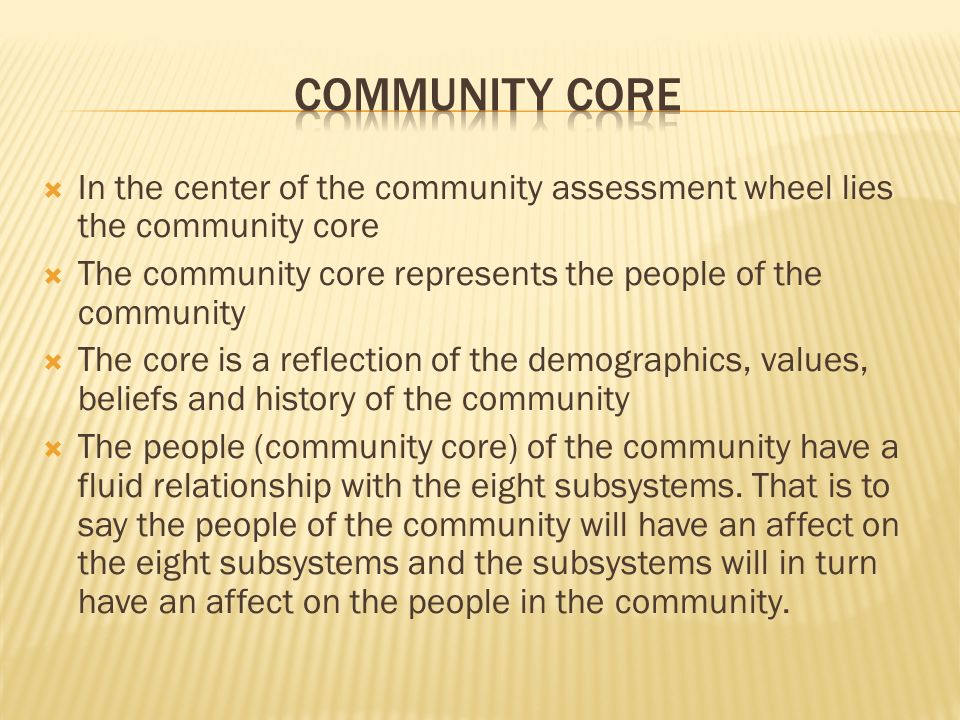
Community core includes traits such as history, socio-demographic characteristics, vital statistics, and values/beliefs/core religions.
Socio-demographically, Uganda has one of the youngest populations globally. This "core" shapes community health needs, requiring a massive focus on maternal-child health, youth reproductive health, and immunizations.- Production, Distribution, and Consumption: The community produces, distributes, and utilizes goods and services that meet the health and welfare needs of its residents.
- Socialization: It is the process by which prevailing knowledge, values, beliefs, and behavior are transmitted to community members to teach them how to be effective.
- Social Control: The community influences the behavior of its members through norms and beliefs of social control. A legal component is often enhanced through law agencies to safeguard and protect the community.
- Social Participation: It provides opportunities for members of the community to achieve psycho-social wellness, communication, social interaction with others, and support to meet self-fulfillment in the community.
- Natural Support: The provision of aid to one another is offered through families, friends, religious groups, official health services, and social fulfillment in the community.
- To educate and cultivate newcomers, e.g., children and immigrants.
- To determine the use of space for living and other purposes.
- To provide opportunities for interaction between individuals and groups.
These factors are categorized into Physical, Social-Cultural, Individuals, and Community Organization.
Physical factors include the influences of geography, the environment, community size, and industrial development.
- Geography: Health problems in a community can be directly influenced by its altitude, latitude, and climate. For example, in tropical countries, parasitic and infectious diseases are leading community problems due to favorable climatic conditions. Ugandan Context: Uganda's tropical climate makes it highly endemic for Malaria, Schistosomiasis (around the lakes), and other vector-borne diseases. Altitude differences, like in Kabale or Kapchorwa, alter vector presence.
- Environment: The quality of our environment is directly related to the quality of our stewardship over it. Uncontrolled population growth continues to deplete non-renewable natural resources, and pollution affects the soil, water, and air.
- Community Size: The larger the community, the greater its range of health problems and the more health resources needed. A community’s size can impact both positively and negatively on its health.
- Industrial Development: Industrial development can have positive or negative effects on health status. Negative effects include environmental pollution and occupational illnesses. Communities experiencing rapid industrial development need to regulate industries in various ways.
Social factors arise from interactions among individuals or groups within the community, while cultural factors stem from societal guidelines.
- Beliefs and Traditions: Community members’ beliefs and traditions can affect the community’s health. Some cultural beliefs influence food choices and health behaviors like smoking and exercise. Ugandan Context: Cultural beliefs heavily influence health-seeking behaviors. Some rural communities may first consult traditional healers or Traditional Birth Attendants (TBAs) before visiting an HC III, impacting maternal outcomes. Dietary taboos for pregnant women in some cultures can also affect nutrition.
- Prejudices among ethnic or racial groups can lead to violence and crime.
- Economy: National and local economies affect health and social services, like education. Economic downturns can lead to inadequate funds for community healthcare and other services, impacting the health of the unemployed and underemployed.
- Politics: Political leaders can improve or jeopardize community health through policy decisions and budgeting. Opposition politicians may propagate propaganda against government health policies.
- Religion: Religious beliefs can influence community health positively or negatively. Some religious communities restrict certain treatments, immunizations, or physician visits.
- Social Norms: Social norms can either positively or negatively impact community health. For example, smoking and excessive alcohol consumption may represent negative social norms in the community.
- Social-Economic Status (SES): Socio-economic status influences individuals’ access to healthcare services and overall well-being. Those with lower SES tend to have poorer health and less access to health-promoting resources.
- The behavior of individual community members contributes to the health of the entire community. Effective community health programs require concerted efforts from many individuals.
- For example, higher immunization rates slow the spread of diseases, reducing exposure through herd immunity.
- Herd Immunity: This concept refers to the resistance of a population to the spread of infectious agents based on the immunity of a high proportion of individuals.
Family planning activities as an individual factor of a community refer to the actions and decisions made by individuals within a community to control their family size and spacing of pregnancies. These activities can have a significant impact on the overall well-being and development of the community. Here are some common family planning activities as an individual factor:
| Focus Area | Activities and Descriptions |
|---|---|
| Contraceptive use | Individuals can choose to use various contraceptive methods to prevent unintended pregnancies. These methods include condoms, oral contraceptives, intrauterine devices (IUDs), implants, and sterilization. |
| Education and awareness | Individuals can actively seek information and educate themselves about different family planning methods, their effectiveness, benefits, and potential risks. They can also engage in discussions and share knowledge with others in the community. |
| Seeking healthcare services | Individuals can visit healthcare providers to access reproductive health services, including family planning counseling, screenings, and the provision of contraceptives. Regular check-ups and consultations can help individuals make informed decisions about their reproductive health. |
| Communication within relationships | Individuals can engage in open and honest communication with their partners regarding family planning decisions. This includes discussing desired family size, spacing of pregnancies, and the choice of contraceptive methods. |
| Responsible parenting | Individuals can actively participate in responsible parenting practices, such as spacing pregnancies appropriately, ensuring the health and well-being of existing children, and providing them with proper education and healthcare. |
| Financial planning | Individuals can consider their financial situation and plan their family size accordingly. By assessing their resources, individuals can make informed decisions about the number of children they can adequately support and provide for. |
| Empowering women | Individuals can support gender equality and women’s empowerment within the community. This includes advocating for women’s access to education, healthcare, and economic opportunities, which can positively impact family planning decisions. |
| Advocacy and community engagement | Individuals can actively participate in community-based organizations, advocacy groups, or local initiatives that promote family planning and reproductive health. By raising awareness and sharing personal experiences, individuals can contribute to the overall improvement of family planning services and policies in their community. |
- Safe H2O System 💧: Having clean and safe water to drink is important for everyone’s health. Dirty water can make people sick.
(Reliance on NWSC in urban areas vs. boreholes and protected springs in rural areas). - Waste Disposal 🗑️: Properly getting rid of trash and waste is crucial. If it’s not done right, it can lead to diseases and pollution.
- Food Supplies (Quality and Quantity) 🍎🍞: Having enough good-quality food to eat is essential. If there’s not enough food or it’s not healthy, people can become malnourished.
- Access to Preventive and Curative Services 🏥💊: It’s important for people to have access to doctors and medicines to stay healthy and get better when they’re sick.
- Transportation System 🚗🚌: Having good transportation helps people get to work, school, and healthcare. It makes life easier for everyone.
(The widespread use of Boda-bodas and Matatus forms the backbone of local health-seeking transport). - Education Facilities 📚✏️: Good schools help children learn and grow. Education is important for a healthy community.
( Programs like Universal Primary Education (UPE) heavily influence community literacy and subsequent health outcomes). - Employment Opportunities 💼👩💼: Having jobs means people can earn money to support themselves and their families. It’s crucial for a happy and healthy community.
- Climatic Conditions ☀️🌧️❄️: The weather can affect our health. Extreme heat or cold can be harmful if we’re not prepared.
- Size of Population 👥: The number of people in a community matters. A very crowded or very small population can have different health challenges.
- Cultural Benefits and Practices 🌍🌏: Different cultures have unique practices and traditions. Some of these practices can affect health positively or negatively.
- Internal and External Economic Influences 💰🌐: Money and trade with other places can impact a community’s wealth and access to resources.
- Formal and Informal Communication 🗣️📱: How people talk and share information matters. Good communication helps in emergencies and sharing health tips.
( Use of community radios, megaphones locally known as 'bizindalo', and WhatsApp groups for rapid health mobilization).
MCH/FP are components of PHC, as an enrolled nurse, how would you. Implement, monitor, sustain. these services
READ THE ANSWERS FROM THIS PAGE: https://nursesrevisionuganda.com/planning-implementing-monitoring-and-evaluation-of-phc-activities/
I have enjoyed keep it up
timetable is out, the way am panicking, just pray for me
good and clear
VERY WELL EXPLAINED