
Table of Contents
TogglePharmacology of the Uterus: Tocolytics, Oxytocics & Abortifacients
I. Introduction to Uterine Pharmacology
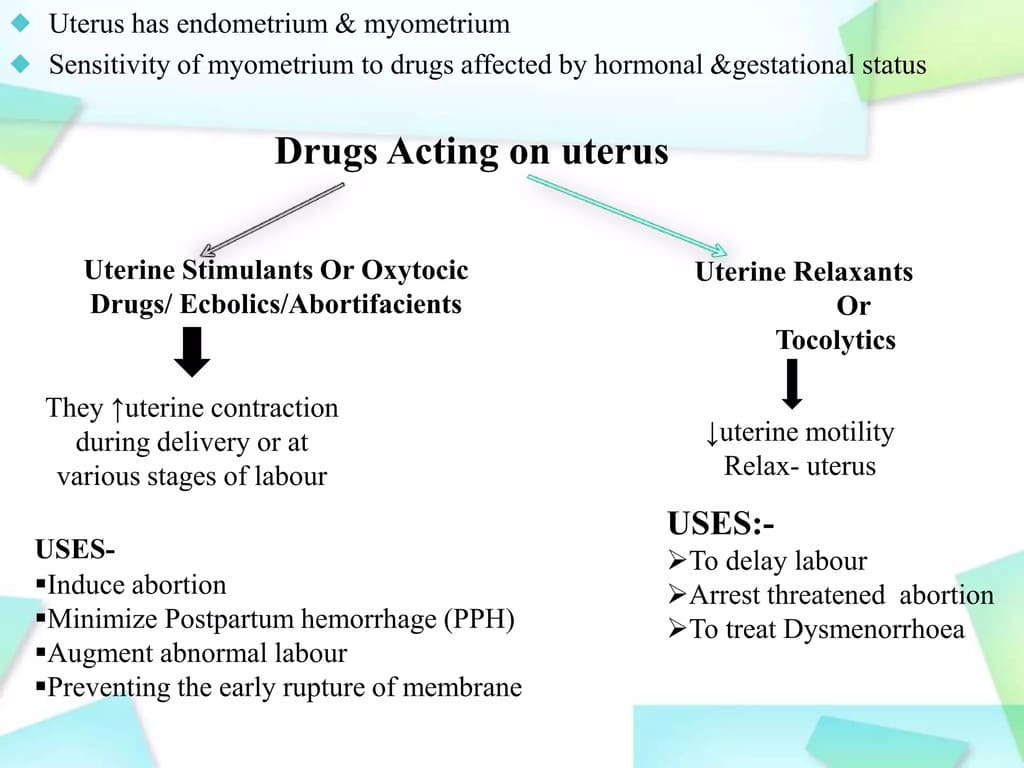
Drugs acting on the uterus primarily target one of two highly specialized layers:
- The Endometrium: The inner mucosal lining. The most important drugs affecting this layer are hormonal (Estrogens, Progestins, and their antagonists).
- The Myometrium: The thick, middle layer of smooth muscle. This layer receives both sympathetic and parasympathetic autonomic innervation, meaning autonomic drugs heavily dictate its motility (its ability to contract or relax).
To understand these drugs, you must understand how smooth muscle cells receive signals (Slides 15 & 16):
- The Contraction Pathway (IP3, DAG, Ca2+): Receptors for Oxytocin, Prostaglandins, and Angiotensin II are Gq-protein coupled. When stimulated, they activate Phospholipase C, creating IP3 and DAG. IP3 opens channels on the sarcoplasmic reticulum, releasing a flood of Calcium (Ca2+). Calcium binds to Calmodulin, which activates Myosin Light-Chain Kinase (MLCK), leading to Uterine Contraction.
- The Relaxation Pathway (cAMP / cGMP): Receptors like β2-adrenergic receptors are Gs-protein coupled. They activate Adenylyl Cyclase, creating cAMP. Nitric Oxide creates cGMP. Both cAMP and cGMP activate protein kinases that actively dephosphorylate (inhibit) MLCK, resulting in profound Uterine Relaxation.
II. Uterine Relaxants (Tocolytics)
Preterm delivery is a major cause of perinatal morbidity and mortality (causing respiratory distress, cerebral palsy, and infections in the premature infant). Tocolytics are drugs specifically designed to decrease uterine motility.
Main Clinical Uses: They are used to delay or postpone labor (buying critical time, usually 48 hours, to administer maternal corticosteroids which speed up fetal lung maturation), arrest threatened abortion, and treat dysmenorrhea (painful uterine cramping during menstruation).
You must NEVER attempt to stop labor if the intrauterine environment is dangerous to the mother or fetus. Tocolytics are strictly contraindicated if:
- Membranes have ruptured: High risk of ascending fatal infection.
- Antepartum Haemorrhage is occurring: E.g., Placental abruption. The only way to stop the bleeding is to deliver.
- Severe Toxaemia of Pregnancy (Pre-eclampsia): The placenta is the source of the toxins; delivery is the only cure.
- Intrauterine Infection (Chorioamnionitis) or Foetal Death.
1. Beta-Sympathomimetics (β2 Agonists)
Examples: Ritodrine, Salbutamol, Terbutaline, Isoxsuprine (oral/IM used historically for threatened abortion, though efficacy is uncertain).
Humans have three types of beta-adrenergic receptors: β1 (heart, small intestine, adipose tissue), β2 (uterus, blood vessels, bronchioles, liver), and β3 (white and brown adipocytes). Ritodrine is a β2 selective agonist.
- Mechanism of Action: Stimulates β2 receptors → raises cAMP → inhibits Myosin Light-Chain Kinase → suppresses premature labor.
- Efficacy limitations: It prolongs gestational age, but the definitive effect is limited to only two days (48 hours). Treatment beyond 48 hours is not recommended because receptors down-regulate (tolerance) and side effects become highly dangerous.
- The Side Effect Dilemma: Although Ritodrine is proposed as β2-selective, at the high dosages required pharmacologically, stimulation of ALL beta receptor types often occurs, leading to massive systemic side effects.
Extensive Side Effects of Ritodrine
- Cardiovascular (CVS): Hypotension (due to β2 vasodilation), severe tachycardia, arrhythmias, and life-threatening Pulmonary Edema.
- Metabolic: Hyperglycemia (forces the liver to break down glycogen), hyperinsulinemia (pancreas overcompensates for the high sugar), and hypokalemia.
- Central Nervous System: Anxiety, restlessness, and headache.
- Neonate/Fetal Effects: Fetal pulmonary edema, fetal hypoglycemia (because the maternal sugar supply stops at birth, but the baby's insulin is still spiked), and ileus (bowel paralysis).
The 9 Strict Contraindications for β-Agonists
Because of the systemic chaos these drugs cause, they must be avoided in:
- Diabetic Mothers: Uncontrolled insulin-dependent diabetes (the drug will cause massive, uncontrolled hyperglycemia).
- Cardiac Disease: Especially ventricular outflow obstruction (the heart cannot handle the severe tachycardia).
- Hyperthyroidism: Creates a synergistic, dangerous tachycardia and metabolic storm.
- Chorioamnionitis: Uterine infection (requires immediate delivery).
- Multifetal Gestation: Twins/triplets (uterus is too stretched, extremely high risk of pulmonary edema).
- Severe Obstetrical Bleeding.
- Severe Anemia: The heart is already stressed compensating for low oxygen.
- Asthmatic Patients on β-blockers: The beta-blocker will completely neutralize the Ritodrine.
- Receiving Steroids: Concurrent use massively amplifies the risk of fatal pulmonary edema.
2. Calcium Channel Blockers (CCBs)
Example: Nifedipine.
- Mechanism of Action: Nifedipine binds to voltage-dependent (and possibly receptor-operated) channels in vascular and uterine smooth muscle. This results in the profound inhibition of calcium influx. Without calcium, Calmodulin cannot activate MLCK, leading to prominent smooth muscle relaxation (reduces tone and opposes contractions).
- Pharmacokinetics & Administration: Given via sublingual or oral routes. Standard dose: Oral Nifedipine 10 mg repeated once or twice after 20–30 mins, followed by 10 mg every 6 hours. Alternatively, a 20 mg regimen every 6 hours produces therapeutic levels with a mean half-life of 81 minutes.
- Clinical Superiority: Clinical trials (Childress and Kate, 1994) show Nifedipine is highly successful—often better than Ritodrine—in stopping preterm contractions while carrying significantly fewer and milder maternal side effects.
- Side Effects: Maternal: Tachycardia (reflex to the vasodilation), hypotension, maternal palpitations, reduced atrio-ventricular (AV) conduction, and headache. Fetal: Fetal hypoxia (if the mother's blood pressure drops too low, placental perfusion is compromised).
3. Magnesium Sulfate (MgSO4)
This is a foundational, first-line tocolytic drug and is also the gold standard for the prevention and treatment of seizures in preeclampsia and eclampsia.
- Mechanism of Action: Magnesium acts as a physiological Ca2+ channel antagonist. It directly competes with Ca2+ ions for entry into the myometrium through both voltage-sensitive and ligand-gated calcium channels.
- Administration & Dosing: Administered via IV infusion. It requires an initial bolus of 4–6 g over 30 minutes, followed by a maintenance continuous infusion of 1–2 g per hour. Target therapeutic serum magnesium levels are 4–7 mEq/L. Once contractions cease, maintain at the lowest effective rate for 12–24 hours, then wean.
- Massive Neuroprotective Benefit: Several observational reports (e.g., Grether JK et al., 2000) show that antenatal magnesium sulfate treatment is associated with a drastically decreased risk for cerebral palsy in very low birth weight infants.
Magnesium is a potent central nervous system and neuromuscular depressant. You must monitor blood levels obsessively:
- > 10 mEq/L: Loss of Deep Tendon Reflexes (DTRs). (Crucial note: Respiratory depression generally does NOT occur before the loss of DTRs, making reflexes the perfect clinical warning sign).
- 12 – 14 mEq/L: Significant Respiratory Depression.
- > 15 mEq/L: Cardiac Arrest.
- The Antidote: Toxic effects can be rapidly reversed with a direct IV infusion of 1 g of Calcium Gluconate.
- Absolute Contraindications: Myasthenia Gravis (will cause immediate total respiratory paralysis) and Heart Block.
- Relative Contraindications: Underlying renal disease (Mg is excreted by the kidneys; bad kidneys = fatal buildup) and recent myocardial infarction.
- Drug Interaction Warning: Concurrent use of CCBs (Nifedipine) and Magnesium Sulfate can theoretically result in profound, synergistic hypotension and should probably be avoided.
4. Prostaglandin Inhibitors (NSAIDs)
Example: Indomethacin.
- Mechanism of Action: Indomethacin is a nonspecific prostaglandin synthetase (COX-1) inhibitor. It completely blocks the uterine formation of PGF2α and PGE2, which are the natural drivers of uterine contraction.
- Efficacy: Trials comparing indomethacin versus ritodrine show both treatments are equally effective in postponing delivery.
- Severe Fetal Side Effects: Prostaglandins are physiologically required to keep the fetal ductus arteriosus open and to maintain fetal renal blood flow. Indomethacin use is linked to:
- Increased rates of Oligohydramnios (low amniotic fluid due to decreased fetal urine output).
- Intraventricular haemorrhage and necrotizing enterocolitis.
- Premature closure of the Ductus Arteriosus.
- Clinical Rule: Doppler studies suggest there is less effect on the ductus at earlier gestations, so its use is strictly limited to before 32 weeks gestation.
5. Nitric Oxide Donors
Example: Nitroglycerin (Nitroderm patch).
Nitric oxide is a physiological vascular smooth muscle relaxant that regulates blood flow in pregnancy.
- Mechanism of Action: NO penetrates the cell, activates the enzyme Guanylyl Cyclase, which converts GTP to cGMP. Elevated cGMP activates Protein Kinase G, causing massive smooth muscle relaxation.
- Efficacy & Safety: Systematic reviews (Morgan PJ et al., 2002) show Nitroglycerin is more effective than a placebo for arresting preterm labor, though not necessarily more effective than ritodrine or magnesium. However, the maternal side effect profile (and treatment discontinuation rates) were significantly fewer for the Nitroderm patch, suggesting it is a safer alternative to ritodrine with equal efficacy (Lees CC et al., 1999).
- Side Effects: Headache and Hypotension (due to systemic vasodilation).
6. Oxytocin Antagonists
Example: Atosiban.
- Mechanism of Action: Atosiban is a highly advanced peptide analogue of oxytocin. It acts as a direct, competitive antagonist strictly at the oxytocin pituitary neuropeptide receptors in the uterus.
- Efficacy & Use: Available specifically for the inhibition of labor between 24–33 weeks of gestation. A trial of 247 women showed its efficacy was completely similar to ritodrine.
- Safety Superiority: Because it exclusively targets oxytocin receptors, it successfully suppresses premature uterine contractions and postpones delivery with far fewer cardiovascular and metabolic complications than β2 adrenergic agonists. It is much better tolerated with significantly fewer maternal and fetal adverse effects (Moutquin JM et al., 2000).
- Mild Side Effects: Primarily nausea and headache.
7. Miscellaneous: Progesterone
- The physiological mechanism of progesterone is complex, and debate remains regarding how its natural withdrawal triggers the onset of labor in women. However, multiple studies (E.B. da Fonseca et al., 2003; M.F. Green et al., 2003) have shown definitively that administering progesterone significantly reduces the incidence of preterm delivery compared to placebo.
III. Ecbolics / Uterine Stimulants
Ecbolics are drugs that violently stimulate the contraction of the uterus, helping in the expulsion of its contents. Their naming depends entirely on the timing of pregnancy:
- Oxytocics: Used at term to induce or augment labor.
- Abortifacients: Used early in pregnancy to induce abortion.
- Control and prevention of Postpartum Haemorrhage (PPH).
- Hastening uterine involution (shrinking of the uterus back to normal size).
- Removing a retained placenta.
- Aiding in the clearance of uterine discharge.
- Treating agalactia (failure of milk let-down) in all species.
- Crucial Warning: For labor, they should only be used if the cervix is sufficiently dilated or ripe.
- Posterior Pituitary Hormones: Oxytocin, pituitary extract, carbotocin.
- Ergot Alkaloids: Ergometrine (Ergonovine), Methylergometrine.
- Prostaglandins & Analogues: PGE2, PGF2α, Misoprostol, Cloprostenol.
- Miscellaneous: Ethacridine, Quinine.
1. Posterior Pituitary Hormones: Oxytocin
Oxytocin is a nonapeptide (9 amino acids long) naturally secreted by the posterior pituitary alongside vasopressin (ADH). It is the absolute drug of choice in modern obstetrics.
- Mechanism of Action: Its action on the myometrium is independent of innervation. It binds to specific Gq-protein coupled oxytocin receptors. This mediates response by (1) Depolarization of muscle fibers, (2) Direct influx of Ca2+ ions, and (3) Phosphoinositide hydrolysis leading to IP3-mediated intracellular release of Ca2+ from the sarcoplasmic reticulum.
- Hormonal Sensitization: Early in pregnancy, the uterus ignores oxytocin. Estrogens specifically sensitize the uterus to oxytocin by vastly increasing the number of oxytocin receptors as term approaches.
- Secondary Mechanisms: Oxytocin also directly increases the synthesis and release of prostaglandins by the endometrium, which further amplifies the contractile response.
Why Oxytocin is the Drug of Choice over Ergometrine/PGs for Labor
Oxytocin is beautifully tailored for safely delivering a living fetus for four specific reasons:
- It has a very short half-life (t½ is 6–12 mins) and is given by slow IV infusion. If fetal distress occurs, stopping the drip stops the contractions almost immediately.
- Low concentrations allow for normal relaxation in between contractions, ensuring that placental blood flow resumes and foetal oxygenation does not suffer.
- At term, increased contractility is restricted strictly to the fundus and body of the uterus, while the lower segment remains relaxed. Because the lower segment is not contracted, foetal descent is not compromised.
- Uterine contractions are consistently and predictably augmented.
Systemic Effects & Pharmacokinetics of Oxytocin
- Breast: Oxytocin contracts the myoepithelium of mammary alveoli, forcing already-produced milk into the bigger milk sinusoids. This creates the "milk ejection reflex" (Note: it does not increase milk production).
- CVS: Conventional obstetric doses have no effect on BP. Higher doses cause severe vasodilatation leading to a brief fall in BP, reflex tachycardia, and flushing. Importantly, it markedly constricts umbilical vessels, helping their closure at birth.
- Kidney (Water Intoxication Risk): Because of its chemical similarity to ADH, high doses exert an ADH-like action (decreased urine output). If large amounts of IV fluids are infused with oxytocin, fatal pulmonary edema and water intoxication can occur.
- Pharmacokinetics: Inactive orally (destroyed in gut). Given IM, IV, or intranasal. Rapidly degraded in liver and kidney. The pregnant uterus and placenta brilliantly produce a specific aminopeptidase called oxytocinase to regulate its levels. (1 IU = 2 μg of pure hormone).
- Adverse Effects of Overdose: Producing too strong uterine contractions can force the presenting part through an incompletely dilated birth canal, causing maternal and foetal soft tissue injury, rupture of the uterus, foetal asphyxia, and death.
Specific Clinical Uses of Oxytocin
- Induction of labour: Indicated in postmaturity, toxaemia, diabetic mother, erythroblastosis, ruptured membranes, or placental insufficiency. Given by slow IV infusion (5 IU diluted in 500 ml glucose/saline). Usually, a total of 2-4 IU is needed.
- Uterine inertia: When contractions are feeble. (Should not be used to hasten normally progressing labour).
- PPH & Caesarean Section: 5 IU injected IM or IV for immediate response. It is the preferred agent for hypertensive women in whom ergometrine is absolutely contraindicated.
- Breast engorgement: An intranasal spray can be given a few minutes before suckling to fix an inefficient milk ejection reflex.
- Oxytocin challenge test: Infused at very low concentrations to elicit contractions every 3-4 mins to test uteroplacental adequacy. A marked increase in foetal heart rate indicates inadequacy. (Note: Highly risky, rarely performed now).
Note on Analogues: Desamino-oxytocin is a buccal formulation used for induction (50 IU tab), inertia (25 IU), involution, and engorgement. Carbetocin is a recently introduced, long-acting synthetic analogue. Because it lasts a long time, it is explicitly used to prevent uterine atony after caesarean sections and control PPH, or for dystocia due to secondary inertia.
2. Ergot Alkaloids
Examples: Ergometrine (Ergonovine), Methylergometrine (a synthetic analogue that is 1.5 times more potent on the uterus but completely lacks vasoconstriction properties).
- Mechanism of Action: They act as partial agonists on 5-HT2 (serotonin) and α-adrenergic receptors.
- Differences from Oxytocin: Ergometrine causes prolonged, tetanic contraction of smooth muscle (uterus and blood vessels). Gravid uterus is more sensitive, but crucially, their stimulant action involves the lower segment also. Because it tetanizes the whole uterus and doesn't allow for relaxation, it is strictly contraindicated in pregnancy and before the 3rd stage of labour (it would crush and asphyxiate the fetus).
- Systemic Effects: CVS: Weaker vasoconstrictors than ergotamine, low propensity for endothelial damage. CNS: No overt effects at usual doses, but high doses produce complex partial agonistic/antagonistic interactions with adrenergic, serotonergic, and dopaminergic receptors in the brain. GIT: High doses increase peristalsis.
- Pharmacokinetics: Rapidly and nearly completely absorbed orally. Onset: Oral = 15 min, IM = 5 min, IV = almost immediate. Metabolized in the liver, excreted in urine. Plasma t½ is 1–2 hours, effects last 3–4 hours.
- Adverse Effects & Contraindications: Less toxic than ergotamine, but causes nausea, vomiting, BP rise, and inhibition of prolactin (due to dopaminergic action). Must be completely avoided in: Vascular disease, hypertension, toxaemia, presence of sepsis (vasoconstriction may cause severe gangrene), and liver/kidney disease.
Clinical Uses of Ergometrine
- Control and prevent PPH: 0.2–0.3 mg IM given right at the delivery of the anterior shoulder massively reduces blood loss. If PPH is currently occurring, 0.5 mg IV is used. (Can be combined with Oxytocin 5 IU in severe bleeding).
- After caesarean/instrumental delivery: To prevent uterine atony.
- Ensure normal involution: 0.125 mg of ergometrine/methylergometrine orally TDS for 7 days ensures the uterus shrinks rapidly.
- Diagnosis of Variant Angina: A tiny IV dose during coronary angiography causes prompt constriction of reactive coronary artery segments, revealing the disease.
3. Prostaglandins and Analogues
Examples: Natural (PGE2, PGF2α / Dinoprost), Synthetic (Misoprostol, Cloprostenol, 15-methyl PGF2α).
Prostaglandins are extraordinarily potent uterine stimulants. Unlike oxytocin, which only works well at term, prostaglandins stimulate the uterus heavily in the later part of pregnancy and are particularly famous for causing structural breakdown of collagen, leading to the ripening of the cervix.
PGF2α is found natively in the ovary and myometrium. It plays a massive role in the oestrus cycle.
- Causes functional and morphological regression of the Corpus Luteum (CL) leading to Luteolysis.
- Causes strong vasoconstriction and diminished blood supply to the CL, leading to a large reduction of progesterone synthesis.
- Strong oxytocic effect in mares.
- Indications: Induction of ovulation, synchronization of estrus, termination of pregnancy, induction of parturition, passing a mummified fetus, treating pyometra, fixing a luteal cyst, and embryo transfer preparation.
- Contraindications for Prostaglandins: Should not be used during pregnancy unless termination is required. Absolutely contraindicated in patients with bronchoconstrictive respiratory disease (e.g., asthma) because PGF2α causes severe bronchospasm.
4. Adjuvant & Miscellaneous Drugs
A. Glucocorticoids
Example: Dexamethasone.
- Mechanism: They drastically increase endogenous PGF2α synthesis directly in the endometrium.
- Use: Mostly used in veterinary medicine. Dexamethasone (20 mg IM) may induce parturition within 48 hours. If used concurrently with Dinoprost (30 mg IM), induction occurs rapidly within 2–3 hours.
B. Cabergoline (Dopaminergic Agonist)
- Mechanism of Action: Cabergoline heavily activates D2 receptors in the pituitary. Dopamine is the natural absolute inhibitor of prolactin. Therefore, cabergoline completely inhibits prolactin secretion.
- Result: Because prolactin is luteotropic (supports the corpus luteum) in many animals, inhibiting it results in secondary luteolysis.
- Uses: Used to induce estrus and specifically to treat pseudopregnancy (false pregnancy) in dogs. Administered at 5 μg/kg orally, once daily for 5–10 days.
Quick Quiz
Tocolytics, Oxytocics and Abortifacients Quiz
Pharmacology
Privacy: Your details are used only for quiz tracking and certificates.
Tocolytics, Oxytocics and Abortifacients Quiz
Pharmacology
Preparing questions...
Choose your answer and keep your streak alive.
Great effort.
Here is your quick performance summary.