
Table of Contents
TogglePharmacology of Erectile Dysfunction (ED) & Benign Prostatic Hyperplasia (BPH)
Part I: Erectile Dysfunction (ED)
Erectile Dysfunction is defined as the persistent inability to attain and/or maintain an erection sufficient to permit satisfactory sexual performance (as defined by the NIH Consensus Conference on Impotence, 1993, and AUA Guidelines). It is a progressive, chronic disorder that heavily impacts quality of life.
1. Prevalence & Epidemiology
According to the landmark Massachusetts Male Aging Study (MMAS), ED is highly prevalent and strongly correlates with advancing age:
- In men aged 40 to 70 years, a staggering 52% have some degree of ED.
- Mild ED: 17%
- Moderate ED: 25%
- Complete ED: 10%
- Age Correlation: The prevalence strictly increases with age (roughly 50% at age 50, 60% at age 60, and 70% at age 70).
2. Physiology of a Normal Erection (The Parasympathetic NO-cGMP Axis)
To master ED pharmacology, you absolutely must understand the underlying physiology. An erection is a hydraulic event driven by neurovascular signals.
- Initiation: Sexual stimulation activates parasympathetic nerves supplying the corpora cavernosa, alongside Non-Adrenergic Non-Cholinergic (NANC) nerve fibers.
- Nitric Oxide (NO) Synthesis: These nerves, along with the vascular endothelium, synthesize NO from the amino acid L-arginine via the enzyme Nitric Oxide Synthase (NOS). (Note: Adequate oxygen tension, pO2 > 55 mmHg, is strictly required for this step, making vascular disease a major barrier).
- Second Messenger Activation: NO diffuses into cavernosal smooth muscle cells and activates the enzyme Guanylyl Cyclase, which converts GTP → cGMP.
- Smooth Muscle Relaxation: cGMP activates Protein Kinase G (PKG), which drastically lowers intracellular Calcium (Ca2+). Without calcium, the arterial smooth muscle relaxes.
- Engorgement: Arterial dilation allows massive blood inflow. The expanding corpora cavernosa physically compress the emissary veins against the tunica albuginea, severely decreasing venous outflow (Venous Compression). The trapped blood creates the erection.
How does the erection go away? Two main pathways destroy the erection:
- cGMP Breakdown: An enzyme called Phosphodiesterase type 5 (PDE5) actively degrades cGMP into inactive 5'-GMP. This allows intracellular calcium to rise again, causing smooth muscle contraction.
- Sympathetic Override (α1-adrenergic pathway): Post-orgasm (or during acute stress/anxiety), the sympathetic nervous system releases Norepinephrine (NE). NE binds to α1 receptors → activates Phospholipase C (PLC) → increases IP3 → massively increases intracellular Calcium → triggers immediate smooth muscle contraction and loss of erection.
3. Pathophysiology: Why does ED occur?
ED occurs when one or more steps in the physiological cascade fail:
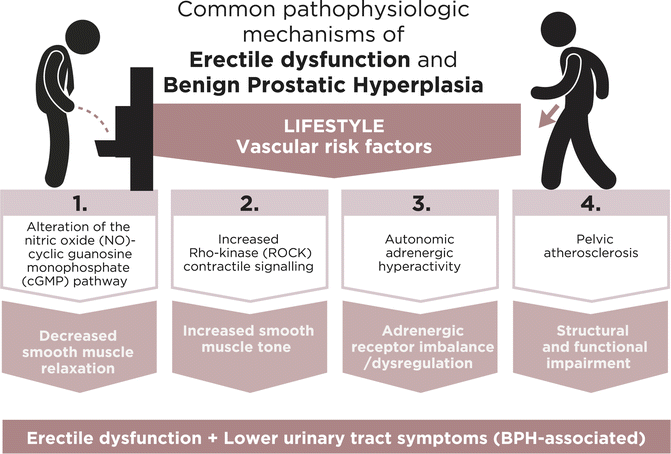
- Reduced Nitric Oxide Availability: Due to endothelial dysfunction seen in Diabetes Mellitus, Atherosclerosis, Smoking, and general aging. Result: Insufficient cGMP generation.
- Excessive PDE5 Activity: cGMP is broken down too quickly, meaning the erection cannot be sustained.
- Endothelial or Vascular Disease: Inadequate arterial inflow (blockages) or inadequate oxygen tension (which directly reduces NO synthesis).
- Increased Sympathetic Tone: Stress, performance anxiety, or certain drugs cause an overwhelming dominance of α1-mediated contraction over relaxation.
4. Risk Factors & Drug-Induced Erectile Dysfunction
Because ED relies heavily on healthy blood vessels, ED shares the exact same risk factors as cardiovascular disease: Lack of exercise, Obesity, Smoking, Hypercholesterolemia, and Metabolic Syndrome.
Furthermore, many prescription medications directly cause ED. Modifying these is a primary goal of treatment:
| Category | Specific Medications Implicated in ED |
|---|---|
| Antihypertensives |
|
| Psychiatric Drugs | Tricyclic Antidepressants (TCAs), Selective Serotonin Reuptake Inhibitors (SSRIs). |
| Inhibitors of Testosterone Production | Spironolactone (acts as an anti-androgen), Ketoconazole, Metronidazole, Flutamide, Cimetidine, Cyproterone. |
| Inhibitors of GnRH (Hormonal Axis) | Progesterone, Estrogen, GnRH agonists (Leuprolide, Goserelin), Prolactinoma (disease state), Phenothiazines, TCAs, Reserpine, Cocaine/Opioids. |
Part II: Management & Pharmacotherapy of ED
Principles of Treatment
- The primary goal is to determine the underlying etiology and treat the disease when possible, rather than just masking the symptom.
- Modifiable or reversible factors (lifestyle changes, drug-related factors) must be addressed first.
- The Rule of Cure: ED can be treated successfully with drugs, but it generally cannot be cured. The only exceptions to this rule are: Psychogenic ED, post-traumatic arteriogenic ED in young patients, and specific hormonal deficiencies.
Treatment Tiers
- Step 1: Lifestyle modifications (Avoid smoking, maintain ideal body weight, regular exercise, stop alcohol abuse, optimize management of Diabetes, HTN, and heart disease).
- First-Line Therapy: Oral drugs (PDE5 inhibitors, Apomorphine), Topical pharmacotherapy, Intraurethral Alprostadil (MUSE).
- Second-Line Therapy: Vacuum constriction devices, Intracavernous Injections (ICI).
- Third-Line Therapy: Surgical Penile prosthesis.
Part III: First-Line Therapies (PDE5 Inhibitors)
Recommended as the absolute first-line therapy according to the American Urological Association (AUA) guidelines.
Mechanism of Action: Drugs like Sildenafil competitively block the PDE5 enzyme in the corpus cavernosum. By doing so, they prevent the breakdown of cGMP, prolonging smooth muscle relaxation.
Crucial Detail: They do not cause an erection directly! They merely enhance the body's natural NO pathway. Therefore, they strictly require sexual stimulation to be effective (if there is no arousal, there is no NO release, meaning no cGMP is made for the drug to protect).
Pharmacokinetics of PDE5 Inhibitors
| Generic Name | Brand Name | Effect of Fatty Meal? | Tmax (Peak onset) | Half-Life (T½) | Duration of Action | Starting Dose | Dose Range |
|---|---|---|---|---|---|---|---|
| Sildenafil | Viagra | Yes (Delays absorption) | 1 hour | 4 hours | 6 - 8 hours | 50 mg | 25 - 100 mg |
| Vardenafil | Levitra | Yes (Delays absorption) | 1 hour | 4.5 hours | 6 - 8 hours | 10 mg | 5 - 20 mg |
| Tadalafil | Cialis | NO (Unaffected) | 2 hours | 17.5 hours | 24 - 36 hours | 10 mg | 5 - 20 mg |
Adverse Events & Side Effects
Most side effects are due to systemic vasodilation or cross-reactivity with other PDE enzymes in the body:
- General (All PDE5i): Headache, flushing, dyspepsia (indigestion), nasal congestion, and dizziness.
- Sildenafil & Vardenafil Only: Abnormal vision (blue-tinted vision or light sensitivity) due to cross-reactivity inhibiting PDE6 in the retina.
- Tadalafil Only: Back pain and severe myalgia (muscle aches) due to cross-reactivity inhibiting PDE11 found in skeletal muscle.
- Nitrates (e.g., Nitroglycerin): TOTALLY CONTRAINDICATED. Combining PDE5 inhibitors (which stop cGMP breakdown) with Nitrates (which massively generate cGMP) causes profound, fatal hypotension.
- α-Blockers: Must be used with extreme caution due to the fear of profound orthostatic hypotension.
- Antihypertensives: Co-administration results in small, additive drops in blood pressure (usually minor).
- CYP3A4 Inhibitors: Drugs like Ketoconazole, Itraconazole, Erythromycin, Clarithromycin, and HIV Protease Inhibitors (Ritonavir, Saquinavir) inhibit the breakdown of PDE5i. Action: You must use lower doses of the PDE5 inhibitor.
- CYP3A4 Inducers: Drugs like Rifampin, Phenobarbital, Phenytoin, and Carbamazepine enhance the breakdown of PDE5i. Action: You must use higher doses.
- Organ Dysfunction: Dosage adjustment is mandatory in severe kidney or hepatic dysfunction.
Why do PDE5 Inhibitors Fail?
Common causes of failure include:
1) Incorrect usage (wrong timing, wrong dose, taken with heavy meals, or lack of sexual stimulation),
2) Inadequate patient education,
3) Unidentified hypogonadism (low testosterone),
4) Performance anxiety,
5) Severe underlying comorbidities,
6) Psychosocial factors, and
7) Severe ED at initial presentation.
Part IV: Alternative & Central Therapies for ED
1. Apomorphine (Sublingual)
Apomorphine is not an opiate, despite the name. It is a central-acting Dopaminergic Agonist.
- Mechanism of Action: It acts directly on D2 receptors in the paraventricular nucleus of the brain (the sexual drive center in humans). Physiologically, dopaminergic stimulation activates oxytocinergic neurons. This action lowers cAMP centrally, allowing NO Synthase to produce the NO responsible for a subsequent erection. (It also acts on serotoninergic neurons in the median raphe).
- Clinical Profile: Stimulates pro-erectile signaling and is more effective than placebo. It requires sexual arousal to work. Highly notable for a very rapid onset of action (12 minutes to erection).
- Side Effects: Nausea occurs in about 1 in 8 men. (Approved in Europe).
2. Yohimbine Hydrochloride
A centrally acting α2-adrenoceptor antagonist. It acts at serotonergic and adrenergic receptors in brain centers associated with libido and erection.
- Peripheral Mechanism: It may also act peripherally by blocking pre-junctional α2-adrenoceptors on penile arteries. Normally, stimulating these receptors inhibits NO release. Therefore, blocking them enhances NO release and promotes arterial relaxation.
- Efficacy: Blinded studies show it provides no benefit to patients with organic ED versus placebo (Morales, 1997). However, it is significantly better than placebo in patients with psychogenic ED (62% success vs 16%).
- Usage & Side Effects: Often prescribed in combination with Trazodone. Side effects include hypertension, extreme anxiety, tachycardia, and severe headache.
A mild antidepressant known for a rare side effect of inducing priapism (prolonged, painful erection). Sexual stimulation with trazodone actively increases circulating oxytocin, aiding in psychogenic ED.
Despite being the biological precursor to Nitric Oxide, clinical trials show it is absolutely no better than placebo for the treatment of ED.
Part V: Localized & Second-Line ED Therapies
1. MUSE (Medicated Urethral System for Erection)
Introduced in 1990, this is intraurethral Alprostadil (PGE1 - a synthetic Prostaglandin E1). It comes as a tiny pellet inserted directly into the urethra.
- Mechanism of Action: Unlike PDE5 inhibitors (which use cGMP), Alprostadil acts locally to directly stimulate Adenylate Cyclase. This massively raises cAMP levels, which dramatically lowers intracellular Ca2+, forcing smooth muscle relaxation in the corpus cavernosum.
- Efficacy & Side Effects: Erection starts reliably 5-20 minutes after administration. Because it acts locally, systemic side effects are reduced. However, penile pain is a major side effect (10-30% incidence). Can also cause urethral bleeding, priapism, hypotension, and syncope.
- Contraindications: Distal urethral stricture, significant penile angulation or fibrosis, balanitis/urethritis, and absolutely contraindicated if engaging in sexual activity with a pregnant female (as prostaglandins can induce premature labor).
2. Intracavernous Injections (ICI)
Introduced in 1980. This involves injecting vasoactive drugs directly into the side of the penis (corpus cavernosum) using a tiny needle. Extremely effective (80-100% success in non-vascular ED patients, giving erections sufficient for penetration in 98% of patients). As a monotherapy, it is 55% effective.
Three main components are used singly or in combination (Trimix):
- PGE1 (Alprostadil): The only FDA-approved injection. Same mechanism as MUSE.
- Papaverine: A non-specific phosphodiesterase inhibitor. It increases both intracellular cAMP and cGMP. It also regulates smooth muscle tone by inhibiting voltage-dependent L-type Ca2+ channels and suppresses Angiotensin II secretion in cavernosal tissue.
- Phentolamine: Directly antagonizes α1 and α2 adrenoceptors. It also acts indirectly via functional antagonism by increasing NO supply through NANC effects. (Never used alone).
Side Effects & Contraindications of ICI: High risk of Priapism (0-35%), Corporal Fibrosis/scarring (1-33% - less common with PGE1), penile pain (less common with Papaverine), and hypotension. Strictly contraindicated in patients with Sickle cell disease (massive risk of priapism), psychiatric illness, and severe systemic disease.
3. Transdermal / Topical Therapies
- Nitroglycerin: Direct smooth muscle relaxant (generates NO). More effective than placebo (Heaton, 1990), but no longer used due to severe systemic hypotension/headaches.
- Minoxidil: Originally a potent antihypertensive agent (opens potassium channels) that causes hypertrichosis (used topically for alopecia since 1988). Double-blinded studies show that topical minoxidil is more effective than both placebo and Nitroglycerin in treating ED. Investigations into commercial topical formulations are ongoing.
Part VI: Drugs for Benign Prostatic Hyperplasia (BPH)
BPH is a non-cancerous enlargement of the prostate gland that compresses the urethra, leading to Lower Urinary Tract Symptoms (LUTS). Symptoms are categorized as voiding (weak stream, hesitancy, urinary retention) and storage (nocturia, urgency, frequency). Pharmacological management aims to relieve these symptoms, drastically improve urine flow, and prevent surgical complications.
1. α1-Adrenergic Receptor Blockers
- Mechanism: They block α1 receptors to directly relax the smooth muscle in the prostate stroma and bladder neck, drastically reducing urethral resistance.
- Agents:
- Selective (Uroselective): Tamsulosin, Silodosin. These target the α1A subtype found specifically in the prostate, resulting in fewer systemic blood pressure drops.
- Non-selective: Terazosin, Doxazosin. These hit all α1 receptors, inherently lowering systemic blood pressure (useful if the patient also has hypertension).
- Efficacy & Use: First-line therapy for moderate-severe LUTS. Provides rapid symptom relief (within days).
- Side Effects: Dizziness, orthostatic hypotension (mainly with non-selective agents). Notably, Tamsulosin and Silodosin frequently cause retrograde ejaculation. Avoid in hypotensive patients and use extreme caution when combining with other antihypertensives.
2. 5-Alpha Reductase Inhibitors (5-ARIs)
- Mechanism: They inhibit the enzyme 5-α reductase, stopping the conversion of Testosterone into its highly active form, Dihydrotestosterone (DHT). Depriving the prostate of DHT causes apoptosis, physically shrinking the prostate over time.
- Agents: Finasteride (Type II inhibitor) and Dutasteride (Dual Type I/II inhibitor).
- Efficacy & Use: Highly effective for patients with significantly enlarged prostates (volume > 30-40 mL). They are the only drugs that actually alter the disease course by reducing the risk of acute urinary retention and the need for surgery. However, they have a slow onset, taking 3-6 months for full effect.
- Side Effects: Sexual dysfunction is prominent (reduced libido, erectile dysfunction) and gynecomastia (breast enlargement). Crucial Clinical Note: They falsely lower Serum PSA levels by ~50%, so you must double the patient's PSA value when screening for prostate cancer.
3. Phosphodiesterase-5 (PDE5) Inhibitors for BPH
- Mechanism: Enhances NO-mediated smooth muscle relaxation in both the bladder and prostate.
- Agents: Tadalafil (often used daily), Sildenafil.
- Use: Provides a massive dual benefit for men suffering from both BPH and ED. However, it is less effective than α-blockers for severe BPH symptoms. Avoid strictly with nitrates.
4. Drugs for Overactive Bladder (OAB) Storage Symptoms
Examples: Oxybutynin, Solifenacin, Tolterodine.
Mechanism: Block muscarinic receptors on the bladder wall, stopping the detrusor from spasming.
Use: Used only if OAB symptoms (urgency, frequency) predominate. Strict Warning: Avoid if the patient has a high Post-Void Residual (PVR) urine volume > 200-300 mL, as paralyzing the bladder will cause acute urinary retention. Side effects: Dry mouth.
Example: Mirabegron.
Mechanism: Stimulates β3 receptors to actively relax the detrusor muscle during the filling phase.
Use: Addresses OAB symptoms and is often combined with alpha-blockers. Side effects include Hypertension and Tachycardia.
5. Combination Therapy & Clinical Decision Making
Combining an Alpha-blocker + a 5-ARI (e.g., Tamsulosin + Dutasteride) is proven superior to monotherapy for long-term symptom control and prostate volume reduction (as proven by the landmark MTOPS trial). Used in men with large prostates and moderate-severe symptoms.
- Based on Prostate Size:
- Small/Medium: Alpha-blockers or PDE5 inhibitors.
- Large (>30-40mL): 5-ARIs ± Alpha-blockers.
- Based on Symptom Profile:
- Storage symptoms (urgency/frequency): Add Anticholinergics or β3 agonists.
- Voiding symptoms (weak stream): Alpha-blockers.
- Based on Comorbidities:
- Hypertension: Use non-selective Terazosin/Doxazosin if BP control is also needed.
- Erectile Dysfunction: Use daily Tadalafil.
Summary Table of BPH Drug Classes
| Class | Examples | Onset | Key Benefits | Key Risks & Side Effects |
|---|---|---|---|---|
| Alpha-blockers | Tamsulosin, Silodosin | Days | Rapid symptom relief. | Hypotension, Retrograde ejaculation. |
| 5-ARIs | Finasteride, Dutasteride | Months | Shrinks prostate, prevents acute retention/surgery. | Sexual dysfunction, Gynecomastia. |
| PDE5 Inhibitors | Tadalafil | Weeks | Dual BPH & ED benefit. | Headache, absolute Nitrate contraindication. |
| Anticholinergics | Oxybutynin, Solifenacin | Weeks | Reduces OAB storage symptoms. | Urinary retention, Severe dry mouth. |
References & Further Reading
- Feldman, H. A., et al. (1994). Impotence and its medical and psychosocial correlates: results of the Massachusetts Male Aging Study (MMAS). Journal of Urology.
- Guthrie, R. M. (1997). The effects of doxazosin on sexual function in patients with benign prostatic hyperplasia/hypertension. Clinical Therapeutics.
- Morales, A., et al. (1997). Clinical efficacy of yohimbine in the treatment of organic erectile dysfunction. International Journal of Impotence Research.
- Heaton, J. P., et al. (1990). Topical glyceryl trinitrate (Nitroglycerin) for the treatment of erectile dysfunction. Urology.
- McConnell, J. D., et al. (2003). The long-term effect of doxazosin, finasteride, and combination therapy on the clinical progression of benign prostatic hyperplasia (MTOPS Trial). New England Journal of Medicine.
- American Urological Association (AUA) Guidelines on the Management of Erectile Dysfunction and Benign Prostatic Hyperplasia.
Quick Quiz
Erectile Dysfunction (ED) and BPH Drugs Quiz
Pharmacology - mobile-friendly and focused practice.
Privacy: Your details are used only for quiz tracking and certificates.
Erectile Dysfunction (ED) and BPH Drugs Quiz
Pharmacology
Preparing questions...
Choose your answer and keep your streak alive.
Great effort.
Here is your quick performance summary.