
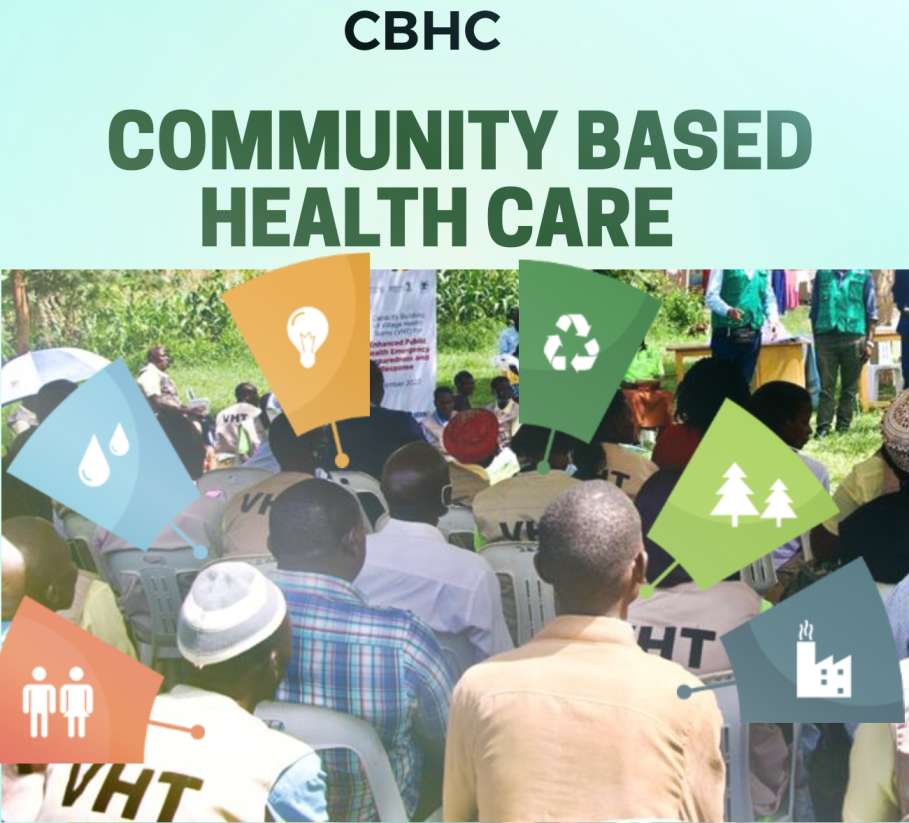
Community Based Health Care (CBHC) is the program of health care in which community members are actively involved in the identification and prioritization of their own health needs, and in the mobilization of their own resources to meet those needs.
- C - Community: The people living in a defined geographical area.
- B - Based / Foundation / Starting Point: Grounded at the grassroots level.
- H - Health / Well-being: Focused on holistic physical, mental, and social wellness.
- C - Care / Looking After / Giving Attention: Active provision of support and medical attention.
- The concept of CBHC emerged from the need to extend primary health care (PHC) services deep into the community, beyond the walls of formal health facilities.
- It aims to enable communities to fully participate in matters concerning their health, especially prioritizing marginalized groups like women, children, and people with disabilities.
- It is centered around full contribution, participation of the beneficiaries, and ensuring the sustainability of health interventions.
- It operates on the principle of being community-controlled: the community itself is responsible for problem identification, planning, implementation, monitoring, and evaluation.
The Alma-Ata assembly (1978) stressed the absolute need for greater participation and involvement of people, alongside the mobilization of all potential societal resources, to achieve self-reliance and sustainability in PHC. CBHC is identified as the most appropriate strategy to implement the concepts and pillars of PHC to achieve "Health for All."
- Most illnesses are preventable: The most common illnesses (e.g., malaria) are preventable or controllable either by the people themselves or through combined efforts between the community, government, and NGOs.
- Reduction of Morbidity and Mortality: A significant reduction in suffering can only occur if there is active "encouragement" and "enablement" of individuals/communities to adopt positive preventive habits, rather than passively expecting them to visit distant health services.
- Reaching Beyond Hospital Walls: This continuous encouraging and enabling must happen in villages and homes, not just within clinics.
- Bridging Coverage Gaps: Even with fully staffed health units, specialized services (e.g., dental and mental health) are mainly located in towns. CBHC ensures rural populations have access to essential health care.
- Establishing a Bottom-Up System: It establishes a sustainable, self-propagating system controlled and managed by the people through village health committees.
- Capacity Building: To build the capacity of each community to care for its own health, becoming self-reliant and working together for their own development. Building capacity means improving their abilities (knowledge and skills) to perform tasks, which is a continuous process.
- Disease Reduction: To actively reduce morbidity (illness) and mortality (death) in the community.
- Awareness Creation: To increase understanding between the people themselves, motivating them to follow healthy lifestyles.
The main objective of CBHC is to encourage and enable the community to take care for its own health and welfare if the community can,
- Identify its own health problems
- Find solutions for those problems
- Make its own decisions
- Find (identify) resources outside the community
- Evaluate its actions and replan
- Together and individually make healthy behaviors into common practices and habits.
The practical implementation of CBHC includes a wide array of grassroots activities:
- Provision of information, health education, and training concerning prevailing health problems and methods of preventing/controlling them.
- Promotion of proper nutrition and safe food supply.
- Maternal and child health care.
- Immunization against major infectious diseases.
- Prevention and control of locally endemic diseases (e.g., diarrheal diseases, acute respiratory infections, malaria).
- Reproductive health services, including family planning and the prevention/control of sexually transmitted infections (STIs), with particular emphasis on HIV/AIDS.
- Appropriate treatment for common diseases and minor injuries.
- Community mental health awareness and support.
- Rehabilitation for people with disabilities.
- School health activities and youth programs.
- Empowerment & Responsibility: The community becomes responsible for its own health problems and is empowered to take systematic care using available means at affordable costs.
- Ownership: Gives communities a strong sense of ownership and belonging in the healthcare system.
- Decision Making: Helps community members in planning, decision-making, implementation, and evaluation of health approaches.
- Cost-Effective: It significantly cuts down the costs of health care delivery.
- Reduces Dependency: Lessens absolute dependency on the government and external donors.
- Accessibility: Forces service delivery nearest to the community members, making health care easily accessible.
- Holistic Care: Promotes care that is physical, psychological, spiritual, and cultural.
- Bridging Gaps: Bridges the gap between the community and extension workers from other ministries (e.g., Agriculture).
- Skill Building for Health Workers: Helps health workers build a knowledge base in family theory, communication principles, group dynamics, and cultural diversity.
- Broader Impacts: Promotes unity, improves the quality of life, uplifts living standards, ensures early disease identification, and fosters community development.
- Lack of Diagnostic Tools: Diagnosis is often made on assumption in most cases, as there are limited or no laboratory investigations available at the grassroots level.
- Potential for Stigma: In close-knit communities, certain diagnoses (like HIV/AIDS or mental health issues) handled by local workers might inadvertently lead to increased stigma or breaches of confidentiality.
Services are drawn from and supported by:
- NGOs and specialized groups (e.g., TASO, UWESO, Hospice).
- Community Based Workers (CBWs).
- Village Health Committees (VHC) / Village Health Teams (VHT).
The structure is based on the need for supporting rather than supervising or controlling the community. It includes:
- Working Together: Collaboration across all local levels.
- Trained Community Members: Utilizing Community Health Workers (CHWs), VHTs, Traditional Birth Attendants (TBAs), and agricultural promoters.
- Development of Committees: E.g., the Village Health Committee (VHC) and Parish Development Committees (PDC).
While PHC and CBHC are deeply connected, there are distinct differences in their approach and execution.
- Both consider improving people’s health in the community as their primary goal.
- Both demand full community participation.
- Both aim at "Health for All" through preventive and curative methods.
- Both target marginalized groups and aim to share power, responsibilities, and health equality.
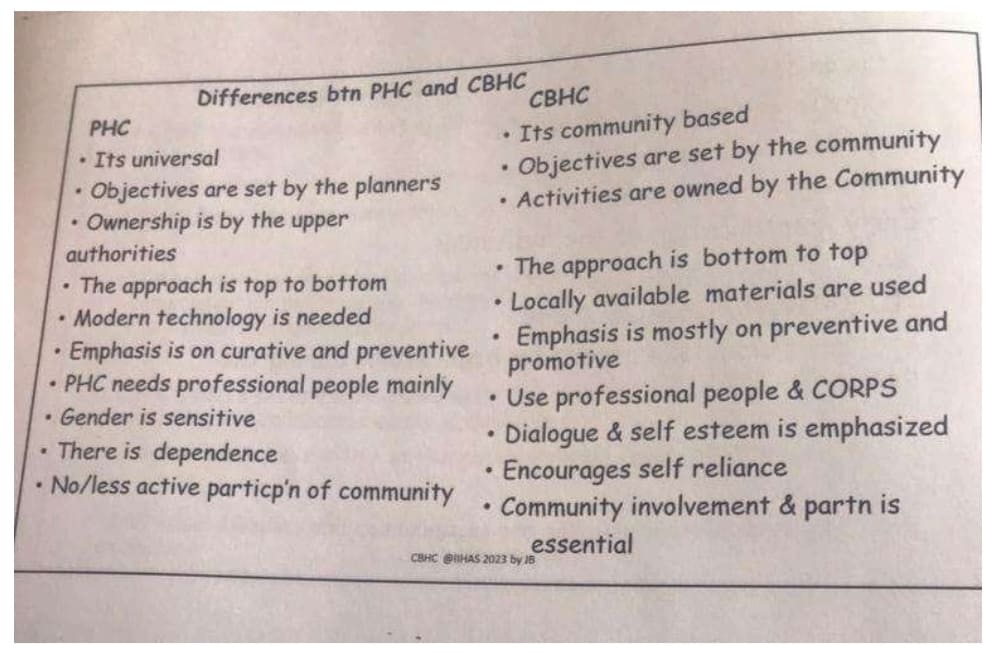
| Feature | Primary Health Care (PHC) | Community-Based Health Care (CBHC) |
|---|---|---|
| Scope & Reach | Universal: Aimed at providing a broad standard of healthcare services to the entire population across the country. | Community-Based: Specifically tailored and localized to meet the unique needs of a particular village or neighborhood. |
| Goal Setting | Set by Planners: Objectives and health targets are determined by government officials, health experts, and policymakers. | Set by Community: The people within the community identify their own health priorities and decide what goals are most important to them. |
| Ownership | Upper Authorities: The health facilities, equipment, and programs are owned and managed by the government or Ministry of Health. | Community Ownership: The community feels a sense of responsibility and "owns" the health activities, ensuring they are maintained locally. |
| Management Approach | Top to Bottom: Decisions are made at the national or regional level and passed down to the local clinics and patients. | Bottom to Top: Ideas and initiatives start with the people at the grassroots level and move upward to influence the health system. |
| Resources & Tools | Modern Technology: Relies on advanced medical equipment, standardized pharmaceuticals, and specialized diagnostic tools. | Local Materials: Utilizes resources that are easily available within the community to ensure solutions are affordable and sustainable. |
| Service Emphasis | Curative and Preventive: Focuses heavily on treating existing diseases (hospitals/clinics) while also providing basic prevention like vaccines. | Preventive and Promotive: Focuses mostly on stopping illness before it starts and teaching healthy lifestyle habits to promote long-term wellness. |
| Human Resources | Professional Staff: Mainly operated by highly trained medical professionals such as doctors, registered nurses, and specialists. | Professionals & CORPS: Uses a mix of professionals and Community Resource Persons (CORPS) or volunteers who live in the area. |
| Social Focus | Gender Sensitive: Programs are designed with an awareness of the different health needs of men and women within the general population. | Dialogue & Self-Esteem: Places high value on community discussions and building the confidence of members to take charge of their health. |
| Sustainability | Dependence: The system depends on continuous government funding, external supplies, and centralized logistical support. | Self-Reliance: Encourages the community to use their own skills and resources to solve problems, reducing outside dependency. |
| Public Participation | Limited Participation: The community are often passive recipients of care; they "use" the service but don't necessarily help run it. | Essential Involvement: Active participation and partnership of the community members are required for the program to function and succeed. |
A Village Health Team (or committee) is a non-political health implementing structure responsible for the health of community members at the household (HH) level.
This structure is put in place to facilitate the process of community mobilization, empowerment, and participation in the delivery, management, and implementation of health services directly at the grassroots. The overall goal of the village health team/committee is to: Achieve an improved quality of life by strengthening service delivery at the household level.
Advice and information are comprehensively given on three main pillars:
- Giving treatment and managing simple illnesses at home.
- Sexually transmitted diseases (including HIV/AIDS).
- Tuberculosis (TB).
- Family Planning (child spacing).
- Pregnancy, delivery, and care of the newborn baby.
- Adolescent sexual and reproductive health.
- Breastfeeding, food, and nutrition.
- Abuse and violence prevention.
- Immunization and mental health.
- Water and sanitation.
- Personal and general hygiene.
- First Aid.
- Community mapping.
- Maintenance of community registers.
- Conducting home visits.
- Talking with neighbors about health issues which have been found.
- Facilitate the community to identify and recognize their health problems.
- Mobilize the community for health programs (e.g., immunization, malaria control).
- Collect information, maintain record books of household members, and use this data for planning and programs.
- Serve as a vital link between the community and formal health providers.
- Follow up with patients or clients and conduct regular home visits.
- Identify individuals who need care at or outside their homes and refer them appropriately.
- Provide basic health messages for behavioral change.
- Distribute drugs, supplies, Information Education and Communication (IEC) materials, and Insecticide-Treated Nets (ITNs).
- Serve as role models in the community and collaborate with other community structures or ministries.
- Select and support the VHT.
- Attend village health events.
- Use available health services.
- Actively improve personal and family health.
- Inform communities about the VHT.
- Advocate for health at home and mobilize communities for health initiatives.
- Supervise VHT activities and give financial support.
- Incorporate planning for VHT into district and village health plans.
- Attend and actively support health events.
- Mature (18 years and above).
- A resident of the village.
- Able to read and write (or at least fluent in the local language).
- Possesses good communication skills.
- A dependable and trustworthy person.
- Interested in health and development issues.
- Should already be recognized as a resource person in the community.
The team generally comprises:
- Community Own Resource Persons (CORPs).
- Local leaders.
- Any similar resource persons in the community.
A Community Own Resource Person (CORP) is a member of a community residing within the same community, selected by the community, and trained to help the community improve their own health and facilitate development.
A CORP / CHW is a resident member of the community, selected by the community members, and trained to help the community improve their health and facilitate development. Their tasks are not confined to healthcare alone but extend to food production, sanitation, and income-generating activities.
His/her specific tasks are not confined to health care delivery alone but also extend to other aspects of development such as food production and income-generating activities.
- Community Health Workers (CHWs)
- Traditional Birth Attendants (TBAs)
- Traditional healers
- Community Drug Distributors (CDDs)
- Community HIV/AIDS counselors
- Community reproductive health workers
- Community DOTS workers (Directly Observed Therapy Short course)
- Peer educators
- Must be a local resident, mature in age and mind, and accepted/respected by the community.
- Healthy physically and mentally.
- A good communicator and listener (fluent in the local language).
- Able to read and write (preferably a reasonable educational standard, e.g., Senior Two).
- Trainable, dependable, and trustworthy.
- Available and willing to offer voluntary service (exemplary behavior).
- Knowledgeable and culturally competent (understands local habits, customs, traditions).
- Cooperative and able to work seamlessly with others.
- Home Visiting: Advising on personal hygiene, home care, and environmental sanitation/protection.
- Health Education: Educating communities on food production, nutrition, prevention of diseases, and the use of safe water.
- Problem Identification: Socially identifying health problems/concerns and prioritizing them together with community members.
- Record Keeping: Keeping records and using health information for organizing, planning, monitoring, and evaluating health services.
- Risk Assessment & Referral: Identifying individuals and families at risk and referring them appropriately to higher-level facilities.
- Direct Care: Treating minor ailments (if trained to do so), distributing prescribed drugs, assisting in immunization, and separating infectious products.
- Mobilization: Organizing simple, appropriate health talks, mobilizing the community for health programs, and serving as a vital link between the community and extension workers.
- Collaboration: Working closely with other community resource persons (TBAs, traditional healers, local leadership).
CHWs are individuals owned, selected, and supported by the community they work for. They are trained and charged with the responsibility of building community capacity at the household level and sustaining social/economic development.
- Giving health education to individuals, families, and groups (in the community and health facilities).
- Growth monitoring, checking the immunization status of under-5 children, and referring missed opportunities to the clinic.
- Promoting a healthy lifestyle (educating about healthy diets; effects of alcohol, drugs, and tobacco use).
- Promoting environmental, home, and personal hygiene, as well as good sanitation and safe water.
- Promoting breastfeeding, utilization of family planning, and the use of Antenatal Care (ANC) and Postnatal Care (PNC) services.
- Conducting home visits and making referrals to health workers and social workers.
- Completing/submitting monthly reports and keeping client registers up to date.
- Giving appropriate first aid for Acute Respiratory Infections (ARI), diarrhea, fever, and headache.
- Organizing health talks, gathering information for planning, and holding sensitization awareness meetings with leaders.
- Advancing the improvement of health issues at the household level, assisting during mobile health clinic days, and taking part in health development projects.
- Mobilizing and monitoring the uses of community resources.
- Identifying people with severe health problems (e.g., complicated cases like the mentally sick) and referring them for further medical management.
- Provide preventative care and health promotion regarding hygiene, nutrition, immunization, PMTCT (Prevention of Mother-to-Child Transmission), and prevention of infectious diseases (HIV, TB, Malaria).
- Educate on treatment adherence.
- Provide emotional, psychological, and spiritual care.
- Assist in accessing welfare services, such as social grants for children and people with disabilities.
- Provide information and referrals to support groups and other agencies (e.g., church groups).
- Refer clients to health facilities and distribute condoms.
- Support activities of daily living: bathing, feeding, mouth wash, prevention/care of bedsores, personal and general hygiene.
- Distributing condoms.
- Educating and counseling youth on life skills and STI/HIV/AIDS.
- Promoting risk-free practices and behaviors among their peers.
Traditional healers and practices are recognized by the WHO and should be integrated and improved to work hand-in-hand with Primary Health Care (PHC).
- Traditional Medicine: The sum total of knowledge, skills, and practices based on theories, beliefs, and experiences indigenous to different cultures, used to maintain health and prevent, diagnose, improve, or treat physical and mental illnesses.
- Alternative/Complementary Medicine: Traditional medicines that have been adopted by other populations outside its indigenous culture.
- Herbal Medicine: Includes herbs, herbal materials, herbal preparations, and finished herbal products that contain parts of plants or other plant materials as active ingredients.
A TBA (traditional midwife or community midwife) is a pregnancy and childbirth care provider who may not receive formal education but acquires skills through apprenticeship or being self-taught.
- Raise awareness and educate about key issues relating to pregnancy and childbirth in the community.
- Routinely refer pregnant women to health facilities for ANC, delivery, PNC, immunization, and Family Planning.
- Conduct clean and safe delivery (strictly only in case of emergencies).
- Identify danger signs during pregnancy, delivery, and post-delivery, referring immediately to the nearest health facility.
- Keep records, send monthly reports, lead by good example, and actively challenge traditional practices which may damage the health of the mother or baby.
Traditional healers are individuals who use herbal medicine to treat diseases at the community level. They include: 1. TBAs, 2. Bone setters, and 3. Herbalists.
- Infertility and Sexual disorders (like impotence, e.g., using Mulondo).
- Respiratory Tract Infections (RTI).
- Ante Natal Care issues (e.g., Morning sickness).
- Skin diseases and Allergies (e.g., to meat, fish, milk).
- Fractures and Snake bites (e.g., using black stone).
- Types of Prepared Medicines: Syrups (e.g., kisa kyamuzadde, aloe vera), herbs for topical application (e.g., kyogero), and herbs incorporated in soil (e.g., Emumbwa).
- Collection of Medicines: Collected secretly, collected by elders, or based on family predisposition.
- Preservation: Boiling/cooking, sun drying, burning, packaging in containers/bottles (sometimes unfortunately operating in dry, dirty environments).
- Administration Routes: Orally (syrups/liquids), topically (e.g., samona), intra-vaginally (e.g., kamunye).
- Dosaging: Dosages are often not clear, even when the components of the medicines are known.
- Payments: Sometimes in the form of barter trade (e.g., food, domestic animals, land) rather than cash.
- Affordable to all categories of people and highly accessible (hawkers come straight to people's homes).
- Possess good communication skills and use the local language, which builds trust.
- Offer valuable counseling, taking time to listen to the person in need.
- Have done grassroots research through discovering new herbal trees/plants for treatments.
- Medications often have fewer side effects, and they successfully treat certain diseases.
- Encourage preventive measures (e.g., using topical herbs to prevent skin disorders in HIV patients, or eating Katunkuma to cut fat and boost immunity).
- Offer health education talks and train other traditional healers.
- Provide self-employment for themselves and others (hawkers, bus owners).
- Promote environmental conservation by preserving specific plant species.
- Organized healers with established clinics sometimes pay taxes, contributing to the economy.
| Challenges & Institutional Issues | Direct Dangers to the Community |
|---|---|
|
|
The professional nurse or midwife acts as the crucial anchor connecting the formal healthcare system to the community-based framework.
| No. | Key Responsibilities in CBHC |
|---|---|
| 1 | Leadership & Supervision: Provide leadership, mentorship, and supervision to Community Health Workers, TBAs, and other local health workers. |
| 2 | Training TBAs & Healers: Cooperate in the training of TBAs and traditional healers on safe methods of client care (e.g., care of pregnant mothers, recognizing obstetric abnormalities, safe delivery, and puerperal care). |
| 3 | Community Education: Work with CHWs and TBAs to educate the community on prevailing health problems and prevention (e.g., sanitation, infant feeding, safe water, personal/public hygiene, malaria prevention). |
| 4 | Problem Identification: Collaborate with the community and local workers to identify health problems and brainstorm localized, viable solutions. |
| 5 | Recruitment: Actively participate in community activities to identify and select potential new health workers (CORPs/VHTs). |
| 6 | Child Growth Monitoring: Run the young child clinic to accurately monitor the growth and development of infants and children. |
| 7 | Maternal Health: Run antenatal clinics giving care/assistance to pregnant mothers, ensuring safe deliveries, and managing post-natal care. |
| 8 | Family Planning: Educate, advise, and provide services regarding family planning options. |
| 9 | Clinical Management: Make use of essential drugs for the treatment of minor disorders and injuries within the community setting. |
| 10 | Referral System: Promptly refer patients with complex conditions to hospitals for advanced care and management. |
| 11 | Research: Participate in and conduct operational community research to improve local health outcomes. |
For CBHC to thrive, it requires robust institutional backing:
- Training and Support: The government must offer comprehensive training for practitioners (like VHTs and CORPs) so they are well-equipped at all phases of the health delivery process.
- NGO Integration: The government should provide structural support to NGOs and the numerous organizations actively involved in community empowerment. This leadership leads to consistency, reduced duplication of efforts, and integration of services across the community.
Ya it has exactly what we considered basics
Thanks,, beautiful legacy
Easly understood
Great, neat and easy 2 understand, it’s my pleasure 🙏 I’m really glad
An easy to understand informative document
Thanks for this breakdown of CBHC. Now my notes are complete. This has made my work very simple. Well done. Blessings to you and team.
Well organized and undertandable👍👍
Any questions about CBHC
Discuss the relevance of community based health care in disease prevention and health promotion.
I like it 😊
THANKS for the good notes
Thanks for the information
Am stunned
nice guide