
🧬 The Cell
CN-1102: Cell Structure & Function
- Cell Structure (Organelles)
- Movement across Membrane (Osmosis, Diffusion)
- Cell Division (Mitosis vs Meiosis)

1. CELL STRUCTURE & ORGANELLES
Definition: The cell is the basic structural and functional unit of all living organisms. All body processes occur at the cellular level.
🔬 Key Organelles & Functions:
- Nucleus: "Control center" - contains DNA, controls cell activities
- Mitochondria: "Powerhouse" - produces ATP (energy) through cellular respiration
- Ribosomes: "Protein factories" - site of protein synthesis
- Endoplasmic Reticulum (ER):
- Rough ER: Studded with ribosomes, makes proteins
- Smooth ER: Makes lipids, detoxifies drugs
- Golgi Apparatus: "Packaging center" - modifies, sorts, packages proteins
- Lysosomes: "Stomach of cell" - contain digestive enzymes, break down waste
- Cell Membrane: "Gatekeeper" - selective permeability, controls what enters/leaves
- Cell Wall (Plants): Provides structural support & protection
- Chloroplasts (Plants): Site of photosynthesis, contains chlorophyll
- Vacuoles: Storage (water, nutrients, waste) - larger in plant cells
ER (Rough/Smooth), Golgi, Lysosomes
2. MOVEMENT ACROSS CELL MEMBRANE
🚶♂️ DIFFUSION
Definition: Movement of particles from an area of HIGH concentration to an area of LOW concentration until evenly distributed.
Key Points: Passive process (NO energy required), happens down concentration gradient
Examples in body: Gas exchange in lungs (O₂ & CO₂), nutrients moving into cells
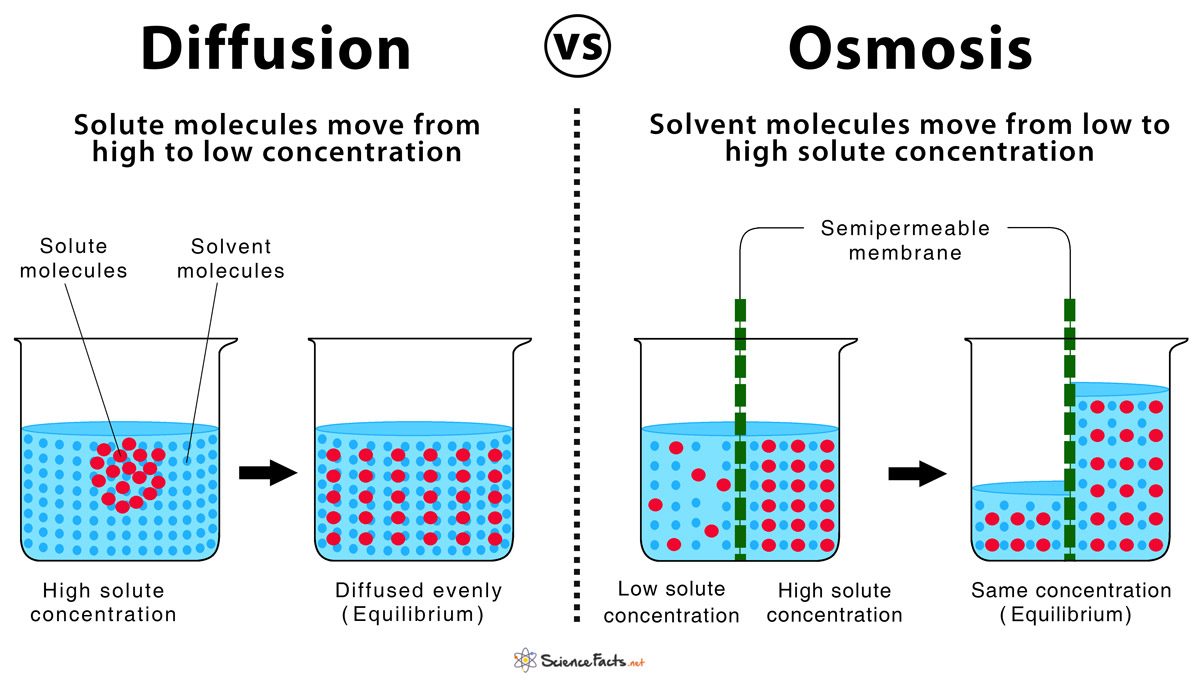
💧 OSMOSIS
Definition: Movement of WATER molecules across a semi-permeable membrane from a region of dilute solution (high water concentration) to a concentrated solution (low water concentration).
Key Points: Special type of diffusion, passive process, occurs through partially permeable membrane
🔍 Types of Solutions:
| Solution Type | Description | Effect on Cell |
|---|---|---|
| Hypotonic | Lower solute concentration outside cell | Water enters → Cell swells (may burst) |
| Hypertonic | Higher solute concentration outside cell | Water leaves → Cell shrinks (crenation) |
| Isotonic | Equal solute concentration | No net movement → Cell remains same |
⚡ ACTIVE TRANSPORT
Definition: Movement of substances AGAINST concentration gradient (low to high) using energy (ATP).
Examples: Sodium-potassium pump, absorption of glucose in intestines
Requires ATP (energy)
3. CELL DIVISION: MITOSIS vs MEIOSIS
🔄 MITOSIS
Purpose: Growth, repair, asexual reproduction, results in 2 IDENTICAL daughter cells
Location: Somatic (body) cells
📍 Stages of Mitosis (PMAT):
- Prophase: Chromosomes condense, nuclear membrane disappears, centrioles move apart
- Metaphase: Chromosomes line up at cell equator (metaphase plate)
- Anaphase: Chromatids separate, move to opposite poles
- Telophase: Nuclear membranes reform, chromosomes decondense
Prophase → Metaphase → Anaphase → Telophase

🔄 MEIOSIS
Purpose: Production of gametes (sperm & ovum), results in 4 genetically DIFFERENT cells
Location: Reproductive organs (testes & ovaries)
Key Feature: Two divisions (Meiosis I & II), creates genetic variation through crossing over
📊 COMPARISON TABLE:
| Feature | Mitosis | Meiosis |
|---|---|---|
| Number of divisions | 1 | 2 (Meiosis I & II) |
| Number of daughter cells | 2 | 4 |
| Chromosome number | Diploid (46 in humans) | Haploid (23 in humans) |
| Genetic variation | No (identical) | Yes (different) |
| Where it occurs | Somatic cells | Germ cells |
| Purpose | Growth & repair | Gamete formation |
📝 LIKELY EXAM QUESTIONS FOR DAY 5
The mitochondria is known as the powerhouse of the cell because it produces ATP (energy).
Diffusion is the movement of particles from an area of high concentration to an area of low concentration.
Which organelle controls all cell activities?
What happens to a red blood cell placed in a hypotonic solution?
The correct sequence of mitosis stages is:
State three differences between mitosis and meiosis.
ANSWER GUIDE:
- Mitosis: 1 division, 2 daughter cells, genetically identical
- Meiosis: 2 divisions, 4 daughter cells, genetically different
- Mitosis: somatic cells, meiosis: germ cells
- Any 3 differences = 5 marks (1 for each difference, 2 for explanation)
Explain why osmosis is important in the human body and give two examples.
ANSWER GUIDE:
- Important for maintaining cell shape and function
- Examples: Reabsorption of water in kidney tubules, absorption in intestines, water movement across cell membranes
- 2 examples with explanation = full marks
You observe plant cells under a microscope. The cells are placed in a strong salt solution. Describe what you would see and explain why.
ANSWER GUIDE:
- See: Cell membrane pulls away from cell wall (plasmolysis)
- See: Cytoplasm shrinks, vacuole becomes smaller
- Why: Hypertonic solution outside → water leaves cell by osmosis
- Cell becomes plasmolyzed
- Diagram with labels = bonus marks!