
- Definition of nursing theories.
- Importance and purpose of theories in healthcare.
- Exploration of specific conceptual and theoretical models of nursing practice.
A theory is a set of concepts, definitions, and propositions that projects a systematic view of phenomena (e.g., Nursing care) by designating specific interrelationships among concepts.
Furthermore, a theory refers to a set of logically interrelated concepts, statements, propositions, and definitions, which have been derived from philosophical beliefs of scientific data, and from which questions or hypotheses can be deduced, tested, and verified.
The development of a theory follows a systematic flow of knowledge building:
- Paradigm ➔ Conceptual Models ➔ Research ➔ Theory ➔ Science ➔ Discipline.
Nursing theories emerged to provide a systematic foundation for nursing practice, education, research, and professional knowledge. They are essential because they:
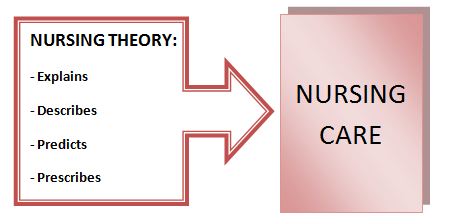
- Explain, Describe, Predict, and Prescribe nursing care.
- Develop and clarify the body of nursing knowledge.
- Enhance the status of nursing as an independent academic and scientific profession.
- Define the boundaries of nursing practice within the broader healthcare system.
- Define the unique contribution of nursing in the holistic care of patients.
- Provide perspectives for relating and collaborating with other healthcare professionals.
- Guide patient assessment and help accurately identify patient needs.
- Plan individualized nursing care and support clinical decision-making.
A meta-paradigm represents the most global, universal ideas or worldview about the central phenomena of interest in a specific discipline. In nursing, the meta-paradigm consists of four core concepts:
- A person is the recipient of nursing care.
- It may include individuals, families, and entire communities.
- Orem (1980) definition: A functional integrated whole with a motivation to achieve self-care.
- Roy (1971) definition: A bio-psycho-social being who presents as an integrated whole and acts as an adaptive system.
- The attributes, characteristics, and actions of a nurse providing care on behalf of or in conjunction with the client.
- The ultimate goal of nursing theories is to improve patient care.
- Roy (1971) definition: Promotes a positive adaptation to the stimuli and stresses encountered by the client.
- Rogers definition: Aims to assist people in achieving their maximum human potential.
- Henderson definition: The ability to function independently.
- Orem (1980) definition: A state of wholeness or integrity of the individual, his parts, and his modes of functioning.
- Roy (1971) definition: The adaptation of the person to stimuli on a continuum between wellness and illness.
- The internal and external surroundings that affect the client.
- Environment includes:
- Positive or negative conditions that affect the patient.
- Social networks (families, friends, etc.).
- The physical setting of healthcare.
Florence Nightingale is recognized as the Founder of Modern Nursing and the pioneer of the Environmental Theory.
- Core Concept: Healthy surroundings are strictly necessary for proper nursing care.
- Role of Nursing: "To put the patient in the best condition for nature to act upon him/her." It is the act of utilizing the environment of the patient to assist him in his recovery.
- 5 Essential Environmental Factors:
- Pure air (ventilation)
- Pure water
- Efficient drainage
- Cleanliness (linens, floors, walls, handwashing, patient bathing)
- Light (direct sunlight)
- Additional Factors: Quiet (noise reduction) and proper Diet (nutrition).
Henderson defined nursing in relation to assisting individuals with activities contributing to health, recovery, or peaceful death.
- Core Concept: Emphasizes the basic human needs (14 fundamental needs).
- Role of Nursing: Nurses assist the patient in the performance of activities that they would perform unaided if they had the necessary strength, knowledge, will, or ability to do so.
- Goal: Nursing assists the patient to gain their own independence.
- The 14 Basic Needs:
- Breathe normally.
- Eat and drink adequately.
- Eliminate body wastes.
- Move and maintain desirable positions.
- Sleep and rest.
- Select suitable clothes (dress/undress).
- Maintain body temperature within a normal range.
- Keep the body clean and well-groomed (protect integument).
- Avoid environmental dangers (and avoid injuring others).
- Communicate with others including emotions, fears, and needs.
- Worship according to one’s faith.
- Work with a sense of accomplishment.
- Play or participate in various forms of recreation.
- Learn, discover, or satisfy the curiosity that leads to normal development and health.
- Self-Care: Activities that an individual initiates and performs on their own behalf to maintain life, healthful functioning, continued personal development, and well-being.
- Dependent Care: Care provided to someone who is unable to perform self-care.
- Self-Care Deficit: Occurs when an individual's agency (ability) for self-care is not adequate to meet their required needs.
- Role of Nursing: Nursing care is the specialized assistance of individuals who have self-care deficit needs.
- Self-Care Requisites: The necessary actions for functioning and development. Universal self-care requisites include:
- Maintenance of sufficient air, food, water, rest, and social interaction.
- Provision of care associated with elimination.
- Prevention of hazards.
- Promotion of functioning and development within social groups.
Developed by Sr. Callista Roy, this model views the person as an adaptive system interacting constantly with a changing environment.
- Core Concept: Roy defines Nursing as both a science and practice that expands adaptive abilities and enhances person and environmental transformation.
- Goal of Nursing: "The promotion of adaptation for individuals and groups, thus contributing to health, quality of life, and dying with dignity."
- System Components (How the model works):
- Input: Stimuli and Adaptation level.
- Control Processes: Coping mechanisms consisting of the Regulator (physiological responses) and Cognator (cognitive/emotional responses).
- Effectors: Four adaptive modes: Physiological function, Self-concept, Role function, and Interdependence.
- Output: Adaptive (effective) or Ineffective responses.
- Feedback: The output loops back to influence future inputs.
Developed in the 1950s in the U.S., this theory heavily influenced psychiatric and mental health nursing.
- Core Concept: Patients are individuals who require help to achieve independence.
- Focus of Nursing: The core of nursing practice is the therapeutic nurse-patient relationship.
- Relational Dynamics: Both the Nurse and the Patient bring their own unique variables into the relationship, which overlap and interact. These include:
- Values
- Culture
- Beliefs
- Past experiences
- Expectations
- (Nurses also bring their preconceived ideas).
- Core Concepts: Patients have their own meaning and interpretations of situations (reactions). Nurses must thoroughly assess before drawing conclusions about these reactions.
- Relationship: There is a reciprocal relationship between nurses and patients.
- Need for Nursing: People become patients when they cannot meet their needs independently (whether mental, physical, or emotional), which leads directly to distress or a feeling of helplessness.
- Outcome: This theory laid the groundwork for the deliberate development of the modern Nursing Process.
| Theorist | Theory / Conceptual Model |
|---|---|
| Jean Watson | Theory of Human Caring |
| Betty Neuman | Neuman Systems Model |
| Martha Rogers | Science of Unitary Human Beings |
| Imogene King | Theory of Goal Attainment |
Nursing theories are not just academic concepts; they directly guide how a nurse approaches patient care. For example, consider a nurse caring for a patient newly diagnosed with diabetes:
- Orem's theory: The nurse will assess the patient's ability to perform self-care (e.g., checking blood sugar, administering insulin). The nurse provides education to cover the self-care deficit until the patient becomes independent.
- Watson's theory: The nurse will deliberately demonstrate caring and respect for the patient's dignity and emotional fears regarding the chronic illness diagnosis.
- Henderson's theory: The nurse will systematically identify unmet basic needs (e.g., dietary knowledge, anxiety affecting sleep) and assist the patient in fulfilling them.
- King's theory: The nurse will collaborate actively with the patient to set mutual, achievable health goals (e.g., target HbA1c levels) and outline the steps to attain them.
Quick Quiz
Theories of Nursing Quiz
Foundations
Privacy: Your details are used only for quiz tracking and certificates.
Theories of Nursing Quiz
Foundations
Preparing questions...
Choose your answer and keep your streak alive.
Great effort.
Here is your quick performance summary.