Nurses Revision

nursesrevision@gmail.com

Growth and Development of a Child

Growth and Development of a Child

Nursing Notes - Child Growth and Development

Child Growth and Development

Growth is the process of physical increase in size, such as height and weight. It is a quantitative measure that also includes the maturation of body systems.

Development is the progressive increase in skill and capacity to function. It is a qualitative measure that results from the maturation and myelination of the nervous system, allowing for more complex body structures and functions.

Patterns of Growth and Development

Growth and development are orderly, predictable, and follow directional patterns.

  • Cephalo-caudal Pattern: This means development proceeds from head to tail (or feet). Structures and functions originating in the head region develop before those in the lower parts of the body.
    • In fetal development, the head grows fastest initially, followed by the trunk, and then the legs.
    • At birth, the head is proportionately larger than the rest of the body. As the child matures, the legs grow significantly, increasing from about 38% to 50% of total body length by adulthood.
    • An infant gains control of their head before they can sit, and can sit before they can walk.
  • Proximo-distal Pattern: This means development proceeds from the center of the body outwards to the extremities.
    • In the respiratory system, the trachea develops first, followed by the branching of bronchi, bronchioles, and finally the alveoli.
    • Motor control of the arms develops before control of the hands, and hand control is established before fine finger control (pincer grasp).
  • Critical or Sensitive Periods

    These are specific times during development when a child is most receptive to learning a particular skill or behavior, such as walking or language acquisition. Environmental influences, whether positive or negative, have the greatest impact during these periods. Factors like injury, illness, or malnutrition can interfere with development during these critical times.

    Factors Influencing Growth and Development

  • Genetics (Heredity): Genetic makeup determines physical traits, intellectual potential, and the presence of certain inherited conditions that can facilitate or hinder development.
  • Environment (Prenatal and Postnatal):
    • Prenatal: The mother's health during pregnancy is crucial. Factors like maternal nutrition, smoking, alcohol use, drug exposure, and infections (e.g., rubella) can lead to congenital abnormalities and developmental delays.
    • Postnatal: After birth, factors like socioeconomic status, family relationships, housing, access to healthcare, and exposure to environmental hazards influence the child's development.
  • Culture: Cultural beliefs, values, and child-rearing practices can shape a child's social and emotional development.
  • Nutrition: Adequate nutrition is essential for physical growth, especially for brain development both prenatally and during the first year of life. Malnutrition can cause irreversible delays.
  • Health Status: Chronic or acute illnesses can impede growth by affecting the delivery of nutrients, hormones, and oxygen to tissues and organs.
  • Play: Play is the "work" of childhood. It is essential for motor, cognitive, language, and social development, allowing children to explore, learn, and practice new skills.
  • Factors Contributing to Effective vs. Poor Growth

    Factors for Effective Growth (Thriving)
    1. Exclusive breastfeeding for the first 6 months, continuing for up to 2 years or more: Breast milk provides optimal nutrition, antibodies for immunity, and promotes healthy bonding. Continued breastfeeding alongside solids extends these benefits.
    2. Timely introduction of appropriate complementary foods (quality and quantity) at 6 months: Around 6 months, breast milk alone isn't sufficient. Introducing nutrient-dense, varied complementary foods in adequate amounts supports increasing energy and nutrient needs.
    3. A regular, balanced diet containing all essential nutrients: Ensuring consistent access to a diverse diet rich in carbohydrates, proteins, fats, vitamins, and minerals is fundamental for sustained physical and cognitive development.
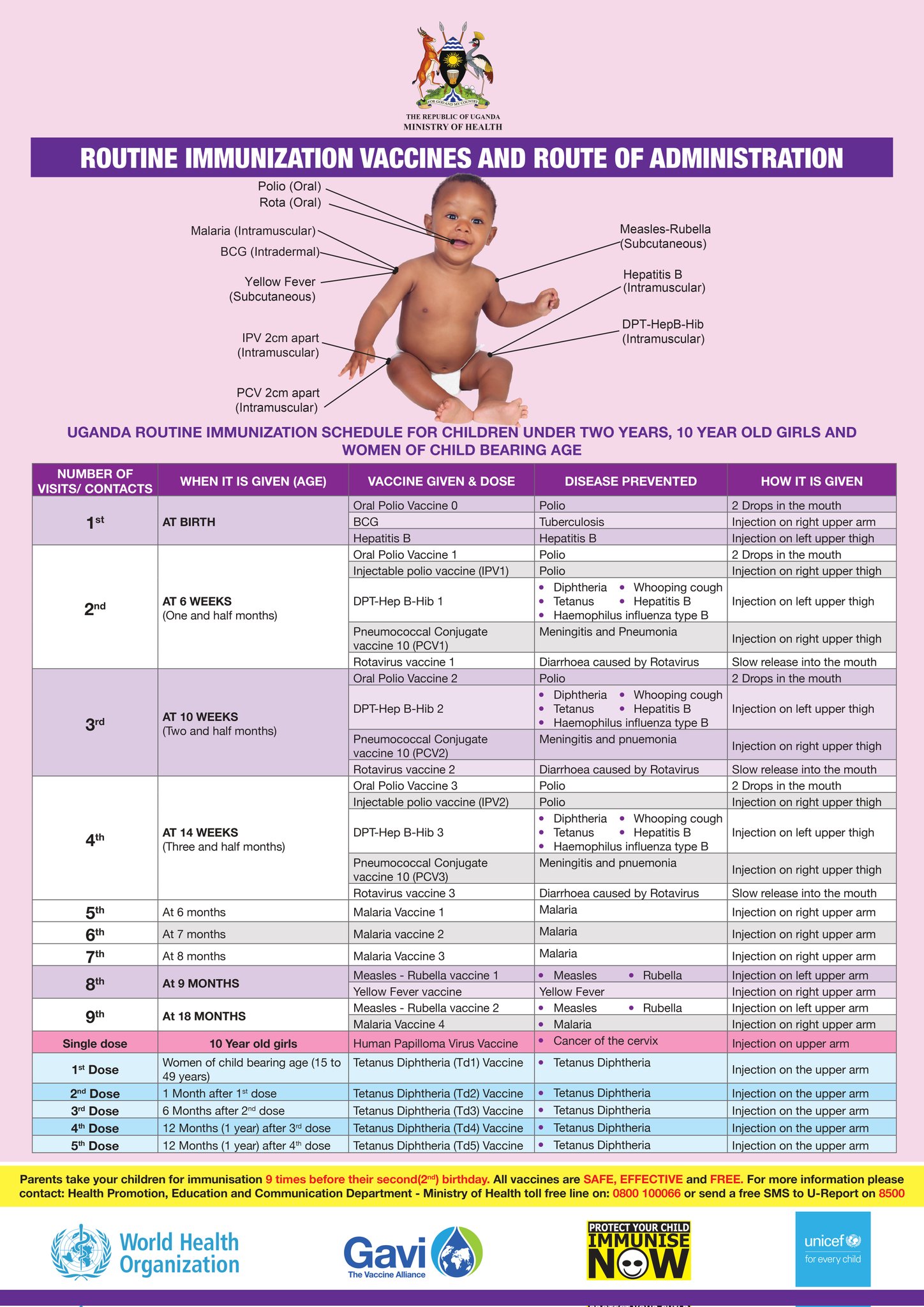
    4. Prevention of childhood illnesses through full immunization and proper sanitation: Vaccinations protect against debilitating diseases, while good hygiene and sanitation reduce exposure to infections that can hinder growth by increasing nutrient demands or reducing appetite.
    5. Early diagnosis and effective treatment of common illnesses like malaria, diarrhea, and respiratory infections: Prompt and correct medical intervention prevents illnesses from becoming chronic or severe, which can significantly deplete a child's nutritional reserves and impair growth.
    6. Adequate birth spacing through family planning services: Longer intervals between births allow the mother's body to recover nutritionally and emotionally, enabling her to dedicate more resources and attention to each child's care and development.
    7. Parental involvement in growth monitoring and health education: Active participation in regular growth monitoring helps identify deviations early, and parental education on nutrition, hygiene, and developmental milestones empowers them to make informed decisions for their child's well-being.
    8. Responsive feeding practices: Parents or caregivers respond to a child's hunger and fullness cues, offering food in an encouraging and supportive manner without force-feeding or restricting. This builds a healthy relationship with food.
    9. Secure attachment and stimulating environment: Emotional security from consistent, loving care fosters psychological well-being, which indirectly supports physical health. A stimulating environment (play, interaction, learning) supports cognitive development that is intertwined with physical growth.
    10. Access to clean water: Essential for hydration and preventing waterborne diseases, which can significantly impact a child's health and ability to absorb nutrients.
    Factors for Poor Growth (Failure to Thrive)
    1. Low birth weight or prematurity: Infants born too small or too early often start life at a disadvantage, with underdeveloped organs and lower nutrient reserves, making them more susceptible to growth faltering.
    2. Unsuccessful breastfeeding (e.g., poor positioning or attachment): Ineffective breastfeeding leads to inadequate milk intake, poor weight gain, and can discourage mothers, leading to early cessation.
    3. Early introduction of complementary feeds (before 6 months) or early cessation of breastfeeding: Introducing solids too early can displace nutrient-dense breast milk, increase infection risk, and overwhelm an immature digestive system. Stopping breastfeeding too soon removes a vital source of nutrition and immunity.
    4. Frequent or chronic illness (e.g., diarrhea, worm infestations, malaria, URTI): Repeated infections increase metabolic demands, reduce appetite, impair nutrient absorption, and lead to nutrient loss, creating a vicious cycle of illness and malnutrition.
    5. Late introduction of solid foods: Delaying the introduction of complementary foods beyond 6 months means a child's increasing nutritional needs are not met, leading to energy and nutrient deficiencies.
    6. Poor socioeconomic status leading to food insecurity: Limited financial resources often translate to insufficient access to diverse, nutritious foods, safe water, and adequate healthcare, directly impacting a child's growth.
    7. Parental ignorance or lack of education about proper nutrition and feeding practices: Lack of knowledge regarding appropriate food choices, preparation, and feeding techniques can lead to inadequate dietary intake and malnourishment, even if food is available.
    8. Poor maternal health or death of a parent: A mother's ill health (physical or mental) or the absence of a primary caregiver can severely compromise the quality of care, feeding, and emotional support a child receives, impacting their growth.
    9. Unresponsive feeding practices: Caregivers who ignore a child's hunger cues, force-feed, or provide limited food choices can create negative associations with eating, leading to reduced intake and poor growth.
    10. Unsanitary living conditions and lack of access to clean water: Exposure to pathogens due to poor hygiene and contaminated water sources increases the risk of recurrent infections, particularly diarrheal diseases, which are major contributors to growth faltering.
    11. Child neglect or abuse: In severe cases, a lack of adequate physical care, nutritional provision, and emotional support due to neglect or abuse can directly result in severe growth failure and developmental delays.

    Stages of Growth and Development

    1. Neonatal Period (Birth to 1 Month)
    • Weight: Average birth weight is 2.5 to 4.3 kg. A newborn typically loses 5-10% of their birth weight in the first 3-4 days, which should be regained by 10-14 days of age.
    • Head: The anterior fontanelle is diamond-shaped, and the posterior is triangular; both are palpable. The head is large, and neck muscles are weak, requiring head support.
    • Reflexes: Primitive reflexes like sucking, rooting, grasping, and the startle (Moro) reflex are present and are key indicators of neurological function.
    • Physical Characteristics: Skin color varies with ethnicity; blood vessels may be visible. Mongolian spots (bluish discolorations on the lower back/buttocks) are common in dark-skinned infants and fade over time. Breast engorgement or vaginal discharge/bleeding can occur in both sexes due to maternal hormones. Testes should be descended into the scrotum in males.
    • Behavior: Sleeps 18-20 hours a day. Can lift head briefly when in a prone position.
    • Vital Signs:
      • Pulse: 120-160 bpm
      • Respirations: 30-50 breaths/min
      • Blood Pressure: 50-100 / 20-60 mmHg
      • Temperature: 36.5 - 37.5°C
    2. Infancy (1 Month to 1 Year)
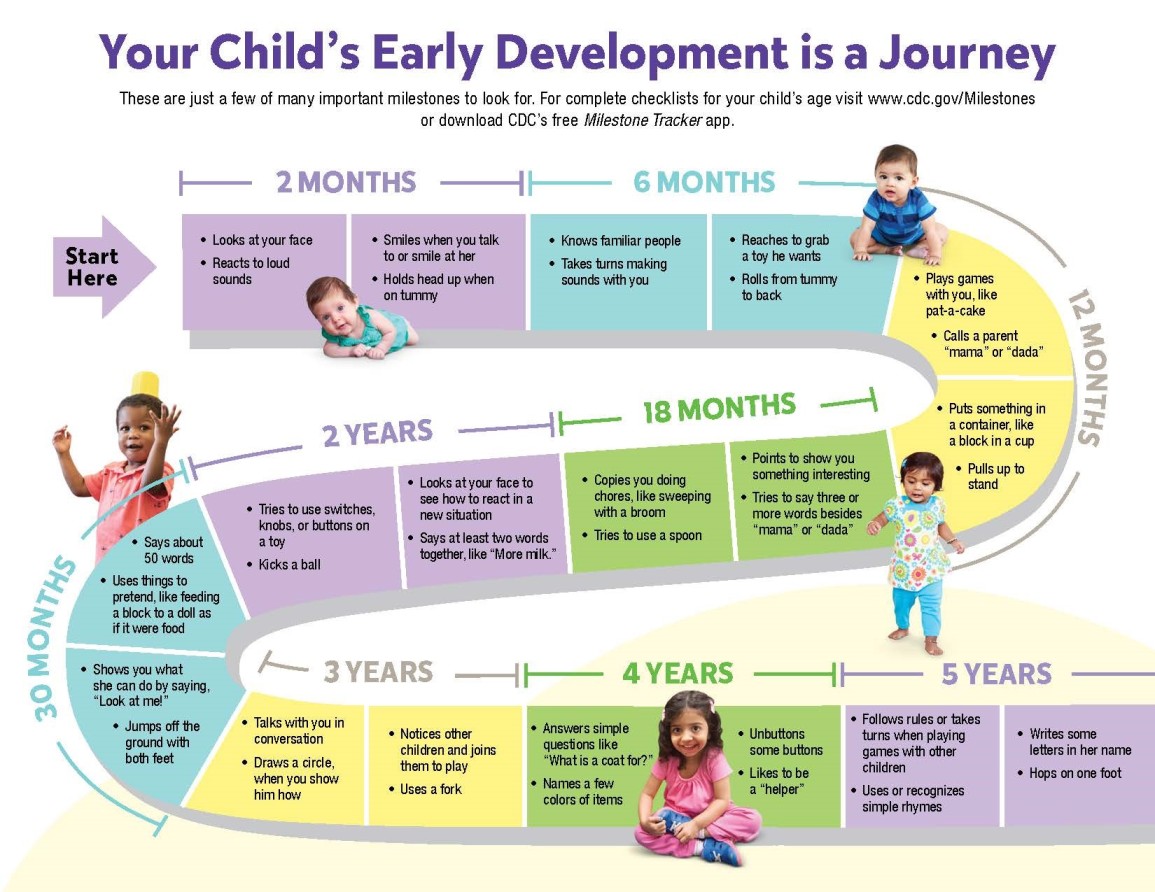
    • Growth: Rapid growth period. Weight doubles by 5-6 months and triples by 1 year.
    • Social Development: Exhibits a real social smile by 2 months. Begins to interact and gurgle by 3 months. Stranger anxiety often develops around 8 months.
    • Motor Skills: Persistence of neonatal reflexes beyond 4 months may indicate an abnormality. Rolls from back to side by 4 months. Bears weight on legs by 6-7 months. Sits alone by 7 months. Pulls to a stand by 9-10 months. Walks with assistance or alone by 12 months. Grasp reflex is replaced by voluntary pincer grasp by 9-11 months.
    • Dentition & Diet: First teeth typically erupt around 6 months; should have 6-8 teeth by 1 year. Solid foods are introduced around 6 months.
    • Vital Signs:
      • Pulse: 80-180 bpm
      • Respirations: 30 breaths/min
      • Blood Pressure: 74-100 / 50-70 mmHg
      • Temperature: 36.5 - 37.2°C
    3. Toddlerhood (1 to 3 Years)
    • Behavior: Characterized by exploration, autonomy, and negativism ("no"). Has the strength and will to resist. Suspect hearing impairment if speech is not clear by age 2.
    • Growth: Growth rate slows. Gains a "pot-bellied" appearance. Head circumference increases about 1 inch between ages 1 and 2. Brain growth reaches about 80% of adult size by age 3.
    • Dentition: Primary dentition (20 teeth) is complete by 30 months.
    • Motor Skills: Improved coordination and equilibrium. Develops sphincter control, making toilet training possible (usually between 18-24 months).
    • Cognitive: Rapid increase in language skills.
    • Vital Signs:
      • Pulse: 80-140 bpm
      • Respirations: 25 breaths/min
      • Blood Pressure: 80-112 / 50-80 mmHg
      • Temperature: 36.0 - 37.2°C
    4. Preschool (3 to 6 Years)
    • Behavior: Generally cooperative and likes to please; responds well to praise. Engages in interactive and imaginative play.
    • Growth: Physical growth continues to slow. The pot-bellied appearance diminishes by age 5.
    • Motor Skills: Skills become more refined; can ride a tricycle, hop, and draw simple shapes.
    • Health: Prone to skin infections and lice due to close interactive play. Dental visits should begin.
    • Vital Signs:
      • Pulse: 80-120 bpm
      • Respirations: 23-30 breaths/min
      • Blood Pressure: 80-110 / 50-70 mmHg
      • Temperature: 36.3 - 37.0°C
    5. Middle Childhood / School Age (6 to 12 Years)
    • Behavior: Capable of following instructions and using age-appropriate language. Privacy becomes important.
    • Growth & Physical Changes: First permanent teeth (molars) appear at age 6. Respirations become thoracic by age 7. In girls, breast budding may begin around 9 years.
    • Cognitive: Thinking becomes more logical. Articulation should be correct by age 7.
    • Vital Signs:
      • Pulse: 70-115 bpm
      • Respirations: 17-20 breaths/min
      • Blood Pressure: 84-120 / 54-80 mmHg
      • Temperature: 36.5 - 36.8°C
    6. Adolescence (13 to 19 Years)
    • Behavior: Seeks independence; may not want caregivers present during examinations. Direct questions to the adolescent. Peer group is highly influential.
    • Physical Changes (Puberty): Development of secondary sexual characteristics. In girls, breasts enlarge and menstruation begins. In boys, testes enlarge and voice deepens. Pubic and axillary hair develops in both sexes.
    • Vital Signs:
      • Pulse: 50-100 bpm
      • Respirations: 16-18 breaths/min
      • Blood Pressure: 94-140 / 62-88 mmHg
      • Temperature: 36.6°C

    Theories of Growth and Development

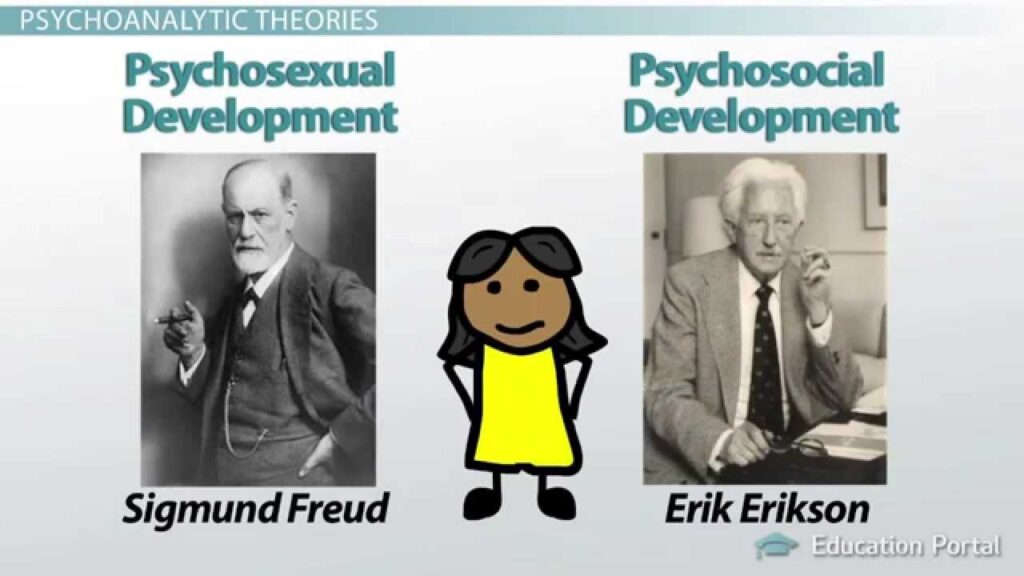
    Theories provide frameworks for understanding human behavior. Key theorists in child development include Erikson (psychosocial), Freud (psychosexual), Piaget (cognitive), and Kohlberg (moral).

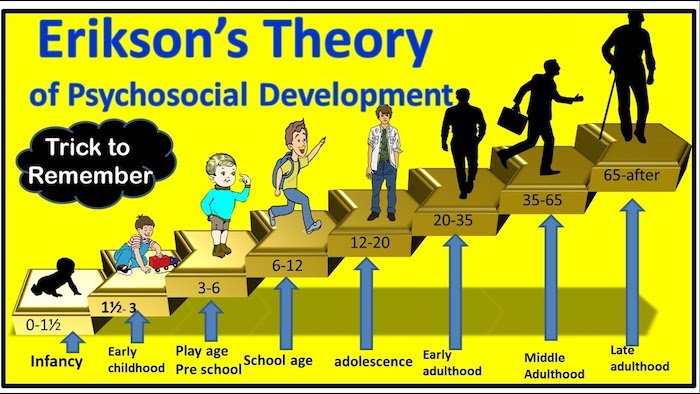
    Erikson's Theory of Psychosocial Development

    Erikson described development as a series of psychosocial crises that must be resolved at each stage for healthy personality development.

    Infancy (Birth-1 year): Basic Trust vs. Mistrust

    The central task is to establish trust. When caregivers consistently meet the infant's needs for food, comfort, and affection, the infant learns to trust the world as a safe place. Failure to do so leads to mistrust, which can hinder future relationships.

    Example: A baby who is consistently fed when hungry and comforted when crying learns to trust their caregivers and the world around them. Conversely, a baby whose needs are inconsistently met may develop a sense of mistrust, becoming anxious or withdrawn.

    Toddlerhood (1-3 years): Autonomy vs. Shame and Doubt

    The child must establish a sense of autonomy (self-governance). As they learn to walk, talk, and do things for themselves, they develop self-confidence. If they are overly criticized or controlled, they may develop a sense of shame and doubt in their own abilities.

    Example: A toddler who is encouraged to choose their own clothes and pour their own juice (even if some spills) develops a sense of autonomy. If caregivers are overly critical or controlling, the toddler might feel shame and doubt about their abilities, becoming hesitant to try new things.

    Preschool (3-6 years): Initiative vs. Guilt

    The central task is to develop a sense of initiative. Children begin to plan activities, make up games, and initiate activities with others. If this initiative is encouraged, they develop a sense of purpose. If it is discouraged or seen as a nuisance, they may develop a sense of guilt.

    Example: A preschooler who enthusiastically proposes a game of "hide-and-seek" and organizes their friends to play is demonstrating initiative. If their attempts to initiate play are constantly dismissed or criticized, they might develop guilt over their desires and become less proactive.

    School Age (6-12 years): Industry vs. Inferiority

    The focus is on developing a sense of industry. Children learn to be productive and master new skills in school and social settings. Success leads to a sense of competence, while repeated failure can lead to feelings of inferiority and inadequacy.

    Example: A school-aged child who diligently works on a science project and feels proud of their completed work is developing industry. If they consistently struggle in school despite effort or are told they are "not good enough," they may develop feelings of inferiority.

    Adolescence (12-19 years): Identity vs. Role Confusion

    The central task is to develop a stable sense of identity (who they are and where they are going). Adolescents explore different roles, values, and beliefs. Success leads to a consistent sense of self. Failure results in role confusion and a weak sense of self.

    Example: An adolescent who tries out for various sports teams, joins different clubs, and explores different academic subjects to discover their interests is forming their identity. Conversely, an adolescent who struggles to find their place, drifts between different social groups without a strong sense of belonging, or adopts an identity without personal reflection, may experience role confusion.

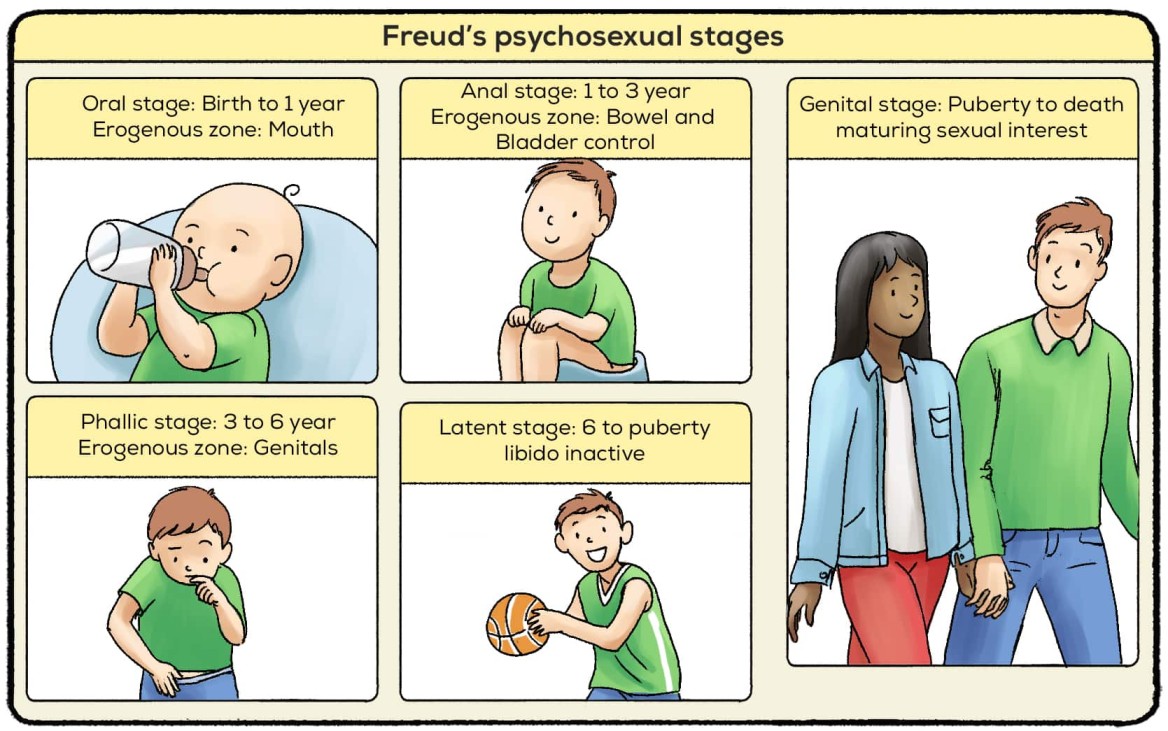
    Freud's Theory of Psychosexual Development

    Freud's theory centers on the idea that personality develops through a series of stages where pleasure-seeking energies (libido) are focused on different erogenous zones.

    Oral Stage (Birth-18 months)

    The focus of pleasure is the mouth (sucking, biting, chewing). This provides not only nourishment but also psychological comfort. Fixation at this stage could lead to behaviors like nail-biting, smoking, or overeating in adulthood.

    Example: A baby putting everything in their mouth to explore their environment and soothe themselves is typical of the oral stage. An adult who constantly chews on pens or overeats when stressed might be experiencing an oral fixation.

    Anal Stage (18 months-3 years)

    The focus of pleasure shifts to the anus and the processes of elimination. This stage is associated with toilet training, where the child learns control. Fixation can lead to personalities that are overly orderly (anal-retentive) or messy (anal-expulsive).

    Example: A toddler who insists on using the potty themselves and is very proud of their ability to control their bladder and bowels is demonstrating control related to the anal stage. An adult with an anal-retentive personality might be excessively neat, punctual, and controlling, while an anal-expulsive person might be messy and disorganized.

    Phallic Stage (3-6 years)

    The focus of pleasure is the genitalia. During this stage, children become aware of gender differences and may develop complexes (Oedipus/Electra). Fixation can lead to issues with sexuality and gender identity.

    Example: A young boy expressing a strong attachment to his mother and showing some jealousy towards his father, characteristic of the Oedipus complex. Fixation could manifest in adulthood as vanity, exhibitionism, or difficulty with intimate relationships.

    Latency Stage (6 years-Puberty)

    Sexual urges are repressed, and energy is channeled into social and intellectual pursuits like school, sports, and friendships with same-sex peers.

    Example: A child focusing on developing friendships, excelling in school, and participating in extracurricular activities, with little overt interest in romantic relationships. This period allows for the development of social skills and learning.

    Genital Stage (Puberty Onward)

    Sexual energy reawakens and is directed towards mature, heterosexual relationships. The focus of pleasure is on sexual intercourse and forming intimate relationships.

    Example: An adolescent beginning to explore romantic relationships and developing a sense of attraction towards others, leading to the formation of mature, loving relationships.

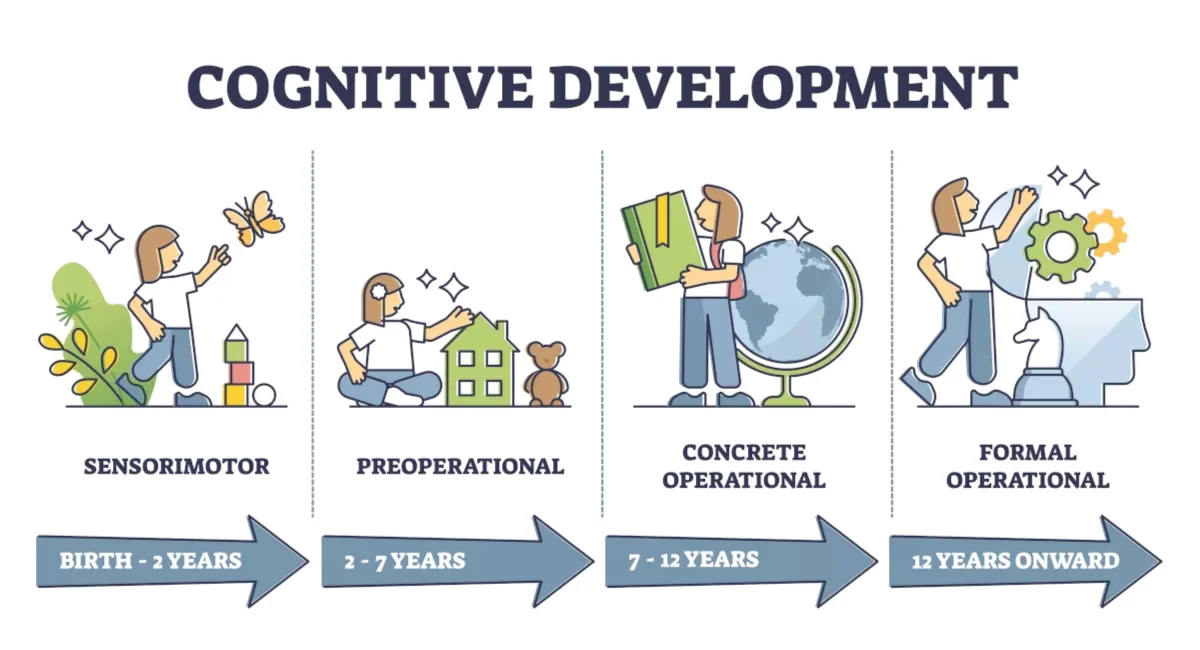
    Piaget's Theory of Cognitive Development

    Piaget's theory explains how a child's thinking and intelligence progress through distinct stages.

    Sensorimotor Period (Birth-2 years)

    Infants learn about the world through their senses and motor actions. A key achievement is object permanence—the understanding that objects continue to exist even when they cannot be seen. Thinking is egocentric.

    Example: A baby crying when a toy is hidden under a blanket, then pulling the blanket away to find it, demonstrates developing object permanence. Prior to this, if the toy is out of sight, it's out of mind.

    Preoperational Period (2-7 years)

    Children use language and symbols, but thinking is illogical and still egocentric. They engage in magical thinking (believing their thoughts can cause events) and animism (attributing life to inanimate objects). They cannot yet grasp the concept of conservation (e.g., that a quantity of liquid remains the same in a differently shaped glass).

    Example: A child believing their doll feels sad when it falls (animism), or insisting that a tall, narrow glass has more juice than a short, wide one, even if both contain the same amount (lack of conservation). They might also cover their eyes and think if they can't see you, you can't see them (egocentrism).

    Concrete Operational Period (7-11 years)

    Thinking becomes more logical and organized, but it is still concrete (tied to physical reality). They can understand conservation, reversibility, and can see things from another's point of view. They can reason about concrete events but struggle with abstract concepts.

    Example: A child understanding that if you pour water from a tall, thin glass into a short, wide glass, the amount of water remains the same (conservation). They can also sort objects by multiple features, but might struggle with hypothetical questions like "What if humans had wings?"

    Formal Operational Period (11 years Onward)

    Adolescents develop the ability to think abstractly, reason hypothetically, and use deductive logic. They can consider multiple possibilities and think about moral, philosophical, and social issues.

    Example: A teenager debating complex social issues like climate change or justice, considering different perspectives and hypothetical scenarios, or planning a multi-step project by thinking through all possible outcomes.

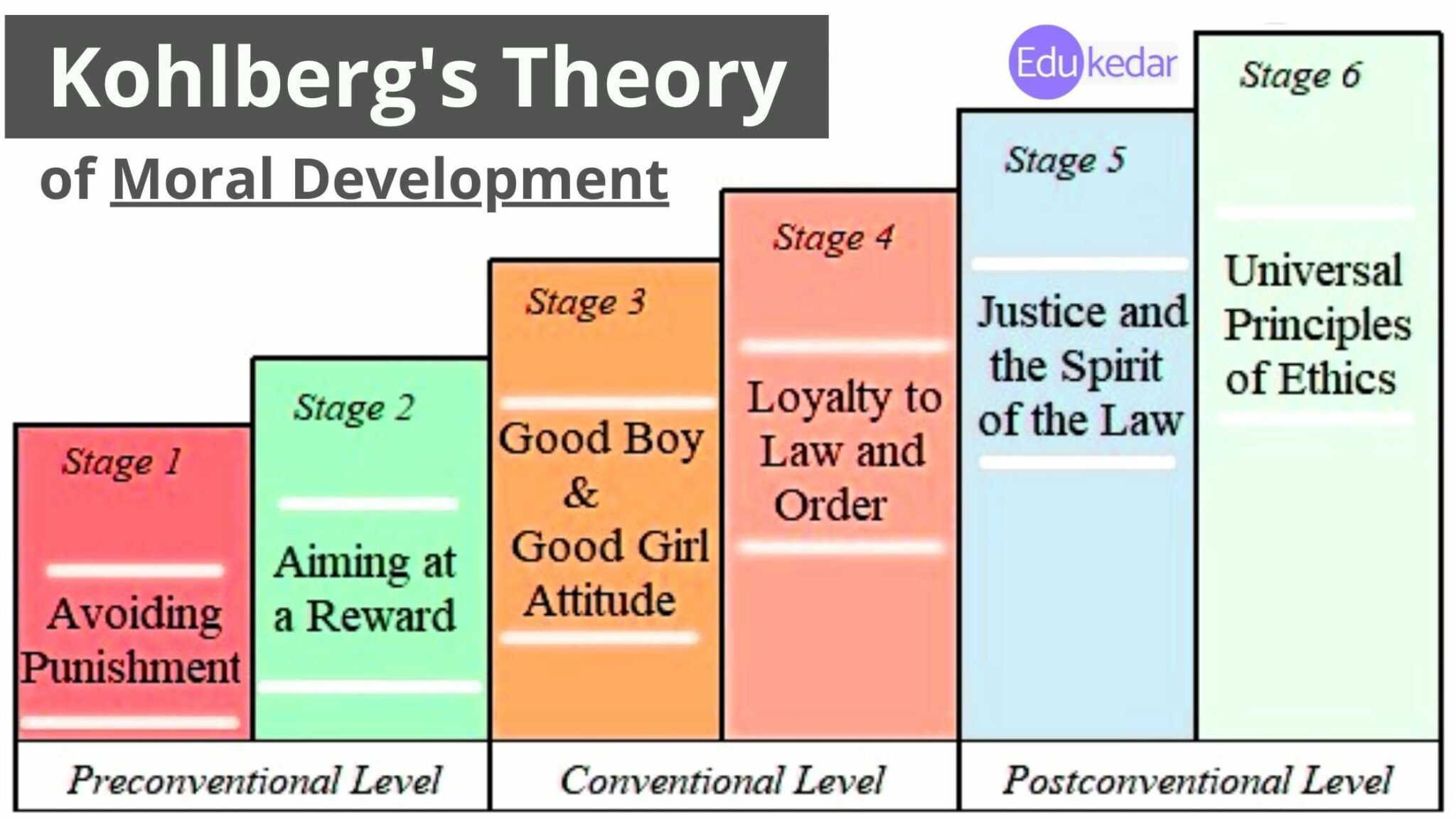
    Kohlberg's Theory of Moral Development

    Kohlberg's theory focuses on the development of moral reasoning, or how people think about right and wrong.

    Level 1: Preconventional Morality (Toddler to School Age)

    Morality is externally controlled. Rules are obeyed to avoid punishment or receive rewards.

    • Stage 1: Obedience and Punishment Orientation. Behavior is judged as wrong if it is punished.
    • Example: A child not stealing a cookie because they know they will get a time-out if caught, or a child refraining from hitting another child solely to avoid being punished by a parent.

    • Stage 2: Individualism and Exchange. "What's in it for me?" orientation. Right behavior is what is in one's own best interest.
    • Example: A child sharing their toy with another child because they expect the other child to share their toy in return, or a child offering to help with chores only if they get paid.

    Level 2: Conventional Morality (School Age to Adolescence)

    Conformity to social rules is important, but not for self-interest. The focus is on maintaining social order and positive relationships.

    • Stage 3: Good Interpersonal Relationships. The "good boy/good girl" orientation. Right behavior is what pleases or is approved of by others.
    • Example: A student following classroom rules because they want to be seen as a "good student" by their teacher and peers, or a teenager refraining from cheating because they want their friends to see them as honest.

    • Stage 4: Maintaining the Social Order. Right behavior consists of doing one's duty, showing respect for authority, and maintaining the given social order.
    • Example: A citizen paying their taxes because they understand it is their duty to uphold the laws of their country and maintain societal order, or a driver obeying traffic laws because it is the rule and necessary for public safety.

    Level 3: Postconventional Morality (Adolescence and Adulthood)

    Morality is defined in terms of abstract principles and values that apply to all situations and societies.

    • Stage 5: Social Contract and Individual Rights. Right is determined by socially agreed-upon standards of individual rights.
    • Example: An individual advocating for changes to a law they believe is unfair, even if it is currently legal, because it violates fundamental human rights and the societal contract for justice, such as protesting against discriminatory policies.

    • Stage 6: Universal Principles. Right is determined by self-chosen ethical principles of conscience, which are abstract and universal (e.g., justice, equality).
    • Example: An activist dedicating their life to fighting for human rights globally, even in the face of personal risk or legal consequences, because they believe in the universal principle of justice for all, like a civil rights leader who non-violently resists unjust laws based on deep moral convictions.

    Growth and Development of a Child Read More »

    Immediate Care of the Newborn

    Immediate Care of the Newborn

    Paediatric Nursing I - Page 3: Care of the Newborn

    Learning Outcomes

    By the end of this section, the learner shall be able to:

    • Describe the step-by-step procedure for immediate care of the newborn at birth.
    • Accurately assess a newborn using the Apgar scoring system.
    • Detail the essential components of daily care for a healthy newborn.
    • Explain the principles of thermoregulation, feeding, hygiene, and infection prevention in neonates.
    • Outline the key observations and assessments required to monitor a newborn's progress.
    • Summarize the essential health education points for the new mother before discharge.

    Introduction

    The care a baby receives immediately after birth and during the first few days of life is critical for their survival, growth, and long-term health. As midwives and nurses, providing expert, timely, and compassionate care can prevent life-threatening complications and support the crucial bonding process between the mother and her new baby.

    Immediate Care of the Newborn (The First Hour)

    This period requires prompt, skilled, and sequential actions focused on establishing breathing, maintaining warmth, and preventing infection.

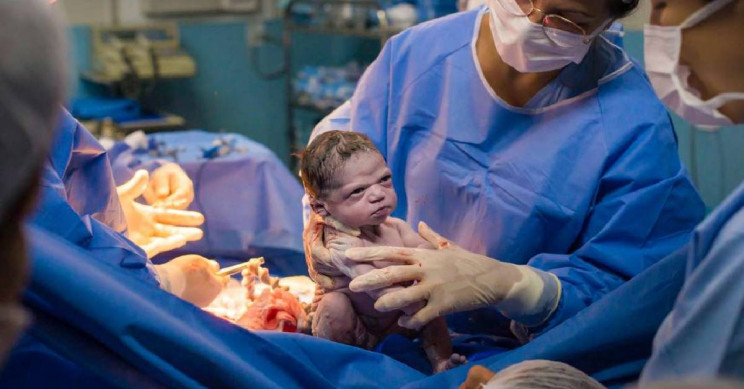
    Care of the Baby at Birth

    Ensure Infection Prevention and Control.

    As soon as the head is born:

    • Clean the eyes.
    • Wipe the face.
    • Clear the airway – clear mucus from the nose and mouth.
    • Feel for the cord around the neck.
    • Safely deliver the rest of the baby.
    • Note the time of delivery.
    • Dry and keep the baby warm.
    • Establish respirations and maintain it.
    • Apgar score and record.
    • Clean the eyes.
    • Instill tetracycline eye ointment.
    • Cut the cord and tie it securely.
    • Show the baby to the mother to identify sex and key features.
    • Maintain warmth (use kangaroo method if the mother and baby are in good condition).
    • Promote bonding.
    • Initiate breastfeeding.
    • Assess the baby’s condition at 1 and 5 minutes using APGAR.

    Procedure at Birth

    1. Prepare the Environment: Ensure a clean, warm, and draft-free delivery area with all necessary equipment ready. Practice strict hand hygiene.
    2. Clear the Airway: As soon as the baby's head is born, gently wipe the face and eyes with a soft cloth. Use a bulb syringe or suction catheter to clear mucus from the mouth first, then the nose. Check if the umbilical cord is around the neck and manage it appropriately.
    3. Deliver and Note the Time: Safely deliver the rest of the baby's body and note the exact time of birth.
    4. DRY AND STIMULATE: This is the most critical step. Immediately place the baby on the mother's abdomen and dry them thoroughly with a warm, clean towel. The act of drying also provides stimulation that encourages the baby to breathe. Remove the wet towel and cover the baby with a dry one.
    5. Assess Respirations: Observe the baby's chest for respiratory effort. A healthy baby should be crying vigorously.
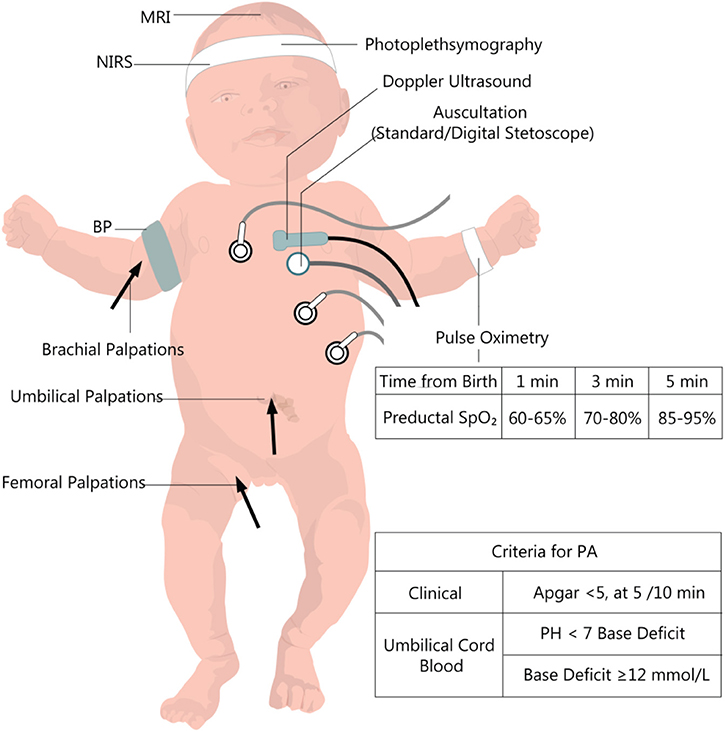
    6. Perform Apgar Score: Assess the baby's condition at 1 minute and again at 5 minutes after birth.

    The Apgar Score

    The Apgar score is a rapid method to assess the physical condition of a newborn and determine the need for resuscitation. It evaluates five signs, each scored from 0 to 2.

    Feature Score 0 Score 1 Score 2
    Appearance (Skin Color) Blue or Pale All Over Body Pink, Extremities Blue (Acrocyanosis) Completely Pink
    Pulse (Heart Rate) Absent Below 100 bpm Above 100 bpm
    Grimace (Reflex Irritability) No Response Grimace or Weak Cry Cries or Pulls Away
    Activity (Muscle Tone) Limp Some Flexion of Extremities Active Motion
    Respiration (Breathing Effort) Absent Slow, Irregular, Weak Cry Good, Strong Cry
    Interpretation of Apgar Scores
    • Score 7-10: Good condition. Routine care is needed.
    • Score 4-6: Moderately depressed. Some assistance, such as stimulation and oxygen, may be required.
    • Score 0-3: Severely depressed. This indicates a need for immediate and active resuscitation.

    Further Care within the First Hour

    • Warmth: Maintain warmth by placing the baby skin-to-skin with the mother (Kangaroo Mother Care) and covering both with a warm blanket. A hat should be placed on the baby's head.
    • Cord Care: Securely clamp and cut the umbilical cord using sterile technique. Check for any bleeding from the cord stump.
    • Eye Care: Administer prophylactic eye ointment (e.g., 1% Tetracycline) to prevent ophthalmia neonatorum (gonococcal infection).
    • Identification: Show the baby to the mother, confirming the sex and noting any identifying features. Apply identification bands as per facility protocol.
    • Bonding and Breastfeeding: Encourage early initiation of breastfeeding, ideally within the first hour of life. This promotes bonding, provides vital nutrients (colostrum), and helps maintain the baby's temperature and blood sugar.
    • Physical Assessment: Perform a quick head-to-toe examination to identify any obvious congenital abnormalities.

    Care After 1 Hour

    • Examine the baby’s head to toe for maturity, abnormalities, etc.
    • Re-ligature and shorten the cord.
    • Ascertain the passage of meconium and urine.
    • Weigh the baby.
    • Ensure warmth.
    • Ensure no bleeding from the cord.
    • Ensure bonding.
    • Ensure the comfort of the mother and the baby.
    • Communicate to the mother all the findings.
    • Report to the ward in-charge and document.

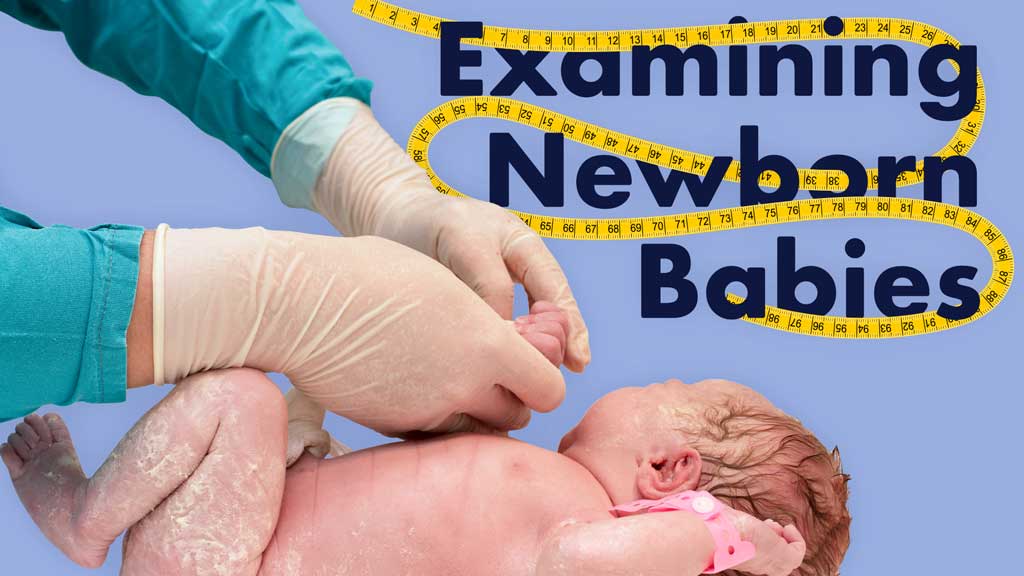
    Examination of a Newborn

    Aims/Reasons of Examination

    • To detect certain malformations or abnormalities that may be a threat to the life of the baby and may need urgent intervention.
    • To detect illness or injury that has arisen before or during delivery.
    • To take body measurements and record them.

    Important Points to Observe:

    • Room should be warm and draught-free.
    • Adequate light.
    • Equipment prepared.
    • Parent or caretaker should be around.
    • Explain the procedure to the parent or caretaker.
    • Baby should be in good condition.

    Equipment

    • Overhead warmer if required.
    • Stethoscope.
    • Ophthalmoscope.
    • Tape measure.
    • Infant scales.
    • Documentation – infant personal health record and hospital medical record.

    Procedure

    • Use a systematic approach to examine the baby – ‘head to toe’ and ‘front to back.’
    • Observe infection prevention measures, i.e., wash hands, put on gloves.
    • Ensure hands are warm.
    • Undress the baby and wrap in a warm towel. Expose the part you are to examine.

    General Appearance

    • The newborn assumes a flexion posture.
    • While the baby is settled, observe skin color. It should be pink.
    • Observe the state of alertness and activity.
    • Observe the range of spontaneous movement, posture, and muscle tone.

    Head

    • Assess size, shape, and symmetry; rule out excessive molding which may suggest the possibility of intracranial injury.
    • Scalp (vault) for swelling e.g. cephalohematoma, caput succedaneum, meningocele, etc.
    • Fontanelles: anterior and posterior fontanels should be flat, soft, and firm, but abnormalities may be a bulge or swelling.
    • Sutures; if separate or wide, it is suggestive of prematurity.
    • Head circumference 33-35cm (use a tape measure). Encircle occipital protuberance and frontal eminences.

    Face

    • Assess the symmetry of structures, features, and movement.
    • Inspect the eyes: setting, rule out Down’s syndrome – upward slanting of the eyes and the upper lip is shorter.
    • Check for cataracts, subconjunctival, nystagmus, strabismus hemorrhage, discharge.
    • Position in relation to the nasal bridge.
    • Palpate the eye to confirm the presence of normal eyeballs. Do this gently.
    • Hold the baby upright – eyes will open spontaneously.
    • Note the space between the eyes (should be 3cm apart).

    Nose

    • Located in the middle of the eye.
    • Check position, patency, and symmetry of the nares and septum. Nares should be equal in size and shape. Lack of patency may indicate choanal atresia (a congenital disorder where the back of the nasal passage (choana) is blocked, usually by abnormal bony or soft tissue).

    Mouth

    • Located in the midline.
    • Size, shape, symmetry, and movement.
    • Press the angle of the jaw to open the baby’s mouth.
    • Check the tongue for tongue tie (ankyloglossia). The tongue should be pink.
    • Lips and gums should be intact, pink, and moist.
    • Inspect tongue, gum, and palate: Pass a little finger in the baby’s mouth and feel for the palate for abnormalities like cleft palate or cleft lip.
    • Note the protrusion reflex of the tongue. The baby will suckle the finger.
    • Excessive salivation may be indicative of tracheoesophageal fistula (TEF).
    • Macroglossia, a protruding tongue that appears too large for the mouth, is indicative of a congenital disorder, e.g., Down’s syndrome or endocrine disorder like hypothyroidism.

    Ears

    • Assess for shape and cartilage development.
    • Observe the tympanic membrane.
    • Assess hearing acuity by evaluating the blink or startle reflex.

    Neck

    • The newborn’s neck is short.
    • Note symmetry.
    • The neck should be soft and free from masses.
    • The thyroid is non-palpable, palpable in hyperthyroidism.
    • Observe a web neck (extra and redundant skin).
    • Flex the neck gently. A web neck is associated with genetic disorders, e.g., Down’s syndrome or Turner’s syndrome.

    Clavicles, Arms, and Hands

    • Assess length, proportions, structure.
    • Count fingers and separate them.
    • Check for extra digits.
    • Rotate the wrists.

    Chest

    • Assess chest size, shape, and symmetry. Chest circumference is 30-36cm, approximately 2cm lower than the head circumference.
    • Observe respiratory movement.
    • Take respiration rate.
    • Observe the location of the nipples. Note size and shape. Nipples should be equally spaced from the middle.
    • Breast engorgement may be due to maternal hormones in both sexes.

    Abnormalities (Chest)

    • If the sternum is protruding, it indicates pectus carinatum, or pigeon chest, or sunken-pectus excavatum or funnel chest.
    • Widely spaced nipples are commonly seen in genetic disorders like Turner’s syndrome.
    • Supernumerary nipples 5-6cm below true nipples are often associated with congenital abnormalities.

    Lungs

    • Newborns are diaphragmatic breathers.
    • They may have paradoxical breathing: the thorax pulls inwards and the abdomen bulges.
    • Periods of apnea may exist lasting less than 15 minutes.
    • On auscultation, breath sounds should be equally distributed and clear.
    • Abnormal sounds may be; crackles, stridor, and wheeze. These should be reported.

    Heart

    • Assessment of the cardiovascular system begins with the assessment of color. Skin should be pink, including the mucous membrane.
    • Palpate chest point of maximum intensity.
    • Auscultate for heart rate, rhythm, and quality of heart sounds.
    • Assess peripheral pulses for rate, character, and quality. Pulses should be strong in the limbs.
    Abnormalities (Heart)

    • Bounding pulses are associated with patent ductus arteriosus.
    • Weakened or absent femoral pulses are associated with aortic lesions, e.g., coarctation of the aorta or low cardiac output.

    Abdomen

    • The abdomen should be round and soft.
    • Assess for visible peristalsis.
    • Check for major organs.
    • The umbilical cord should be located in the midline.
    • Two arteries and one vein should be visible on the umbilical cord. Absence of one of the arteries is associated with cardiovascular or renal anomalies.
    • Type of the cord.
    • Auscultate bowel sounds before palpation. They are audible within 15 minutes after birth.
    • Note the position of the liver, 1-2 cm below the right costal margin.
    • The spleen is felt 1-2 cm below the left costal margin.
    • The lower portion of the kidney is found 1-2 cm above the umbilicus on deep palpation.

    Genitalia

    Female Baby
    • At birth, the female genitalia are edematous, especially in breech deliveries. Labia majora is enlarged in full-term babies.
    • Inspect vulva for normal formation of: presence of labia, vaginal orifice, urethral orifice, and clitoris.
    • White mucoid discharge is common in the first week. Blood-tinged discharge may be noted as a result of withdrawn hormones.
    Male Baby
    • The foreskin completely covers the glans penis.
    • Abnormalities may include:
      • Hypospadias, epispadias.
      • Foreskin, check for phimosis.
    • Testes are present in the scrotum.
    • Scrotum: examine for undescended testes. The scrotum may be edematous at birth.
    • If testes have not descended by age 18 months, surgical intervention is required.

    Anus

    • Inspect for patency and masses.
    • Take the temperature, normal – 36.5-37°C.
    • Abnormalities: Anorectal malformations (imperforate anus).

    Musculoskeletal System

    • Examine the back when a child is in a prone position.
    • The back is gently rounded. Skin along the spine should be intact.
    • Any depression or openings along the spine may indicate a neural tube defect e.g. spina bifida.
    • Full range of motion should be easy in the newborn. When legs or arms are extended, they should return to the flexion position.
    Hips, legs, and feet:
    • Assess hips for stability.
    • Assess legs and feet for length, proportions, and symmetry.
    • Assess the structure and number of digits. Toes and fingers should be straight.
    Abnormalities Hands and Feet
    • Extra digits (polydactyly).
    • Absence of a digit (syndactyly).
    • Webbing of fingers or presence of a simian crease – a single long crease that crosses the entire palm is indicative of Down’s syndrome.
    • Macrodactyly (enlarged fingers or toes): indicative of neurofibromatosis, and overlapping 2nd and 3rd fingers, seen in infants with trisomy 18.
    • Clubfoot.

    Neurologic

    • Assess behavior.
    • Posture: position the baby adopts. In normal full-term, a baby lies with limbs flexed while in a supine position. In preterm babies, limbs are stretched out along the side of the trunk.
    • Muscle tone.
    • Cry: it should be lusty and full cry.
    • Reflexes: Moro, suck, rooting, grasp.

    Gastrointestinal Tract

    • Examine for rooting and swallowing reflexes.
    • An immature cardiac sphincter often leads to regurgitation.
    • Meconium is passed in the first 2 days after birth.

    Renal System

    • Expected urine output of a newborn is 250ml in 24hrs. The bladder capacity is 15mls full.
    • Because the urinary system is immature, urine is not concentrated. Urine is colorless or clear yellow; odorless with a specific gravity of approximately 1.020.

    Immune System

    • Infants are born with passive immunity from the mother, IgG through the placenta, IgA through breast milk. The immunity lasts 3-6 months.

    Thermoregulation

    • Newborns have a limited capacity to regulate heat loss and pain. The child’s ability to produce heat is immature and ineffective, thus prone to hypothermia. Infants lose heat because:
      • The metabolic rate is higher.
      • The surface area for heat loss is large.
      • Infants cannot shiver to generate heat.
      • Infants metabolize brown fat to generate heat.
      • Subcutaneous tissue is small.
    • Newborns lose heat by or through conduction, evaporation, convection, and radiation.

    Hemopoietic System

    • The blood volume of a newborn is 80-110ml/kg.
    • The lifespan of RBCs is 50-90 days.

    Hepatic System

    • There is unconjugated bilirubin in the 1st week of birth, and this is due to:
      • Increased bilirubin load on hepatocytes.
      • The lifespan of fetal RBCs is short.
      • Increased enterohepatic bilirubin circulation.
      • Defective bilirubin conjugation and excretion.
    • Physiological jaundice occurs after 1st day. This is due to the increased number and short lifespan of RBCs, and an immature liver to conjugate bilirubin.

    When the examination is completed, make the baby comfortable and warm.

    Record findings

    Report abnormalities detected to the in-charge of the ward pediatrician for appropriate action.

    Danger Signs in a Newborn

    • Breathing Difficulty: This includes rapid, labored, or irregular breathing patterns. If a newborn is struggling to breathe, it’s a serious concern.
    • Convulsions, Spasms, Loss of Consciousness, or Arching of the Back: These signs may indicate neurological issues or seizures.
    • Cyanosis (Blueness): Bluish discoloration of the skin or lips can be a sign of inadequate oxygenation and requires immediate attention.
    • Hot to Touch (Fever) or Cold to Touch: Abnormal body temperature, whether too high (fever) or too low, is a concern.
    • Bleeding: Any unexplained bleeding, especially from the umbilicus, eyes, or skin, is a danger sign.
    • Jaundice: While some level of jaundice is common in newborns, excessive or rapidly progressing jaundice may indicate a problem.
    • Pallor: An unusually pale complexion can signal anemia or other issues.
    • Diarrhea: Persistent diarrhea in a newborn is a cause for concern and can lead to dehydration.
    • Persistent Vomiting or Abdominal Distention: Frequent or forceful vomiting and abdominal swelling can indicate various medical conditions.
    • Poor Sucking or Not Feeding: If the baby is not feeding properly or is experiencing difficulty in sucking, it may not be getting adequate nutrition.
    • Pus or Redness of Umbilicus, Eyes, or Skin: Any sign of infection, such as pus or redness in these areas, should be addressed.
    • Swollen Limb: Unexplained swelling of a limb is a sign that requires immediate attention.
    • Lethargy: If the newborn is unusually tired, unresponsive, or lacks energy, it can indicate a medical issue.

    Daily Care of the Baby

    After one hour in the labor ward, the baby should be transferred with its mother in her arms to avoid heat loss and promote mother-baby attachment. The following are the main points considered during the care of the baby to prevent neonatal complications:

    1. Maintenance of Respiration

    • A baby with mucus should be observed and the airway cleared frequently using a suction catheter or bulb syringe.

    2. Provision of Warmth

    • The baby should be kept at a comfortable temperature between 21 – 25 degrees Celsius.
    • Overdressing and overheating should be avoided.
    • Baby’s temperature is maintained by proper monitoring of the incubator for those admitted in the nursery or skin-to-skin contact with the mother for babies who are sick.

    3. Provision of Food

    • A normal baby should be put onto the breast immediately after delivery or within the first 30 minutes.
    • Exclusive breastfeeding is up to 6 months. Mother should breastfeed the baby on demand.

    4. Protection from Injury and Infection

    • Midwives as well as mothers should not keep long nails, and even those for babies should be cut short to avoid injuring themselves.
    • Prevention of infection is important to minimize the risk of cross-infection to both midwives and mothers.
    • Infected babies should be isolated.
    • Installation of tetracycline eye drops as prophylaxis against gonococcal infection.

    5. Hygiene

    • The baby should be bathed daily and twice if the weather is not cold.
    • Special care is paid where two skin folds meet, and this is important.
    • The first and other non-urgent procedures may be deferred in order to minimize heat loss.

    6. Umbilical Cord

    • The cord is a source of infection in the neonatal period.
    • The midwives should aim at preventing hemorrhage and getting the cord dried up and separate cord cleaned with normal saline 0.9% at least 3 times in 24 hours.

    7. Prevention of Hemorrhage

    • Prophylactic vitamin K (1 mg) is given intramuscularly or orally to promote prothrombin formation.

    8. Observations

    • Temperature, respiration, and heart rate are checked every four hours.
    • The child is weighed twice weekly.
    • The condition of the cord is observed.
    • The color of the skin is monitored.
    • Urine and stool color and amount passed are noted.

    9. Assessment of Baby’s Progress

    • A thriving baby is a baby who is growing well. A baby who is growing well has bright eyes.
    • It is active and kicks rigorously.
    • It is free from infection.
    • Feeds well and is always eager to eat.
    • Fontanelles are not depressed.
    • Has a pink color with firm muscles.
    • Baby sleeps well, and when it wakes up, it stretches and yawns.
    • Passes normal quality of urine, stools are semi-solid and yellow.
    • In order to assess the above, it is necessary to examine the baby thoroughly at least once daily.

    10. Education of the Mother

    • Education of the mother should start from the antenatal period.
    • After delivery, the mother should be educated about the care of the baby and herself.
    • As the baby and mother’s condition is good, discharge is considered.
    • Every procedure that is carried out on the baby should be done when the mother is observing so that after discharge, she is able to carry it out, for example, dressing the baby, baby bathing, and care of the cord.

    11. Immunization

    • All neonates should be immunized with BCG vaccine and ‘OPV’ at birth.
    • Mother should be given vitamin A so that the baby can get it through breast milk.
    • The mother should be informed about the recommended national immunization schedules and the importance of completing immunization.

    Follow-up

    • Each infant should be followed up at least once every month for the first 3 months and subsequently at 3-month intervals until one year of age.
    • Follow-up is necessary for assessment of growth and development, early detection and management of health problems, and health education for prevention of childhood illnesses.

    Essential Elements of Daily Care

    1. Maintenance of Respiration: Continue to observe for signs of respiratory distress (grunting, nasal flaring, retractions). Keep the baby's nose and mouth clear of mucus.
    2. Provision of Warmth: Keep the room temperature comfortable (21-25°C). Avoid overdressing. Skin-to-skin contact remains an excellent method for temperature regulation.
    3. Provision of Food (Nutrition): Encourage exclusive breastfeeding on demand (typically every 2-3 hours). A breastfed baby is getting enough milk if they are passing urine 6-8 times a day and are gaining weight.
    4. Protection from Injury and Infection: Strict handwashing is the most important measure. Isolate any infected babies. Keep the baby's fingernails short.
    5. Hygiene:
      • Bathing: Daily bathing is not always necessary and can cause heat loss. "Top and tail" washing (cleaning the face, neck, hands, and bottom) with warm water is sufficient. The first full bath should be delayed until the baby's temperature is stable.
      • Skin Folds: Pay special attention to cleaning and drying skin folds (neck, armpits, groin) to prevent irritation.
    6. Umbilical Cord Care: The goal is to keep the cord clean and dry to prevent infection and promote separation. Clean the base of the cord with normal saline or sterile water if it becomes soiled with urine or stool. Fold the diaper down to expose the cord to air. Do not apply any traditional substances.
    7. Prevention of Haemorrhage: Administer Vitamin K (1mg) intramuscularly at birth to promote prothrombin formation and prevent bleeding.
    8. Observation and Assessment:
      • Vital Signs: Monitor temperature, respiration, and heart rate regularly as per facility protocol.
      • Weight: Weigh the baby at birth and then daily or twice weekly to monitor for appropriate weight gain (after the initial physiological weight loss).
      • Elimination: Record the passage of urine and stool, noting frequency, color, and consistency.
      • Overall Condition: Assess for skin color (jaundice), activity level, muscle tone, and feeding behaviour. A thriving baby is active, feeds eagerly, has a strong cry, and appears content after feeds.
    9. Education of the Mother: This is a continuous process. Teach the mother about feeding, bathing, cord care, signs of illness (e.g., fever, poor feeding, lethargy), and the importance of immunization. Ensure she is confident in caring for her baby before discharge.
    10. Immunization: Before discharge, ensure the baby receives the birth doses of vaccines according to the national schedule (BCG and Oral Polio Vaccine - OPV 0).
    11. Follow-up: Advise the mother on the schedule for postnatal and child welfare clinic visits for continued assessment of growth, development, and immunizations.

    Revision Questions

    1. What is the very first and most important action a nurse should take immediately after a baby is born to stimulate breathing and prevent heat loss?
    2. A newborn at 1 minute of life has a pink body and blue extremities, a heart rate of 90 bpm, makes a weak grimace when suctioned, has some flexion in the arms, and a slow, irregular cry. Calculate the Apgar score.
    3. Why is breastfeeding within the first hour of life so important for both the mother and the newborn? List three reasons.
    4. Describe the correct procedure for daily umbilical cord care. What should you advise the mother NOT to do?
    5. List five signs that indicate a newborn baby is "thriving."
    6. A mother asks why her healthy baby needs an injection (Vitamin K) right after birth. How would you explain the reason to her in simple terms?

    Immediate Care of the Newborn Read More »

    Changes in the newborn at birth

    Changes in the newborn at birth

    Paediatric Nursing I - Page 2: Physiology of the Newborn

    Learning Outcomes

    By the end of this section, the learner shall be able to:

    • Explain the major physiological changes a newborn undergoes at birth.
    • Describe the transition from fetal to pulmonary respiration.
    • Detail the changes in the cardiovascular system, including the closure of fetal shunts.
    • Discuss the immaturities of the newborn's digestive, hepatic, and renal systems.
    • Explain the mechanism of temperature regulation in a neonate.
    • Describe the status of the newborn's immune and haematopoietic systems at birth.

    Introduction to Newborn Physiology

    The moment of birth marks the most dramatic physiological transition in a person's life. The newborn must rapidly adapt from a dependent, fluid-filled intrauterine environment, where the placenta performed all vital functions, to an independent, air-breathing existence. This transition involves profound and immediate changes in nearly every organ system, most critically the respiratory and cardiovascular systems.

    Changes in the Newborn at Birth

    Changes in the newborn at birth are a number of changes that an infant’s body undergoes to allow it to survive outside the womb and adapt to life in a new environment.

    During intrauterine life, the fetus receives oxygen and nutrients by absorption through the placenta. It does not use its lungs or the digestive organs. Similarly, it excretes carbon dioxide and other waste products through placental structures into the mother’s blood.

    It is protected from many harmful factors/organisms by the placenta, and it is kept in a warm environment.

    Size and Growth:

    • The term infant weighs about 3000g. Boys weigh approximately 250g more than girls.
    • Infants of less than 2500g are classified as ‘low birth.’
    • During the first 3–5 days, up to 10% of birth weight is lost. This is regained by 7–10 days.
    • In the first month, average weight gain per week is 200g.

    Skin:

    • The newborn skin is immature, with a thin epithelial layer and incompletely developed sweat and sebaceous glands.
    • Combined with the high surface area to body mass ratio, this renders the baby prone to heat and water losses.
    • Numerous benign skin lesions occur, e.g. a greasy protective layer, the vernix caseosa.

    Temperature Regulation:

    • The neonate has a low metabolic activity resulting in a poor ability to produce heat.
    • The infant enters a much cooler environment than to which it is used. Its body is wet and thus liable to lose heat through evaporation.
    • Receptors on the baby’s skin send messages to the brain that the baby’s body is cold.
    • The baby’s body then creates heat by shivering and by burning stores of brown fat, a type of fat found only in fetuses and newborns.

    Head:

    • The average occipito-frontal head circumference is 35 cm.
    • Two soft spots or fontanels are present.
    • The anterior fontanel closes at 18 months of age, and the posterior closes by 6–8 weeks.

    Respiratory System:

    The initiation of respiration is the most crucial event in the newborn's adaptation. In the womb, the lungs are filled with fluid and are not used for gas exchange.

    • Changes that occur at birth allow the newborn to convert from dependence on the placenta to breathing air for the exchange of respiratory gases.
    • In utero, the airways and lungs are filled with fluid that contains surfactant.
    • The lung fluid is removed by the squeezing of the thorax during vaginal delivery and by reduced secretion and increased absorption mediated by fetal catecholamine during labor and after birth.
    • Surfactant lines the air–fluid interface of the alveoli and reduces the surface tension, thereby facilitating lung expansion. This is associated with a fall in pulmonary vascular resistance.
    • The rate is variable and normally ranges between 30 and 60 breaths/min. Brief self-limiting apnoeic spells might occur during sleep.

    Factors That Stimulate the First Breath

    The first breath is not a single event but a response to a combination of powerful stimuli:

    • Chemical Stimuli: During labor, placental blood flow is temporarily reduced, causing a slight decrease in oxygen (hypoxia) and an increase in carbon dioxide (hypercapnia) in the baby's blood. This change in blood chemistry directly stimulates the respiratory center in the brain.
    • Mechanical Stimuli: The passage through the birth canal squeezes the baby's chest (thoracic squeeze), forcing approximately one-third of the fluid out of the lungs. As the chest recoils after birth, air is drawn in for the first time. Crying also helps to expand the lungs.
    • Thermal Stimuli: The sudden change from the warm intrauterine environment (approx. 37°C) to the cooler delivery room stimulates sensory receptors in the skin, which in turn stimulate the respiratory center.
    • Sensory Stimuli: The new experiences of being touched, dried, and exposed to light and sound all provide stimulation that encourages breathing.
    Normal Breathing Patterns

    A newborn's respiratory rate is 30-60 breaths per minute. Their breathing is often irregular, with short pauses of 5-15 seconds (periodic breathing), which is normal. They are also obligatory nose breathers and use their abdominal muscles to breathe.

    Cardiovascular System

    With the first breath and the clamping of the umbilical cord, the entire circulatory system must reroute itself. Fetal circulation, which bypasses the lungs, must switch to newborn circulation, where blood is sent to the lungs for oxygenation.

    • Major changes in the lungs and circulation allow adaptation to extra-uterine life.
    • In the fetal circulation, the right-sided (pulmonary) pressure exceeds the left-sided (systemic) pressure. Blood flows from right to left through the foramen ovale and ductus arteriosus.
    • At birth, these relationships reverse: Left-sided (systemic) pressure rises with clamping of umbilical vessels. Right-sided (pulmonary) pressure falls as the lungs expand, and the rising pressure triggers a prostaglandin-mediated vasodilatation.
    • The foramen ovale and ductus arteriosus close functionally shortly after birth. The ductus closes due to muscular contraction in response to rising oxygen tension.

    Closure of Fetal Shunts

    This rerouting is accomplished by the closure of three fetal shunts:

    1. Foramen Ovale: A flap-like opening between the right and left atria. Increased blood flow from the newly functioning lungs raises the pressure in the left atrium, pushing this flap closed.
    2. Ductus Arteriosus: A blood vessel connecting the pulmonary artery to the aorta, which shunted blood away from the fetal lungs. It constricts and closes in response to higher oxygen levels in the blood and other hormonal changes.
    3. Ductus Venosus: A vessel that shunted oxygenated blood from the placenta away from the liver and directly to the heart. When the umbilical cord is clamped, blood flow ceases, and this shunt closes.

    A newborn's heart rate is typically 110-160 beats per minute and can fluctuate with activity and sleep.

    Thermoregulation

    Newborns are at a high risk for heat loss (hypothermia) due to several factors: a large body surface area to mass ratio, thin skin with less subcutaneous fat, and an inability to shiver effectively.

    How Newborns Lose Heat

    • Evaporation: Loss of heat as amniotic fluid dries from the skin after birth. (Action: Dry the baby thoroughly).
    • Conduction: Loss of heat through direct contact with a cooler surface, like a cold scale or stethoscope. (Action: Place the baby on warm surfaces; use skin-to-skin contact).
    • Convection: Loss of heat to cooler air currents, like drafts from windows or air conditioners. (Action: Keep the baby wrapped and away from drafts).
    • Radiation: Loss of heat to a nearby cooler object without direct contact, like a cold windowpane. (Action: Keep cribs away from cold outer walls).

    How Newborns Produce Heat

    The primary method of heat production in newborns is non-shivering thermogenesis. This is the metabolism of a special type of fat called brown adipose tissue (BAT), or "brown fat," which is uniquely located around the newborn's neck, back, and major organs. Burning this fat produces heat and warms the blood passing through it.

    Haematopoietic and Immune Systems

    Haematopoietic System (Blood)

    • Hemoglobin: Newborns have a high concentration of red blood cells and hemoglobin, specifically fetal hemoglobin (HbF), which is very efficient at carrying oxygen.
    • Physiological Jaundice: After birth, the excess red blood cells are broken down. This process releases bilirubin. The newborn's immature liver cannot process this bilirubin quickly, causing it to build up in the blood and lead to a temporary yellowing of the skin and eyes (physiological jaundice), typically appearing on the 2nd or 3rd day of life.
    • Vitamin K: The newborn's gut is sterile and cannot yet produce Vitamin K, which is essential for blood clotting. To prevent hemorrhagic disease of the newborn, all babies are given a prophylactic injection of Vitamin K at birth.

    Immune System

    The newborn's immune system is immature and inexperienced, making them vulnerable to infections. They receive temporary protection through passive immunity:

    • IgG: These antibodies cross the placenta from the mother during the third trimester, providing protection against diseases to which the mother is immune.
    • IgA: These antibodies are found in high concentrations in colostrum and breast milk, providing protection to the gastrointestinal and respiratory tracts.
    • The neonatal immune system is incomplete compared to older children and adults:
      • Impaired neutrophil reserves.
      • Diminished phagocytosis and intracellular killing capacity.
      • Decreased complement components.
      • Low IgG2, leading to infections with organisms.
    • The presence of maternal antibody in babies born greater than 30 weeks’ gestational age provides some protection against infection.

    Gastrointestinal and Renal Systems

    • At term, the secretory and absorbing surfaces are well developed, as are digestive enzymes, with the exception of pancreatic amylase.
    • Meconium is usually passed within 6 hrs, and delay beyond 24 hrs is considered abnormal.
    • Normally, meconium is replaced by yellow stool by day 3-4.

    Gastrointestinal (Digestive) System

  • Stomach: The stomach capacity is very small at birth (about 15-30 ml) and empties rapidly, which is why newborns need to feed frequently.
  • Gut: The gut is sterile at birth but is quickly colonized by bacteria from the environment and feeding. These bacteria are essential for digestion and Vitamin K production.
  • Stools: The stools change in a predictable pattern:
    1. Meconium: The first stool, passed within 24-48 hours. It is sticky, thick, dark green/black, and odorless.
    2. Transitional Stool: Appears by day 3-4. It is thin, slimy, and greenish-brown to yellowish-brown.
    3. Milk Stool: By day 4-5. If breastfed, the stool is loose, seedy, and mustard-yellow. If formula-fed, it is paler, firmer, and has a more noticeable odor.
  • Liver:

    • In the fetus, the liver acts as a storage site for sugar (glycogen) and iron.
    • When the baby is born, the liver has various functions: It produces substances that help the blood to clot. It begins breaking down waste products such as excess red blood cells. It produces a protein that helps break down bilirubin.
    • Immaturity of the liver enzymes responsible for conjugation of bilirubin is responsible for the ‘physiological jaundice’ which can occur from the second day of life.

    Genitourinary System:

    • The infant should void within the first 24 hours of life.

    The kidneys are able to produce urine, but their ability to concentrate it is limited. This makes newborns susceptible to dehydration if fluid intake is insufficient. A newborn should pass their first urine within 24 hours of birth, though it can take up to 48 hours.

    Central Nervous System:

    • The central nervous system (CNS) is relatively immature at birth.
    • Newborn infants sleep for a total of 16–20 hours each day.
    • The touch of a nipple on the baby’s face initiates the sequence of rooting and the complex coordination of lip, tongue, palate, and pharynx required for sucking and swallowing.
    • Crying (without tears) is the main means of communication.

    Revision Questions

    1. What are the four main stimuli that trigger the first breath in a newborn?
    2. Explain the function of the ductus arteriosus in the fetus and describe what causes it to close after birth.
    3. A newborn is placed on a cold weighing scale. Which mechanism of heat loss is this, and what is one nursing action to prevent it?
    4. What is physiological jaundice, and what two factors in the newborn's liver and blood system contribute to its development?
    5. Describe the normal progression of a newborn's stools, from meconium to milk stool. Why do these changes occur?
    6. Why is Vitamin K administered to all newborns at birth?

    Changes in the newborn at birth Read More »

    Paediatrics Introduction

    Paediatrics Introduction

    Paediatric Nursing I - Page 1: Introduction, Terms & Characteristics

    Learning Outcomes for this Section

    By the end of this section, the learner shall be able to:

    • Define Paediatrics and related terminologies.
    • Explain the core principles and scope of paediatric nursing.
    • Describe the various roles of a paediatric nurse.
    • State the fundamental rights of a child in a healthcare setting.
    • Describe the physical and behavioural characteristics of a normal newborn.

    Introduction to Paediatric Nursing

    Paediatrics is a specialized branch of medicine that focuses on the prevention, diagnosis, treatment, and management of health problems affecting young patients—from infants and children to adolescents. The term originates from the Greek words "paed" meaning "child" and "iatrikē" meaning "treatment." It encompasses not only the clinical aspects but also the psychological and social well-being of the child.

    Paediatric nursing requires a deep understanding of genetics, obstetrics, physiological development, management of disabilities, and the effects of social conditions on a child's health. Since a child is entirely dependent on their caregivers, it is essential that the care provided is family-centered. Providing quality care for sick children depends on the nurse's ability to understand the developmental variations anticipated in different age groups.

    Paediatrics is a branch of medicine that focuses on the prevention, diagnosis, treatment and management of all types of health problems that affect young patients – from infants and children to adolescents.

    It includes the clinical and psychological aspect of medical care. It requires detailed knowledge of genetics, obstetrics, physiological development, management of disabilities at home and school and the effects of social condition on the child’s health.

    As the child is totally dependent on the care-givers, it is important that the care provided is family centered. Providing quality care for sick children depends on you, understanding developmental variations as anticipated in different age groups.

    Core Concepts in Paediatric Nursing

    Principles of Paediatric Nursing

    • Family-Centered Care: This approach recognizes the family as the primary source of strength and support for the child. The nurse collaborates with the family in all aspects of planning, delivering, and evaluating healthcare.
    • Atraumatic Care: This principle focuses on minimizing the psychological and physical distress experienced by children and their families. It involves using procedures and communication that reduce pain, fear, and anxiety.
    • Health Promotion and Disease Prevention: A key focus is on educating families about healthy habits (e.g., nutrition, safety) and preventive measures (e.g., immunizations) to ensure optimal health and well-being.
    • Advocacy: The paediatric nurse acts as a voice for the child, ensuring their needs are met and their rights are protected within the healthcare system and the community.

    Scope of Paediatric Nursing

    Paediatric nurses practice in a wide variety of settings, including:

    • Hospitals: General paediatric wards, Paediatric Intensive Care Units (PICU), Neonatal Intensive Care Units (NICU), and outpatient clinics.
    • Community Health Centres: Providing primary care, health screenings, and immunizations.
    • Schools: Managing the health needs of students during school hours.
    • Home Care: Providing care for children with chronic conditions or those recovering from illness in their own homes.

    Roles of the Paediatric Nurse

    • Direct Care Provider: Assessing health, administering medications and treatments, and providing hands-on care.
    • Educator: Teaching children and families about health conditions, treatments, and self-care.
    • Advocate: Protecting the child's rights and ensuring their best interests are served.
    • Counselor: Providing emotional support and guidance to children and their families during stressful times.
    • Collaborator: Working with doctors, therapists, and other healthcare professionals to create a comprehensive care plan.

    Rights of the Child in Healthcare

    Every child has fundamental rights that must be respected in any healthcare setting. These include:

    • The right to the best possible health.
    • The right to be cared for by parents or guardians.
    • The right to be protected from pain and to receive pain relief.
    • The right to be informed in a way they can understand.
    • The right to participate in decisions about their care.
    • The right to privacy and confidentiality.

    Antenatal Care

    Good antenatal care is important to the future development of the child. Attendance by the mother at maternity clinic at regular intervals during pregnancy will ensure that any problems which may influence fetal development are recognized promptly, as well as providing an opportunity for the mother and father to attend parentcraft sessions, e.g. in breastfeeding, in order to help the parents rear their baby happily and successfully.

    Fetal Development

    Development of the fetus during pregnancy is a time of rapid growth. After fertilization, when the spermatozoon meets an ovum usually in the outer third of the fallopian tube, the cells multiply rapidly into a morula which passes into the uterine cavity and embeds in the endometrium.

    After four weeks the fetal shape resembles a mammal and is about 1cm long. By about 8 weeks limbs have developed.

    At 12 weeks the fetus is obviously human. The length is now about 9 cm. All essential organs have formed before the twelfth week.

    After this the fetus continues to grow, peaking at about the 34th week of pregnancy.

    About the 27/28th week the fetus is said to be viable i.e. if born the fetus attempts to breath.

    After 28 weeks the fetal muscles develop and fat is laid down. The fetus is coated with a greasy substance known as vernix. The fetus is now able to move quite freely within the amniotic cavity.

    End of pregnancy occurs after a gestation period of about 40 weeks.

    Nursing Goals

    • Normalize the life of the child during hospitalization in preparation for the family home, school and community.

      Example: For a hospitalized child with asthma, the nurse ensures the child's daily routine includes opportunities for play and learning (e.g., child life activities, scheduled playtime), within the limits of their condition, to minimize disruption to their normal life and facilitate easier transition back home and to school upon discharge.

    • Minimize the impact of the child’s unique condition.

      Example: For a child with newly diagnosed Type 1 Diabetes, the nurse provides comprehensive education to the child and family on insulin administration, blood glucose monitoring, and dietary management, empowering them to manage the condition effectively and reduce its interference with daily activities and future development.

    • Foster maximal growth and development.

      Example: For an infant admitted for failure to thrive, the nurse collaborates with dietitians to establish an appropriate feeding plan and implements interventions like structured feeding times and positive reinforcement to ensure adequate nutritional intake, thereby supporting healthy physical growth and cognitive development.

    • Develop realistic, functional and coordinated home care plans for the children and families.

      Example: For a child discharged with a new tracheostomy, the nurse coordinates with social work, home health agencies, and equipment providers to ensure the family has necessary supplies, training, and support (e.g., skilled nursing visits, emergency contact numbers) to safely manage the tracheostomy at home.

    • Respect the roles of the families in the care of their children.

      Example: When caring for a child who requires complex wound care, the nurse actively involves the parents in the dressing changes, teaching them the technique, allowing them to ask questions, and incorporating their preferences (e.g., timing of dressing changes around the child's nap schedule) to foster their sense of control and competence in their child's care.

    • Prevention of disease and promotion of health of the child.

      Example: The nurse administers age-appropriate immunizations as scheduled during well-child visits and provides anticipatory guidance to parents on healthy eating habits, regular physical activity, and injury prevention (e.g., car seat safety, poison control) to protect the child from illness and promote overall well-being.

    Definition of Terms

    Pediatrics: The term pediatrics is derived from Greek words. ‘Paed’ means child, ‘icitrike’ means treatment, ‘..ics’ means the science of child care and scientific treatment of childhood diseases.

    Neonatal Period: Neonatal period is the period from birth to 28 days of life or the first month of life.

    Normal Baby: A normal baby should have the following characteristics. A normal term baby weighs approximately 3.5 kg, when fully extended measures 50 cm from the crown of the head to the heels, and has an average occipitofrontal head circumference of 34-35 cm. Most babies are plump and have a prominent abdomen. They lie in an attitude of flexion, with arms flexed; their fingers reach upper thigh level.

    Infant: An infant is a child from birth up to one year of life.

    Toddler: A toddler is a child from one year to three years of life.

    Preschool: A child of three to five years is considered as a preschooler.

    Middle Childhood: Is defined as ages six to twelve years.

    Adolescent: WHO defines adolescence as the period in human growth and development that occurs after childhood, from ages twelve to nineteen years.

    Preterm Baby: A preterm baby is a baby born with a gestational age of less than 37 completed weeks (or less than 259 days) but greater than 28 weeks. These babies are also termed as immature, born early, or premature.

    Term Baby: A baby born with a gestational age between 37 to 41 weeks (259-293 days).

    Low Birth Weight Baby: Any baby weighing 2500 g or less at birth.

    Post-Term Baby: A baby born with a gestational age of 42 weeks or more (294 days or more).

    Live Birth: Any signs of life at delivery.

    Stillbirth: A baby born after 24 weeks of gestation with no sign of life at birth.

    Perinatal Mortality: Stillbirths and first-week deaths per 1000 total births.

    Neonatal Mortality: Deaths of live births in the first month of life per 1000 live births.

    Infant Mortality: Deaths of all live births in the first year of life per 1000 live births.

    Post-Neonatal Mortality: Post-neonatal mortality is referred to as the deaths of all babies from 1 month to 1 year per 1000 babies alive at 1 month.

    Characteristics of a Normal Newborn

    A normal newborn (0-28 days) exhibits a unique set of physical and behavioural characteristics as they adapt to life outside the womb.

    The Newborn

    A newborn is a just or recently born child (0-28 days).

    Physical Characteristics

    Weight: The normal full-term infant weighs approximately 3.5 kgs. In Uganda, the weight may range from 2.5 kg-3.5 kg. Babies in the tropics tend to be smaller than European babies. Newborn infants usually are considered to be tiny and powerless, completely dependent on others for life.

    Length: Measurement is taken from the highest point of vertex of the head to the heel. It ranges from 45-50 cm (average 50cm).

    Lie: He lies in an attitude of flexion – in the supine position with his head turned to one side and one shoulder elevated off the mattress or in the prone position with his buttocks elevated, his knees drawn up under his abdomen and his head turned to one side with his arms extended; his fingers reach to mid-thigh level.

    Temperature: Ranges between 36°C to 37.5°C

    Blood Pressure: Systolic 50 to 75mmHg and Diastolic 30 to 45mmHg

    Nails: The nails are fully formed and adhered to the tips of the fingers, sometimes extending beyond the fingertips.

    Head and Hair: The head circumference is approximately 33-35 cm (13-14 in) with a cranium that is disproportionately large compared with the face. This is from molding of the skull bones during labor and birth or due to swelling of the scalp or slight bleeding under the scalp. The anterior and posterior fontanels or “soft spots” are open and the sutures can be felt. The anterior fontanel is diamond-shaped and closes by 18 months. The fontanel on the back (posterior) is shaped like a triangle and closes by 6 weeks of age. The baby may be born with a full head of hair or none at all.

    Arms and Legs: After birth, the baby’s arms and legs may look bowed and are held close to the body. Hands are in tight fists, the arms and legs may appear too short for the body because of their bent appearance. This is temporary; by 3 to 4 months, the arms and legs stretch out.

    Sensory Development

    Vision: The baby’s eye color depends on skin tone, blue-gray if fair-skinned or brown if dark-skinned. By 6 months to 1 year of age, the baby’s eye color will be permanent. Eyes: When the newborn cries, tears may be absent. Tear ducts may not function for the first few weeks after birth. Cross-eyed: A newborn’s eye muscles are weak at birth. Over the next few weeks, eye muscle strength will improve, and the baby can better focus on objects.

    Hearing: Babies can hear loud and soft noises at birth. Loud noises may cause the baby to startle, while soft noises may help to calm your baby. The baby quickly learns the difference in voice sounds. The baby will turn its head to a familiar voice, especially mom’s and dad’s voice.

    Taste and Smell: Newborns can taste and smell at birth. The baby will be able to taste breast milk.

    Skin and Body Systems

    Skin: At birth, the baby may have a thick cheese-like covering. This is called vernix caseosa. Vernix helps to protect the baby’s skin while in the uterus. Over the baby’s forehead, nose, and cheeks, you may see “whiteheads” or milia. These are immature oil glands that will go away in several weeks. The baby may have soft downy hair that may cover its face and body. This is called lanugo, and it will go away within a few weeks after birth. The baby may have pale pink marks on the face and neck. They are called stork bites and will fade during childhood. The baby may have bluish-black marks on the lower back or bottom. These are called Mongolian spots and are more common on dark-skinned children. The subcutaneous fat is small and the skin looks red and elastic.

    Chest and Breathing: Babies take little breaths and use abdominal muscles to help breathe. You may even notice short pauses between some breaths. The rate of breathing is 30 to 60 times a minute. This is because their heart rate is rapid at 120 to 160 times a minute. The breasts of boy and girl babies may look enlarged after birth. The hormones that cross the placenta during the last two weeks before birth cause the breasts to fill with milk. Do not squeeze the breasts. The enlarged breasts will go away in about 2 weeks.

    Abdomen: The abdomen may be round or stick out slightly (big compared to the thorax). The umbilical cord is clamped, cut, and tied. It will dry and fall off in 1 to 2 weeks. If there is redness around the umbilical cord or pus-like drainage, give the necessary care.

    Genitalia: In boys, the testicles are descended into the scrotum which has plentiful rugae. The urethral meatus opens at the tip of the penis, and the prepuce is adhered to the glans. In girls born at term, the labia majora normally cover the labia minora. The hymen and clitoris may appear disproportionately large. The hormones in a girl may cause the baby to have white vaginal discharge or vaginal spotting (false period).

    Behavior

    Behavior: The newborn baby will probably spend a lot of time sleeping. The baby may be very alert and gaze at the mother or people or be very quiet and drowsy right after birth. During the next month, the baby will spend less time sleeping and more time awake.

    Summary

    Physical Characteristics

    • Weight: A normal full-term infant weighs approximately 3.5 kg. In Uganda, the range is typically 2.5-3.5 kg.
    • Length: Measured from crown to heel, the average length is 50 cm (range 45-50 cm).
    • Lie/Posture: The newborn typically lies in a flexed position, with arms and legs bent and held close to the body.
    • Head: The head circumference is 33-35 cm and appears large in proportion to the body. The anterior fontanelle (diamond-shaped) and posterior fontanelle (triangular) are soft spots on the skull that are open at birth.
    • Temperature: Normal range is 36.5°C to 37.5°C.

    Skin

    • Vernix Caseosa: A thick, white, cheese-like substance that covers and protects the fetal skin in utero. It is gradually absorbed after birth.
    • Lanugo: Fine, soft, downy hair that may cover the body, especially on the shoulders and back. It disappears within a few weeks.
    • Milia: Tiny white bumps (plugged oil glands) often seen on the nose and cheeks, which disappear on their own.
    • Mongolian Spots: Bluish-black marks, resembling bruises, commonly found on the lower back or buttocks of dark-skinned babies. They are harmless and fade over time.

    Chest and Abdomen

    • Breathing: Newborn breathing is primarily abdominal, with a rate of 30-60 breaths per minute. Short pauses (periodic breathing) are normal.
    • Heart Rate: The heart rate is rapid, ranging from 120-160 beats per minute.
    • Umbilical Cord: The stump is clamped at birth. It will dry, harden, and typically fall off within 1-2 weeks. It should be kept clean and dry to prevent infection.

    Genitalia

    • Due to maternal hormones, the genitalia of both boys and girls may appear swollen.
    • Girls: May have a white vaginal discharge or a small amount of bloody mucoid discharge (pseudomenstruation), which is normal.
    • Boys: In a full-term male, the testes have descended into the scrotum, which has folds (rugae).

    The Common Reflexes Observed in the Newborn

    A reflex is an automatic or voluntary response to a stimulus, which is brought about by relatively simple nervous circuits without consciousness being necessarily involved. They include:

    • Pupil Reflexes: The newborn infant will turn his head towards the source of light, providing it is not too bright.
    • Moro Reflex (Startle): Response to sudden stimulus or sound causing the infant’s body to stiffen, the arms to go up and out, then forward and towards each other. This reflex usually disappears at about the age of 3-4 months and may be difficult to elicit in a preterm baby.
    • The Grasp Reflex: This may be obtained in the hand or foot by either introducing a finger into the palm of the hand, which the infant grasps quite strongly, or by gently stroking the sole of the foot behind the toes.
    • Rooting Reflex: When the corner of the mouth is touched with a finger which moves towards the cheek, the infant will turn his head towards the object and open his mouth.
    • Withdrawal Reflex: Pricking the sole of the foot will result in the infant’s leg being flexed at the hip, knee, and ankle.
    • Babinski Reflex: This occurs when the sole of the baby’s foot is stimulated. This has an effect of causing an unusual extension of the big toe as well as fanning the other toes. The simulation may be started from the heel all the way to the base of the baby’s toes. This reflex is normally used to ascertain the adequateness of the central nervous system.
    • Sucking and Swallowing Reflexes: This is essential for safe feeding and adequate nutrition. Place a nipple or finger in the mouth of the baby, the infant should suck vigorously and swallow.
    • Traction Response: When the baby is pulled upright by the wrists to a sitting position, the head will lag initially, then right itself momentarily before falling forward onto the chest.
    • Blinking and Corneal Reflex: This protects the eyes from trauma.
    • Walking and Stepping Reflexes: When the baby is supported upright with his feet touching a flat surface, the baby simulates walking. If held with the tibia in contact with the edge of a table, the baby will step up onto the table.

    Revision Questions

    1. In your own words, what is family-centered care and why is it a core principle of paediatric nursing?
    2. Differentiate between a 'preterm baby,' a 'term baby,' and a 'low birth weight baby.'
    3. A mother is worried about the fine, soft hair (lanugo) and the tiny white spots (milia) on her newborn's face. As a nurse, how would you explain these findings to her?
    4. Describe the Moro reflex. What is its significance, and when does it typically disappear?
    5. List three distinct roles of a paediatric nurse and provide a practical example for each role.
    6. What is pseudomenstruation in a female newborn, and what causes it?

    Paediatrics Introduction Read More »

    EDUCATIONAL TECHNOLOGY AND TEACHING AIDS

    EDUCATIONAL TECHNOLOGY AND TEACHING AIDS

    EDUCATIONAL TECHNOLOGY AND TEACHING AIDS

    Educational Technology refers to application of scientific knowledge about learning and conditions of learning in order to improve the effectiveness of teaching, learning and evaluation.

    Examples of educational technology include;
     
    • Radios
    • Televisions
    • Computers
    • Projectors
    • Printers
    • Internet
    • Social Media
    • Software Packages

    Purpose of using technology in education

    1️⃣ To reach more students 🌎: Technology transcends physical boundaries, making education accessible to a global audience.

    2️⃣ To transmit information like e-mails 📧: Digital communication tools streamline information dissemination, enhancing communication between educators and learners.

    3️⃣ Assisting in the practice of specific skills 🎯: Interactive simulations and virtual labs allow students to hone practical skills in a safe and controlled environment.

    4️⃣ Serving as a role model like when watching videos of procedures 📹: Video demonstrations and online tutorials provide real-life examples, fostering better understanding.

    5️⃣ Developing certain models or teaching aids to assist in teaching 🧰: Technology aids in the creation of interactive models and multimedia presentations, enriching teaching materials.

    6️⃣ To offer greater opportunities for independent study 📚: Online resources enable self-paced learning, empowering students to explore topics at their own speed.

    7️⃣ Contributes to the provision of feedback by providing students responses in case of inquiry 📝: Technology facilitates prompt assessment and feedback, enhancing the learning process.

    8️⃣ Personalized learning experiences 🎓: Adaptive learning software tailors content to individual student needs, optimizing comprehension and retention.

    9️⃣ Collaboration and teamwork 🤝: Digital platforms promote collaboration among students and with instructors, fostering teamwork skills.

    🔟 Assessment and analytics 📊: Technology enables data-driven assessment and analytics to monitor student progress and adjust teaching strategies accordingly.

    Others purposes include;

    1️⃣ Accessibility and inclusivity ♿️: Assistive technologies make education more accessible to students with disabilities, promoting inclusivity.

    2️⃣ Innovative teaching methods 📲: Technology allows educators to experiment with innovative teaching approaches, making lessons more engaging and interactive.

    3️⃣ Global learning experiences 🌍: Virtual exchanges and international collaborations expose students to diverse perspectives and cultures.

    4️⃣ Lifelong learning 🌟: Technology encourages continuous learning beyond traditional classroom settings, supporting lifelong education.

    5️⃣ Research and information access 📖: Online databases and research tools facilitate access to a vast array of academic resources.

    6️⃣ Environmental sustainability 🌱: Digital textbooks and online materials reduce the need for physical resources, contributing to a more eco-friendly learning environment.

    ADVANTAGES OF EDUCATIONAL TECHNOLOGY.

    1️⃣ It makes education more productive 📈: Educational technology enhances efficiency by streamlining administrative tasks, automating assessments, and providing tools for data analysis. This productivity boost allows educators to focus more on teaching and students to spend their time learning.

    2️⃣ It can give instructions a more scientific base 🧪: Educational technology facilitates data-driven decision-making. Educators can collect and analyze data on student performance to tailor instructional methods, ensuring that teaching is evidence-based and targeted to specific needs.

    3️⃣ It makes education more individualized 🧑‍💻: Technology enables personalized learning experiences. Students can access a wealth of resources and adaptive learning platforms that adapt to their unique learning styles and pace, making education more tailored to individual needs.

    4️⃣ It makes access to education more equal 🌐: Technology breaks down geographical and socioeconomic barriers to education. Online courses and digital resources provide access to quality education regardless of a student’s location or financial resources.

    5️⃣ It makes access to education more immediate 📲: The internet and digital learning platforms offer on-demand access to educational content. Students can access lectures, materials, and resources instantly, reducing wait times and enhancing the immediacy of learning.

    6️⃣ It fosters interactive and engaging learning 📱: Educational technology includes multimedia elements, gamification, and interactive simulations that make learning more engaging and enjoyable for students. This interactive approach enhances comprehension and retention.

    7️⃣ It encourages self-directed learning 📘: Technology empowers students to take ownership of their education. They can explore topics of interest, conduct research, and set their learning goals, fostering a sense of responsibility and autonomy.

    8️⃣ It facilitates collaboration and communication 🤝: Digital tools enable students and educators to collaborate seamlessly, whether through online discussions, virtual group projects, or communication apps. This promotes teamwork and communication skills.

    9️⃣ It supports lifelong learning 🌟: Educational technology encourages continuous learning beyond formal education. Online courses, webinars, and resources are readily available for individuals to upskill and stay current in their fields.

    1️⃣0️⃣ It prepares students for a digital world 💻: By using technology in education, students gain valuable digital literacy and tech skills, which are essential for success in the modern workforce.

    Teaching Aids and Technology

    TEACHING AIDS

    Teaching aides are materials used in teaching to help the learners grasp a given concept better or easily.
    • Teaching resources/materials are things that facilitate the teaching process. I.e. text books, classrooms, chalk, black board etc.
       
    • The issue of teaching aides is closely linked to information technology because a lot of technology is now being used as teaching aides.

    Types of Teaching Aids

    1. Visual Aids: Visual aids refer to instructional tools that engage the sense of sight. Examples include actual objects, models, pictures, charts, maps, flashcards, flannel boards, bulletin boards, chalkboards, overhead projectors, and slides. Among these, chalkboards are among the most commonly used.

    2. Audio: Aids Audio aids are teaching tools that involve the sense of hearing. Examples include radios, tape recorders, and gramophones.

    3. Audio-Visual Aids: Audio-visual aids combine both visual and auditory elements to enhance the learning experience. Examples include television and film projectors.

    Purpose of Using Teaching Aids

    The utilization of teaching aids serves several important purposes in education:

    1. Engaging Senses: Teaching aids help engage multiple senses, such as hearing, sight, and touch, making the learning process more immersive and effective.

    2. Clarifying Abstract Concepts: They make abstract concepts more tangible and understandable, enhancing students’ comprehension.

    3. Enhancing Learning and Retention: Teaching aids enrich and intensify the learning experience, leading to better retention and understanding of the material.

    4. Practical Skill Reinforcement: They illustrate and reinforce practical skills, making complex procedures easier to grasp.

    5. Motivating Learning: Properly used teaching aids can motivate students by introducing variety and excitement into the learning environment.

    6. Facilitating Conceptual Thinking: Teaching aids provide concrete examples that facilitate students’ conceptual thinking and problem-solving abilities.

    7. Creating Interest: They create an engaging and stimulating learning environment, reducing anxiety and boredom while presenting information in captivating ways.

    8. Expanding Vocabulary: Teaching aids contribute to expanding students’ vocabulary by introducing them to new terms and concepts.

    9. Providing Direct Experience: Teaching aids offer students direct experiences, helping them gain a deeper understanding of the subject matter.

    Factors Considered While Selecting Teaching Aids

    When a teacher is considering the use of audiovisual aids, several factors should be taken into account:

    1. Instructional Objectives: The teacher should assess whether the lesson’s objectives warrant the use of teaching aids and how the selected aid aligns with achieving those objectives.

    2. Individual Needs and Learning Styles: Consideration should be given to materials that present information in various formats. Utilizing videos, images, and diverse media can make learning more engaging and cater to different learning styles.

    3. Class Size: The size of the class affects the choice of teaching aid in terms of material size and visibility, ensuring that all students can adequately view and interact with it.

    4. Cognitive Nature and Age of Learners: The age and cognitive development of the learners are crucial factors. Materials should be chosen that suit the learners’ attention spans, interests, and developmental stages.

    5. Teacher’s Ability to Use the Material: The instructor should possess the necessary knowledge and skills to effectively use the teaching aid in the teaching and learning process.

    6. Availability of the Aid: It’s essential to ensure that the chosen teaching aid is readily accessible to both the teacher and the students.

    7. Amount of Advance Preparation Needed: Considering the time required for preparation is vital to prevent unnecessary delays and disruptions during lessons.

    8. Degree of Disruption During Preparation and Use: Teaching aids should not distract or detract from the main focus of the lesson but should enhance the learning experience without causing undue disruption.

    Characteristics of Good Teaching Aids

    Effective teaching aids share several characteristics:

    1. Alignment with Objectives: They should be directly related to the teaching objectives to support the intended learning outcomes.

    2. Relevance to Learners: Teaching aids should be appropriate for the intellectual maturity and previous experiences of the learners.

    3. Meaningful and Purposeful: They should serve a clear and meaningful purpose in the context of the lesson.

    4. Motivating: Teaching aids should be interesting and relevant to students’ interests, thus motivating them to engage with the material.

    5. Accessibility: Ideally, teaching aids should be improvised or made from locally available materials, ensuring easy access.

    6. Simplicity: They should be simple and straightforward to avoid confusion or complexity.

    7. Cost-Effective: Good teaching aids are cost-effective or affordable to ensure they can be used in a variety of educational settings.

    8. Visibility: They should be large enough in size to be visible to the entire class, promoting engagement for all students.

    9. Current and Up-to-Date: Teaching aids should reflect the most current subject matter, avoiding outdated or obsolete information.

    10. Portability: They should be easily transported and set up, allowing for flexibility in their use across different teaching environments.

    📽️ Advantages of Audiovisual Aids 📚

    Teaching aids play a very important role in the Teaching-Learning process. The importance of teaching aids is as follows:

    1. 🚀 Motivation: Teaching aids motivate the students so that they can learn better.

    2. 🎯 Clarification: Through teaching aids, the teacher clarifies the subject matter more easily.

    3. 🧠 Discouragement of Cramming: Teaching aids can facilitate the proper understanding of the students, discouraging the act of cramming.

    4. 📖 Increase in Vocabulary: Teaching aids help to increase the vocabulary of the students more effectively.

    5. 🏫 Lively and Active Classroom: Teaching aids make the classroom lively and active, avoiding dullness.

    6. 🌟 Direct Experience: Teaching aids provide direct experience to the students.

    7. ⏱️ Time and Energy Savings: They save time and energy for both teachers and students by simplifying complex issues within a short period of time.

    8. 💡 Development of Higher Abilities: Teaching aids stimulate imagination, thinking, and reasoning power of students.

    Antique Schoolhouse Chalkboard Rental - A to Z Event Rentals, LLC.
    Chalkboard 📝

    The chalkboard is one of those aids that is usually present in the classroom. Some are portable and others are fixed. You can write on them during classroom sessions. It is possible to use different colors of chalk for writing a topic, new words, exercises, illustrations, brainstorming ideas, writing drafts, drawing pictures.

    Guidelines for Using Chalkboards

    1. Make sure everything needed for using the chalkboard should be kept ready before class begins.
    2. Clean the board before starting class and leave it cleaned after the class.
    3. Divide the board into two or three parts by drawing vertical lines.
    4. It should bear the date and the main topic of the day.
    5. Diagrams and pictures can be sketched before the class on a flip chart.
    6. Do not speak to the chalkboard. First talk to the class before writing on the board.
    7. Do not crowd the chalkboard with too much matter.
    8. Rub off the board periodically if you do not need the stuff.
    9. Ensure that the handwriting is clear and readable.

    Advantages of Chalkboard

    • 🚀 No advanced preparation required.
    • 💡 The chalkboard is easy to use.
    • 💰 It is almost always available and is cheap.
    • 🧠 It helps to focus the students on the lecture.
    • 📝 It is useful in building up maps, graphs, and diagrams.
    • ✍️ It improves on writing skills of the person.
    • 📊 Information on the board is very useful for recapitulation (summarizing and restating main points).
    • 🔌 Technology is not dependent on electricity.

    Disadvantages of Chalkboard

    • 🖋️ It needs some skill to be able to use the chalkboard effectively.
    • 🕰️ Occasionally, the teacher has to turn his/her back to the students.
    • 🕒 Time-consuming if you have a lot to write.
    • 👀 Handwriting may be difficult to read (legibility, size, glare, etc.).
    • 🧼 Can’t go back to something you’ve erased.
    Flip Charts and Easels | Office Products Depot Gold Coast
    Flip Chart 📄

    The flip chart is made of paper of different quality which you can write on using marker pens of different colors just like the chalkboard. The difference is that the flip chart is portable and can be pre-prepared where you can draw your illustrations prior.

    Advantages of Flip Chart

    • 💰 The flip chart is inexpensive.
    • 🎒 It is easy to carry and the information does not have to be removed from the classroom; it can be referred to later.
    • 🌈 It can be used to capture ideas during brainstorming, a lecture, or during revision.
    • 🖌️ It can have diagrams and whatever else the teacher needs to show.
    • 📆 The teacher can decide and prepare it in advance.

    Disadvantages of Flip Chart

    • 🖍️ It needs skill to use effectively.
    • 📝 Most educators tend to use it as a scribbling surface (write on it carelessly) and fail to demonstrate its effective use.
    • 📊 Flipcharts should be clear and simple with a few points only. They should not be cluttered with too much information. Color contrasts increase their effectiveness.
    bar graph model 3d for science exhibition - diy using cardboard | craftpiller | still model - YouTube
    Charts and Models 📊🏭

    These are already made visual aids usually used to display factual data in different forms.

    Advantages

    • 📈 They emphasize the verbal content and can act as operational guides.
    • 🏛️ Models provide three-dimensional visual impressions which might be difficult for the students to imagine.

    Disadvantages

    • 🔄 They need to be revised at intervals to make sure they are up to date.
    Graphics 📊📈🖼️

    These are non-language printed aides, such as flow charts, graphs, line drawings, and illustrations. They are used to show relations and to emphasize specific aspects.

    Advantages

    • 🌟 They present the full scope of the information in a clearly illustrative manner.
    • 🧐 They stimulate interest.
    • 🤔 They help students comprehend and remember complex information.

    Disadvantages

    • 🙈 They are inappropriate for the visually impaired.
    Handouts 📄🖨️

    Handouts are well-planned documents prepared by the teacher for his/her students in order to promote their participation in the teaching-learning process. They ensure every student has access to the same information and can review that information whenever necessary.

    Advantages of Using Handouts

    • 🎯 Keeps you and students focused.
    • 📚 Useful as study aids.
    • 👥 Good for absent students.
    • 🔁 Can cover previous material.
    • 📝 Can include review or supplementary/look-ahead material.
    • 🧾 Ensures consistency.
    • 🔄 Reusable.

    Disadvantages

    • 📖 Don’t facilitate deviation from the lesson plan.
    • 📖 Might be considered a study-aid crutch where the teacher puts emphasis on reading the content instead of explaining.
    • 📆 Some handouts are not up-to-date or may have brief contents.
    Amazon.com: Mini Projector, CLOKOWE 2023 Upgraded Portable Projector with  9000 Lux and Full HD 1080P, Movie Projector Compatible with iOS/Android  Phone/Tablet/Laptop/PC/TV Stick/Box/USB Drive/DVD/Game Console : Electronics
    Projector 📽️

    A projector is an electrical device that enlarges words or diagrams on a screen or clear wall. It’s a very popular and versatile visual aid that has been made available to the modern-day lecturer.

    Advantages

    • 🧳 The machine is portable.
    • 💡 Little technical attention is required if it is looked after well.
    • 💡 It can be used without darkening the room.
    • 🎨 It allows for a lot of creativity because the teacher can create overlays and other varieties of presentations.
    • 📋 The transparency is easy to prepare.
    • 👩‍🏫 During use, the teacher does not turn his/her back to the learners.
    • 📚 The teacher can prepare in advance.
    • 📖 There is no need to rely on printed textbooks.
    • 🕒 Using a projector can save time used to write on a blackboard.

    Disadvantages

    • 🧾 The transparency paper can be expensive.
    • 💡 It can only be used where there is electricity.
    • 👀 You need to pay attention to the focus so that the learners see clearly. Position it so that all students can see.
    • 👉 Use a pointer rather than fingers. Point on the machine, not on the wall (depends on pointer).
    Computers 🖥️

    Computers are being used in teaching because they have the advantages of speed, accuracy in transmitting information; they are convenient and store large amounts of information. Once prepared, the teacher does not need to be there. Students can learn at their own pace.

    Disadvantages

    • 🖱️ Computers do not provide adequate guidance for psychomotor skills. They need to be complemented by other methods.
    • 🔌 Some may have short battery life span, so they are not reliable without electricity.
    • 💾 Data can be lost when the devices get lost or do not function well.
    • 💰 Computers are generally expensive for some schools.

    EDUCATIONAL TECHNOLOGY AND TEACHING AIDS Read More »

    COMMUNICATION IN TEACHING AND LEARNING

    COMMUNICATION IN TEACHING AND LEARNING

    COMMUNICATION IN TEACHING AND LEARNING

     Communication🗨️ is a word derived from the Latin word communis or commūnicāre, which means ‘to make common’ or ‘to share’. 🌐

    📚 Communication is the act of conveying intended meaning to another person through the use of mutually understood signs and language. 

    OR Communication is the art of transmitting information, ideas, and attitudes from one person to another. 🗣️

    📢 Reasons why we communicate in education:

    1. To 🔄 change in behavior: Communication allows us to convey information and guidance that can lead to changes in how people think or act.

    2. To 🌟 influence others: Through effective communication, we can persuade and inspire others to adopt new ideas or viewpoints.

    3. To 🗯️ express our thoughts and emotions through words & actions: It’s a means of sharing our innermost feelings, thoughts, and ideas, fostering understanding and connection.

    4. It is a 🛠️ tool for controlling and motivating people: Communication helps in managing and motivating individuals by providing direction and feedback.

    5. It is a 🤝 social and emotional process: Communication is the cornerstone of building and nurturing relationships, as it allows us to connect emotionally and socially.

    6. Communication for improving 💪 self-confidence: Expressing oneself and receiving positive feedback can boost self-esteem and confidence.

    7. 🎉 Entertain: Communication serves as a medium for entertainment, enabling us to share stories, jokes, and experiences that bring joy and laughter.

    8. 📚 Educate: Through communication, we transfer knowledge and information, facilitating the process of learning and understanding.

    9. Establish 🤝 relationships: Communication is essential for forming and maintaining connections with others, be it friendships or professional relationships.

    10. Solve 🧩 problems: Effective communication helps identify issues, discuss solutions, and reach consensus, making it a valuable problem-solving tool.

    11. Make 📝 orders: Communication allows us to give clear instructions and make requests efficiently.

    12. Give 🗺️ directions: Whether it’s navigating physical spaces or guiding someone through a task, communication helps provide directions effectively.

    Types/forms of Classroom Communication

    Communication within the classroom is important in order for students to learn effectively. Classroom communication exists in four categories: verbal, nonverbal, written, and visual.

    1. Verbal communication refers to sending or receiving a message through sounds and languages. Teachers can address one student or the whole classroom through verbal communication. For example, a teacher may ask a student to stand up, which is verbal communication.

    2. Non-verbal communication refers to communicating without words through body language, gestures, facial expressions, the tone and pitch of the voice, and posture. For example, if a teacher is nodding their head while a student is speaking, this can be encouraging or show that they agree with the student.

    3. Written communication is sending or receiving information through writing. For example, a teacher may arrange a written assignment for students to test their knowledge or present lecture slides or notes for complicated information.

    4. Visual Communication – This form of communication involves the visual display of information, wherein the message is understood or expressed with the help of visual aids. For example, typography, photography, signs, symbols, maps, colors, posters, banners, and designs help the viewer understand the message visually.

    Levels of Communication

    There are five different levels of communication laid out by the classical theory of communication. Each of these different levels of communication has a different purpose and is used in different situations. However, it is vital to recognize and use all five levels of communication in order to have an effective conversation.

    1. Intrapersonal Communication – This is communication that a person does with themselves. This type of communication is known as self-talk and is the internal process that people use to think, reflect, and make sense of their experiences. It can be considered surface-level communication as both the sender and the receiver of the message are the same person. It includes the silent conversations we have with ourselves. This process of communication, when analyzed, can either be conveyed verbally to someone or stay confined as thoughts.

    2. Interpersonal Communication – This form of communication takes place between two individuals and is thus a one-on-one conversation. Here, the two individuals involved will swap their roles of sender and receiver in order to communicate in a clearer manner.

    3. Small Group Communication – This type of communication can take place only when there are more than two people involved. Here, the number of people will be small enough to allow each participant to interact and converse with the rest. Examples of group communication include class discussions, board meetings, and staff meetings.

    4. Public Communication – This type of communication takes place when one individual addresses a large gathering of people. Public speeches are examples of this type of communication. In such cases, there is usually a single sender of information and several receivers who are being addressed.

    5. Mass Communication – This is communication that is directed toward a very large audience who is not always in the same room or are not always receiving the message at the same time. This would be things like the morning announcements, everyone watching a TV show, looking up something on the internet, reading a book/newspaper/magazine.

    Channels/Media of Communication

    Educational media refers to channels of communication that carry messages with an instructional purpose. These channels include:

    1. Face-to-face communication: This is the ability to see the other person or people during a conversation. It allows for the exchange of more than just words because both the speaker and listener(s) can observe and adjust based on body language and expression. Examples include classroom teaching and discussion groups.

    2. Print media: This category includes books, journals, magazines, newspapers, workbooks, and textbooks. These materials are easy to use, portable, and inexpensive.

    3. Electronic media: Electronic media is a form of mass media that requires electronic energy to create and distribute informative or entertaining content in the form of audio, visual, or audio-visual formats. These categories include:

      a) Audio media: These are teaching-learning devices that appeal to the auditory sense. They carry sounds and can be heard independently. Examples include phone calls, audio tapes, conferencing, record players, and radio.

      b) Visual media: These are media that appeal to the sense of sight (eyes) or media that can be seen. Examples include computer work, projected presentations, emails, chats, and messages.

      c) Audio-Visual: This category refers to instructional materials that provide learners with audio and visual experiences by engaging both the hearing and seeing senses simultaneously. Examples include television and video tapes.

    Factors to consider in communication

    1. Language: 🗣️ To communicate effectively, individuals must share a common language so that each can be understood. In case of a failure to understand the language, an interpreter may be necessary to enhance communication.

    2. Nature of Message: 📜 The means of communication depend on the nature of the message. Urgent, confidential, private, and important messages should be distinguished from ordinary, routine, open, and less important messages, and the means of communication should be chosen accordingly.

    3. Cost: 💰 The cost of sending a message should also be considered when selecting a mode of communication. The result obtained should justify the expenditure.

    4. Record: 📝 If the record of the communication is important, it should be written; otherwise, oral communication is sufficient and can be lost easily.

    5. Distance: 🌍 Distance is another factor for consideration. The mode of communication to be chosen depends on whether the message is to be sent to a nearby place or somewhere at a long distance. Letters and face-to-face communication can be favorable for short distances, while electronic means are suitable for long distances.

    6. Scale of Organization: 🏢 Means of communication in large-scale businesses differ from those in small-scale businesses. In small businesses, most communication is oral, while in large businesses, it is written.

    7. Supporting Technology: 📡 Both the sender and the receiver must have supporting technological communication tools to use a particular media. For example, if individual A sends an e-mail to person B, B should have a personal computer.

    8. Urgency: ⏰ Selection of the means of communication should consider the urgency of the communication. Time available is the main factor here, and higher cost may be justified for sending the message in time. Choose a media that will quickly deliver the information to the receiver.

    9. Secrecy: 🤫 If the message to be communicated is secret or confidential, means that can maintain secrecy should be adopted. In such cases, face-to-face talking may solve the problem.

    10. Safety: 📦 The sender must be careful about the safety of the message. Decisions need to be made about whether the message would be sent by ordinary post or by registered post, through a courier or messenger, etc.

    11. Relationship: 🤝 The relationship between the sender and recipient may be a decisive factor in the choice of the means of communication. Private messages may require personal contact, while formal relationships demand official and conventional modes of communication.

    Benefits of Effective Communication

    Effective communication is the process of exchanging ideas, thoughts, opinions, knowledge, and data so that the message is received and understood with clarity and purpose. When we communicate effectively, both the sender and receiver feel satisfied. The following are the benefits that result from effective communication:

    1. Right information is shared 📚
    2. Minimizes conflicts 🤝
    3. Resources such as time and money are saved 💰⏰
    4. Helps in establishing rapport 🤗
    5. Intended results are achieved 🎯
    6. Sender is able to provide intended feedback 📢
    7. Enhances harmonious co-existence, and conflicts are resolved amicably 🤝🕊️

    Important Things to Consider When Effective Communicating

    1. Pre-thinking: Pre-thinking about the message is an important quality of effective communication. Pre-thinking enables the sender to develop a creative message and transmit it efficiently. 🤔✍️

    2. Specific Objective: Communication occurs with specific objectives. Therefore, the communicator must know the objective of communication and arrange the message accordingly. 📝🎯

    3. Command of Subject (Mastery of Subject Matter): One should communicate information they have mastered so that, in case of questions or confusion from the receiver, the sender can clarify the information confidently. 📚🧠🗣️

    4. Timeliness: Usefulness of any message depends on its timely transmission. If the message is not transmitted at the appropriate time, its utility is lost. So, the communicator should consider the timing of communication. 🕒⏰

    5. Conciseness: Another important quality of effective communication is that the message should be concise or brief. A concise message contains only relevant and necessary facts, avoids repetition, and is organized properly. ✂️📄

    6. Completeness: Effective communication transmits a complete message so that the receiver can understand the full meaning of the message. The sender should not sacrifice completeness to attain conciseness. 📦🧩

    7. Correctness: Effective communication contains only correct messages. False, manipulated, and exaggerated information irritates the receiver and makes the communication ineffective. ✅❌🤥

    8. Speed and Sequence of Speech: Speaking too fast can make it difficult for the receiver to understand the message. The sender should speak slowly and sequence their words to ensure clear comprehension. 🗣️🎙️

    9. Persuasiveness: Persuasiveness is an important quality of effective communication. It helps develop a positive attitude in the receiver toward the message. 🗣️💡

    10. Feedback: Effective communication always allows for feedback. Feedback ensures that the message has reached the intended receiver and they have understood it clearly. 📣📬

    11. Mutual Interest: Communication is effective when it considers the interests of both the sender and receiver. Ignoring the receiver’s interests can lead to communication failure. 🤝🤝

    12. Use of Appropriate Language: Effective communication uses appropriate language that avoids ambiguity, complex words, misleading non-verbal cues, and technical jargon. The language should be simple and easy to understand. 🗣️📖🗨️

    13. Considering the Receiver: An effective communicator thinks about the receiver’s knowledge, ability, interest, origin, etc. This increases the utility and acceptability of communication. 🧠👥

    14. Use of Appropriate Media: Selecting suitable media is essential for successful communication. The sender should choose written or oral media based on the nature and importance of the message, availability of time, cost, and the receiver’s ability. 📰📻📹

    15. Emphasizing Informal Relationship: Establishing informal relationships with the receiver, in addition to formal ones, ensures the success of communication. Building rapport with the receiver enhances the acceptability of the message. 🤗🤝

    16. Effective Listening: An effective communicator is also an effective listener. They must listen attentively to the response of the receiver, showing patience and understanding. 👂🤝🗣️

    Barriers to Communicating in Teaching and Learning

    1. Physical barriers 🚧: These are physical factors that can distract or block the communication process. They include background noise and malfunctioning public address systems.

    2. Physiological barriers 🤕👂👁️: These barriers arise when a sender or receiver of communication is physically unable to express or receive the message with clarity due to physiological issues like severe pain, hearing problems, poor eyesight, or speech impediments.

    3. Emotional and Attitude (Psychological) barriers 😢🤬: Psychological barriers play an important role in interpersonal communication. The state of mind of the sender or receiver can make it difficult to understand conveyed information, often leading to misunderstanding. Emotions like anger, fear, and sadness, as well as attitudes such as the need to be right all the time or beliefs of superiority or inferiority, affect objectivity. Stereotypical assumptions based on cultural backgrounds also contribute to these barriers.

    4. Language (Semantic) barriers 🗣️🌍: Improper communication between the sender and receiver leads to these barriers. Examples include speaking different languages, strong accents, and the use of slang or jargon, which can frustrate communication in teaching and learning.

    5. Organizational barriers 🏢📋: These barriers result from the structure, rules, and regulations within an organization. Superior-subordinate relationships can hinder the free flow of communication and distort information, leading to miscommunication. For instance, a student may need to go through class leaders and student leaders before reaching the principal, making communication less straightforward.

    6. Cultural barriers 🌏🤝: Cultural differences create barriers due to variations in beliefs, practices, and interpretations among different cultures worldwide. What may be harmless in one culture can be perceived as slang in another, and beliefs can vary significantly. Gestures like hugging as a greeting may also be misinterpreted differently in various cultures.

    7. Lack of Common Ground 🧑‍🤝‍🧑: When the audience cannot relate to the message because they lack a shared experience with the speaker, communication is hindered. Using examples or stories that students have knowledge or experience of can bridge this gap.

    8. Lack of Eye Contact 👁️🤨: Failure to maintain eye contact with students can raise doubts and make them feel disconnected or suspicious. Maintaining eye contact is crucial for effective communication.

    9. Information Overload and Lack of Focus 📊🧠: Providing excessive information or too many details can overwhelm and distract the audience from the main message, causing a loss of focus.

    10. Lack of Preparation 📊📚: Being unprepared or lacking factual information can erode trust and credibility, affecting the effectiveness of communication.

    11. Talking Too Much 🗣️🤐: Excessive talking without allowing the audience to respond or engage can hinder effective communication. Active listening is vital for balanced communication.

    12. Lack of Enthusiasm 😒🎉: If the communicator lacks interest or enthusiasm for the message, it can affect the audience’s engagement and belief in the message.

    13. Expectations and Prejudices 🤝🙅: Preconceived expectations or biases can lead to false assumptions and stereotyping, causing misinterpretation.

    14. Lack of Trust 🤝❌: Trust is essential for effective communication. When individuals don’t trust their leaders or managers, communication suffers.

    15. Wrong Communication Channels 📡👥: The complexity of communication channels today can make it challenging to select the right ones to deliver relevant information in a timely manner.

    COMMUNICATION IN TEACHING AND LEARNING Read More »

    HEALTH AND DISEASE

    HEALTH AND DISEASE

    HEALTH AND DISEASE

    Health: Health refers to a state of complete physical, mental, and social well-being, and not merely the absence of disease or infirmity.

    Disease: A disease is a specific abnormal condition that affects the body or mind and impairs normal functioning. It is often characterized by specific symptoms and signs.

    Terminologies Used
    • Endemic: Prevailing or continuously present in a community, e.g., TB and Malaria, Malnutrition, or diseases that are constantly found among people in a particular area.
    • Epidemic: A widespread occurrence of an infectious disease in a community at a particular time.
    • Prevalence: The number of cases of a disease existing at a particular time within a given population.
    • Prevalence Rate: The proportion of people in a population who have a particular disease at a specified point in time or over a specified period.
    • Pandemic: A disease widely prevalent in a population, e.g., HIV/AIDS.
    • Sporadic: Occurrence at irregular intervals or only in a few places; scattered or isolated.
    • Quarantine: Used to separate and restrict the movement of well persons who may have been exposed to a communicable disease to see if they become ill. It is often mistakenly used interchangeably with isolation, which means to separate ill persons who have a communicable disease from those who are healthy.
    • Maternal Death: The death of women while pregnant or within 42 days of the termination of pregnancy.
    • Mortality: The state of being subject to death.
    • Infant Mortality: The death of a child less than one year of age.
    • Infant Mortality Rate: The number of infants dying in the first month (year) of life (under 28 days) in a year per 1000 live births in the same year.
    • Perinatal Mortality Rate: The number of stillbirths plus deaths in the first week of life per 1000 live births in a year.
    • Postnatal Mortality Rate: The number of infants’ deaths at 28 days of one year of age per 1000 live births in a given year.
    • Morbidity: A diseased state or symptom.
    • Bioterrorism: The threatened or intentional release of biological agents (viruses, bacteria, or their toxins) for the purpose of influencing the conduct of government or intimidating or coercing a civilian population to further political or social objectives. These agents can be released via the air (aerosols), food, water, or insects.
    Disease Causation and Prevention

    Definition of Disease: A condition that impairs normal body functioning, typically manifested by distinguishing signs and symptoms. It represents a departure from a state of health. Diseases can be broadly categorized as communicable (infectious) or non-communicable (non-infectious).

    Causes of Disease (Etiology)

    Understanding the etiology of a disease is crucial for effective prevention and treatment. Diseases can arise from a variety of factors, often in combination:

    Biological Agents:

    These are living organisms that can cause disease, often referred to as pathogens.

    • Bacteria: Single-celled microorganisms (e.g., strep throat, tuberculosis).
    • Viruses: Tiny infectious agents that replicate inside living cells (e.g., common cold, flu, HIV).
    • Fungi: Eukaryotic organisms that can cause infections (e.g., athlete's foot, ringworm).
    • Parasites: Organisms that live on or in a host and derive nutrients at the host's expense (e.g., malaria, hookworm).
    Genetic Factors:

    Inherited predispositions or mutations in genes can increase susceptibility to certain diseases or directly cause them.

    • Single Gene Disorders: Caused by a mutation in one gene (e.g., cystic fibrosis, sickle cell anemia).
    • Chromosomal Disorders: Involve changes in the number or structure of chromosomes (e.g., Down syndrome).
    • Complex (Multifactorial) Disorders: Result from a combination of genetic and environmental factors (e.g., heart disease, diabetes, some cancers).
    Environmental Factors:

    Exposure to certain substances or conditions in the environment can lead to disease.

    • Physical Agents: Radiation, extreme temperatures, noise pollution, injury.
    • Chemical Agents: Toxins, pollutants (e.g., lead poisoning, pesticide exposure), allergens.
    • Nutritional Deficiencies or Excesses: Lack of essential nutrients (e.g., scurvy from vitamin C deficiency) or excessive intake (e.g., obesity).
    Lifestyle Factors:

    Individual behaviors and choices significantly impact health and disease risk.

    • Diet: Unhealthy eating habits (high in processed foods, sugar, unhealthy fats).
    • Physical Activity: Sedentary lifestyle.
    • Smoking and Alcohol Consumption: Major risk factors for numerous diseases.
    • Stress: Chronic stress can impact various bodily systems.
    • Sleep: Insufficient or poor quality sleep.
    Immunological Factors:

    Dysfunctions in the immune system can lead to disease.

    • Autoimmune Diseases: Immune system attacks the body's own healthy cells (e.g., rheumatoid arthritis, lupus).
    • Immunodeficiency: Weakened immune system making the body more susceptible to infections (e.g., HIV/AIDS).
    Modes of Disease Transmission (for Communicable Diseases)

    Understanding how infectious diseases spread is fundamental to their prevention.

    Direct Contact:
    • Person-to-person: Touching, kissing, sexual contact (e.g., common cold, STIs).
    • Droplet Spread: Respiratory droplets from coughing or sneezing (e.g., influenza).
    Indirect Contact:
    • Airborne Transmission: Droplet nuclei or dust particles suspended in the air (e.g., measles, tuberculosis).
    • Vehicle-borne Transmission: Contaminated inanimate objects (fomites) like doorknobs, toys, or contaminated food/water (e.g., food poisoning, cholera).
    • Vector-borne Transmission: Living organisms (vectors) like mosquitoes, ticks, or fleas transmit the pathogen (e.g., malaria, Lyme disease).
    Strategies for Disease Prevention and Control

    A multi-faceted approach is often required for effective disease prevention.

    Public Health Initiatives:
    • Immunization Programs: Widespread vaccination to achieve herd immunity.
    • Sanitation and Hygiene: Ensuring safe water, proper waste disposal, and promoting personal hygiene practices.
    • Disease Surveillance: Monitoring disease patterns and outbreaks to facilitate rapid response.
    • Health Education and Promotion: Empowering individuals and communities with knowledge and skills to make healthy choices.
    • Environmental Regulations: Controlling pollution and exposure to harmful substances.
    Individual Actions:
    • Healthy Lifestyle: Balanced diet, regular physical activity, adequate sleep, stress management.
    • Personal Hygiene: Handwashing, proper food handling, respiratory etiquette.
    • Seeking Medical Care: Regular check-ups, early symptom recognition, and adherence to treatment plans.
    • Avoiding Risk Behaviors: Abstaining from smoking, limiting alcohol consumption, practicing safe sex.
    Medical Interventions:
    • Vaccines: To prevent infectious diseases.
    • Antimicrobials: Antibiotics, antivirals, antifungals for treating infections.
    • Screening and Diagnostic Tests: For early detection.
    • Medications: For managing chronic conditions.
    • Surgery and Other Therapies: For treatment and management.
    The Epidemiologic Triangle(The Epidemiological Triad)

    This is the classic model for understanding infectious disease causation. It demonstrates that for a disease to occur, there must be an interaction between three components: an Agent, a Host, and an Environment.

    Introduction

    There are three elements that determine the etiology of health problems in a population: Agent, Host, and Environment. These are referred to as the epidemiological triad.

    Epidemiology is the study of the distribution and determinants of diseases and health-related events in human populations.

    A disease occurs when the agent is more powerful than the host, causing the host to weaken and the environment to become favorable for the growth, multiplication, and survival of the agent.

    This is possible when the host becomes stronger, the agent is removed, and the environment becomes unfavorable to the agent.

    Agent

    It is a factor whose presence or absence causes a disease.

    It is a specific factor without which a disease cannot occur.

    Agent: The microorganism or factor that causes the disease (the "what"). Agents can be:

    • Biological: Bacteria, viruses, fungi, parasites.
    • Chemical: Toxins, poisons, allergens.
    • Physical: Trauma, radiation, heat.
    • Nutritional: Lack or excess of certain nutrients.

    A disease agent is defined as a substance, living or non-living, or a force, tangible or non-tangible, the excessive presence or relative lack of which is the immediate cause of a particular disease.

    The disease agent is classified as follows:

    • Physical Agents: Various mechanical forces or frictions that may produce injury, as well as atmospheric abnormalities such as extremes of heat, cold, humidity, pressure, radiation, electricity, sound, etc.
    • Biological Agents: Include all living organisms such as viruses, bacteria, rickettsia, chlamydia, protozoa, fungi, helminths, among others.
    • Chemical Agents:
      • a) Endogenous: Some chemicals may be produced in the body as a result of decayed function, e.g., urea (uraemia), ketones, ketosis, sodium, bilirubin (jaundice), uric acid (gout), CaCO3 (kidney stones), among others.
      • b) Exogenous Agents: These arise from outside the human host, such as allergens, metals, fumes, insecticides, etc. They may be acquired by inhalation, ingestion, or inoculation.
    • Genetic Agents: Transmitted from parent to child through genes.
    • Mechanical Agents: Chronic friction and other mechanical forces resulting in injuries, trauma, fractures, sprains, dislocations, and even death.
    • Nutrient Agents: Dietary components needed for survival, e.g., proteins, fats, carbohydrates, vitamins, minerals, and water. The excessive or deficient intake of nutrients can lead to malnutrition, which in turn leads to susceptibility to disease.
    Host

    Refers to humans or animals that come into contact with the agent.

    Host factors influence the interaction with the agent and the environment.

    Host: The person or animal who gets the disease (the "who"). Host factors that influence susceptibility include:

    • Age: The very young and the elderly are often more vulnerable.
    • Sex: Some diseases are more common in one sex than another.
    • Genetic Factors: Inherited traits can increase or decrease susceptibility.
    • Immunity: Previous exposure or vaccination can provide protection.
    • Lifestyle: Habits like diet, exercise, and smoking affect health.

    Factors include age, sex, race, genetic factors, habits, nutrition, customs, human mobility, immunity, social status, economic status, educational status, and more.

    Environment

    Refers to the aggregate of all external conditions and influences affecting the life and development of organisms, human behavior, and society.

    Environment: The external factors that allow or promote disease transmission (the "where"). Environmental factors include:

    • Physical Environment: Climate, water and food quality, housing conditions.
    • Social Environment: Cultural norms, socioeconomic status, access to healthcare.
    • Biological Environment: Presence of insects (vectors) or other animals that can transmit the agent.

    Includes physical environment (non-living things and physical factors), biological environment (living organisms), and social environment (cultural values, customs, habits, beliefs, attitudes, morals, religion, and other psychological factors).

    Key Terms in Disease Causation
    Term Definition
    Infectivity The ability of a pathogenic agent to enter, multiply, and establish an infection in a host.
    Pathogenicity The ability of an agent to cause disease in an infected host.
    Virulence The degree or severity of the disease caused by the agent. A highly virulent agent causes a more severe illness.
    Susceptibility The likelihood of a host becoming infected and developing the disease. A host with low immunity is highly susceptible.
    Immunogenicity The ability of an agent to produce an immune response in the host, which can lead to immunity.
    Natural History of Disease

    The natural history of disease refers to the progression of a disease process in an individual over time, in the absence of intervention.

    The process begins with exposure to or accumulation of factors capable of causing disease and ends with recovery, disability, or death.

    Most diseases have a characteristic natural history, although the time frame and specific manifestations may vary from individual to individual.

    Intervention can halt the usual course of a disease’s progression.

    Main Stages of a Disease (Development of a Disease)
    1. Susceptible Stage: Conditions favoring disease development are present as risk factors, but the disease has not developed in the individual.
    2. Pre-symptomatic (Subclinical) Stage: Interaction of factors and pathogenic changes have occurred, but the disease has not manifested.
    3. Symptomatic (Clinical) Stage: Organ and functional changes have occurred, leading to recognizable signs and symptoms.
    4. Disability Stage: Inability stage, which may be partial or total disability.
    Types of Diseases
    • Communicable/Infectious Diseases
    • Non-communicable/Non-infectious Diseases
    Communicable/Infectious Diseases

    Definition: Communicable disease is an illness due to specific infectious agents and their toxic products, which, under certain conditions, tend to spread among individuals in a community.

    Period of Communicability: This refers to the time during which an infectious agent may be transferred directly or indirectly from an infected person to a susceptible person. This period is usually equal to the maximum known incubation period for that disease.

    Examples of Communicable/Infectious Diseases:

    • Tuberculosis
    • Cholera
    • Malaria
    • Meningococcal meningitis and Niral meningitis
    • Plague
    • HIV
    • Ebola virus and Marburg virus
    • Hepatitis A, B, C, and E
    Modes of Transmission of Communicable Diseases

    The modes of transmission may be classified into two broad categories: direct and indirect.

    Direct Transmission
    • Direct Contact: e.g., sexual contact, kissing, and continued close contact. Diseases transmitted here include STIs/HIV, Leprosy, and Scabies.
    • Droplet Infection: Through coughs, sneezing; diseases like common cold, TB, measles, whooping cough, meningitis, etc.
    • Contact with Infected Soil: e.g., Tetanus infective hookworm larvae.
    • Inoculation into Skin or Mucosa: e.g., animal bites (dog bites -rabies and HIV or Hepatitis B virus from contaminated needle pricks).
    • Transplacental or Vertical Transmission: e.g., toxoplasmosis, HIV, rubella virus, syphilis.
    Indirect Transmission
    • Vehicle-Borne Transmission: The common vehicle of transmission is water, milk, or food; other vehicles may be blood, serum, plasma, and other biological products. This group includes waterborne, milk-borne, food-borne, and bloodborne infections, e.g., enteric fever, cholera, dysentery, diarrhea, hepatitis A, B, E, food poisoning.
    • Vector-Borne Transmission: e.g., malaria, filarial, kala-azar, and plague are transmitted by insects. The mode of transmission is vector transmission.
    • Airborne Transmission: e.g., Droplet nuclei (very small infective particles that float in the air, e.g., TB, infected dust; due to sweeping or dusty infected settled droplets on the ground.
    • Fomite-Borne Transmission: Fomites are articles that convey infection to others because they have been contaminated, e.g., handkerchief, drinking glasses, doorknobs, clothing, etc. Highly infectious diseases, e.g., Ebola, can be easily transmitted by fomites.
    Disease Transmission Cycle (The Chain of Infection)

    For a communicable disease to spread, a series of linked events must occur. This is known as the Chain of Infection. Breaking any link in this chain can stop the spread of disease. As a nurse, understanding this cycle is fundamental to infection control.

    1. Infectious Agent: The pathogen (bacterium, virus, fungus, etc.) that causes the disease.
    2. Reservoir: The place where the infectious agent normally lives, grows, and multiplies. This can be humans, animals, or the environment (e.g., soil, water).
    3. Portal of Exit: The path by which the pathogen leaves the reservoir. Examples include respiratory tract (coughing, sneezing), gastrointestinal tract (feces, saliva), skin (wounds), or blood.
    4. Mode of Transmission: How the pathogen travels from the reservoir to the susceptible host.
      • Direct Contact: Person-to-person physical contact (e.g., touching, kissing).
      • Droplet Infection: Spread through respiratory droplets from coughing or sneezing that travel short distances.
      • Indirect Contact: Spread via a contaminated intermediate object (called a fomite), such as a doorknob, medical equipment, or utensil.
      • Airborne: Spread through tiny droplet nuclei that can remain suspended in the air for long periods and travel long distances.
      • Vehicle-borne: Spread through a medium such as contaminated water, food, or blood.
      • Vector-borne: Spread by an animal or insect, usually a biting arthropod (e.g., mosquito, tick).
    5. Portal of Entry: The path by which the pathogen enters a new host. This is often the same as the portal of exit (e.g., respiratory tract, broken skin, mucous membranes).
    6. Susceptible Host: An individual who is at risk of developing the infection. Factors increasing susceptibility include lack of vaccination, compromised immune system, malnutrition, and extreme age.

    The nurse's role involves implementing strategies to break the chain, such as hand hygiene, using personal protective equipment (PPE), ensuring proper waste disposal, and patient education.

    Other Terms Used in Communicable Diseases
    • Zoonoses: An infectious disease transmissible under natural conditions from vertebrate animals to humans is called a zoonosis. There are over 150 diseases common to both humans and animals. Examples include anthrax, liver fluke, bovine TB, salmonellosis, brucellosis, rabies, plague, typhus, and yellow fever.
    • Nosocomial Infections: An infection occurring in a patient in a hospital or other healthcare facility and in whom it was not present or incubating at the time of admission or arrival at a healthcare facility is called a nosocomial infection. It refers to diseases transmitted from a hospital. Usually, such infections are more difficult to manage as they are generally resistant to most common antibiotics. Nosocomial infections also include those infections contracted in the hospital but manifested after discharge and infections suffered by staff members if they were exposed to the infection from hospitalized patients.
    • Herd Immunity: The immune status of a group of people/community is called herd immunity as it represents the immune status of the population. For many communicable diseases, an outbreak of the disease is only possible if the level of immunity is sufficiently low, and there are a large number of susceptible individuals in the population. In diseases like poliomyelitis, diphtheria, measles, etc., herd immunity plays an important role. However, in diseases like tetanus or rabies, where every individual is at risk unless specifically protected, herd immunity plays no role.
    Factors Responsible for the Increased Risk of Infectious Diseases Are:
    • Failure to control vectors, especially mosquitoes.
    • Breakdown of the water and sanitation system.
    • Failure to detect the disease early.
    • Lack of immunization programs.
    • High-risk human behavior.
    Prevention & Control of Communicable Diseases
    Methods/Approaches of Prevention and Control of Communicable Diseases

    This refers to the reduction of the incidence and prevalence of communicable diseases to a level where they cannot be a major public health problem.

    There are three main methods of controlling communicable diseases:

    • Eliminating the reservoir (attacking the source)
    • Interrupting transmission
    • Primordial prevention
    Eliminating the Reservoir (Attacking the Source)
    • Detection and Adequate Treatment of Cases: This arrests the communicability of the disease, e.g., control of tuberculosis and leprosy and most sexually transmitted diseases.
    • Isolation: This means that the person with the disease is not allowed to come into close contact with other people except those who are providing care, preventing the organism from spreading. It is used to control highly infectious diseases such as hemorrhagic viral fevers.
    • Quarantine: Limitation of the movement of apparently well persons or animals who have been exposed to the infectious disease for the duration of the maximum incubation period of the disease.
    • Reservoir Control: In diseases that have their main reservoir in animals, mass treatment, chemoprophylaxis, or immunization of the animals can be carried out, e.g., in brucellosis. Other methods include separating humans from animals or killing the animals and thus destroying the reservoir, e.g., plague, rabies, and hydatid disease.
    • Notification: This means immediately informing the local health authorities (e.g., the District Medical Officer) if you suspect a patient is suffering from an infectious disease.
    Interrupting Transmission

    This involves the control of the modes of transmission from the reservoir to potential new hosts through:

    • Environmental sanitation
    • Personal hygiene and behavior change
    • Vector control, e.g., mosquitoes
    • Disinfection and sterilization
    • Protection of susceptible hosts
    • Immunization: This increases host resistance by strengthening internal defenses. It is one of the most effective controls of communicable diseases in Africa. To be more effective, immunization has to be given to a high proportion of the population (at least 80%).
    • Chemoprophylaxis: Drugs that protect the host may be used for suppressing malaria and preventing infection with diseases such as plague, meningitis, and tuberculosis.
    • Personal Protection: The spread of some diseases may be limited by the use of barriers against infection, e.g., shoes to prevent the entry of hookworms from the soil, bed nets, and insect repellants to prevent mosquito bites.
    • Better Nutrition: Malnourished children are more susceptible to infections and suffer more severe complications. Prevention and actions aimed at eradicating, eliminating, or minimizing the impact of disease and disability.
    Primordial Prevention

    This consists of actions and measures that inhibit the emergence of risk factors in a country or population. It begins with changes in social and environmental conditions.

    Examples of primordial prevention actions:

    • National policies and programs on nutrition involving the agricultural sector and the food industry.
    • Comprehensive policies to discourage smoking.
    • Programs to promote regular physical activity.
    Screening of Diseases

    Screening denotes the search for unrecognized diseases or defects in apparently healthy persons through the application of rapid diagnostic tests, examinations, or procedures. The basic objective of screening is to facilitate an early diagnosis so that the prognosis can be improved by remedial action.

    Types of Epidemiological Disease Screening
    • Mass Screening: When all members of a population are screened for disease, it is called mass screening. This is very costly, and the yield of cases is usually too small to warrant such a screening procedure.
    • High-Risk Screening: High risk or selective screening refers to the situation where tests are offered only to those individuals who are at high risk of developing a specific disease. This makes the screening process more focused and reduces overall costs, as a large number of people with extremely remote chances of developing a disease are not screened.
    The Sensitivity and Specificity of the Screening Test
    • Sensitivity: This refers to the proportion of truly diseased individuals in the population who have been correctly identified as diseased by the screening test. A test with high sensitivity gives only a few false negatives.
    • Specificity: This refers to the proportion of normal individuals who are correctly labeled as non-diseased by the screening test. A test with high specificity will only give a few false positives. It is desirable that a screening test should have high sensitivity and specificity.
    Disease Outbreak
    Introduction

    An epidemic is the occurrence of a disease clearly in excess of normal expectations.

    The number of cases that should be diagnosed before declaring an epidemic status depends on the number of cases routinely seen in that area. In an area where a disease has not been seen for many years, even the occurrence of a single case may be sufficient to call it an epidemic.

    Epidemic diseases need not necessarily be communicable diseases; therefore, WHO also looks at smoking as an epidemic. A pandemic is an epidemic that breaks out across many continents, occurring across the world. Some pandemic diseases include HIV/AIDS, Multi-drug Resistant Tuberculosis, and smoking, as they have affected millions of people across the world. Plague was also pandemic in historical times.

    Endemic diseases:
    The constant, continuous, or usual presence of a disease in a defined geographic area or delimited territory is called an endemic disease. An endemic disease may become an epidemic if the number of cases usually seen suddenly increases in proportion. Malaria, tuberculosis, leprosy, filariasis, etc., are examples of endemic diseases.

    Causes of Epidemics
    • Unplanned and under-planned urbanization.
    • Overcrowding.
    • Poor sanitation.
    • Deteriorating public health infrastructure, e.g., blocked sewage.
    • Resistance to antibiotics.
    • Increased exposure of humans to disease vectors and reservoirs.

    Other important factors responsible for epidemics include:

    • Illiteracy.
    • Ignorance.
    • Low socioeconomic status.
    • High population growth, etc.
    Management of an Epidemic in a Community
    Individual Cases
    • Managing individual cases demands a proper history and meticulous physical examination to clinically rule out all possible causes of fever in that area.
    • Consideration of appropriate laboratory investigation will also assist in narrowing down the list of possible differential diagnoses and arriving at the right diagnosis.
    • Once the diagnosis is confirmed, treatment should be promptly instituted accordingly (see the satellite module for health officers’ algorithm).
    • While managing individual cases, one should make note of their addresses and see if there is any clustering of the cases.
    Epidemic (Outbreaks)

    Surveillance for Early Detection of Epidemics

    Surveillance is an ongoing collection, analysis, and interpretation of data about people’s health.

    Health officials use the information to plan, implement, and evaluate health programs and activities.

    Types of Disease Surveillance
    No. Passive Active
    1. Gathers disease data without stimulating healthcare workers to report disease Gathers disease data that requires a stimulus to healthcare workers in the form of feedback or incentives.
    2. Data requested is minimal Requires more time and resources
    3. Most common type Data is more complete than passive surveillance
    4. Data is often incomplete because there are few incentives for healthcare workers to report the required data Example: trawling questionnaire for local infectious disease outbreak
    5. Example: Vaccination uptake
    No. Sentinel Syndromic
    1. Selection of health workers/services from whom data is gathered, e.g., selection of General Practices Monitors disease indicators in real-time or near real-time to detect clusters or outbreaks of disease earlier than would normally be possible
    2. Requires more time and resources Based on syndromes or clinical features, NOT diagnosis
    3. Can produce more detailed and more complete data, particularly if healthcare workers have volunteered to participate Inexpensive and rapid
    4. Example: Influenza surveillance Lacks specificity
    5. Example: Early detection of communicable and non-communicable disease outbreaks during the 2012 Olympic Games in London

    Syndromic Surveillance is the process of collecting, analyzing, and interpreting health-related data to provide an early warning of human or veterinary public health threats that require public health action.

    Uses of Disease Surveillance
    • Monitor, determine, and describe the magnitude and natural history (trends) of disease incidence and prevalence.
    • Identify key risk groups/populations, important risk factors, and etiological factors.
    • Timely detection of epidemics, outbreaks, incidents, and other untoward events.
    • Enable prediction of future trends (i.e., predictive modeling).
    • Inform or evaluate health improvement programs.
    Surveillance Loop
    Data Sources
    • Healthcare professionals.
    • Hospital activity data.
    • Laboratory data.
    • Mortality data.
    • Disease registers.
    • Internet.
    • Paper.
    • Telephone.
    • Electronic – emails.
    • Online portals.
    • Direct access via secure network.
    Data Collation and Analysis
    • Microsoft Excel & Access databases.
    • De-duplication and de-notification.
    • Time, place, person (Descriptive epidemiology).
    • Statistical algorithms.
    • Automated exceedance calculations.
    • Statistical process control charts (C-charts).
    • Statistical modeling.
    Data Interpretation

    Key considerations in interpreting trends:

    • Natural and random variation.
    • Data artifact – batched reporting, data entry errors, etc.
    • Clinical & system changes – changes in case definition, increased awareness/ascertainment, improved diagnostics.
    • Corroborate findings with other datasets and explore alternative explanations – highlight caveats (if any).
    • Decide if these are real changes.

    Key considerations in associations:

    • Bias e.g. self-selection of the sample.
    • Chance i.e. pure chance association.
    • Confounding e.g. association explainable by a third factor.
    Dissemination of Findings
    • Ad-hoc and routine reports.
    • Routine (weekly, monthly, or quarterly) epidemiological summaries.
    • Web-based datasets/summaries.
    • Special reports, guidelines, briefings, and queries.
    • Research articles.
    Evaluation

    Steps in Evaluating a Surveillance System

    • Usefulness.
    • Simplicity.
    • Flexibility.
    • Data quality.
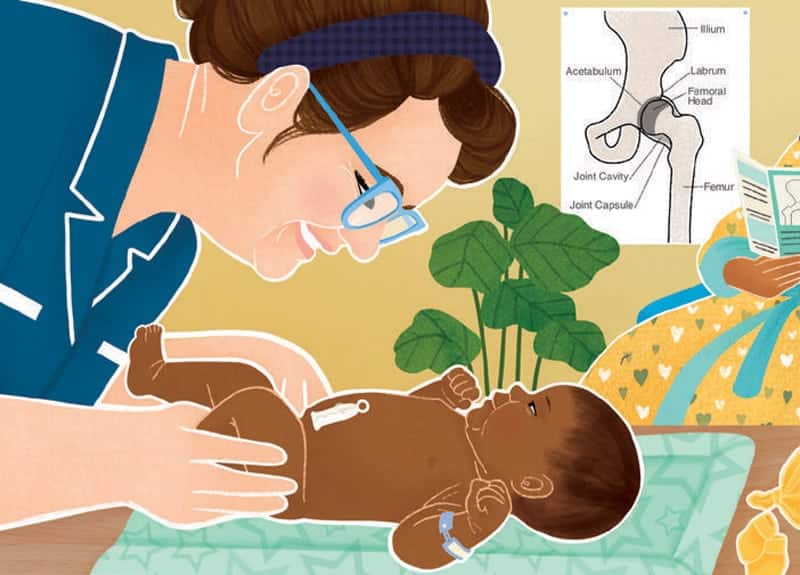
    • Acceptability.
    • Sensitivity.
    • Predictive positive value.
    • Representativeness.
    • Timeliness.
    • Stability.
    Challenges Faced by Disease Surveillance
    • Secular trends.
    • Defining the population at risk.
    • Magnitude.
    • Changes from background incidence (outbreaks).
    • Trajectory.
    Disease Surveillance: Summary
    • Information for action.
    • Collect, collate, analyze, interpret, and disseminate.
    • Understand epidemiology, identify problems, guide policy, monitor changes, etc.
    • Cyclical in nature.
    • Should be regularly evaluated.
    • A key component of Public Health practice.
    Purpose of Surveillance
    • Detect outbreaks early.
    • Plan vaccination campaigns.
    • Estimate how many people become sick or die.
    • Assess the extent of the outbreak.
    • See if the outbreak is spreading and where.
    • Decide whether the control measures are working.

    It is essential to detect the epidemic early enough for preventive measures like vaccination campaigns to have an impact. Provide feedback of the surveillance data to peripheral levels to promote cooperation and interest in the surveillance system.

    Investigation of an Epidemic

    In the investigation of an epidemic, it is wise to follow a systematic approach, although public reaction, urgency, and the local situation may make this difficult.

    The following list of steps need not always be undertaken in the order given, and some are done concurrently.

    Verification of the Diagnosis
    • Take a detailed history as possible from the informants.
    • Make tentative differential diagnoses.
    • Make all arrangements, including laboratory equipment, for ascertaining the tentative differential diagnosis.
    • Conduct clinical and laboratory studies to confirm the diagnosis. This should be done except in a few situations where the urgency demands immediate action based on clinical diagnosis alone.
    Verify the Existence of an Epidemic
    • The existence of an epidemic could be ascertained by comparing the current incidence of the disease with its usual incidence in the community.
    • Approximate estimates of previous incidence of the disease could be obtained from clinical and hospital data and by questioning the local people.
    Identification of Affected Persons and Their Characteristics
    • Establish a case definition.
    • Record details of each confirmed or suspected case, including age, sex, occupation, address, recent movements, symptoms, and other relevant details.
    • Actively search for additional cases by interviewing all persons related in time and place to already known cases.
    • For food poisoning, identify and interview all persons who attended the meal.
    • Visit all health facilities, including dispensaries and village health workers, for unreported cases.
    General Management of the Epidemic
    • Begin by treating individual cases.
    • Prevent the spread and initiate control measures depending on the type of disease. Immediate measures may include chemoprophylaxis for immediate contacts, immunization, isolation of affected persons (quarantine), and measures to protect water sources, ensure food hygiene, and control vectors.
    • Health education plays a significant role in preventing the spread of the epidemic.
    • Continue surveillance of the population to detect further changes in incidence and ensure the effectiveness of selected control measures.
    Prevention
    • Proper disposal of feces in a well-maintained sanitary latrine that is screened or vented to discourage fly access.
    • Use of drinking water from protected sources, pot storage, exposure of drinking water to sunlight, or boiling before drinking.
    • Washing of cooking and eating utensils using soap and hot water, drying them on a rack, and storing them in a cabinet out of the reach of children and animals such as dogs, cats, and chickens.
    • Conduct hygiene education for the general public and especially for food handlers in mass catering institutions like prisons, restaurants, and hospitals.
    • Periodically check cooks from such institutions to restrict carriers from working in food preparation areas.
    Case Management
    In Healthcare Setting
    • Isolation of patients.
    • Implementation of barrier nursing practices (wearing gloves, masks).
    • Replenishment of fluid and electrolytes.
    • Administration of appropriate prescribed therapy.
    • Detection and prompt management of complications.
    At the Community Level
    • Visiting health posts and the community at large.
    • Performing home, school, and prison visits.
    • Following up at the homes of patients discharged from health centers.
    • Providing health education and demonstrations.
    • Offering immunizations and other preventive health programs.
    Role of the Public Health Nurse in Epidemic Management
    • Accurate diagnosis of cases.
    • Prompt provision of treatment.
    • Continuous follow-up.
    • Accurate reporting to the concerned body.
    • Active participation in the epidemic control system.
    • Investigation of cases.
    • Mobilization of the community for prevention activities.
    • Analysis of data from the peripheral level for epidemiological links, trends, and achievement of control targets.
    • Providing feedback to the peripheral level.
    • Organizing essential logistics.
    Sample of Management of a Cholera Epidemic

    Management of Cholera Epidemic in a Community

    Epidemic management activities include taking appropriate control measures, such as treating those who are ill to reduce the reservoir of infection, and providing health education to limit the transmission of the disease to others.

    Case Management:

    • Patients are admitted to a temporary facility (e.g., school, tents, cholera camp) in the community in the case of cholera.
    • Appropriate laboratory investigations are considered to narrow down possible differential diagnoses and confirm the diagnosis.
    • Patients are managed with water and electrolyte replacement in case of dehydration and electrolyte depletion.
    • The cause is treated with appropriate antimicrobials (e.g., Cotrimoxazole, erythromycin, ciprofloxacin, and doxycycline).

    Disease Prevention and Control Measures:

    • Proper disinfection and disposal of body fluids such as vomitus and stool.
    • Water purification, including sterilization by boiling or chlorination in areas where cholera may be present.
    • Ensuring food safety, avoiding uncooked food, covering leftovers to prevent fly contamination, and temporarily stopping food vendors until the epidemic is controlled.
    • Chemoprophylaxis for immediate contacts (e.g., Cotrimoxazole) as prophylaxis in the case of cholera.
    • Inspection of markets and other public institutions.

    Health Education to the Community/Public

    • Proper washing of cooking and eating utensils using soap and hot water, followed by drying and storage in a cabinet out of the reach of children and animals.
    • Hygiene education, especially for food handlers in mass catering institutions like prisons, restaurants, and hospitals.
    • Improving sanitation.
    • Promoting proper use of pit latrines.

    Disease Surveillance:

    This is continuous monitoring of all aspects of diseases, including field investigations such as culturing. It describes the magnitude and distribution of diseases by place, time, and personal characteristics such as age and sex.

    Public health surveillance of communicable diseases involves continuous data collection, data analysis, interpretation of the data, and dissemination of the information to concerned bodies such as the District Health Office and nearby Health Centers. Disease Surveillance helps evaluate progress toward control measures.

    Summary on Prevention of Infectious Diseases:

    This depends on:

    • The reservoir or source of infection.
    • Routes of transmission of infection.
    • Susceptible hosts (people at risk).

    The primary aim behind controlling and preventing a disease is to:

    • Eliminate the source of infection.
    • Interrupt the routes of transmission.
    • Strengthen the defense mechanisms of people at risk.
    Levels of Disease Prevention:
    Primary (1°) Prevention:
    • Prevention that occurs before disease or dysfunction and is applied to individuals considered physically and emotionally healthy.
    • It aims at intervention before pathological diseases have begun during the stage of susceptibility.
    • It includes activities directed at reducing the probability of specific illnesses or impairments.
    • 1° prevention includes both general health promotion and specific protection.

    General health promotion includes:

    • Health education.
    • Good standards of nutrition adjusted to developmental stages of life.
    • Attention to personality development.
    • Provision of adequate housing, recreation, and agreeable working conditions.
    • Genetic screening.
    • Marriage and sex education.
    • Periodic selective examination.

    Specific Protection refers to measures aimed at protecting individuals against specific agents, e.g.:

    • Immunization.
    • Vaccination.
    • Attention to personal hygiene for self-care.
    • Use of environmental sanitation, e.g., chlorination of wells.
    • Protection from accidents, e.g., wearing helmets.
    • Use of specific nutrients.
    • Protection or avoidance of allergens.
    • Protection from carcinogens.

    Any specific disease or health problem is the result of interactions between specific or associated risk factors that can be classified as Agent, Host, and Environmental factors. This interaction can be understood by visualizing the concepts of positive health and disease.

    Secondary Prevention (2°):
    • Focuses on individuals who are experiencing health problems or illnesses and who are at risk of developing or worsening conditions.
    • Efforts seek to detect diseases early and treat them promptly.
    • The goal is to cure the disease at the earliest stage when a cure is possible or to slow its progression and prevent conditions of limited disability.

    Activities are directed at:

    • Early Diagnosis and Treatment:
      • Case finding measures, both individual and mass.
      • Screening surveys.
      • Selective exams.
      • Cure and prevention of the disease process to prevent the spread of communicable diseases, prevent conditions, and shorten the period of disability.
    • Limitation of Disability:
      • Adequate treatment to arrest the disease process and prevent conditions.
      • Provision of facilities to limit disability and prevent death.
    Tertiary (3°) Prevention:
    • Occurs when the defect or disability is permanent.
    • It includes rehabilitation for those individuals who have already experienced residual damage.
    • Tertiary prevention activities focus on the middle to latter phases of clinical disease, where irreversible pathological damage produces disability (e.g., post-stroke rehabilitation).

    Activities include:

    • Provision of hospital and community facilities for training and education to maximize the use of remaining capacities.
    • Education of the public and industries to use rehabilitated individuals to the fullest extent.
    • Selective placement.
    • Work therapy and hospital-based interventions.

    In 3° prevention, activities mainly aim at rehabilitation rather than diagnosis and treatment. The goal at this level is to help patients achieve the highest level of functioning possible despite limitations caused by illness or impaired functions.

    Malnutrition in the Community

    Definition of Malnutrition: Malnutrition is a disparity between the amount of food and other nutrients that the body needs and the amount that is received. This imbalance can result in undernutrition or overnutrition.

    Causes of Malnutrition in the Community:
    • Age: Basal metabolic rate (BMR) and physical energy expenditure vary with age, e.g., kwashiorkor is common in children.
    • Sex: Pregnant mothers usually suffer from nutritional anemia.
    • Habits and Traditional Beliefs: For example, the habit of consuming fast food rather than traditional foods.
    • Socioeconomic Factors: People with lower incomes are more likely to suffer from undernutrition, while the affluent may suffer from overnutrition.
    • Physical Factors: Climate, geographic location, and home environment can affect nutrition.
    • Population Density: Overpopulated areas compete for resources, including food, and are more likely to suffer from malnutrition.
    • Prevalence of Communicable and Parasitic Infestations: For example, measles in children and intestinal worms.
    • Unfavorable Climate Conditions: Such as droughts.
    • Lifestyles: Consuming excessive alcohol (alcoholism) and smoking can cause malnutrition.
    • Political Instability.
    • Natural Disasters, etc.
    Roles of a Nurse/Midwife in the Prevention of Community Malnutrition:

    These roles can be divided into three levels:

    Primary Level of Prevention:

    This involves preventive measures before the occurrence of malnutrition in the community. These include:

    • Health Education: Providing community education about preventive, curative, and rehabilitative measures for malnutrition.
    • Immunization: Encouraging community members to immunize their children against communicable diseases.
    • Promoting Income-Generating Activities: To help individuals earn a living.
    • Family Planning: Encouraging people to have smaller families they can care for.
    • Promotion of Girl Child Education.
    • Advocating for Adequate Food Storage.
    • Proper Weaning Practices.
    • Encouraging a Well-Balanced Diet.
    • Early Detection of Congenital Abnormalities.
    • Maintaining Hygiene to Prevent Illness.
    Secondary Prevention:
    • Conducting Population Screening to identify individuals with malnutrition and providing immediate referrals to prevent illness from becoming severe.
    • Case Management: Starting patients on nutritional intervention programs.
    • Maintaining Personal and Communal Sanitation.
    Tertiary Prevention:

    This involves interventions to prevent the recurrence of malnutrition in the community and includes:

    • Encouraging Drug Compliance.
    • Promoting Girl Child Education.
    • Encouraging Follow-up to Assess the Effectiveness of Interventions.
    • Educating the Public on Various Economic Activities to Earn a Living.
    • Improving Medical Facilities, Including Maternal and Child Health Services in the Community.
    Role of the Family in Health Promotion:
    • Child Spacing.
    • Engaging in Income-Generating Activities.
    • Improving Nutrition.
    • Providing Good Housing.
    • Ensuring Immunization.
    • Practicing Enhanced Personal Hygiene.
    • Creating a Safe Environment.
    Role of the Community in Health Promotion:
    • Proper Excreta Disposal.
    • Appropriate Refuse Disposal.
    • Contact Tracing.
    • Health Education.
    • Screening.
    • Rehabilitation.
    • Enhancing School Health.
    • Encouraging Community Participation and Involvement.
    Role of Government in Health Promotion:
    • Conducting Health Education.
    • Implementing Health Awareness and Enlightenment Programs.
    • Facilitating Inter-Sectoral Collaboration.
    • Establishing National Policies.
    • Enforcing Rules and Regulations to Protect Children Against Child Abuse.
    • Monitoring and Evaluating Programs.
    Role of Community Health in Disease Prevention and Health Promotion:
    • Maintaining Good Sanitation and Access to Clean Water.
    • Providing Health Education on Healthcare and Nutrition.
    • Controlling Both Communicable and Non-Communicable Diseases.
    • Organizing Adequate Medical and Nursing Services.
    • Improving Living Standards with the Help of Other Sectors and Active Involvement of Beneficiaries and the Community.
    Revision Questions:
    1. Explain the three components of the Epidemiological Triad and give an example of each for a common cold.
    2. What is the difference between Pathogenicity and Virulence?
    3. List the six links in the Chain of Infection in order. For each link, provide one example of a nursing intervention to break it.
    4. Describe the goal of each of the three levels of prevention.
    5. Giving a patient a vaccination is an example of which level of prevention? Why?

    Quick Quiz

    Health & Disease Quiz

    Community - mobile-friendly and focused practice.

    Privacy: Your details are used only for quiz tracking and certificates.

    HEALTH AND DISEASE Read More »

    Dimensions & Determinants of Health

    Dimensions & Determinants of Health

    Concept of Health
    I. Definition of Health

    According to WHO, health is defined as a state of complete physical, mental, and social well-being, and not merely the absence of disease or infirmity.

    Expanding on this, health is recognized as a dynamic state of complete physical, mental, social, and spiritual well-being, and not merely the absence of disease or infirmity.

    II. Components / Dimensions of Health

    According to WHO and holistic health models, the components and dimensions of health are interrelated and include the following:

    1. Physical Health

    Physical health means that an individual should be physically fit. The state of physical health implies the notion of perfect functioning of the body, including anatomical, physiological, and biochemical functioning.

    • Every cell and organ must function optimally and in perfect harmony with the rest of the body.
    • Body organs are structurally and functionally in a normal state, and there is a perfect coordination between the organs and systems.
    • Absence from sickness or disease does not solely mean that a person is healthy. Apart from being free from sickness and disease (including communicable and non-communicable diseases), a healthy person should not have any physical handicap (i.e., crippled legs or arms, or defective eyes) and there should not be any deformity of the body.
    • It includes the hygiene of different parts of the body such as the skin, hair, teeth, eyes, ears, hands, feet, rest, and sleep.
    2. Mental Health

    Mental health is defined as the ability of the individual to make personal and social adjustments. These adjustments are concerned with one's daily life in relation to others. A positive mental health state indicates that the individual is well adapted to both external and internal stressors, has harmonious relations within the family and community spheres, and is able to lead a productive life.

    • Physical health and mental health are highly interrelated with each other. If a person is physically healthy, he will also become mentally healthy because mental health depends on physical health and vice versa. Therefore, good physical health is the first stepping stone to mental health.
    • As the saying goes, "a healthy mind resides in a healthy body."
    Characteristics of a Mentally Healthy Person:
    • A mentally healthy person feels satisfied, happy, and cheerful.
    • A mentally healthy person is able to think for himself and take his own decisions.
    • He has firm determination and self-control.
    • He is not dominated by stress, fear, and anger.
    3. Social Well-being (Social Health)

    This refers to the level of health that enables a person to live in harmony and integration with their surroundings. Man is a social animal; he cannot live individually. He has to depend on each other to fulfill his basic needs.

    • He is not a family member only but a member of society, locality, city, country, or the world. Therefore, the problem of an individual is considered as the problem of the area, city, or country.
    • Because of this interconnectedness, the necessity arose for creating world organizations like the WHO, United Nations Organization (UNO), etc.
    • It includes the quantity and quality of an individual’s interpersonal ties and their involvement with the community.
    • The health of the people depends primarily on the social and environmental conditions under which they live and work. Economic tensions, poverty, unemployment, and adverse social relations greatly affect the health of an individual.
    • Customs and religious obligations affect the social health of an individual as well as community health.
    4. Spiritual Dimension (Spiritual Health)

    This refers to the part of an individual that seeks meaning and purpose in life. It recognizes our search for meaning and purpose in human existence. It is concerned with spirit or soul and is that health which evokes the good spirits and right things and keeps away from bad activities.

    • The body is guided by the soul. If the spiritual health is sound, bad thinking is always controlled by the inner soul, and the person hesitates to do bad events.
    • When the inner soul is overpowered by the mind, then the inner voice does not come to guide the mind; thus, he/she does not hesitate to do bad activities.
    • All religions are concerned mainly with spiritual welfare. It is a supernatural power that contributes to the health of an individual.
    • Spiritual health is necessary to follow a set of rules and regulations in daily life (e.g., "Early to bed and early to rise makes a man healthy, wealthy, and wise").
    • Doing prayers in the morning and evening is a healthy sign of spiritual health.
    5. Emotional Dimension

    The emotional dimension involves awareness and acceptance of one’s feelings. Emotional wellness includes the degree to which one feels positive and enthusiastic about oneself and life.

    6. Occupational Dimension

    The occupational dimension recognizes personal satisfaction and enrichment in one’s life through work. Work, when fully adapted to human goals, capacities, and limitations, often plays a role in promoting both physical and mental health.

    III. Determinants of Health

    There are many influences that affect health and well-being, known as determinants of health. These determinants include:

    1. Individual Factors
  • a) Heredity / Genetic Configuration: The state of health of an individual or population is greatly dependent on the genetic constitution and genetic characters received from parents. Genes play a very important role in the health and development of a child. Genetic traits related to certain enzyme deficiencies and hereditary diseases can lead to changes in individuals' health status. Many diseases are hereditary, like Haemophilia, sickle cell anaemia, Hypertension, Diabetes, etc.
  • b) Lifestyle of Individuals: Lifestyle plays a great role in health. It may promote and maintain good health, or it may adversely affect health. Lifestyle includes many personal activities like care of the body, washing, care of teeth, hair, nails, and habits.
    • If a person is having good habits and has a better attitude towards others, he will enjoy physical, mental, social, and spiritual health.
    • However, if a person has bad habits, quarrels with others, and uses alcohol, narcotics, or other drugs, he will be a problem to himself, the community, and society.
    • Sedentary lifestyles, excessive competition, lack of regular exercise, and the excessive consumption of alcohol and other substances like smoking have compromised individuals' health status, leading to non-communicable diseases.
  • 2. Environmental Factors
  • a) Socio-economic factors / Level of Development: Economic and social development helps improve the health status of populations. The health of an individual depends on socio-economic factors which are governed by a set of rules and regulations framed and accepted by society. If a society is financially sound, there will be development in education, housing, social relations, and hygienic conditions. Poverty is the root cause of all problems. Poor nutrition, illiteracy, slums, and a lack of basic needs lead to ill health.
  • b) Environment: The physical, social, and biological environment is a crucial determinant of health. Factors such as poor environmental sanitation, inadequate safe water, and excessive air and water pollution can heavily impact health.
  • c) Political Will: As discussed, poverty is the root cause of all problems. If firm political decisions are taken and policies are framed, then within no time, facilities like fresh water, pacca houses, pacca roads, electricity, educational, and medical facilities are provided free of cost or at a reasonable cost. This directly promotes the health status of those people living in slums.
  • d) Availability of Health Care Services / Health Infrastructure: Accessibility and acceptability of health facilities have a direct impact on health status. Availability and utilization of primary health facilities improve the health of individuals and communities. This includes:
    • Adequate supply of safe and drinking water.
    • Adequate supply of nutritious food.
    • Maternal child health care and family planning services.
    • Preventive measures against disease and immunisation against infectious diseases.
  • 3. Other Factors

    Additional holistic factors impacting the wide spectrum of individual and community well-being.

    IV. Health Indicators

    A Health indicator is a measure designed to summarize the information about a given priority topic in population health or health system performance. Also referred to as health variables or health indices, they are measurable characteristics of a population that provide insights into its health status.

    These indicators serve several essential roles in the realm of healthcare management, including description, prediction, explanation, system oversight, evaluation, advocacy, accountability, research, and the assessment of gender disparities.

    Health indicators are typically classified into two main categories: Vital Indicators and Behavioral Indicators.

    A. Vital Indicators

    These encompass a wide range of measures that provide critical information about the health of a population. Some key types include:

  • I. Mortality Indicators: These focus on data related to deaths within a population.
    • Crude death rate: The total number of deaths per 1,000 people in a given year.
    • Infant mortality rate (IMR).
    • Maternal mortality rate (MMR).
    • Life expectancy.
    • Specific death rates for various causes (e.g., cardiovascular disease, cancer).
  • II. Morbidity Indicators: These provide insights into the prevalence and incidence of diseases and illnesses within a population.
    • Incidence rate: Examples include the incidence of new cases of tuberculosis.
    • Prevalence rate: Examples include the prevalence of diabetes in a community.
  • III. Health Care Services Indicator (Service Indicators): These gauge the accessibility, availability, and quality of healthcare services.
    • Doctor-patient ratio.
    • Doctor-nurse ratio.
    • Population-bed ratio.
    • Other measures like the number of healthcare facilities per capita or the availability of essential medications.
  • IV. Disability Indicators: These assess the prevalence of disabilities, impairments, and limitations in functioning within the population.
  • V. Comprehensive Indicators: These offer a more holistic view of health by combining multiple aspects of well-being. They may include the Human Development Index (HDI), which factors in life expectancy, education, and income.
  • VI. Growth Rates: Track changes in population size over time, which can impact healthcare resource planning and allocation.
  • VII. Fertility Rates: Indicators such as the Total Fertility Rate (TFR) provide information about the average number of children born to women of childbearing age in a population.
  • VIII. Couple Protection Rates: Evaluate the use and effectiveness of family planning methods among couples.
  • IX. Birth Rates: Indicate the number of live births per 1,000 people in a specific population during a given year.
  • B. Behavioral Health Indicators

    In contrast to vital indicators, behavioral health indicators focus on the actions, behaviors, and attitudes of individuals and communities regarding healthcare. Examples include:

    • Utilization of Services: Measure the extent to which healthcare services are accessed by the population, including factors like hospital admissions, doctor visits, and preventive screenings.
    • Compliance Rates: Assess the adherence of individuals to recommended treatments, medications, and health guidelines.
    • Population Attitudes: Surveys and data related to public perceptions and attitudes regarding health and healthcare facilities.
    V. Common Health Problems in the Community

    Health problems vary significantly across different demographic groups within the community. Common health problems include:

    Demographic Group Common Health Problems
    Children
    • Diarrhea
    • Malnutrition (including protein-energy malnutrition like kwashiorkor)
    • Convulsions
    • Malaria
    • Failure to thrive
    • Common childhood diseases including: measles, TB, diphtheria, polio, tetanus, pertussis (whooping cough), yellow fever, hepatitis B, and Haemophilus influenzae type B (Hib).
    Women
    • Malaria
    • Pregnancy-related problems (e.g., miscarriages, abortions, and anemia from excess bleeding)
    • Stress-induced hypertension
    • Diabetes
    • HIV/AIDS
    • Typhoid, Tuberculosis (TB), Cholera
    Men
    • Malaria
    • Typhoid
    • Tuberculosis (TB)
    • Alcohol and drug addiction
    • Infections, including HIV/AIDS
    • Problems related to smoking, such as lung cancer
    VI. Implications of Health Problems on the Family

    The occurrence of severe or chronic health problems can have profound socio-economic and psychological implications for families, including:

    • Poverty: Due to out-of-pocket medical expenses and loss of income.
    • Loss of jobs: Resulting from prolonged absenteeism or disability.
    • Family instability: Stemming from financial and emotional stress.
    • Family separation or divorce: Caused by the continuous strain of managing a severe illness.
    • High mortality rates: Leading to the loss of key family members and primary breadwinners.

    Quick Quiz

    Health Concept Quiz

    Community - mobile-friendly and focused practice.

    Privacy: Your details are used only for quiz tracking and certificates.

    Dimensions & Determinants of Health Read More »

    Concept of the Community

    Concept of the Community

    Concept of the Community (Primary Health Care)
    Concept of the Community

    Community is a social group determined by geographic boundaries, values, and interests. According to WHO (1974),

    OR

    It is a group of inhabitants living together in a somewhat localized area under the same general regulations and having common interests, functions, needs, and organizations.

    OR

    A cluster of people with at least one common characteristic (geography, occupation, race, ethnicity, housing condition…).

    In Uganda, a community is often structurally defined from the grassroots up, starting at the Local Council 1 (LC1) or village level, scaling up to the parish, sub-county, and district levels. Culturally, it can also refer to ethnic or tribal clusters (e.g., Baganda, Acholi, Langi) that share a common language, housing conditions, and localized traditional leadership.
    A. Definitions of Community
    • Community is a group of people living together in a particular geographical area or having the same culture/subculture, or who are associated with each other on the basis of education, occupation, etc.
    • Lundberg: "Community is a human population living within a limited geographic area and carrying on a common inter-dependent life."
    • Kingsley: "The smallest territorial group that can embrace all aspects of social life."
    • Green Arnold: "A community is a cluster of people, living within a contiguous area, who share a common way of life."
    From these definitions, it can be concluded that a community includes:
    • Common living.
    • Common people.
    • Common culture.
    • Common independent life.
    • Limited geographical area (contiguous area: all areas within a state or a group of two or more states sharing common borders).

    Saunders viewed the community in three ways:

    1. Common place: means geographical location.
    2. Social system: social units and systems with the pattern of interactions.
    3. Group of people.

    The nurse should be aware of the demographic characteristics of the population, their health status, and health resources available within the geographic area of the community. Nurses should understand the culture, attitudes, beliefs, feelings, and lifestyles to develop appropriate plans through active participation.

    Elements of the Community:

    Elements of the Community:

    1. Membership – a sense of identity and belonging.
    2. Common symbol systems, e.g., a similar language, rituals, and ceremonies.
    3. Shared values and norms.
    4. Mutual influence, i.e., community members have influence and are influenced by each other.
    5. Shared needs and commitment to meeting them.
    6. Shared emotional connection, i.e., members share common problems, experiences, and mutual support.
    A prime example of shared emotional connection and mutual support in Uganda is the "Munno Mukabi" (a friend in need) groups or local SACCOs, where members pool resources to support one another during funerals, weddings, or medical emergencies.
    Features of a Community:

    A community has three features: location, population, and a social system.

    • Location: Every physical community carries out its daily existence in a specific geographical location. The health of the community is affected by this location, including the placement of services and geographical features.
    • Population: It consists of specialized aggregates, but all the diverse people who live within the boundary of the community.
    • Social system: The various parts of the community’s social system that interact and include the health system, family system, economic system, and educational system.
    Location significantly impacts health access here; island communities on Lake Victoria or mountainous regions like the Rwenzori face unique logistical challenges in accessing health centers. The social system heavily integrates Village Health Teams (VHTs) and traditional extended family networks.
    Components of Community:

    Communities have common components which include people, goals, needs, environment, service systems, and boundaries.

    • The People: Refers to community residents; people are the most important resource; they are the community. People will cluster or separate based on a variety of individual demographics, hence psycho-social, economic & cultural characteristics.
    • Goals & Needs: Refers to the goals & needs of people within the community. These are reflected & determine community goals & needs, which follow Maslow’s hierarchy in order of physiology, safety, social affiliation, esteem & self-actualization.
    • Environment: Refers to where people are living. It includes physical characteristics such as geography, climate, and social entities. Biological & chemical characteristics like bacteria, water quality, and social characteristics such as economic, education, religion, and recreation, etc.
    • Boundaries: Community has boundaries which serve to regulate the exchange of energy between a community and its external world. The boundaries may be complete or conceptual, etc.
    • Service System: Residents of the community need to carry on their life within its boundaries. The community must be of sufficient size to sustain services & systems. The community must organize these systems so that the needs & goals of the population are met. These services & systems include health education, social welfare, religion, recreational facilities, and government.
    B. Characteristics of a Community

    Each community has characteristics whose extent varies depending upon the size and nature of the community:

    • 1. Self-sufficiency: The community provides space to live, means for livelihood, education, protection, and security (i.e., all means and facilities which help in meeting the basic needs of its people).
    • 2. "We" feeling: The people in the community have a "we feeling," meaning community feeling, and they identify themselves with the community.
    • 3. Closeness: People have face-to-face interactions and free communication. It is more commonly apparent in small communities/villages and neighborhoods. Members are physically closer, have direct contacts, and intimate associations (e.g., common activities like community meals, visiting, and exchanging things).
    • 4. Homogeneity: The community has similarity in the psychosocial characteristics of people living within defined boundaries. They are similar in language, lifestyles, customs, and traditions.
    • 5. Defined geographical boundaries: Each community has defined geographical boundaries having its beginnings and its end (e.g., boundaries of a neighborhood, village, or city).
    II. Types of Communities (Adapted for the Ugandan Context)

    Communities are broadly classified into two main types: Village/Rural communities and Urban communities.

    A. Village / Rural Community

    A village community is a small area with a small population that follows agriculture not only as an occupation but also as a way of life. It is the oldest permanent community, emerging when humans passed from a nomadic mode of collective life to a settled one (thought to have exited five thousand years ago with the knowledge of agriculture).

    Features of a Village Community:
    • A sense of unity: All families in the village are united, share sorrows & joys together, and unite to protect themselves from invaders.
    • Intimate relation: Villagers have intimate relations with each other and know each other's personality.
    • Common culture: People have a common culture; even customs and conventions are common.
    • Joint participation: Villagers jointly organize religious/cultural activities and take part in them.
    • Close neighborhood relation: Neighborhood is of great importance. There is not much individuality; village people pay attention to neighbors and assist each other.
    • Joint / Extended family: The extended family system exists. For agricultural occupations, they require the co-operation of all family members.
    • Deep faith in religion & duties: Dependent on nature for agriculture, villagers often hold deep reverence for natural forces and strong religious faith.
    • Away from modern civilization & simple: Villagers are simple, their behavior is natural, and they live a peaceful life far from the "evils" of modern civilization.
    • Hardworking: Sincere, hardworking, and generally free from extreme urban mental conflicts.
    • Hospitality: Show great hospitality toward guests, dealing with others warmly and welcomingly.
    • High moral values: Life is governed by strong community norms and high morality.
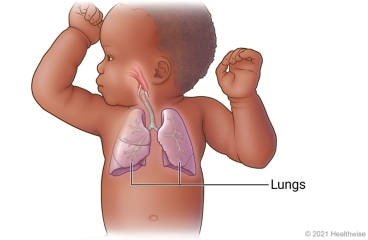
    Characteristics of Ugandan Villages (Adapted Context):
    While fundamental rural characteristics are universal, in the Ugandan context, the village structure is uniquely defined by local governance, distinct developmental challenges, and cultural ties.
    • Demographics: The village is the core unit of the Ugandan social structure, with a vast majority (around 70-75%) of the total population living in rural areas.
    • Socially or economically connected to cities: Earlier, villages were isolated and self-sufficient. With the development of transport (boda-bodas, taxis) and communication (mobile networks), the barrier between Ugandan cities and villages has been broken.
    • Structure of simplicity, calmness & peace: Villages have a simple, calm atmosphere. While traditional mud-walled and grass-thatched houses are still present, they are rapidly giving way to well-designed brick buildings and iron-sheet roofs as development reaches the grassroots.
    • Strong attachment to customs & traditions: The rural outlook often remains conservative, strongly adhering to cultural and tribal traditions (e.g., traditional marriage ceremonies, clan gatherings).
    • Poverty & illiteracy challenges: Villagers generally have lower incomes and rely heavily on subsistence farming. Educational opportunities, especially for higher education, can be limited, perpetuating a cycle of poverty.
    • Local self-government: Villagers manage their affairs through local administrative structures, primarily the Local Council 1 (LC1) system, which provides autonomy, dispute resolution, and community governance.
    B. Urban Community

    An urban community means an area with a high density of population. These areas have a local authority (like a City Council, Municipality, or Town Board). In an urban community, at least 75% of the male population is engaged in non-agricultural pursuits.

    Features of an Urban Community:
    • Class extremes: Class extremes exist between the richest and the poorest. We can see people living in slums/pavements alongside those having luxurious lives in bungalows or estates.
    • No primary contact: Inhabitants do not come into primary contact with each other. They are sometimes unaware of who is living next door.
    • Mechanical attitude: Attitudes are mechanical, showing superficial manners of politeness and mutual convenience. Strangers are often dealt with impersonally.
    • No sense of belongingness: People are aware of institutional organizations but often do not feel a deep sense of belongingness to any group or community.
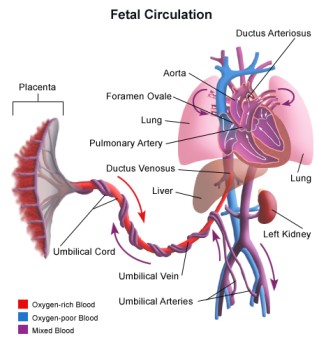
    • Breeding ground of biological & cultural hybrid: People of various races, cultures, and ends of the earth come together. Cultural life and ideas vary widely.
    • Social contacts: Contacts are impersonal and segmented. Social distance is maintained due to heterogeneity and anonymity.
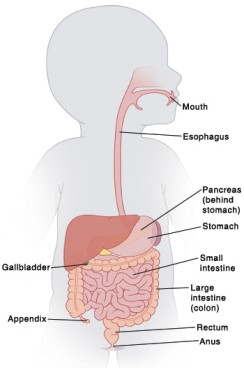
    • Energy and speed: People are ambitious and work day & night. Life is hectic and materialistic, leading to emotional tension and insecurity.
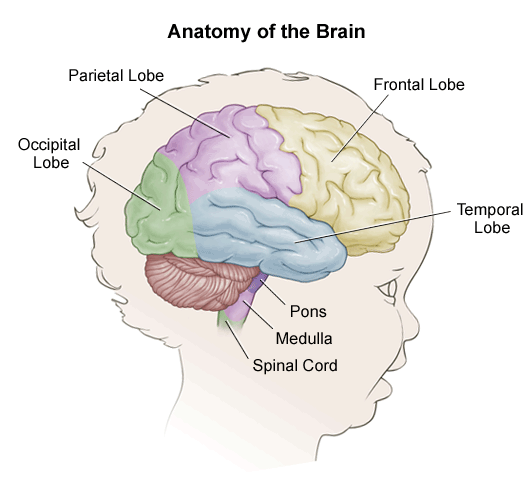
    • Health and disease: Overcrowding and high population density adversely affect health. Sickness rates can be high due to work stress, pollution, unhealthy habits, and junk food.
    Growth of Urban Communities:

    The factors which led to the growth of true cities include:

    • Availability of increased resources: Technological improvements exploit natural resources, leading to city growth where resources exceed mere sustenance.
    • Industrialization: New production techniques, machinery, and huge capital led to the establishment of big plants, mobilizing workers towards these areas.
    • Commercialization: Trade and commerce play an important part in goods distribution.
    • Development of means of transport: Transporting raw/manufactured materials led to a concentration of people.
    • Means of communication: Phones, internet, and information regarding factory establishment and manpower needs lead to migration.
    • Increased opportunities for higher education: Maximum numbers of universities, colleges, big libraries, and recruiting agencies are in cities.
    • Recreational facilities: Art galleries, amusement parks, museums, and theaters attract the younger generation.
    COMMUNITY CORE & FUNCTIONS
    Community Core

    Community core includes traits such as history, socio-demographic characteristics, vital statistics, and values/beliefs/core religions.

    Socio-demographically, Uganda has one of the youngest populations globally. This "core" shapes community health needs, requiring a massive focus on maternal-child health, youth reproductive health, and immunizations.
    Functions of the Community:
    1. Production, Distribution, and Consumption: The community produces, distributes, and utilizes goods and services that meet the health and welfare needs of its residents.
    2. Socialization: It is the process by which prevailing knowledge, values, beliefs, and behavior are transmitted to community members to teach them how to be effective.
    3. Social Control: The community influences the behavior of its members through norms and beliefs of social control. A legal component is often enhanced through law agencies to safeguard and protect the community.
    4. Social Participation: It provides opportunities for members of the community to achieve psycho-social wellness, communication, social interaction with others, and support to meet self-fulfillment in the community.
    5. Natural Support: The provision of aid to one another is offered through families, friends, religious groups, official health services, and social fulfillment in the community.
    6. To educate and cultivate newcomers, e.g., children and immigrants.
    7. To determine the use of space for living and other purposes.
    8. To provide opportunities for interaction between individuals and groups.
    Production often revolves around agriculture (e.g., growing matooke, maize, or coffee) which directly ties to local nutritional status. Social control is heavily influenced by Local Council (LC) courts and traditional clan elders (e.g., the Bataka), who play a vital role in conflict resolution and enforcing community hygiene bylaws.
    Factors Affecting the Health of the Community:

    These factors are categorized into Physical, Social-Cultural, Individuals, and Community Organization.

    Physical Factors:

    Physical factors include the influences of geography, the environment, community size, and industrial development.

    • Geography: Health problems in a community can be directly influenced by its altitude, latitude, and climate. For example, in tropical countries, parasitic and infectious diseases are leading community problems due to favorable climatic conditions. Ugandan Context: Uganda's tropical climate makes it highly endemic for Malaria, Schistosomiasis (around the lakes), and other vector-borne diseases. Altitude differences, like in Kabale or Kapchorwa, alter vector presence.
    • Environment: The quality of our environment is directly related to the quality of our stewardship over it. Uncontrolled population growth continues to deplete non-renewable natural resources, and pollution affects the soil, water, and air.
    • Community Size: The larger the community, the greater its range of health problems and the more health resources needed. A community’s size can impact both positively and negatively on its health.
    • Industrial Development: Industrial development can have positive or negative effects on health status. Negative effects include environmental pollution and occupational illnesses. Communities experiencing rapid industrial development need to regulate industries in various ways.
    Social and Cultural Factors:

    Social factors arise from interactions among individuals or groups within the community, while cultural factors stem from societal guidelines.

    • Beliefs and Traditions: Community members’ beliefs and traditions can affect the community’s health. Some cultural beliefs influence food choices and health behaviors like smoking and exercise. Ugandan Context: Cultural beliefs heavily influence health-seeking behaviors. Some rural communities may first consult traditional healers or Traditional Birth Attendants (TBAs) before visiting an HC III, impacting maternal outcomes. Dietary taboos for pregnant women in some cultures can also affect nutrition.
    • Prejudices among ethnic or racial groups can lead to violence and crime.
    • Economy: National and local economies affect health and social services, like education. Economic downturns can lead to inadequate funds for community healthcare and other services, impacting the health of the unemployed and underemployed.
    • Politics: Political leaders can improve or jeopardize community health through policy decisions and budgeting. Opposition politicians may propagate propaganda against government health policies.
    • Religion: Religious beliefs can influence community health positively or negatively. Some religious communities restrict certain treatments, immunizations, or physician visits.
    • Social Norms: Social norms can either positively or negatively impact community health. For example, smoking and excessive alcohol consumption may represent negative social norms in the community.
    • Social-Economic Status (SES): Socio-economic status influences individuals’ access to healthcare services and overall well-being. Those with lower SES tend to have poorer health and less access to health-promoting resources.
    Individual Behavior:
    • The behavior of individual community members contributes to the health of the entire community. Effective community health programs require concerted efforts from many individuals.
    • For example, higher immunization rates slow the spread of diseases, reducing exposure through herd immunity.
    • Herd Immunity: This concept refers to the resistance of a population to the spread of infectious agents based on the immunity of a high proportion of individuals.
    FAMILY PLANNING & COMMUNITY INFLUENCES
    Family Planning Activities:

    Family planning activities as an individual factor of a community refer to the actions and decisions made by individuals within a community to control their family size and spacing of pregnancies. These activities can have a significant impact on the overall well-being and development of the community. Here are some common family planning activities as an individual factor:

    Focus Area Activities and Descriptions
    Contraceptive use Individuals can choose to use various contraceptive methods to prevent unintended pregnancies. These methods include condoms, oral contraceptives, intrauterine devices (IUDs), implants, and sterilization.
    Education and awareness Individuals can actively seek information and educate themselves about different family planning methods, their effectiveness, benefits, and potential risks. They can also engage in discussions and share knowledge with others in the community.
    Seeking healthcare services Individuals can visit healthcare providers to access reproductive health services, including family planning counseling, screenings, and the provision of contraceptives. Regular check-ups and consultations can help individuals make informed decisions about their reproductive health.
    Communication within relationships Individuals can engage in open and honest communication with their partners regarding family planning decisions. This includes discussing desired family size, spacing of pregnancies, and the choice of contraceptive methods.
    Responsible parenting Individuals can actively participate in responsible parenting practices, such as spacing pregnancies appropriately, ensuring the health and well-being of existing children, and providing them with proper education and healthcare.
    Financial planning Individuals can consider their financial situation and plan their family size accordingly. By assessing their resources, individuals can make informed decisions about the number of children they can adequately support and provide for.
    Empowering women Individuals can support gender equality and women’s empowerment within the community. This includes advocating for women’s access to education, healthcare, and economic opportunities, which can positively impact family planning decisions.
    Advocacy and community engagement Individuals can actively participate in community-based organizations, advocacy groups, or local initiatives that promote family planning and reproductive health. By raising awareness and sharing personal experiences, individuals can contribute to the overall improvement of family planning services and policies in their community.
    Organizations like Marie Stopes Uganda and Reproductive Health Uganda (RHU), alongside government VHTs, play an active role in pushing these family planning activities. Given Uganda's high fertility rate, promoting spacing and empowering young women to stay in school are critical local community interventions.
    Factors in the community which might influence the community health
    • Safe H2O System 💧: Having clean and safe water to drink is important for everyone’s health. Dirty water can make people sick.
      (Reliance on NWSC in urban areas vs. boreholes and protected springs in rural areas).
    • Waste Disposal 🗑️: Properly getting rid of trash and waste is crucial. If it’s not done right, it can lead to diseases and pollution.
    • Food Supplies (Quality and Quantity) 🍎🍞: Having enough good-quality food to eat is essential. If there’s not enough food or it’s not healthy, people can become malnourished.
    • Access to Preventive and Curative Services 🏥💊: It’s important for people to have access to doctors and medicines to stay healthy and get better when they’re sick.
    • Transportation System 🚗🚌: Having good transportation helps people get to work, school, and healthcare. It makes life easier for everyone.
      (The widespread use of Boda-bodas and Matatus forms the backbone of local health-seeking transport).
    • Education Facilities 📚✏️: Good schools help children learn and grow. Education is important for a healthy community.
      ( Programs like Universal Primary Education (UPE) heavily influence community literacy and subsequent health outcomes).
    • Employment Opportunities 💼👩‍💼: Having jobs means people can earn money to support themselves and their families. It’s crucial for a happy and healthy community.
    • Climatic Conditions ☀️🌧️❄️: The weather can affect our health. Extreme heat or cold can be harmful if we’re not prepared.
    • Size of Population 👥: The number of people in a community matters. A very crowded or very small population can have different health challenges.
    • Cultural Benefits and Practices 🌍🌏: Different cultures have unique practices and traditions. Some of these practices can affect health positively or negatively.
    • Internal and External Economic Influences 💰🌐: Money and trade with other places can impact a community’s wealth and access to resources.
    • Formal and Informal Communication 🗣️📱: How people talk and share information matters. Good communication helps in emergencies and sharing health tips.
      ( Use of community radios, megaphones locally known as 'bizindalo', and WhatsApp groups for rapid health mobilization).

    Quick Quiz

    Community Concept Quiz

    Community - mobile-friendly and focused practice.

    Privacy: Your details are used only for quiz tracking and certificates.

    Concept of the Community Read More »

    Euthanasia

    Euthanasia

    Euthanasia in Nursing Practice
    Understanding Euthanasia
    Definition

    Euthanasia refers to the practice of intentionally ending a person's life to relieve pain and suffering. It is a deliberate act (or deliberate omission) undertaken with the specific intention of bringing about death in order to spare the patient from unbearable distress.

    Etymology: The Origin of the Word

    The term comes from the Greek words:

    • "Eu" = good, well, easy
    • "Thanatos" = death

    Together, euthanasia means "Good Death" or "Gentle and Easy Death." It is often referred to colloquially as "mercy killing," though this term is considered less precise in medical and legal contexts because it implies "killing" rather than a medically supervised, compassionate act.

    📜 Historical Note: The term "euthanasia" was first used in a medical context by Francis Bacon in the 17th century. He described it as a painless, happy death where it was a physician's duty to alleviate physical suffering. Bacon saw euthanasia not as killing, but as the art of dying well: managing symptoms so that death comes peacefully and without agony.

    Methods of Euthanasia

    Euthanasia involves ending a person's life through various means:

    • Pharmacological: Administration of a lethal dose of medication (e.g., barbiturates, neuromuscular blockers) that induces coma, respiratory arrest, and death.
    • Withholding or Withdrawing Treatment: Ceasing life-sustaining interventions such as mechanical ventilation, dialysis, artificial nutrition, or hydration.
    • Assisted Suicide: The patient self-administers a lethal substance provided by a physician. This is legally and ethically distinct from euthanasia in many jurisdictions, though the lines can blur.

    ⚠️ Critical Distinction: Euthanasia = someone else (physician/nurse) administers the lethal act. Assisted Suicide = the patient performs the final act themselves. In nursing ethics exams, knowing this distinction is essential. Some countries legalise one but not the other.

    Types of Euthanasia

    Understanding the types of euthanasia is critical for nurses because each type carries different legal, ethical, and professional implications. In exams, you may be asked to classify a scenario or defend a position based on the type involved.

    Type Definition Examples & Nursing Relevance
    Active Euthanasia Death is brought about by a direct action: deliberately administering a substance or performing an act with the intention of causing death. Example: A physician injects a lethal dose of potassium chloride or barbiturates at the patient's request.

    Nursing note: In jurisdictions where active euthanasia is legal (e.g., Netherlands, Belgium), nurses may assist in preparation, monitoring, or post-procedure care but rarely administer the lethal agent themselves.
    Passive Euthanasia Death results from an omission: withholding or withdrawing life-sustaining treatment, allowing the disease or condition to take its natural course. Example (Withdrawing): Turning off a ventilator in a patient with irreversible brain damage.
    Example (Withholding): Not starting CPR on a terminally ill patient with a valid DNR (Do Not Resuscitate) order.

    Nursing note: This is the most common form nurses encounter. It is legal in most countries when there is informed consent or advance directive.
    Voluntary Euthanasia The patient willingly cooperates and makes an autonomous, informed decision without external pressure or coercion. Example: A patient with terminal cancer, fully aware of their diagnosis and prognosis, repeatedly requests euthanasia over several weeks and signs legal consent forms.

    Nursing note: The nurse's role is to ensure the decision is truly voluntary, informed, and free from coercion by family members seeking inheritance or relief from caregiving burden.
    Non-Voluntary Euthanasia A decision is made for a patient who is unable to consent: unconscious, in a persistent vegetative state, severely cognitively impaired, or a neonate with profound disabilities. Example: A patient in a coma after a road accident with no advance directive; the family and medical team decide to withdraw life support based on futility and best-interest principles.

    Nursing note: This is highly controversial and illegal in most jurisdictions. Nurses may be asked to participate in withdrawal of treatment but must ensure legal and ethical safeguards are met.
    Indirect (Double Effect) Euthanasia Providing treatments primarily to reduce pain or symptoms, with the foreseen but unintended side effect of shortening the patient's life. Example: Administering high-dose morphine to a dying patient in severe pain. The primary intention is pain relief; the foreseen but unintended consequence may be respiratory depression and earlier death.

    Nursing note: This is ethically and legally distinct from active euthanasia. The Doctrine of Double Effect justifies it in palliative care.

    📝 Exam Tip (Classifying Euthanasia): Use the "AVP-NI" framework: Active / Voluntary / Passive / Non-voluntary / Indirect. When given a scenario, ask two questions: (1) Is there a direct action or an omission? (Active vs. Passive) and (2) Did the patient consent? (Voluntary vs. Non-voluntary). This gives you the correct classification every time.

    The Doctrine of Double Effect (DDE)

    This is one of the most important ethical principles in end-of-life nursing. It allows nurses and doctors to administer treatments that may hasten death, provided four conditions are met:

    1. The action itself must be morally good or neutral. (Giving pain relief is good.)
    2. The good effect must be intended, and the bad effect merely foreseen. (Intention = pain relief. Foreseen but not intended = earlier death.)
    3. The bad effect must not be the means to the good effect. (You are not killing the patient to relieve their pain. You are relieving pain, and death happens as a side effect.)
    4. There must be a proportionate reason. (The benefit of pain relief must outweigh the risk of earlier death.)

    🏥 Clinical Example: A 78-year-old man with metastatic bone cancer is screaming in pain. The nurse administers morphine, increasing the dose until pain is controlled. The patient's respirations slow, and he dies peacefully 6 hours later. Was this euthanasia? No. Under the Doctrine of Double Effect, the intention was pain relief. The earlier death was a foreseen but unintended side effect. The nurse acted ethically. This distinction protects nurses in palliative care.

    Religious Perspectives on Euthanasia

    Religious beliefs profoundly shape how patients, families, and even healthcare providers view euthanasia. As a nurse, you will care for patients from diverse faith backgrounds. Understanding these perspectives helps you provide culturally sensitive care and recognise when a patient's refusal of treatment is rooted in religious conviction rather than confusion or depression.

    Islam
    • Core Belief: Muslims generally oppose euthanasia, considering life sacred ("And do not kill yourselves" : Qur'an 4:29). Life is a trust from Allah, and only Allah has the right to decide when it ends.
    • Active euthanasia is considered equivalent to suicide or murder, both of which are forbidden (haram).
    • Permissible Exception: The Islamic Medical Association of North America (IMANA) allows for the discontinuation of mechanical life support for patients in a persistent vegetative state with no hope of recovery. This is not considered euthanasia but rather acceptance of God's will when medical intervention becomes futile.
    • Palliative care is encouraged: relieving pain is a duty. However, intentionally causing death remains prohibited.

    💡 Nursing Implication: When caring for a Muslim patient, do not assume they want euthanasia even if they are suffering. Offer excellent palliative care. Involve the family and, if appropriate, an Islamic scholar or chaplain in end-of-life discussions.

    Christianity
    • Core Belief: Most Christian denominations oppose euthanasia, emphasising the sanctity of life: the belief that human life is sacred because it is created in the image of God (imago Dei).
    • Catholic teaching: Direct euthanasia is morally unacceptable. However, the Church supports the withdrawal of "burdensome, dangerous, extraordinary, or disproportionate" treatment. Ordinary care (food, water, basic hygiene) must always be provided.
    • Protestant views: Vary widely. Some conservative groups oppose all forms of euthanasia. More liberal denominations may support patient autonomy and compassion, accepting passive euthanasia in some circumstances.
    • Ethical Consideration: Many churches stress not interfering with the natural process of death and respecting human life as a gift from God. Suffering may also be viewed as having redemptive or spiritual meaning.

    💡 Nursing Implication: A Christian patient may refuse withdrawal of feeding tubes or hydration, viewing it as "starving" the patient. Respect this. Provide spiritual support through a chaplain or pastor. Never dismiss religious concerns as "irrational."

    Judaism
    • Core Belief: Jewish medical ethics show division on euthanasia and end-of-life treatment. Traditional Jewish law (Halakha) places high value on preserving life.
    • Orthodox Judaism: Generally opposes active euthanasia and even passive euthanasia in many cases. Withholding nutrition is particularly controversial.
    • Reform and Conservative Judaism: More accepting of passive euthanasia and withdrawal of futile treatment. Some support voluntary passive euthanasia in specific circumstances where suffering is unbearable and death is imminent.
    • Key Concept: Goses (a person in the final hours of life). Traditional law forbids any act that might hasten death, but also forbids any act that might prolong the dying process artificially.

    💡 Nursing Implication: Jewish patients may have specific end-of-life directives. Some may refuse treatment on the Sabbath unless life is immediately threatened. Consult with a rabbi or the patient's family when making decisions.

    Shinto (Japan)
    • Core Belief: In Japan, where Shintoism is culturally dominant, a majority of religious organisations agree with voluntary passive euthanasia.
    • Shintoism views the body as a gift from ancestors and the divine. However, it also values naturalness and harmony with nature.
    • Opposition to artificial prolongation: Shintoism discourages artificial life prolongation when it merely extends suffering without hope of recovery. Dying naturally is preferred over being kept alive by machines.
    • This cultural perspective has influenced Japan's relatively permissive stance on withdrawal of life support compared to some other Asian nations.
    Buddhism
    • Core Belief: Compassion (Karuna) is a core value in Buddhism and can be used to justify euthanasia in relieving unbearable suffering. A compassionate act that ends suffering may be seen as morally virtuous.
    • The First Precept: However, Buddhism also maintains the precept of ahimsa (non-violence) and prohibits taking life: including one's own. The intentional destruction of human life is generally viewed as creating negative karma.
    • Diverse Views: Different Buddhist traditions interpret this differently. Some Theravada schools are stricter, while some Mahayana schools emphasise compassion and may be more accepting of passive euthanasia.
    • Middle Way: Many Buddhist ethicists advocate for high-quality palliative care as the middle path: neither aggressively prolonging death nor actively hastening it.

    📝 Exam Tip: When asked about religious perspectives in an exam, avoid generalisations like "All religions oppose euthanasia." Instead, show nuance: "While most Abrahamic traditions (Islam, Christianity, Orthodox Judaism) oppose active euthanasia based on the sanctity of life, there is greater acceptance of passive euthanasia and withdrawal of futile treatment across many traditions. Buddhism and Shintoism place strong emphasis on compassion and natural death, leading to more varied interpretations."

    The Nurse's Role in Euthanasia

    Nurses are not passive observers in end-of-life care. They are frontline caregivers, patient advocates, family counsellors, and ethical gatekeepers. Even in jurisdictions where euthanasia is illegal, nurses play a critical role in palliative care, symptom management, and supporting patient autonomy. Where euthanasia is legal, the nurse's role is carefully defined by law and professional codes.

    ⚠️ Important Legal Note: In most countries (including Uganda and most of Africa), active euthanasia is illegal. Nurses must know the law of their jurisdiction. This section describes roles in jurisdictions where euthanasia is legal, and the ethical principles that apply everywhere. Never participate in illegal acts, even if you believe them morally justified.

    Phase I: Pre-Euthanasia (Assessment and Preparation)

    This is the longest and most complex phase. The nurse's role here is primarily assessment, advocacy, and education.

    A. Comprehensive Assessment
    • Listen attentively to the patient's request for euthanasia. Do not dismiss it, judge it, or immediately agree with it. Active listening builds trust and reveals the true motivations behind the request.
    • Is the request driven by uncontrolled physical pain? (This may be treatable with better palliative care.)
    • Is it driven by psychological suffering: depression, anxiety, fear of being a burden?
    • Is it driven by social factors: family abandonment, financial ruin, loss of dignity?
    • Is it driven by existential distress: loss of meaning, hopelessness, spiritual crisis?
    • Assess the underlying reasons and contributing factors. Many patients who request euthanasia change their minds when their suffering is properly addressed. A nurse who identifies treatable suffering may prevent an unnecessary death.
    • Evaluate the patient's knowledge. Does the patient truly understand their diagnosis, prognosis, and available alternatives? Many patients request euthanasia because they believe nothing more can be done: when, in fact, excellent palliative care could give them months of meaningful life.
    • Physical examination and severity assessment. Document the patient's condition objectively. Is the disease truly in its terminal phase? Is the suffering truly unbearable and irremediable?
    • Family assessment. Evaluate the family's reaction to the request. Are they supportive, opposed, or indifferent? Is there evidence of coercion: family members pressuring the patient to "end it" because of cost or caregiver burden? Encourage open communication and identify the family's emotional needs.
    B. Consultation and Advocacy

    Nurses become advocates representing the patient's condition and their relatives' wishes in a multidisciplinary panel. This panel typically includes:

    • Attending physician(s)
    • Clinical psychologist (to assess mental capacity and screen for depression)
    • Social worker (to assess social and financial supports)
    • Palliative care specialist (to confirm that all alternatives have been explored)
    • Ethics committee member (in some institutions)

    The nurse provides objective, detailed observations about the patient's physical state, emotional state, family dynamics, and response to previous treatments. The nurse is often the team member who knows the patient best.

    C. Informed Consent Process
    • Environment: Ensure the consent process takes place in a quiet, private, non-disturbing environment. The patient must feel safe to express doubt or withdraw consent.
    • Communication: Explain the process with a calm, non-threatening tone. Use simple language. Allow time for questions. Repeat information if necessary. Do not rush.
    • Understanding: Ensure the patient and family fully understand:
      • The euthanasia process itself (what drugs will be used, what the patient will experience).
      • Potential discomfort or complications (rare, but possible: e.g., prolonged coma if the first dose is insufficient).
      • The patient's right to revoke their request at any time: even seconds before administration. This is absolute and must be emphasised repeatedly.
      • The cooling-off period required by law (varies by country: e.g., 1 month in some jurisdictions).
    • Documentation: Ensure written consent is obtained, witnessed, and stored securely. The nurse may be asked to witness the signature.

    📝 Exam Tip: When asked about the nurse's pre-euthanasia role, structure your answer as "ACE": Assess (patient, family, knowledge), Consult (multidisciplinary team), Educate and obtain consent. This mnemonic ensures you cover all three domains.

    Phase II: Intra-Euthanasia (The Procedure)

    This phase is typically led by the physician, but the nurse has critical supportive, monitoring, and documentation responsibilities. In most legal frameworks, nurses do not administer the lethal agent: but they prepare the environment, support the family, and ensure safety protocols.

    A. Preparation
    • Establish intravenous access for medication administration, if this is the route chosen.
    • Reiterate the procedure to the patient and family members. Even though consent was obtained days or weeks ago, the patient must confirm their wish immediately before the procedure in most jurisdictions. This is called the "last confirmatory consent."
    • Provide reassurance and emotional support. The patient may be anxious. The family may be crying, arguing, or silent. The nurse must remain calm, composed, and compassionate.
    • Assist in preparing medication. This may include sedatives (e.g., midazolam), analgesics, and the euthanatic agent (e.g., barbiturates, potassium chloride, or neuromuscular blockers depending on protocol). Ensure proper labelling and double-checking.
    • Premedication: If the patient wishes to be unaware of the moment of coma induction, administer premedication such as midazolam (a benzodiazepine sedative) according to protocol. This respects patient autonomy regarding consciousness at the moment of death.
    B. Assistance During the Procedure
    • Prepare an emergency set as per protocol. Although the intention is death, some jurisdictions require resuscitation equipment to be available in case the patient revokes consent at the last moment or complications arise.
    • Offer emotional support to family members if present. Some families choose to be present; others wait outside. Respect their choice. Provide tissues, water, and a private space.
    • Monitor the patient: Observe vital signs, level of consciousness, and signs of distress. Report any unexpected reactions to the physician.
    C. Documentation
    • Maintain a detailed record of all medications used, dosages, times of administration, events, and all persons present. This is a legal requirement in all jurisdictions where euthanasia is legal.
    • Complete all required forms:
      • Signed consent forms (original and copies).
      • Pain assessment records (to demonstrate that suffering was indeed unbearable).
      • Record of euthanasia (standardised government form in some countries).
      • The "last office" chart (post-mortem nursing care documentation).

    ⚠️ Ethical Boundary: A nurse who has a conscientious objection to euthanasia has the right to refuse participation: but must ensure the patient is not abandoned. The nurse should inform the supervisor in advance, transfer care to a willing colleague, and continue to provide compassionate non-participatory care (e.g., palliative symptom management) up to the point of their ethical boundary.

    Phase III: Post-Euthanasia (Aftercare and Support)

    The nurse's role does not end when the patient dies. Post-euthanasia care involves legal certification, family support, safe disposal, and institutional review.

    A. Certifying Death
    • After the physician has certified death, the nurse may be asked to explain the cessation to the family. This includes confirming that the patient has died, describing the peaceful nature of the death (if true), and answering questions.
    • Prepare the body with dignity and respect: the "last offices." This includes cleaning the body, closing the eyes, positioning the body, and removing medical equipment.
    B. Support for the Family
    • Provide emotional support. Family members may experience a complex mix of grief, relief, guilt, anger, and numbness. These emotions are normal but can be overwhelming.
    • Offer reassurance and active listening. Do not rush them. Allow them to sit with the body if they wish. Silence is okay.
    • Utilise communication and counselling skills. Use therapeutic communication: open-ended questions, reflection, validation ("It sounds like you are feeling guilty, even though you supported her choice").
    • Timely referral to a counsellor if emotions are uncontrolled, if there is family conflict, or if a family member expresses suicidal ideation. Some family members regret supporting the decision and need professional help.
    • Provide practical information: Death certificate process, funeral arrangements, bereavement support groups.
    C. Safe Disposal of Medications
    • Return all unused euthanatic agents to the pharmacy for proper disposal. This is a legal and safety requirement.
    • Prevent improper use. Euthanatic agents are potent and dangerous. If taken home by family members or stolen, they could cause accidental or intentional deaths. Double-check the inventory: what was prepared vs. what was used vs. what is returned.
    • Document the disposal with signatures from the nurse, physician, and pharmacist.
    D. Incident Evaluation
    • Complete an incident evaluation form in case of unexpected problems, such as:
      • Underdosing: The patient did not die and regained consciousness. This is traumatic for everyone and requires immediate medical and ethical review.
      • Prolonged dying: The patient took hours to die instead of minutes. This may indicate a protocol failure.
      • Family distress: A family member who was not informed became violent or threatened legal action.
      • Patient revoked consent at the last moment: The procedure was stopped. This is not a failure: it is a success of the consent process: but it must be documented.
    • Debriefing: The healthcare team should hold a debriefing session. Euthanasia is emotionally taxing. Nurses may experience moral distress, grief, or guilt even when they believe the act was ethically justified.

    📝 Exam Tip (Nursing Roles): Memorise the three phases as "Pre-Intra-Post" or "PIP":
    Pre = Assess + Consult + Educate/Consent
    Intra = Prepare + Assist + Document
    Post = Certify + Support family + Safe disposal + Evaluate
    In an exam, write one bullet point under each phase. This structure guarantees full marks.

    Ethical Dilemmas Surrounding Euthanasia

    An ethical dilemma in euthanasia refers to a situation where there is a conflict between different ethical principles, values, or beliefs when considering end-of-life decisions. Nurses face these dilemmas regularly: even when euthanasia itself is not an option: because the same principles apply to withdrawal of treatment, DNR orders, and palliative sedation.

    The Four Pillars of Medical Ethics

    Before examining specific dilemmas, recall the four foundational principles:

    Principle Meaning Conflict in Euthanasia
    Autonomy The right to self-determination and control over one's own body and life. The patient says "I want to die." But does severe illness or depression compromise true autonomy?
    Beneficence The duty to do good and act in the patient's best interest. Is ending life "doing good"? Or is preserving life, even with suffering, the greater good?
    Non-maleficence The duty to do no harm. Is killing the patient a form of harm? Or is prolonging unbearable suffering the greater harm?
    Justice Fairness in distribution of resources and treatment of all persons. Could legalising euthanasia pressure poor or disabled patients to "choose" death because they lack access to palliative care?

    💡 Mnemonic: "Be ANd Justice" = Beneficence, Autonomy, Non-maleficence, Justice. Or the classic: "ABNJ."

    Dilemma 1: Balancing Autonomy and Sanctity of Life

    The Conflict: One ethical dilemma revolves around the tension between respecting an individual's autonomy and the belief in the sanctity of life. Advocates for euthanasia argue that individuals should have the right to decide when and how to end their lives to escape suffering. Opponents believe that life is inherently valuable and should be protected, even if the individual desires to die.

    🩺 Scenario: A 45-year-old patient with terminal motor neuron disease (ALS) is fully conscious, intellectually intact, and in constant pain. He expresses a strong desire to end his life to avoid further suffering. However, his adult children, who are devout Christians, believe that life is a gift from God and that euthanasia is murder. They threaten to disown him and sue the hospital if the procedure proceeds.

    Nursing Considerations:
    • The patient's autonomy is clear and legally valid: but autonomy does not exist in a vacuum. It exists within a web of relationships.
    • The nurse must respect the patient's decision while also acknowledging the family's distress. The nurse is not a mediator, but can facilitate family meetings with a counsellor or chaplain.
    • Document everything. If the patient proceeds, the family may later claim they were not consulted. If the patient delays, the family may claim they pressured him.
    • The nurse must ask: Is the patient's request truly autonomous, or is he responding to a perceived burden on his family? Sometimes patients request euthanasia to spare their families: this is not pure autonomy.

    ⚡ Key Principle: Autonomy does not mean isolation. A truly autonomous decision is informed, voluntary, and made without coercion: but it can still be influenced by love, guilt, and family dynamics. The nurse's role is to help the patient see these influences clearly.

    Dilemma 2: Healthcare Professionals and Personal Morals

    The Conflict: Healthcare professionals often face ethical dilemmas when their personal beliefs conflict with their professional duty to provide care and alleviate suffering. Some healthcare providers have moral or religious objections to participating in euthanasia, which creates a conflict between their professional responsibilities and personal values.

    🩺 Scenario: A nurse who opposes euthanasia on moral grounds is assigned to care for a patient scheduled for physician-assisted dying. The nurse has been the patient's primary carer for six months and has built a trusting relationship. The patient specifically requests that this nurse be present during the procedure.

    Nursing Considerations:
    • The nurse has a right to conscientious objection in most legal frameworks. However, this right is not absolute. The nurse must ensure the patient is not abandoned or discriminated against.
    • The nurse should inform the supervisor in advance: not on the day of the procedure. This allows time for reassignment.
    • The nurse can continue to provide non-objectionable care up to the ethical boundary: symptom management, emotional support, family counselling: and then hand over to a colleague for the procedure itself.
    • The nurse should seek peer support or counselling after the decision. Moral distress is real and can lead to burnout, depression, or leaving the profession.

    ⚡ Key Principle: Conscientious objection is a right, but abandonment is not. A nurse who refuses to participate must still ensure continuity of care and treat the patient with dignity up to the point of their ethical boundary.

    Dilemma 3: Palliative Care and Access

    The Conflict: The availability and quality of palliative care can present ethical dilemmas related to euthanasia. If individuals do not have access to adequate pain management and end-of-life care, they may feel compelled to choose euthanasia as a means to alleviate their suffering. This raises questions about the responsibility of healthcare systems.

    🩺 Scenario: A patient with terminal cancer in a rural district hospital is experiencing severe, uncontrolled bone pain. The hospital has run out of morphine. The patient has no money to travel to the city for palliative care. He asks the nurse, "If you cannot stop my pain, why can't you just end my life?"

    Nursing Considerations:
    • This is a justice dilemma. The patient is not choosing euthanasia because he truly wants to die: he is choosing it because the healthcare system has failed to provide pain relief.
    • The nurse must advocate for urgent pain relief: contacting the district pharmacist, requesting emergency morphine stocks, exploring alternative analgesics (e.g., tramadol, NSAIDs in combination), or arranging transfer.
    • The nurse must also recognise that the patient's request may change once pain is controlled. Studies show that many patients who request euthanasia withdraw their request after receiving excellent palliative care.
    • This scenario highlights a broader public health issue: legalising euthanasia without first ensuring universal palliative care access may create a coercive environment where poor patients "choose" death because they cannot afford to live comfortably.

    ⚡ Key Principle: Euthanasia should never be a substitute for palliative care. A society that offers euthanasia but not pain relief is not offering a choice: it is offering abandonment dressed as compassion.

    Dilemma 4: Psychological Impact on Healthcare Professionals

    The Conflict: Euthanasia can have a profound psychological impact on healthcare professionals involved in the process, as well as on family members and loved ones. Witnessing or participating in euthanasia may lead to moral distress, guilt, or emotional trauma, raising ethical concerns about the potential harm inflicted on those involved.

    🩺 Scenario: A physician performs euthanasia on a patient with whom the primary nurse has built a deep, trusting relationship over eight months. After the procedure, the nurse cannot sleep. She replays the moment of death in her mind. She wonders, "Did I fail as a nurse? Should I have fought harder for better palliative care? Did I become an accomplice to killing?"

    Nursing Considerations:
    • This is moral distress: knowing the ethically correct action but being unable to take it, or taking an action that conflicts with one's values. Moral distress is a leading cause of nurse burnout and turnover.
    • The nurse should seek debriefing: informal peer support or formal counselling. Many hospitals where euthanasia is legal mandate debriefing sessions.
    • The nurse should reflect on the ethical framework that justifies their participation. If they acted within the law, with proper consent, and with the intention of relieving suffering, their actions were ethically defensible: even if emotionally painful.
    • Institutions have a duty to provide psychological safety for staff involved in euthanasia. This includes scheduled counselling, peer support groups, and the right to opt out of future cases.

    ⚡ Key Principle: Compassion for the patient must be matched by compassion for the caregiver. A nurse who suffers silently will eventually break. Institutions must normalise seeking help after ethically challenging cases.

    Dilemma 5: Assessing Quality of Life and the Need for Euthanasia

    The Conflict: Evaluating the subjective experience of suffering and the quality of life is another ethical dilemma. Determining whether a person's suffering is "unbearable" and if their quality of life has significantly deteriorated involves subjective judgments and personal values. Different stakeholders may disagree profoundly.

    🩺 Scenario: A patient with ALS (Amyotrophic Lateral Sclerosis) is gradually losing motor function. He can no longer walk, feed himself, or speak clearly. He uses a ventilator to breathe. He communicates via eye-tracking technology and says, "I have no dignity left. I want to die." However, his wife says, "He still laughs at jokes. He still watches football with me. His life has value." The medical team is divided: some see unbearable suffering; others see a man who could live years with good care.

    Nursing Considerations:
    • Quality of life is subjective. What one person considers unbearable, another may accept. The nurse must not impose their own values on the patient.
    • However, the nurse must also assess whether the patient's judgment is clouded by depression, anxiety, or social isolation. A patient who says "I have no dignity" may be responding to a lack of proper assistive care, incontinence management, or psychological support: not to an objectively hopeless condition.
    • The nurse should explore: "What would need to change for your life to feel worth living?" Sometimes the answer is practical ("I want a better wheelchair") rather than existential ("I want to die").
    • Disability rights advocates argue that framing disability as a reason for euthanasia devalues the lives of people with disabilities. A nurse must be aware of this broader ethical debate.

    ⚡ Key Principle: The question is not "Is this life worth living?" but "Whose life is it, and who gets to decide?" The nurse's role is to ensure the patient has explored all alternatives and that the decision is truly their own: not a reflection of inadequate care or social stigma.

    Dilemma 6: Safeguards and the Slippery Slope

    The Conflict: Establishing clear criteria and safeguards to prevent abuse or misuse of euthanasia is an ethical challenge. The concern of a "slippery slope" arises when there is a fear that legalising euthanasia for specific cases may lead to broader acceptance and potentially open the door to abuse, coercion, or involuntary euthanasia.

    🩺 Scenario: In a country where euthanasia is legal for terminally ill patients with unbearable suffering, there is a debate about whether to expand the criteria to include individuals with chronic illnesses (e.g., severe rheumatoid arthritis) or psychiatric conditions (e.g., treatment-resistant depression). Proponents argue that these individuals also experience significant suffering. Opponents fear that a depressed teenager could request euthanasia after a breakup, or that an elderly person with arthritis might feel pressured by cost-conscious children.

    Nursing Considerations:
    • The slippery slope argument is not purely theoretical. In the Netherlands and Belgium, euthanasia has been extended from terminal cancer patients to include people with dementia, psychiatric illness, and even children in some cases. Nurses in these countries report increasing requests from patients who are not terminally ill.
    • The nurse must be vigilant for signs of coercion or abuse: a family member speaking for the patient, a patient who seems fearful of their family, a patient who has recently changed their will, or a patient who requests euthanasia immediately after a family visit.
    • The nurse must also recognise institutional pressure: a hospital with bed shortages may subtly encourage withdrawal of treatment. A cost-conscious insurance system may nudge patients toward "cheaper" death over expensive long-term care.
    • Safeguards matter: Multiple independent medical opinions, psychiatric evaluation, mandatory waiting periods, and review committees are essential. The nurse should ensure all safeguards are followed and report violations.

    ⚡ Key Principle: "First, do no harm" applies to society as well as the individual. Legalising euthanasia for the truly suffering may harm vulnerable populations if safeguards fail. The nurse is the last line of defence against abuse.

    Quick Self-Check for the Exam

    Cover the answers and test yourself. If you can answer these clearly, you are ready!

    • Define euthanasia:

      The intentional ending of a person's life to relieve pain and suffering. From Greek "eu" (good) + "thanatos" (death) = "good death." Remember: The intention matters. Accidentally causing death through medical error is not euthanasia.

    • Distinguish active from passive euthanasia:

      Active = direct action to cause death (e.g., lethal injection). Passive = omission: withholding or withdrawing treatment and allowing natural death (e.g., turning off a ventilator, not starting CPR). Mnemonic: Active = ACT. Passive = PAUSE (stop doing something).

    • What is voluntary vs. non-voluntary euthanasia?

      Voluntary = patient consents. Non-voluntary = patient cannot consent (unconscious, vegetative state, neonate). Involuntary = against the patient's wishes (this is murder, not euthanasia). Voluntary requires capacity. Non-voluntary requires surrogate decision-makers and best-interest standards.

    • Explain the Doctrine of Double Effect with a nursing example:

      A nurse gives high-dose morphine to a dying patient in severe pain. The intended effect is pain relief. The foreseen but unintended effect is respiratory depression and earlier death. The action is morally permissible because the intention is good, the bad effect is not the means to the good effect, and the benefit outweighs the harm. This protects nurses in palliative care. Know the four conditions.

    • Compare Islamic and Christian perspectives on euthanasia:

      Both generally oppose active euthanasia based on the sanctity of life. Islam views life as a trust from Allah; Christianity views it as a gift from God. Both permit withdrawal of futile treatment (passive euthanasia in some interpretations). Both support palliative pain relief. Show nuance: "Generally oppose" does not mean "universally oppose." Mention IMANA's exception for PVS in Islam and the Catholic Church's acceptance of withdrawing burdensome treatment.

    • Describe the nurse's role in the three phases of euthanasia:

      Pre: Assess (patient, family, knowledge), Consult (multidisciplinary team), Educate and obtain consent.
      Intra: Prepare (IV access, medications, environment), Assist (support family, monitor patient), Document (medications, times, events, consent).
      Post: Certify death with dignity, Support family emotionally, Safe disposal of unused drugs, Evaluate and debrief.
      Mnemonic: PIP = Pre-Intra-Post. Or ACE-PAD-CSSD.

    • What is a conscientious objection, and how should a nurse handle it?

      A conscientious objection is the right to refuse participation in euthanasia based on moral, religious, or ethical beliefs. The nurse must inform the supervisor in advance, ensure the patient is not abandoned, continue non-objectionable care up to the ethical boundary, and seek support for their own moral distress. Key phrase: "Right to object, but not right to abandon."

    • Identify one ethical dilemma in euthanasia and explain both sides:

      Example: Autonomy vs. Sanctity of Life: The patient has the right to self-determination (autonomy) and says "I want to die." But society and many religions believe life is inherently valuable (sanctity of life) and that intentionally ending it is wrong, regardless of consent. The nurse must navigate between respecting the patient's wish and upholding professional values. Always present both sides in an exam. Do not simply state your opinion.

    • Why is the "slippery slope" argument important in euthanasia debates?

      It warns that legalising euthanasia for narrow, compassionate cases may gradually expand to include broader, more controversial cases (chronic illness, psychiatric conditions, economic pressure), potentially leading to abuse, coercion, and devaluation of vulnerable lives. The nurse is a safeguard against this slope. Vigilance, documentation, and reporting violations are ethical duties.

    • Why should euthanasia never replace palliative care?

      Because a patient who requests euthanasia due to uncontrolled pain may withdraw that request once pain is managed. If euthanasia is offered but palliative care is not, the "choice" is coerced by systemic failure. Justice requires that all patients have access to symptom relief before death is presented as an option.

    References
    • Beauchamp, T. L., & Childress, J. F. (2019). Principles of Biomedical Ethics (8th ed.). Oxford University Press.
    • International Council of Nurses (ICN). (2021). The ICN Code of Ethics for Nurses. Geneva, Switzerland.
    • World Health Organization (WHO). (2014). Global Atlas of Palliative Care at the End of Life. Worldwide Palliative Care Alliance.
    • Johnstone, M. J. (2015). Bioethics: A Nursing Perspective (6th ed.). Churchill Livingstone.
    • Nursing and Midwifery Council (NMC) professional guidelines on end-of-life care and ethical decision-making.

    Quick Quiz

    Euthanasia Quiz

    Palliative Care - mobile-friendly and focused practice.

    Privacy: Your details are used only for quiz tracking and certificates.

    Euthanasia Read More »

    Want notes in PDF? Join our classes!!

    Send us a message on WhatsApp
    0726113908

    Scroll to Top
    Enable Notifications OK No thanks