Nurses Revision

Mental Health

Mood Disorders in Children and Adolescents

Mood Disorders in Children and Adolescents

Mood Disorders In Children and Adolescents

In psychiatry, mood disorders (also known as affective disorders) are a group of mental health conditions characterized by a significant disturbance in a person's emotional state or mood.

This disturbance is severe enough to cause considerable distress and impair functioning in various aspects of life, such as school, family, social relationships, and daily activities.

For children and adolescents, these mood disturbances are often expressed differently than in adults, making diagnosis challenging. While adults might overtly express sadness or euphoria, youth might present with irritability, somatic complaints, behavioral problems, or school refusal.

The key feature is a sustained change in mood that represents a departure from the individual's typical emotional baseline and is not attributable to a transient situation or normal emotional fluctuations.

Primary Mood Disorders in Children and Adolescents:

The primary mood disorders we focus on are depressive disorders and bipolar disorders.

A. Depressive Disorders:

These are characterized by persistent sadness, loss of interest or pleasure (anhedonia), and a range of associated emotional, cognitive, behavioral, and physical symptoms.

  1. Major Depressive Disorder (MDD): Characterized by one or more Major Depressive Episodes. A Major Depressive Episode involves a period of at least two consecutive weeks where an individual experiences five or more of the following symptoms, with at least one symptom being either (1) depressed mood or (2) loss of interest or pleasure:
    • Depressed mood most of the day, nearly every day (often irritable mood in children/adolescents).
    • Markedly diminished interest or pleasure in all, or almost all, activities most of the day, nearly every day.
    • Significant unintentional weight loss or gain, or decrease/increase in appetite.
    • Insomnia or hypersomnia nearly every day.
    • Psychomotor agitation or retardation nearly every day.
    • Fatigue or loss of energy nearly every day.
    • Feelings of worthlessness or excessive or inappropriate guilt nearly every day.
    • Diminished ability to think or concentrate, or indecisiveness, nearly every day.
    • Recurrent thoughts of death, recurrent suicidal ideation without a specific plan, or a suicide attempt or a specific plan for committing suicide.
    In Youth: Depressed mood is often manifested as irritability, anger, or temper outbursts rather than overt sadness. Other common presentations include social withdrawal, academic decline, somatic complaints (headaches, stomachaches), and an increase in disruptive behaviors.
  2. Persistent Depressive Disorder (PDD) / Dysthymia:
    • Core Feature: A chronic form of depression, characterized by a depressed mood (or irritable mood in children/adolescents) for most of the day, for more days than not, for at least one year (for children and adolescents; two years for adults).
    • Symptoms: While less severe than MDD, individuals experience at least two additional depressive symptoms (e.g., poor appetite/overeating, insomnia/hypersomnia, low energy/fatigue, low self-esteem, poor concentration/difficulty making decisions, feelings of hopelessness).
    • In Youth: Can be insidious in onset and often perceived as part of the child's "personality," leading to delayed diagnosis. Impairs functioning over a prolonged period.

B. Bipolar Disorders:

These are characterized by significant mood swings that include episodes of both depression and abnormally elevated, expansive, or irritable mood (mania or hypomania).

  1. Bipolar I Disorder: Defined by the occurrence of at least one Manic Episode. A Manic Episode is a distinct period of abnormally and persistently elevated, expansive, or irritable mood and abnormally and persistently increased goal-directed activity or energy, lasting at least one week and present most of the day, nearly every day.
    • Symptoms: During this period, three or more of the following symptoms (four if the mood is only irritable) are present to a significant degree and represent a noticeable change from usual behavior:
      • Inflated self-esteem or grandiosity.
      • Decreased need for sleep.
      • More talkative than usual or pressure to keep talking.
      • Flight of ideas or subjective experience that thoughts are racing.
      • Distractibility.
      • Increase in goal-directed activity or psychomotor agitation.
      • Excessive involvement in activities that have a high potential for painful consequences (e.g., unrestrained buying sprees, sexual indiscretions, foolish business investments).
    • In Youth: Manic episodes in children and adolescents often present with severe irritability, explosive temper outbursts, aggressive behavior, rapid mood shifts, and distractibility rather than classic euphoria. Grandiosity might involve exaggerated claims of ability or possessions. Psychotic features can occur. Depressive episodes also typically occur.
  2. Bipolar II Disorder: Defined by at least one Hypomanic Episode and at least one Major Depressive Episode. A Hypomanic Episode is similar to a manic episode but is less severe and shorter in duration (at least four consecutive days). It does not cause marked impairment in social or occupational functioning or necessitate hospitalization.
    In Youth: Often presents with chronic or recurrent depression punctuated by episodes of elevated energy, decreased need for sleep, and irritability. Hypomanic episodes can be easily missed or misinterpreted as normal "highs" or behavioral problems.
  3. Cyclothymic Disorder: A chronic, fluctuating mood disturbance involving numerous hypomanic symptoms and numerous depressive symptoms for at least one year (for children and adolescents; two years for adults), that do not meet the full criteria for a hypomanic or major depressive episode.
    • In Youth: Characterized by recurrent mood swings that are less extreme but more persistent than those in Bipolar I or II.
  4. Premenstrual Dysphoric Disorder (PMDD): This includes depressive symptoms, irritability, and tension before menstruation.
    Consideration for Children/Adolescents: PMDD is primarily diagnosed in post-menarcheal adolescents and adult women. While it can certainly affect adolescent females, especially after the onset of regular menstrual cycles, it's generally considered a diagnosis for individuals who are experiencing regular menstruation. Its symptoms are specifically timed to the luteal phase of the menstrual cycle and remit shortly after the onset of menses. It would be an important consideration for adolescent girls presenting with cyclical mood symptoms.
  5. Mood Disorder Due to a General Medical Condition: Many medical illnesses, including cancer, injuries, and chronic medical illnesses, can trigger symptoms of depression.
    Consideration for Children/Adolescents: This is absolutely critical in pediatric and adolescent psychiatry. Any child or adolescent presenting with mood symptoms must undergo a thorough medical workup to rule out underlying medical causes.

    Examples include:

    • Endocrine disorders: Thyroid dysfunction, diabetes.
    • Neurological conditions: Epilepsy, traumatic brain injury, multiple sclerosis.
    • Chronic illnesses: Autoimmune diseases (e.g., lupus), cancer, chronic pain conditions, inflammatory bowel disease.
    • Nutritional deficiencies: Vitamin D, B12 deficiency.
    • Infections: Post-viral syndromes.

    The key here is that the mood disturbance is judged to be a direct physiological consequence of another medical condition.

  6. Substance-Induced Mood Disorder: Symptoms of depression due to drug use, the effects of a medication, or exposure to toxins.
    Consideration for Children/Adolescents: Highly relevant for adolescents. Substance use (alcohol, cannabis, stimulants, opioids, hallucinogens, etc.) can both induce mood symptoms (depressive or manic-like) and exacerbate pre-existing mood disorders. Certain prescribed medications (e.g., corticosteroids, some acne medications like isotretinoin, certain antihypertensives) can also cause mood side effects. Exposure to environmental toxins is less common but possible. A thorough substance use history and medication review are essential during assessment. The mood disturbance must develop during or soon after substance intoxication or withdrawal, or after exposure to a medication/toxin, and the involved substance must be capable of producing the symptoms.

Differentiating Primary Mood Disorders from Mood Dysregulation:

This distinction is particularly important with the introduction of a new diagnosis in DSM-5.

1. Disruptive Mood Dysregulation Disorder (DMDD):

DMDD was introduced in DSM-5 to address concerns about the overdiagnosis of Bipolar Disorder in children, especially those with chronic, severe irritability and temper outbursts, who did not experience distinct, episodic mania/hypomania.

  • Core Features:
    • Severe Recurrent Temper Outbursts: Outbursts are grossly out of proportion in intensity or duration to the situation or provocation, occur frequently (three or more times per week), and are inconsistent with developmental level.
    • Persistent Irritable or Angry Mood: Present most of the day, nearly every day, between temper outbursts.
    • Duration: Symptoms must be present for at least 12 months, without a period of 3 or more consecutive months without all symptoms.
    • Onset: Onset before age 10, with diagnosis not made before age 6 or after age 18.
    • Exclusivity: The diagnosis cannot coexist with Bipolar Disorder or Oppositional Defiant Disorder (ODD), though it can coexist with MDD, anxiety disorders, and ADHD.
  • Key Differentiation from Bipolar Disorder: DMDD is characterized by chronic, inter-episode irritability and non-episodic temper outbursts, not distinct periods of mania or hypomania. Children with DMDD do not have the classic "mood cycling" of bipolar disorder, nor do they typically experience the same degree of grandiosity, decreased need for sleep, or racing thoughts that characterize mania/hypomania. The mood is persistently negative, not episodically elevated.
  • Key Differentiation from ODD: While both involve irritability and defiance, DMDD's temper outbursts are more severe, more frequent, and more pervasive, with persistent severe irritability between outbursts that is not seen in ODD.

Manifestations of Depressive Disorders and Bipolar Disorders as they present in children and adolescents.

The symptoms of mood disorders in children and adolescents are often age-dependent and can be masked by developmental stage, making them difficult to recognize. Unlike adults who might articulate feelings of sadness or euphoria, youth often express their distress through behavioral changes, irritability, or physical complaints.

Depressive disorders (Major Depressive Disorder, Persistent Depressive Disorder/Dysthymia) in youth are characterized by a pervasive low mood and/or loss of pleasure, accompanied by a range of emotional, cognitive, behavioral, and physical symptoms.

A. Emotional Manifestations:

  1. Irritability/Anger (Most Common in Youth): This is perhaps the most significant difference from adult depression. Instead of sadness, children and adolescents often present with persistent crankiness, short temper, rage outbursts, or an inability to tolerate minor frustrations. They might seem constantly annoyed or easily provoked.
  2. Persistent Sadness/Unhappiness: While often masked by irritability, children may express feelings of sadness, being down, or tearfulness. They might report feeling "empty" or "nothing matters."
  3. Loss of Interest or Pleasure (Anhedonia): A decrease in enjoyment from activities previously found pleasurable (e.g., hobbies, sports, playing with friends, video games). They might seem bored, withdrawn, or uninterested in anything.
  4. Feelings of Hopelessness/Worthlessness/Guilt: Children may express negative self-perception, feeling like a failure, blaming themselves for problems, or believing things will never get better.
  5. Anxiety Symptoms: Increased worry, nervousness, or fearfulness often co-occurs with depression.

B. Behavioral Manifestations:

  1. Social Withdrawal/Isolation: Avoiding friends, family activities, or social events. Spending more time alone in their room.
  2. Changes in Activity Level: Can be either psychomotor retardation (slowing down, lack of energy, lethargy) or psychomotor agitation (restlessness, inability to sit still, fidgeting).
  3. Academic Decline: Decreased concentration, difficulty focusing, forgetfulness, lower grades, missing assignments, or school refusal.
  4. Behavioral Problems/Acting Out: Increased defiance, aggression, oppositional behavior, or substance use (especially in adolescents) can sometimes be a manifestation of underlying depression.
  5. Increased Sensitivity/Tearfulness: Crying easily or becoming upset over minor issues.
  6. Self-Harm/Suicidal Behavior: Non-suicidal self-injury (e.g., cutting, burning) or suicidal ideation, threats, gestures, or attempts are serious manifestations and require immediate attention.

C. Cognitive Manifestations:

  1. Difficulty Concentrating/Indecisiveness: Problems paying attention in class, reading, or making simple decisions.
  2. Memory Problems: Forgetfulness, difficulty retaining new information.
  3. Negative Thinking: Pervasive pessimistic outlook, catastrophic thinking, focusing on failures.
  4. Preoccupation with Death/Dying: Thoughts about death, their own mortality, or wishing they weren't alive.

D. Physical (Somatic) Manifestations:

  1. Changes in Appetite/Weight: Can be either decreased appetite leading to weight loss (or failure to gain weight as expected) or increased appetite leading to weight gain.
  2. Sleep Disturbances: Insomnia (difficulty falling or staying asleep, early morning waking) or hypersomnia (sleeping excessively, difficulty waking up).
  3. Fatigue/Low Energy: Persistent tiredness, lack of motivation, feeling physically drained even after rest.
  4. Unexplained Physical Complaints: Frequent headaches, stomachaches, or other body aches without a clear medical cause.

II. Core Manifestations of Bipolar Disorders in Children and Adolescents:

Bipolar disorders involve distinct periods of elevated mood (mania or hypomania) and often periods of depression. The manifestation of mania/hypomania in youth is particularly challenging to differentiate from severe ADHD or ODD.

A. Manic/Hypomanic Episodes (Often Present as Irritability/Explosiveness in Youth):

  1. Severe Irritability/Explosiveness (Most Common): Instead of classic euphoria, manic episodes in children and adolescents are often characterized by persistent, severe irritability, rage, violent outbursts, and extreme defiance. This can be episodic or more continuous during an episode.
  2. Elevated/Expansive Mood: Less common, but can include periods of excessive cheerfulness, giddiness, silliness, or inappropriate euphoria, sometimes out of context.
  3. Grandiosity/Inflated Self-Esteem: Exaggerated beliefs about one's abilities, talents, or importance. May make unrealistic plans, believe they have special powers, or feel invulnerable.
  4. Decreased Need for Sleep: Significant reduction in sleep duration (e.g., sleeping only 2-3 hours) without feeling tired, feeling rested after very little sleep. This is a classic and highly diagnostic symptom.
  5. Pressured Speech/Increased Talkativeness: Talking excessively, very rapidly, loudly, or about multiple topics simultaneously, difficult to interrupt.
  6. Flight of Ideas/Racing Thoughts: Subjective experience that thoughts are moving too quickly, jumping from one idea to another, difficulty staying on topic.
  7. Distractibility: Easily sidetracked by irrelevant stimuli, difficulty focusing attention.
  8. Increased Goal-Directed Activity/Psychomotor Agitation: Excessive involvement in multiple activities, starting many projects but not finishing them, restlessness, fidgeting, pacing, impulsively engaging in risky behaviors.
  9. Reckless/Risky Behavior: Engaging in actions with high potential for negative consequences without considering the risks (e.g., sexual promiscuity, substance use, shoplifting, driving recklessly, excessive spending).
  10. Rapid Mood Swings: Abrupt and frequent shifts between intense emotions (e.g., from rage to giddiness to sadness). This is often referred to as "affective lability."
  11. Psychotic Features (Severe Cases, Bipolar I): Hallucinations (seeing/hearing things that aren't there) or delusions (false, fixed beliefs, e.g., believing they have special powers or are being targeted).

B. Depressive Episodes:

  • As described above for depressive disorders. Children and adolescents with bipolar disorder will experience periods that meet criteria for Major Depressive Episodes, which can be particularly debilitating. The cycling between these states (manic/hypomanic and depressive) is characteristic.

C. Cyclothymic Disorder:

  • Persistent Mood Swings: Less severe but more chronic fluctuations between mild depressive symptoms and mild hypomanic symptoms. These do not meet full criteria for major depressive or hypomanic episodes but are noticeably different from the child's typical mood.
  • Irritability and Dysphoria: Often present with chronic grumpiness, discontent, and fluctuating periods of increased energy and restlessness, interspersed with periods of low mood and fatigue.

Etiology and Risk Factors Associated with Mood Disorders

Mood disorders in children and adolescents are complex, multifactorial conditions resulting from an interplay of various biological, psychological, and social factors.

No single cause explains their development; rather, a vulnerability-stress model is often applied, suggesting that individuals with certain predisposing vulnerabilities are more likely to develop a disorder when exposed to specific stressors.

I. Genetic Contributors:

Genetics play a significant role in increasing susceptibility to mood disorders.

  1. Family History: A strong family history of depression, bipolar disorder, or other mood disorders significantly increases a child's risk.
    • Children with a parent who has Major Depressive Disorder have a 2-4 times higher risk of developing depression themselves.
    • The risk for bipolar disorder is even higher; children with one parent with bipolar disorder have a 15-30% chance of developing a mood disorder (often bipolar disorder), and the risk increases to 50-75% if both parents are affected.
  2. Heritability: Twin and adoption studies consistently demonstrate a substantial heritable component for both depressive and bipolar disorders. However, it's important to note that specific genes are not solely responsible; rather, polygenic inheritance (multiple genes acting together) is suspected, contributing to a predisposition rather than a deterministic outcome.

II. Neurobiological Contributors:

Advances in neuroimaging and neurochemistry have identified several brain-based factors associated with mood disorders.

  1. Neurotransmitter Dysregulation: Imbalances or dysregulation in key neurotransmitter systems are implicated.
    • Serotonin: Involved in mood regulation, sleep, appetite, and impulse control. Lower levels or dysregulation are commonly linked to depression.
    • Norepinephrine: Affects alertness, energy, and attention. Dysregulation can contribute to both depressive and manic symptoms.
    • Dopamine: Associated with pleasure, reward, motivation, and motor control. Implicated in both depression (low levels leading to anhedonia, low energy) and mania (excessive activity leading to euphoria, grandiosity).
  2. Brain Structure and Function: Differences in certain brain regions and their connectivity have been observed.
    • Limbic System: (e.g., Amygdala, Hippocampus) Involved in emotion processing and memory. Dysregulation can lead to altered emotional responses.
    • Prefrontal Cortex: (PFC) Involved in executive functions (planning, decision-making, impulse control, emotional regulation). Reduced activity or altered connectivity in the PFC can impair these functions, contributing to symptoms of depression and the impulsivity seen in mania.
    • Neural Circuitry: Alterations in neural circuits that regulate emotion, reward, and cognition are increasingly recognized as contributing factors.
  3. Hormonal Imbalances: Dysregulation of the hypothalamic-pituitary-adrenal (HPA) axis, which controls the stress response, is often seen in mood disorders. Elevated cortisol levels can impact brain function and lead to depressive symptoms. Pubertal hormonal changes may also play a role, particularly in adolescent-onset mood disorders.

III. Psychosocial Contributors:

These factors relate to an individual's psychological makeup and their interactions within social environments.

  1. Temperament and Personality Traits:
    • Negative Affectivity: A predisposition to experience negative emotions (anxiety, sadness, irritability).
    • Behavioral Inhibition: A tendency to be shy, withdrawn, and fearful in novel situations.
    • Neuroticism: A personality trait characterized by emotional instability, anxiety, and worry.
    • Perfectionism: Can lead to excessive self-criticism and feelings of inadequacy.
  2. Cognitive Distortions: Maladaptive thought patterns, such as negative self-talk, catastrophic thinking, hopelessness, and learned helplessness, can perpetuate or exacerbate depressive symptoms.
  3. Poor Coping Skills: Inadequate strategies for managing stress, emotions, and challenges can increase vulnerability.
  4. Low Self-Esteem: A pervasive negative self-view can contribute to and be maintained by depressive episodes.

IV. Environmental Contributors (Stressors):

Exposure to adverse environmental experiences and stressors can precipitate mood disorders, especially in genetically vulnerable individuals.

  1. Adverse Childhood Experiences (ACEs):
    • Trauma: Physical, emotional, or sexual abuse.
    • Neglect: Physical or emotional neglect.
    • Household Dysfunction: Exposure to domestic violence, parental substance abuse, parental mental illness, parental separation/divorce, or incarceration of a household member.
    • High ACE scores are strongly linked to an increased risk of mood disorders.
  2. Family Environment:
    • Parental Psychopathology: Parents with mental health disorders, especially mood disorders, can create a less supportive or more chaotic home environment.
    • Parent-Child Conflict: High levels of conflict, lack of warmth, or critical parenting styles.
    • Family Instability: Frequent moves, financial difficulties, or disruptions in family structure.
    • Poor Attachment: Insecure attachment patterns with primary caregivers.
  3. Peer Relationships:
    • Bullying/Victimization: Being subjected to physical, verbal, or social aggression by peers.
    • Social Isolation/Rejection: Feeling lonely or excluded by peers.
    • Peer Pressure: Pressure to engage in risky behaviors, especially when coupled with low self-esteem.
  4. Academic Stress: High academic demands, school-related failures, or learning difficulties.
  5. Life Stressors: Significant life changes (moving, changing schools), loss of a loved one, chronic illness (personal or family member), relationship breakups (in adolescence).
  6. Substance Use: As discussed in Objective 1, substance abuse can induce or exacerbate mood symptoms. Self-medication with substances is also common in youth struggling with underlying mood disorders.

Diagnostic Process for Mood Disorders in Children and Adolescents

There is no single "test" for mood disorders; instead, diagnosis relies on a comprehensive clinical assessment.

  1. Multimodal/Multi-informant Assessment: Information should be gathered from various sources:
    • Child/Adolescent Interview: Direct assessment of symptoms, feelings, thoughts, and perception of functioning. Rapport building is key.
    • Parent/Caregiver Interview: Crucial for developmental history, family history, home behavior, onset/duration of symptoms, and impact on family life.
    • Teacher/School Reports: Essential for understanding behavior, mood, and academic functioning in the school setting, often providing objective observations.
    • Other Relevant Informants: (e.g., coaches, therapists, previous providers) if applicable and with consent.
  2. Developmental Sensitivity: Symptoms must be evaluated in the context of the child's age and developmental stage. What is problematic for a 15-year-old might be normal for a 5-year-old.
  3. Longitudinal Perspective: Mood disorders are not static. Symptoms often fluctuate, and a comprehensive history helps understand the course of the illness, including onset, duration, severity, and previous episodes.
  4. Emphasis on Functional Impairment: Symptoms must cause clinically significant distress or impairment in social, academic, occupational, or other important areas of functioning.
  5. Rule-Out Approach (Differential Diagnosis): Before concluding a mood disorder, other conditions that could mimic or explain the symptoms must be systematically considered and ruled out.

Components of the Diagnostic Assessment:

A. Detailed History Taking:

  1. Presenting Problem: Detailed description of current symptoms, including onset, frequency, intensity, duration, triggers, and what makes them better or worse.
  2. Developmental History: Pregnancy and birth complications, developmental milestones, temperament, early childhood experiences, significant traumas.
  3. Psychiatric History: Previous episodes of mood disturbance, psychiatric diagnoses, hospitalizations, previous treatments (medications, therapy), response to treatment, self-harm or suicide attempts.
  4. Family Psychiatric History: History of mood disorders, anxiety disorders, substance use, suicide in first-degree relatives. This helps assess genetic risk.
  5. Medical History: Past and current medical illnesses, hospitalizations, surgeries, current medications (prescription, OTC, supplements), allergies. Rule out medical conditions that could cause mood symptoms.
  6. Substance Use History: For adolescents, inquire about alcohol, tobacco, illicit drug use, and prescription medication misuse.
  7. Social History: Peer relationships, bullying, social skills.
  8. Academic History: School performance, learning difficulties, disciplinary issues, school attendance, relationships with teachers.
  9. Trauma History: Exposure to abuse (physical, emotional, sexual), neglect, domestic violence, significant losses, natural disasters.
  10. Cultural and Spiritual Factors: Understanding the family's cultural background, beliefs about mental illness, and spiritual practices can influence how symptoms are expressed and perceived.

B. Mental Status Examination (MSE):

  • A systematic observation and evaluation of the individual's current mental state, including:
    • Appearance: Grooming, hygiene, age appropriateness.
    • Behavior: Psychomotor activity (agitation, retardation), eye contact, tics, mannerisms.
    • Speech: Rate, rhythm, volume, clarity, spontaneity.
    • Mood: Subjective report of emotional state (e.g., "sad," "angry," "upbeat").
    • Affect: Objective observation of emotional expression (e.g., "flat," "constricted," "labile," "irritable," "appropriate to mood").
    • Thought Process: Organization, logic, coherence (e.g., "linear," "flight of ideas," "loose associations").
    • Thought Content: Presence of delusions, obsessions, suicidal/homicidal ideation, paranoia. Crucially, assess for suicidal ideation, intent, plan, and access to means.
    • Perceptual Disturbances: Hallucinations (auditory, visual, etc.).
    • Cognition: Orientation, attention, concentration, memory, general knowledge.
    • Insight: Understanding of their condition.
    • Judgment: Ability to make sound decisions.
  • C. Use of Standardized Rating Scales and Screening Tools:

  • These are adjuncts to clinical assessment, not diagnostic tools themselves. They can help quantify symptom severity, track changes over time, and screen for potential diagnoses.
    • Depression Scales: Children's Depression Inventory (CDI), Beck Depression Inventory (BDI), PHQ-9 (modified for adolescents), Center for Epidemiologic Studies Depression Scale for Children (CES-DC).
    • Mania/Bipolar Scales: Mood Disorder Questionnaire (MDQ), Child Mania Rating Scale (CMRS), Young Mania Rating Scale (YMRS).
    • General Symptom Checklists: Child Behavior Checklist (CBCL), Strengths and Difficulties Questionnaire (SDQ).
    • Suicide Risk Scales: Columbia-Suicide Severity Rating Scale (C-SSRS).
  • D. Physical Examination and Laboratory Tests:

  • A thorough physical exam by a physician is essential to rule out medical conditions that can present with mood symptoms.
  • Laboratory tests may include:
    • Complete Blood Count (CBC).
    • Thyroid Function Tests (TFTs) to rule out hypo/hyperthyroidism.
    • Electrolyte Panel.
    • Vitamin D and B12 levels.
    • Urine toxicology screen (especially for adolescents) to rule out substance-induced mood symptoms.
    • Other tests as indicated by clinical presentation (e.g., EEG for seizure disorders, neuroimaging if neurological concerns).
  • Differential Diagnosis

    This is the process of distinguishing a particular disease or condition from others that present with similar symptoms. For mood disorders in youth, this often involves differentiating from:

    1. Normal Developmental Fluctuations: Mood swings and irritability are common during adolescence. The key is the intensity, persistence, and impact on functioning.
    2. Anxiety Disorders: Can co-occur, but primary anxiety disorders might present with irritability, poor sleep, and concentration difficulties.
    3. Attention-Deficit/Hyperactivity Disorder (ADHD): Hyperactivity, impulsivity, and inattention can mimic manic/hypomanic symptoms, especially irritability and distractibility. Differentiation often lies in the episodic nature of bipolar symptoms versus the chronic presentation of ADHD.
    4. Oppositional Defiant Disorder (ODD)/Conduct Disorder (CD): Chronic irritability, defiance, and behavioral outbursts can resemble DMDD or symptoms within a depressive or manic episode.
    5. Substance Use Disorders: Can cause or exacerbate mood symptoms. A comprehensive toxicology screen and history are essential.
    6. Psychotic Disorders: Early stages of schizophrenia or other psychotic disorders can sometimes present with mood symptoms, especially with disorganized thought processes.
    7. Trauma-Related Disorders (PTSD, Adjustment Disorders): Symptoms of depression or anxiety can arise in response to traumatic events.
    8. Medical Conditions: As discussed in Objective 1 (e.g., thyroid disease, neurological conditions, anemia, chronic pain).
    9. Medication Side Effects: Some medications (e.g., corticosteroids, anticonvulsants) can induce mood symptoms.

    Nursing Diagnoses for Children and Adolescents

    1. Risk for Suicide
      • Related Factors: Depressed mood, feelings of hopelessness/worthlessness, previous suicide attempts, family history of suicide, access to means, substance abuse, chronic illness, social isolation, impulsive behavior (especially in adolescents).
      • Defining Characteristics: (Not directly observed, as it's a risk diagnosis, but inferred from risk factors and verbal/behavioral cues) Verbalization of suicidal ideation, making plans, giving away possessions, sudden improvement in mood after prolonged depression, self-harm gestures.
      • Priority: This is often the highest priority nursing diagnosis in depression.
    2. Hopelessness
      • Related Factors: Chronic pain or illness, long-term stress, deteriorating physical condition, perceived loss of control, social isolation, feelings of worthlessness, lack of support system.
      • Defining Characteristics: Verbal cues (e.g., "I give up," "What's the use?"), decreased affect, lack of initiative, passivity, sleep disturbance, decreased appetite, withdrawal, decreased problem-solving ability.
    3. Low Self-Esteem (Situational or Chronic)
      • Related Factors: Lack of positive feedback, perceived failure (academic, social), dysfunctional family dynamics, negative self-talk, body image disturbance, social isolation, peer rejection/bullying.
      • Defining Characteristics: Self-negating verbalizations (e.g., "I'm stupid," "I can't do anything right"), expressions of shame/guilt, social withdrawal, lack of eye contact, indecisiveness, excessive need for reassurance, aggressive behavior (as a compensatory mechanism).
    4. Social Isolation
      • Related Factors: Depression, anxiety, perceived rejection, immature interests, developmental delay, inadequate social skills, withdrawal behaviors, family conflict.
      • Defining Characteristics: Absence of supportive significant others, expressions of loneliness, withdrawal from social activities, preoccupation with own thoughts, sad/dull affect.
    5. Inadequate protein energy nutritional intake
      • Related Factors: Depressed mood, loss of appetite, anhedonia, poor oral intake, inadequate knowledge of nutritional needs.
      • Defining Characteristics: Weight loss (or failure to gain weight appropriate for age), aversion to eating, poor muscle tone, pale conjunctiva and mucous membranes, verbal report of inadequate food intake.
    6. Disrupted Sleep Pattern
      • Related Factors: Psychological stress, internalizing behaviors (anxiety, depression), worry, environmental disturbances, medication side effects.
      • Defining Characteristics: Verbal complaints of difficulty falling asleep, frequent awakenings, early morning awakening, not feeling rested, changes in mood/irritability, lethargy, dark circles under eyes.
    7. Ineffective Coping
      • Related Factors: Inadequate coping skills, emotional distress, poor impulse control, trauma history, low self-esteem, lack of problem-solving skills, unsupportive environment.
      • Defining Characteristics: Verbalization of inability to cope, inability to meet basic needs, destructive behavior towards self or others, use of maladaptive coping mechanisms (e.g., substance abuse, self-harm), changes in usual behavior patterns.
    8. Risk for Delayed Development (especially for younger children with chronic, severe depression)
      • Related Factors: Chronic illness, poor social interaction, lack of environmental stimulation, impaired primary caregiver, physical/emotional neglect.
      • Defining Characteristics: (Inferred from risk factors) Regression in developmental milestones, difficulty learning new skills, apathy, lack of initiative.
    9. Risk for Injury
      • Related Factors: Extreme psychomotor agitation, poor judgment, impulsivity, grandiosity, decreased need for sleep, aggressive behavior, engagement in risky activities, environmental hazards.
      • Defining Characteristics: (Inferred from risk factors) Restlessness, hyperactivity, inability to control impulses, engaging in high-risk behaviors without regard for consequences, self-neglect.
      • Priority: Often the highest priority during acute manic phases.

    Specific Nursing Interventions for Children and Adolescents with Mood Disorders

    Nursing interventions for children and adolescents aiming to promote safety, stabilize mood, improve functioning, enhance coping skills, and support overall well-being.

    Principles Guiding Nursing Interventions:

    1. Safety First: Prioritize interventions that address immediate risks, especially suicide, self-harm, and aggression.
    2. Therapeutic Relationship: Establish a trusting, empathetic, and non-judgmental relationship with the child/adolescent and their family.
    3. Individualized Care: Tailor interventions to the specific needs, developmental stage, and cultural background of the child/adolescent and family.
    4. Family-Centered Care: Involve parents/caregivers as active partners in the treatment plan, providing education and support.
    5. Interdisciplinary Collaboration: Work closely with psychiatrists, psychologists, social workers, teachers, and other healthcare professionals.
    6. Psychoeducation: Provide comprehensive information about the disorder, treatment options, symptom management, and relapse prevention.
    7. Skill Building: Help the child/adolescent develop coping mechanisms, problem-solving skills, emotional regulation strategies, and social skills.
    8. Least Restrictive Environment: Strive to provide care in the least restrictive setting possible while ensuring safety and effectiveness.

    Nursing Interventions Across Settings:

    A. Inpatient Setting (Acute Stabilization, High-Risk Situations):

  • Safety Monitoring (Continuous):
    • Suicide/Self-Harm Precautions: Implement constant observation (1:1 sitter) or frequent checks, remove all dangerous objects (sharps, ligatures), ensure tamper-proof environment.
    • Aggression Management: Monitor for escalation, use de-escalation techniques, implement least restrictive restraints (verbal, chemical, physical) as per policy and only when absolutely necessary, followed by debriefing.
  • Medication Management:
    • Administration & Monitoring: Administer prescribed psychotropic medications (antidepressants, mood stabilizers, antipsychotics) accurately.
    • Side Effect Monitoring: Closely observe and document side effects (e.g., akathisia, sedation, weight changes, suicidal ideation with SSRIs in some youth). Educate about side effects.
    • Therapeutic Efficacy: Monitor for therapeutic effects and report to the prescriber.
  • Structured Environment:
    • Routine and Predictability: Establish consistent daily schedules for activities, meals, and sleep to provide a sense of security and structure.
    • Limit Setting: Consistently enforce clear, fair, and firm boundaries to manage behavior and provide a sense of control and safety.
  • Therapeutic Communication & Engagement:
    • Active Listening & Validation: Listen to concerns, validate feelings, even if behavior is maladaptive.
    • Individual & Group Therapy Participation: Encourage and facilitate participation in therapeutic activities (e.g., CBT, DBT, art therapy).
    • Psychoeducation: Begin educating the patient and family about the diagnosis, medication, and coping skills.
  • Promoting Self-Care:
    • ADLs Assistance: Assist with activities of daily living (hygiene, grooming) if self-care deficits are present.
    • Nutrition & Hydration: Monitor intake, offer nutritional supplements if needed, encourage regular meals.
    • Sleep Promotion: Implement sleep hygiene practices (quiet environment, consistent bedtime, no electronics).
  • B. Outpatient Setting (Ongoing Management, Prevention, Skill Building):

  • Medication Management:
    • Adherence Education: Educate child/adolescent and family about medication purpose, dosage, administration, importance of adherence, and potential side effects.
    • Side Effect Monitoring: Assess for and manage side effects in collaboration with the prescriber.
    • Relapse Prevention: Emphasize the importance of continued medication use even when feeling better.
  • Psychoeducation (Comprehensive):
    • Disease Education: Explain the specific mood disorder, its etiology, symptoms, and prognosis.
    • Coping Strategies: Teach stress management, relaxation techniques (deep breathing, progressive muscle relaxation), problem-solving skills, and emotional regulation.
    • Communication Skills: Improve assertive communication and conflict resolution.
    • Relapse Recognition & Prevention: Help identify early warning signs of worsening mood and develop an action plan.
  • Therapeutic Support:
    • Referrals: Facilitate referrals to individual, family, and group therapy (e.g., CBT, DBT, interpersonal therapy).
    • Support Groups: Suggest age-appropriate peer support groups.
  • Life Style Interventions:
    • Nutrition & Exercise: Promote a balanced diet and regular physical activity.
    • Sleep Hygiene: Reinforce healthy sleep habits.
    • Stress Reduction: Encourage hobbies, mindfulness, and healthy leisure activities.
  • Monitoring & Follow-up:
    • Symptom Tracking: Use symptom rating scales to monitor progress and adjust treatment.
    • Safety Planning: Review and update safety plans (for suicide/self-harm risk).
    • Appointment Adherence: Encourage attendance at all appointments.
  • C. School Setting (Support, Integration, Early Identification):

  • Collaboration with School Staff:
    • IEP/504 Plans: Advocate for and participate in the development and implementation of individualized education plans (IEPs) or 504 plans to accommodate academic needs (e.g., reduced workload, extended time, preferential seating, quiet testing environment).
    • Communication: Liaison between family, healthcare team, and school staff to ensure consistent support.
  • Behavioral Support:
    • Behavioral Plans: Help develop and implement classroom management strategies tailored to the student's needs.
    • Social Skills Training: Facilitate opportunities for social skill development and positive peer interactions.
  • Academic Support:
    • Tutoring/Extra Help: Suggest academic accommodations or support services.
    • Monitoring Attendance & Performance: Track school attendance and academic progress, noting changes that may indicate worsening symptoms.
  • Crisis Preparedness:
    • Emergency Protocols: Ensure school staff are aware of emergency protocols for mental health crises, including suicide risk.
    • Referrals: Assist with referrals to school counselors or external mental health services.
  • Psychoeducation:
    • Staff Education: Educate teachers and school personnel on recognizing signs of mood disorders and appropriate responses.
    • Peer Education: Promote anti-stigma initiatives and understanding among peers (age-appropriate).
  • D. Community Setting (Prevention, Advocacy, Resource Connection):

  • Resource Navigation:
    • Connecting Families to Resources: Provide information and referrals to community mental health services, support groups, advocacy organizations, and financial assistance programs.
    • Advocacy: Advocate for policies that support mental health services for youth.
  • Public Health Education:
    • Awareness Campaigns: Participate in or initiate community-wide campaigns to reduce stigma and increase awareness of mental health issues in youth.
    • Early Identification: Educate community groups (e.g., youth sports coaches, scout leaders) on recognizing early signs of mood disorders.
  • Crisis Services:
    • Emergency Planning: Inform families about local crisis hotlines, walk-in clinics, and emergency services.
  • Promoting Healthy Lifestyles:
    • Youth Programs: Support and encourage participation in positive youth development programs that foster resilience, self-esteem, and social connections.
  • Evaluation of the Effectiveness of Nursing Interventions and Treatment Plan.

    Evaluation is an ongoing and systematic process that determines the effectiveness of nursing interventions and the overall treatment plan.

    I. Principles of Evaluation:

    1. Continuous Process: Evaluation is not a one-time event but an ongoing cycle that occurs throughout the entire care trajectory, from initial assessment to discharge and follow-up.
    2. Client-Centered: Outcomes should reflect improvements that are meaningful to the child/adolescent and their family.
    3. Objective and Subjective Data: Utilize both measurable data (e.g., symptom scores, school attendance) and the client's/family's subjective reports of well-being.
    4. Multimodal Approach: Gather evaluative data from multiple sources (child/adolescent, parents, teachers, other providers).
    5. Interdisciplinary Collaboration: Share evaluation findings and collaborate with the entire treatment team to make informed decisions.
    6. Documentation: Clearly document all evaluation findings, adjustments to the care plan, and the rationale behind those changes.

    II. Key Areas for Evaluation:

    A. Symptom Severity and Frequency:

    • Tools: Re-administer standardized rating scales (e.g., PHQ-9, CDI for depression; CMRS, YMRS for mania) at regular intervals to track changes in symptom severity.
    • Observation: Nurses' ongoing observation of behaviors, mood, and affect for improvement or worsening.
    • Self-Report/Parent Report: Ask the child/adolescent and parents to rate symptom severity (e.g., on a 0-10 scale) and note any changes.
    • Specific Symptoms: Monitor specific target symptoms identified during assessment (e.g., frequency of rage outbursts, duration of sleep, presence of anhedonia, suicidal ideation).

    B. Functional Impairment:

    • Academic Performance: Monitor grades, school attendance, completion of homework, participation in class, and reports from teachers.
    • Social Functioning: Observe and inquire about peer interactions, participation in extracurricular activities, social withdrawal, and family relationships.
    • Activities of Daily Living (ADLs): Assess for improvements in self-care, hygiene, and age-appropriate responsibilities.
    • Behavioral Regulation: Note changes in impulsivity, aggression, defiance, and overall behavioral control.

    C. Safety:

    • Suicide Risk: Continuously assess for suicidal ideation, intent, plan, and behaviors. Any increase in risk necessitates immediate intervention and care plan adjustment.
    • Self-Harm: Monitor for cessation or reduction of non-suicidal self-injury, and the use of healthy coping strategies instead.
    • Aggression/Violence: Track the frequency and intensity of aggressive outbursts and the effectiveness of de-escalation strategies.

    D. Medication Adherence and Side Effects:

    • Adherence: Ask the child/adolescent and parents about consistent medication taking.
    • Side Effects: Routinely assess for the presence and severity of medication side effects.
    • Therapeutic Efficacy: Determine if the medication is achieving its intended therapeutic effect on mood and behavior.

    E. Coping Skills and Resilience:

    • Observed Use: Note whether the child/adolescent is actively using taught coping strategies (e.g., relaxation techniques, problem-solving, communication skills) in stressful situations.
    • Self-Report: Ask the child/adolescent about their perceived ability to cope with challenges.
    • Stress Management: Assess their ability to manage daily stressors without significant decompensation.

    F. Family Functioning and Support:

    • Family Communication: Observe and inquire about improvements in family communication patterns.
    • Parental Coping: Assess parents' ability to cope with the child's illness and their engagement in the treatment plan.
    • Support System: Evaluate the adequacy of the family's formal and informal support systems.

    G. Client and Family Satisfaction:

    • Feedback: Obtain feedback from the child/adolescent and family regarding their satisfaction with the care received, their perception of progress, and any unmet needs.

    III. Adjusting the Care Plan:

    Based on the evaluation findings, the nursing care plan, and the broader treatment plan, will be adjusted as follows:

    1. If Goals Are Met:
      • Reinforce Success: Acknowledge and celebrate the child/adolescent's progress and efforts.
      • Set New Goals: Establish new, more advanced goals to continue progress, focusing on relapse prevention and further skill development.
      • Transition Care: Consider stepping down to a less intensive level of care if appropriate and safe.
      • Discharge Planning: Prepare for discharge, ensuring adequate follow-up and community resources.
    2. If Goals Are Partially Met or Not Met:
      • Reassessment: Conduct a thorough reassessment to identify new or persistent problems, changes in circumstances, or barriers to progress.
      • Review Diagnoses: Re-evaluate the accuracy and relevance of existing nursing diagnoses.
      • Modify Interventions: Adjust nursing interventions. This might involve:
        • Increasing the intensity or frequency of an intervention.
        • Introducing new interventions.
        • Modifying the approach (e.g., trying a different teaching method).
        • Addressing previously overlooked barriers.
      • Collaborate with Team: Discuss findings with the interdisciplinary team to consider changes in medication, therapy type, or other aspects of the overall treatment plan.
      • Family Engagement: Re-engage the family to ensure their understanding and participation in any revised plan.
      • Problem-Solve Barriers: Identify and problem-solve any identified barriers to treatment (e.g., transportation issues, financial constraints, lack of motivation).
    3. Emergence of New Problems/Risks:
      • Immediate Action: Address any new safety concerns (e.g., increased suicidal ideation) or significant symptom worsening with immediate, appropriate interventions.
      • Re-prioritize: Adjust priorities in the care plan to reflect the most pressing needs.
      • Escalate Care: Consider a higher level of care (e.g., inpatient hospitalization) if the current setting cannot adequately manage the new risks or symptoms.

    Mood Disorders in Children and Adolescents Read More »
    Attention-deficit/hyperactivity disorder

    Attention-Deficit/Hyperactivity Disorder

    Attention-Deficit/Hyperactivity Disorder (ADHD)
    Attention-Deficit/Hyperactivity Disorder (ADHD)

    Attention-Deficit/Hyperactivity Disorder (ADHD) is a neurodevelopmental disorder characterized by a persistent pattern of inattention and/or hyperactivity-impulsivity that interferes with functioning or development.

    Key Definitions:
    • Inattention means a person wanders off task, lacks persistence, has difficulty sustaining focus and is disorganized and these problems are not due to defiance or lack of comprehension.
    • Hyperactivity means a person seems to move about constantly, including in situations in which it is not appropriate or excessively fidgets, taps, or talks.
    • Impulsivity means a person makes hasty actions that occur in the moment without first thinking about them and that may have high potential for harm or a desire for immediate rewards or inability to delay gratification. An impulsive person may be socially intrusive and excessively interrupt others to make important decisions without considering the long-term consequences.

    It is one of the most common neurodevelopmental disorders of childhood and often persists into adulthood.

    Key characteristics of ADHD:
    • Neurodevelopmental: This classification emphasizes that ADHD is a disorder of brain development and function, rather than solely a behavioral or psychological issue. It involves differences in brain structure, function, and connectivity, particularly in areas related to executive functions such as attention, impulse control, and regulation of activity level.
    • Persistent Pattern: The symptoms are not transient; they are ongoing, lasting for at least six months, and are inconsistent with the individual's developmental level.
    • Interferes with Functioning or Development: The symptoms must cause significant impairment in at least two settings (e.g., home, school, work, social situations). This impairment can affect academic performance, occupational success, social relationships, and overall quality of life.
    Primary Presentations (Subtypes) of ADHD (as per DSM-5 criteria):

    The Diagnostic and Statistical Manual of Mental Disorders, Fifth Edition (DSM-5), specifies three primary presentations, or subtypes, of ADHD based on the predominant symptoms experienced by the individual over the past six months:

    1. Predominantly Inattentive Presentation:
      • Individuals primarily exhibit symptoms of inattention, with fewer hyperactive-impulsive symptoms.
      • Symptoms often include: Difficulty sustaining attention in tasks or play activities, being easily distracted, not seeming to listen when spoken to directly, often losing things necessary for tasks or activities, difficulty organizing tasks and activities, avoiding or disliking tasks that require sustained mental effort, and being forgetful in daily activities.
    2. Predominantly Hyperactive-Impulsive Presentation:
      • Individuals primarily exhibit symptoms of hyperactivity and impulsivity, with fewer inattentive symptoms.
      • Symptoms often include: Fidgeting or squirming, often leaving seat in situations when remaining seated is expected, running about or climbing in situations where it is inappropriate, difficulty playing or engaging in leisure activities quietly, often "on the go" or acting as if "driven by a motor," talking excessively, blurting out answers before questions have been completed, difficulty waiting their turn, and often interrupting or intruding on others.
    3. Combined Presentation:
      • Individuals meet the criteria for both inattention and hyperactivity-impulsivity.
      • This is the most common presentation of ADHD.
    Etiology and Risk Factors for ADHD

    The etiology of Attention-Deficit/Hyperactivity Disorder (ADHD) is complex involving a significant interplay of genetic, neurobiological, and environmental factors. It is not caused by poor parenting, too much sugar, or excessive screen time, although these factors can exacerbate symptoms or influence management.

    I. Genetic Factors (The Strongest Link):
    • High Heritability: Genetic factors are considered the strongest contributors to ADHD. Studies, particularly twin and family studies, show that ADHD is highly heritable, with heritability estimates ranging from 70% to 80%. This means that if a parent has ADHD, their child has a significantly higher chance of also having it.
    • Polygenic Disorder: ADHD is not typically linked to a single gene but rather to the combined effect of multiple genes, each contributing a small amount to the overall risk. Many of these genes are involved in the regulation of neurotransmitters (especially dopamine and norepinephrine) and brain development.
    • Neurotransmitter System Genes: Research often points to genes involved in dopamine regulation (e.g., dopamine receptor genes DRD4 and DRD5, and dopamine transporter gene DAT1) and norepinephrine regulation as key players, affecting brain circuits related to reward, motivation, attention, and executive function.
    II. Neurobiological Factors:
  • Brain Structure and Function: Individuals with ADHD often show differences in brain structure and function, particularly in areas of the brain responsible for executive functions (e.g., planning, organizing, self-regulation, inhibition). These areas include:
    • Prefrontal Cortex: Involved in attention, decision-making, impulse control, and working memory. Studies often show reduced activity or smaller volume in certain areas of the prefrontal cortex in individuals with ADHD.
    • Basal Ganglia: Important for regulating movement, reward, and motivation.
    • Cerebellum: Involved in motor control, timing, and cognitive functions.
    • Default Mode Network (DMN): Differences in the connectivity and activity of the DMN, which is active when the brain is at rest, have been observed.
  • Neurotransmitter Dysregulation: As mentioned under genetic factors, there is evidence of dysregulation in neurotransmitter systems, primarily dopamine and norepinephrine. These neurotransmitters play critical roles in:
    • Dopamine: Reward, motivation, pleasure, attention, and executive control.
    • Norepinephrine: Alertness, arousal, attention, and decision-making.
    • Imbalances or inefficiencies in these systems are thought to contribute to the core symptoms of ADHD.
  • III. Environmental Factors (Risk Factors, not direct causes):

    While not primary causes, certain environmental factors can increase the risk of developing ADHD or exacerbate its symptoms.

  • Prenatal Exposures:
    • Maternal Smoking, Alcohol, or Drug Use during Pregnancy: Exposure to toxins during crucial periods of fetal brain development can increase the risk.
    • Maternal Stress/Anxiety during Pregnancy: Emerging research suggests a potential link, though more studies are needed.
  • Perinatal and Early Childhood Complications:
    • Premature Birth / Low Birth Weight: Babies born significantly premature or with very low birth weight have a higher risk of developing ADHD.
    • Brain Injury: Traumatic brain injury in early development can sometimes lead to ADHD-like symptoms.
    • Exposure to Environmental Toxins: Lead exposure in early childhood has been linked to an increased risk of ADHD symptoms.
  • Psychosocial Factors:
    • Severe Early Deprivation: Extreme neglect or institutionalization in early childhood, although rare, can lead to attention and hyperactivity problems that mimic ADHD.
    • Note: While family stress, chaotic home environments, or poor parenting do not cause ADHD, they can significantly worsen symptoms and make management more challenging.
  • Clinical Manifestations and Common Comorbidities of ADHD

    Attention-Deficit/Hyperactivity Disorder (ADHD) is characterized by a persistent pattern of inattention and/or hyperactivity-impulsivity. core manifestations significantly interfere with an individual's functioning in multiple areas of life.

    I. Manifestations of ADHD (DSM-5 Criteria):

    The core symptoms of ADHD are categorized into two main domains: Inattention and Hyperactivity-Impulsivity. To meet diagnostic criteria, an individual must display a certain number of symptoms in one or both domains, with onset before age 12, present in two or more settings, and causing significant impairment.

    A. Inattention:

    (At least six symptoms for children up to age 16, or five for adolescents 17 and older and adults; symptoms must have been present for at least 6 months)

    1. Often fails to give close attention to details or makes careless mistakes in schoolwork, at work, or during other activities (e.g., overlooks or misses details, work is inaccurate).
    2. Often has difficulty sustaining attention in tasks or play activities (e.g., has difficulty remaining focused during lectures, conversations, or lengthy reading).
    3. Often does not seem to listen when spoken to directly (e.g., mind seems elsewhere, even in the absence of any obvious distraction).
    4. Often does not follow through on instructions and fails to finish schoolwork, chores, or duties in the workplace (e.g., starts tasks but quickly loses focus and is easily sidetracked).
    5. Often has difficulty organizing tasks and activities (e.g., difficulty managing sequential tasks; difficulty keeping materials and belongings in order; messy, disorganized work; has poor time management; fails to meet deadlines).
    6. Often avoids, dislikes, or is reluctant to engage in tasks that require sustained mental effort (e.g., schoolwork or homework; for older adolescents and adults, preparing reports, completing forms, reviewing lengthy papers).
    7. Often loses things necessary for tasks or activities (e.g., school materials, pencils, books, tools, wallets, keys, paperwork, eyeglasses, mobile telephones).
    8. Is often easily distracted by extraneous stimuli (for older adolescents and adults, may include unrelated thoughts).
    9. Is often forgetful in daily activities (e.g., doing chores, running errands; for older adolescents and adults, returning calls, paying bills, keeping appointments).
    B. Hyperactivity and Impulsivity:

    (At least six symptoms for children up to age 16, or five for adolescents 17 and older and adults; symptoms must have been present for at least 6 months)

    Hyperactivity:
    1. Often fidgets with or taps hands or feet or squirms in seat.
    2. Often leaves seat in situations when remaining seated is expected (e.g., leaves his or her place in the classroom, in the office or other workplace, or in other situations that require remaining in place).
    3. Often runs about or climbs in situations where it is inappropriate (Note: In adolescents or adults, may be limited to feeling restless).
    4. Often unable to play or engage in leisure activities quietly.
    5. Is often "on the go" acting as if "driven by a motor" (e.g., is uncomfortable being still for extended time, as in restaurants, meetings; may be experienced by others as restless or difficult to keep up with).
    6. Often talks excessively.
    Impulsivity:
    1. Often blurts out an answer before a question has been completed (e.g., completes people's sentences; cannot wait for turn in conversation).
    2. Often has difficulty waiting his or her turn (e.g., while waiting in line).
    3. Often interrupts or intrudes on others (e.g., butts into conversations, games, or activities; may start using other people's things without asking or receiving permission; for adolescents and adults, may intrude into or take over what others are doing).
    II. Common Comorbidities of ADHD:

    Comorbidity is the rule rather than the exception in ADHD, with many individuals having at least one other mental health or learning disorder. These co-occurring conditions can significantly impact the presentation of ADHD symptoms, complicate diagnosis, and require integrated treatment approaches.

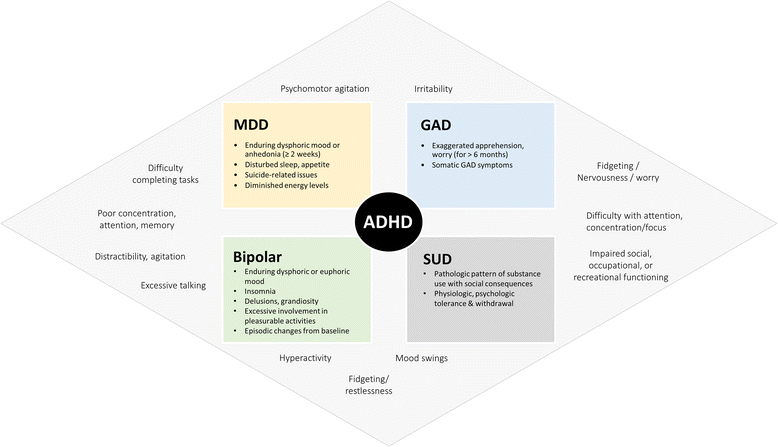
    1. Oppositional Defiant Disorder (ODD) and Conduct Disorder (CD): ODD involves a pattern of angry/irritable mood, argumentative/defiant behavior, or vindictiveness. CD involves a more severe pattern of antisocial behavior, aggression, destruction of property, deceitfulness, or serious rule violations.
    2. Anxiety Disorders: Generalized anxiety disorder, social anxiety, separation anxiety, panic disorder.: Can lead to internalizing behaviors, perfectionism, or avoidance, and can make ADHD symptoms (e.g., inattention due to worry) worse.
    3. Depressive Disorders (Major Depressive Disorder, Persistent Depressive Disorder): Can be difficult to differentiate from ADHD symptoms (e.g., fatigue, lack of motivation). ADHD can increase the risk of depression due to chronic challenges and low self-esteem.
    4. Specific Learning Disorders (SLDs): Difficulties in learning and using academic skills (e.g., reading/dyslexia, written expression/dysgraphia, mathematics/dyscalculia).
    5. Autism Spectrum Disorder (ASD): Both disorders involve challenges with attention, social interaction, and sensory processing. ADHD symptoms can be present in individuals with ASD, and vice versa.
    6. Tourette's Syndrome and Chronic Tic Disorders: Involuntary, repetitive movements or vocalizations (tics).
    7. Substance Use Disorders (SUDs): Individuals with untreated ADHD, especially the combined type, have a significantly higher risk of developing SUDs, particularly nicotine and alcohol.
    8. Sleep Disorders: Insomnia, restless legs syndrome, sleep apnea.
    Diagnostic Process for ADHD

    The process is conducted by a trained healthcare professional, such as a pediatrician, child psychiatrist, psychologist, or neurologist, and often involves a multidisciplinary team approach.

    1. No Single Test: There is no blood test, brain scan, or single psychological test that can definitively diagnose ADHD.
    2. Clinical Evaluation: Diagnosis is based on a careful clinical assessment of symptoms and their impact on functioning, using established diagnostic criteria (DSM-5).
    3. Multisource Information: Information is gathered from various settings and multiple informants (e.g., parents, teachers, caregivers, the individual themselves).
    4. Developmental area: Symptoms must be inconsistent with the individual's developmental level.
    5. Pervasiveness and Impairment: Symptoms must be present in two or more settings (e.g., home, school, work, social situations) and cause significant impairment in major life activities.
    6. Exclusion of Other Conditions: Other medical or psychological conditions that could explain the symptoms must be considered and ruled out.
    Components of the Diagnostic Process:
    1. Initial Clinical Interview and History Taking:
      • Patient Interview: For adolescents and adults, a detailed interview to understand their current symptoms, their impact, and their history.
      • Parent/Caregiver Interview: For children and younger adolescents, interviews with parents or primary caregivers are essential to gather information about:
        • Developmental History: Milestones, early behaviors, temperament.
        • Symptom Onset and Duration: When symptoms first appeared, how long they have been present, and their course over time (DSM-5 requires symptoms to be present before age 12, though this can be recalled retrospectively).
        • Symptom Severity and Pervasiveness: How severe the symptoms are, and in which settings they occur (e.g., home, school, daycare, social gatherings).
        • Impact on Functioning: How symptoms affect academic performance, social relationships, family life, self-care, and daily activities.
        • Family Medical and Psychiatric History: To identify any genetic predispositions or co-occurring family conditions.
        • Past Medical History: Including pregnancy and birth history, illnesses, injuries, and medication use.
    2. Information from Multiple Informants:
      • Teacher Reports: For school-aged children, information from teachers is critical as they observe behavior in a structured, demanding environment. Teachers can provide insights into inattention, hyperactivity, impulsivity, academic performance, and social interactions in the classroom.
      • Other Caregivers: Reports from daycare providers, coaches, or tutors can also be valuable.
    3. Standardized Rating Scales (Behavior Rating Scales):
      • Purpose: These are questionnaires completed by parents, teachers, and often the individual themselves (for older children/adults) to systematically assess ADHD symptoms and related behaviors. They compare the individual's behavior to age and gender norms.
      • Common Scales:
        • Conners 3rd Edition (Conners 3): Widely used for children and adolescents, with parent, teacher, and self-report forms.
        • ADHD Rating Scale-5 (ADHD-RS-5): Directly maps to DSM-5 criteria.
        • Vanderbilt ADHD Diagnostic Teacher and Parent Rating Scales: Popular in educational and clinical settings.
        • Adult ADHD Self-Report Scale (ASRS): For adults.
      • Interpretation: Scores are typically compared to normative data to indicate the likelihood and severity of ADHD symptoms.
    4. Observation:
      • Clinical Observation: The clinician observes the individual's behavior during the evaluation, noting attention span, activity level, impulsivity, and social interaction.
      • Naturalistic Observation (less common): Sometimes, a professional may observe the child in a classroom or home setting, though this is often impractical.
    5. Psychological and Educational Testing (Optional but often recommended):
      • Neuropsychological Testing: Can assess specific cognitive functions often impacted by ADHD, such as executive functions (working memory, inhibitory control, planning), attention, and processing speed. This helps identify specific areas of strength and weakness and rule out other conditions.
      • Achievement Testing: To screen for specific learning disorders, which frequently co-occur with ADHD.
      • Intellectual Assessment (IQ Testing): To ensure symptoms are not better explained by intellectual disability.
    III. DSM-5 Diagnostic Criteria (Summary):
    • Six (or more) symptoms of inattention and/or six (or more) symptoms of hyperactivity-impulsivity for at least 6 months.
    • Several inattentive or hyperactive-impulsive symptoms were present before age 12 years.
    • Several symptoms are present in two or more settings.
    • There is clear evidence that the symptoms interfere with, or reduce the quality of, social, academic, or occupational functioning.
    • The symptoms do not occur exclusively during the course of schizophrenia or another psychotic disorder and are not better explained by another mental disorder.
    Management Strategies for ADHD

    Evidence consistently supports a combination of medication and behavior therapy as the most effective approach, especially for children.

    I. Pharmacological Interventions:

    Medication do not offer permanent cure for ADH but may help someone with the condition to concentrate better, be less impulsive, fell calmer and learn to practice new skills. Drugs licensed for treatment of ADHD include;

    • Methylphenidate one tablet once a day
    • Lisdexamfetamine once capsule once a day
    • Dexamfetamine one tablet once or twice a day
    • Atomoxetine one capsule once or twice a day
    • Guanfacine one tablet once a day
    • tricyclic antidepressants
    • Antipsychotics
    • serotonin specific reuptake inhibitors

    Medications do not cure ADHD but can significantly reduce core symptoms, allowing individuals to benefit more from behavioral and educational interventions.

    1. Stimulants (First-line for most ages):
      • Mechanism of Action: Increase the availability of dopamine and norepinephrine in the brain, primarily by blocking their reuptake and, to a lesser extent, by promoting their release. This enhances signaling in brain regions responsible for attention, focus, and impulse control (e.g., prefrontal cortex).
      • Examples:
        • Methylphenidate-based: Ritalin, Concerta, Daytrana (patch), Focalin, Quillivant XR, Adhansia XR.
        • Amphetamine-based: Adderall, Vyvanse, Dexedrine, Mydayis.
      • Forms: Available in short-acting (taken 2-3 times/day) and long-acting (once daily) formulations. Long-acting forms are often preferred for convenience and smoother symptom control.
      • Efficacy: Highly effective in reducing core symptoms (inattention, hyperactivity, impulsivity) in approximately 70-80% of individuals.
      • Common Side Effects: Decreased appetite/weight loss, sleep disturbances (insomnia), headache, stomachache, irritability, increased heart rate and blood pressure (usually minor).
      • Nursing Considerations: Monitor growth, weight, blood pressure, and heart rate. Educate on administration (e.g., timing to avoid sleep issues), potential side effects, and importance of adherence. Assess for effectiveness and adjust dose as prescribed.
    2. Non-Stimulants (Alternatives or adjuncts):
      • Mechanism of Action: Work differently than stimulants, often by selectively targeting norepinephrine or other neurotransmitter systems.
      • Examples:
        • Atomoxetine (Strattera): Selective norepinephrine reuptake inhibitor (SNRI). Takes several weeks for full effect.
        • Guanfacine (Intuniv) and Clonidine (Kapvay): Alpha-2 adrenergic agonists. Can be particularly helpful for hyperactivity, impulsivity, tics, and sleep disturbances.
        • Bupropion (Wellbutrin): A dopamine and norepinephrine reuptake inhibitor, sometimes used off-label, especially with comorbid depression.
      • Efficacy: Less rapid and generally less potent in symptom reduction compared to stimulants, but effective for many, especially those who don't respond to or tolerate stimulants.
      • Common Side Effects:
        • Atomoxetine: Nausea, stomach upset, fatigue, dry mouth, suicidal ideation (rare).
        • Guanfacine/Clonidine: Drowsiness, fatigue, low blood pressure, dizziness.
      • Nursing Considerations: Educate on delayed onset of action for atomoxetine. Monitor blood pressure and heart rate for alpha-2 agonists, especially during initiation and discontinuation.
    II. Behavioral Interventions and Psychotherapy:

    These strategies teach skills, modify behaviors, and create supportive environments.

    1. Behavior Therapy (Parent Training in Behavior Management for Children): Teaches parents specific skills to reinforce desired behaviors and reduce unwanted ones.
      • Key Strategies:
        • Positive Reinforcement: Praising, rewarding, or providing privileges for target behaviors (e.g., following instructions, completing tasks).
        • Consistent Consequences: Implementing clear, predictable consequences for problematic behaviors (e.g., time-out, loss of privileges).
        • Token Economy: Using a system of earning points or tokens for positive behaviors that can be exchanged for rewards.
        • Structuring the Environment: Creating predictable routines, minimizing distractions, providing clear rules.
      • Efficacy: Highly effective, especially for younger children, in improving behavior, parent-child relationships, and reducing ADHD symptoms. Often considered first-line for preschoolers with ADHD.
    2. Behavioral Interventions in the School Setting: Classroom management techniques (e.g., daily report cards, positive reinforcement, clear rules), preferential seating, frequent breaks, reduced workload, use of organizational aids, peer tutoring.
      • Efficacy: Improves academic performance, on-task behavior, and social interactions in school.
    3. Organizational Skills Training (for Older Children, Adolescents, and Adults): Teaches explicit strategies for time management, planning, organization, and problem-solving.
      • Strategies: Using planners, calendars, checklists, breaking down large tasks, decluttering, managing distractions.
      • Efficacy: Helps improve academic performance, reduce procrastination, and enhance daily functioning.
    4. Cognitive Behavioral Therapy (CBT) (for Adolescents and Adults): Helps individuals identify and change unhelpful thought patterns and behaviors.
      • Strategies: Addressing negative self-talk, developing problem-solving skills, improving emotional regulation, managing impulsivity, stress management.
      • Efficacy: Particularly useful for managing comorbid conditions (anxiety, depression), improving self-esteem, and developing coping strategies for ADHD-related challenges. Does not directly treat core ADHD symptoms but helps manage their impact.
    5. Social Skills Training: Explicitly teaches social cues, communication skills, conflict resolution, and empathy. Improves social interactions and peer relationships.
    III. Educational Interventions and Accommodations:
    • Individualized Education Programs (IEPs) or 504 Plans: Legally mandated plans in schools to provide accommodations (e.g., extended time on tests, quiet testing environment, preferential seating, reduced distractions, use of technology) and specialized instruction to meet academic needs.
    • Parent and Patient Education: Crucial for understanding ADHD, treatment options, potential side effects, and strategies for managing symptoms at home and in school/work.
    IV. Lifestyle Modifications and Complementary Approaches:
    • Regular Exercise: Can improve focus, reduce hyperactivity, and boost mood.
    • Healthy Diet: While diet doesn't cause ADHD, balanced nutrition supports overall brain health. Some individuals report sensitivity to certain foods, though evidence for widespread dietary changes is limited.
    • Adequate Sleep: Essential for managing symptoms; sleep hygiene strategies are critical.
    • Mindfulness and Meditation: Can help improve attention regulation and emotional control in some individuals.
    V. Nursing interventions

    Children with ADHD need guidance and understanding from their parents, families, and teachers to reach their full potential and to succeed. For school age children, frustration, blame and anger may hinder recovery in other wards children need special help to overcome negative feeling and to develop new skills and attitudes.

    • Social skills training; this will help the child learn how to behave in social situations by learning how their behaviours affect others
    • Parenting skills training (behavioural parent management training) this teaches parents the skills to encourage and reward positive behaviours in their children. It helps parents learn how to use a system of rewards and consequences to change a child’s behaviour
    • Stress management techniques, these can benefit parents of children with ADHD by increasing their ability to deal with frustration so that they can respond calmly to their child’s behaviour
    • Support groups; these help parents and families connect with others who have similar problems and concerns. Groups often meet regularly to share frustration and successes to exchange information about recommended specialists and strategies and to talk with experts
    • Diet; sugar, food colourings and additives as well as caffeine should be excluded in the patients diet as they aggravate hyperactivity

    Help the child with ADHD to stay organised and stay organised by;

    • Keeping a routine and a schedule. Keep the same routine every day from wake-up time to bedtime. Include times of homework, outdoor play and indoor activities. Write all changes on the schedule in advance as possible
    • Organizing everyday items; have a place for everything and keep everything in its place. This includes clothing, backpacks and toys
    • Using homework and notebook organizers. Stress to the child the importance of writing down assignments and bringing home necessary books
    • Being clear and consistent. Children with ADHD need consistent rules they can understand and follow
    • Giving praise or rewards when rules are followed. Children with ADHD often receive and expect criticism. Look for good behaviour and praise it.
    • Develop a trusting relationship with the child that conveys acceptance of the child separate from unacceptable behaviour
    • Ensure patient has a safe environment free from dangerous objects that can injure him due to random hyperactive movements
    • Keep the child in an environment that is free from distractions to help him comply on given tasks
    • Ensure child’s attention by calling his name and maintain an eye contact before giving instructions
    • Ask patient to repeat instructions before beginning the task
    • establish goals that allow the patient to complete part of the task, rewarding each step completion with a break for physical activity
    • Provide assistance on one-to-one basis beginning with simple concrete instructions
    • Gradually decrease the amount of assistance given to task performance while assuring patient that assistance is available if still needed
    • Offer recognition for successful attempts and positive reinforcement for attempts made
    • Provide quiet environment, self-contained classrooms an small group activities
    • Help the patient to learn how to take his turn, wait in line and follow rules
    • Provide information an materials related to the child’s disorder and effective parenting techniques
    • Explain and demonstrate positive parenting techniques to parents such as being vigilant in identifying the child’s behaviour and responding positively to that behaviour
    • Co-ordinate overall treatment plan with schools, child and family
    Nursing Diagnoses for Individuals with ADHD
    1. Impaired Attention
      • Related to: Neurotransmitter imbalance (e.g., dopamine, norepinephrine dysregulation) affecting executive function, difficulty processing multiple stimuli, inconsistent processing of information.
      • As evidenced by: Difficulty sustaining focus on tasks, frequent distractibility, difficulty following instructions, losing belongings, making careless errors, poor academic/work performance, difficulty with organization.
      • Rationale: This is a direct reflection of the inattentive symptoms, impacting learning, task completion, and safety.
    2. Impaired Organizational Ability
      • Related to: Deficits in executive function (e.g., planning, sequencing, prioritizing), difficulty with time management, chronic inattention.
      • As evidenced by: Disorganized living/work space, difficulty completing multi-step tasks, frequently missing deadlines, misplacing items, poor planning for future events.
      • Rationale: Directly addresses the functional impact of inattention and executive dysfunction on daily living and responsibilities.
    3. Deficient Knowledge (e.g., of effective study strategies, time management, disease process)
      • Related to: Impaired attention, difficulty with information processing, lack of prior education on condition.
      • As evidenced by: Verbalization of unfamiliarity, inappropriate or inefficient performance of tasks, frequent academic/work difficulties despite effort, questions about ADHD.
      • Rationale: Individuals and families often lack comprehensive understanding of ADHD and effective coping strategies.
    4. Risk for Injury
      • Related to: Impulsive behavior, hyperactivity, reduced hazard perception, restless motor activity, difficulty inhibiting responses.
      • As evidenced by: (This is a "risk for" diagnosis, so it doesn't have "as evidenced by" statements, but rather risk factors like:) Frequent accidents or near-misses, engaging in dangerous activities, difficulty adhering to safety rules, tendency to rush tasks.
      • Rationale: Hyperactivity and impulsivity increase the likelihood of accidents and unsafe behaviors.
    5. Impaired Impulse Control
      • Related to: Neurotransmitter dysregulation affecting inhibitory control, difficulty delaying gratification, underdeveloped prefrontal cortical function.
      • As evidenced by: Interrupting others, blurting out answers, difficulty waiting turns, making hasty decisions, engaging in risky behaviors, frequent social conflicts.
      • Rationale: Directly addresses the core impulsive symptom, impacting social interactions and decision-making.
    6. Disrupted Sleep Pattern
      • Related to: Hyperactivity, restlessness, difficulty winding down, medication side effects (stimulants), comorbid anxiety.
      • As evidenced by: Difficulty falling asleep, frequent awakenings, non-restorative sleep, daytime fatigue, irritability.
      • Rationale: Sleep disturbances are common in ADHD and can exacerbate symptoms.
    7. Low Self-Esteem
      • Related to: Chronic academic/social difficulties, negative feedback from peers/adults, perception of personal failures, co-occurring anxiety/depression.
      • As evidenced by: Negative self-talk, withdrawal from social situations, difficulty accepting compliments, expression of feelings of worthlessness, avoidance of new challenges.
      • Rationale: Repeated failures and criticisms can significantly erode self-worth.
    8. Impaired Social Interaction
      • Related to: Impulsivity (e.g., interrupting), difficulty with turn-taking, inattention to social cues, difficulty regulating emotions, peer rejection.
      • As evidenced by: Few close friendships, reports of being disliked, difficulty maintaining conversations, conflicts with peers, misinterpreting social cues.
      • Rationale: Core symptoms of ADHD can interfere with developing and maintaining healthy social relationships.
    9. Ineffective Coping (Individual or Family)
      • Related to: Inadequate problem-solving skills, overwhelming demands of managing ADHD symptoms, insufficient support systems, presence of co-occurring conditions, caregiver burden.
      • As evidenced by: Verbalization of inability to cope, difficulty with decision-making, maladaptive behaviors, strained family relationships, exacerbation of symptoms.
      • Rationale: Addresses the challenges individuals and families face in managing a chronic condition.
    10. Risk for Inadequate protein energy nutritional intake (especially relevant with stimulant medication)
      • Related to: Anorectic side effects of stimulant medication, decreased appetite.
      • As evidenced by: (Risk diagnosis) Reports of decreased appetite, weight loss, verbalization of food aversion after starting medication.
      • Rationale: Stimulants can suppress appetite, necessitating monitoring of nutritional intake.
    Role of the Nurse in the Care of Individuals with ADHD

    Given the chronic nature of the condition, its varied presentations across age groups, and the complexity of multimodal treatment, nurses are often at the forefront of assessment, education, advocacy, and coordination of care.

    I. Assessment and Early Identification:
    • Screening: Nurses in various settings (pediatric clinics, schools, primary care) are often the first to screen for ADHD symptoms during routine visits. They can administer standardized screening tools and observe behaviors indicative of ADHD.
    • Detailed History Taking: Collecting comprehensive developmental, medical, family, and psychosocial histories from patients and families.
    • Symptom Evaluation: Systematically assessing for core ADHD symptoms (inattention, hyperactivity, impulsivity) and their impact on functioning across multiple settings (home, school, work, social).
    • Comorbidity Assessment: Identifying potential co-occurring conditions (e.g., anxiety, depression, learning disabilities, ODD, sleep disorders) that frequently accompany ADHD and can complicate diagnosis and treatment.
    • Differential Diagnosis Support: Gathering information to help rule out other medical or psychiatric conditions that might mimic ADHD symptoms.
    II. Education and Counseling:
    • Psychoeducation: Providing individuals and families with accurate, evidence-based information about ADHD, including its neurobiological basis, symptoms, course, and treatment options. Dispelling myths and reducing stigma.
    • Treatment Rationale: Explaining the purpose, expected benefits, potential side effects, and administration guidelines for both pharmacological and non-pharmacological interventions.
    • Behavior Management Strategies: Teaching parents and caregivers effective behavioral techniques (e.g., positive reinforcement, consistent consequences, token economies, establishing routines) to manage challenging behaviors and promote desired ones.
    • Organizational and Study Skills: Counseling older children, adolescents, and adults on strategies for time management, planning, organization, note-taking, and reducing distractions.
    • Lifestyle Modifications: Educating on the importance of healthy diet, regular exercise, adequate sleep, and stress management in mitigating ADHD symptoms.
    • Coping Strategies: Helping individuals develop effective coping mechanisms for frustration, emotional dysregulation, and low self-esteem often associated with ADHD.
    III. Medication Management and Monitoring:
    • Administration Education: Instructing patients/families on the correct dosage, timing, and method of administration for prescribed medications (e.g., stimulants, non-stimulants).
    • Side Effect Monitoring: Assessing for and educating about common and serious side effects of ADHD medications (e.g., appetite suppression, sleep disturbances, cardiovascular changes for stimulants; GI upset for atomoxetine; sedation for alpha-agonists).
    • Therapeutic Response Evaluation: Monitoring the effectiveness of medication in reducing target symptoms and improving functioning, often using rating scales and patient/family reports.
    • Growth Monitoring: For children on stimulant medication, regularly monitoring height and weight to track growth.
    • Cardiovascular Monitoring: Taking baseline and regular blood pressure and heart rate measurements, especially for individuals on stimulant or alpha-agonist medications.
    • Adherence Promotion: Addressing barriers to medication adherence and promoting consistent medication use as prescribed.
    IV. Care Coordination and Advocacy:
    • Collaboration with Multidisciplinary Team: Working closely with physicians, psychiatrists, psychologists, social workers, teachers, and other specialists to ensure integrated and comprehensive care.
    • School Liaison: Communicating with school personnel (teachers, counselors, special education staff) to facilitate academic accommodations (IEPs, 504 plans), behavioral interventions in the classroom, and exchange of information.
    • Referrals: Facilitating referrals to specialists (e.g., occupational therapy for sensory issues, tutoring for learning disabilities, therapy for mental health comorbidities).
    • Advocacy: Advocating for the individual's needs within healthcare systems, educational settings, and the community. Empowering patients and families to advocate for themselves.
    • Resource Navigation: Connecting families to support groups, community resources, and reliable information sources.
    V. Supporting Across the Lifespan:
    • Children and Adolescents: Focus on psychoeducation for parents, behavior management strategies, school collaboration, medication monitoring, and supporting social skill development.
    • Adults: Emphasis on medication adherence, organizational skills, stress management, coping with comorbidities (anxiety, depression), workplace accommodations, and managing the impact of ADHD on relationships and daily responsibilities.
    • Geriatric Population: While less common for initial diagnosis, nurses might encounter older adults managing lifelong ADHD, focusing on medication interactions, cognitive changes, and maintaining functional independence.

    Attention-Deficit/Hyperactivity Disorder Read More »

    Standards of Care

    Standards of Care

    Standards of Care in Mental Health Nursing
    Standards of Care in Mental Health Nursing

    Standard of care refers to the degree of care that a reasonably prudent and competent mental health nurse would exercise under similar circumstances.

    It is a benchmark against which nursing actions are judged. These standards include both clinical competence and ethical conduct, reflecting the nature of caring for individuals with mental health conditions.

    Sources of Standards:

    They were enunciated by the American Nurses Association (ANA) in 1973.

    • Professional Organizations: Bodies such as the American Nurses Association (ANA) or country-specific nursing councils publish detailed standards of psychiatric-mental health nursing practice. These are often the primary source.
    • Legislation and Regulations: Laws like the Mental Treatment Act, Nurse Practice Acts, and patient rights legislation set legal mandates that directly influence nursing standards.
    • Institutional Policies and Procedures: Each healthcare facility develops its own policies and procedures, which must align with professional and legal standards and guide staff behavior within that specific environment.
    • Accrediting Bodies: Organizations that accredit healthcare institutions (e.g., The Joint Commission) set standards that influence care delivery and quality.
    • Published Literature and Research: Evidence-based practice guidelines, nursing textbooks, and peer-reviewed research contribute to defining optimal care.
    • Expert Consensus and Case Law: The opinions of expert witnesses in legal cases and previous court rulings (case law) can establish or clarify standards of care.
    Key Principles Guiding Mental Health Care:

    Underlying all standards of care are fundamental ethical and philosophical principles that are particularly salient in mental health:

    • Patient Safety: Paramount in all care, especially concerning risks like suicide, self-harm, or aggression.
    • Therapeutic Relationship: The development of a trusting, empathetic, and professional relationship is central to effective mental health nursing.
    • Autonomy: Respecting the patient's right to make decisions about their care, even when their capacity may be impaired, and supporting them to regain decision-making abilities.
    • Beneficence: Acting in the best interest of the patient, aiming to do good.
    • Non-Maleficence: The duty to do no harm.
    • Justice: Ensuring fair and equitable access to care, regardless of background or diagnosis.
    • Fidelity: Being faithful to promises and commitments made to patients.
    • Confidentiality: Protecting sensitive patient information, which is especially critical given the stigma often associated with mental illness.
    Legal Aspects in Psychiatric Nursing

    The practice of psychiatric nursing is influenced by law, particularly initial concern for the rights of patients and the quality of care they receive.

    • The client’s right to refuse a particular treatment, protection from confinement, intentional torts, informed consent, confidentiality and Promotion of research in mental health nursing.
    • The nurse contributes to nursing and the mental health field through innovations in theory and practice and participation in research.
    • Cost-effective nursing care: Studies need to be conducted to find out the viability in terms of cost involved in training a nurse and the quality of output in terms of nursing care rendered by her.
    • Focus of care: A psychiatric nurse has to focus care on certain target groups like the elderly, children, women, youth, mentally retarded and chronic mentally ill.
    • Record keeping are a few legal issues in which the nurse has to participate and gain quality knowledge.
    STANDARDS OF MENTAL HEALTH NURSING

    The purpose of Standards of Psychiatric and Mental Health Nursing practice is to fulfill the profession’s obligation to provide a means of improving the quality of care. The standards presented here are revision of the standards enunciated by the Division on Psychiatric and Mental Health Nursing Practice in 1973.

    Professional Practice Standards
    Standard I: Theory

    The nurse applies appropriate theory that is scientifically sound as basis for decisions regarding nursing practice. Psychiatric and mental health nursing is characterized by the application of relevant theories to explain phenomena of concern to nurses and to provide a basis for intervention.

    Standard II: Data Collection

    The nurse continuously collects data that are comprehensive, accurate and systematic. Effective interviewing, behavioral observation, physical and mental health assessment enable the nurse to reach sound conclusions and plan appropriate interventions with the client.

    Standard III: Diagnosis

    The nurse utilizes nursing diagnosis and/or standard classification of mental disorders to express conclusions supported by recorded assessment data and current scientific premises.

    Nursing logic basis for providing care rests on the recognition and identification of those actual or potential health problems that are within the scope of nursing practice.

    Standard IV: Planning

    The nurse develops a nursing care plan with specific goals and interventions delineating nursing actions unique to each client’s needs.

    The nursing care plan is used to guide therapeutic intervention and effectively achieve the desired outcomes.

    Standard V: Intervention

    The nurse intervenes as guided by the nursing care plan to implement nursing actions that promote, maintain or restore physical and mental health, prevent illness and effect rehabilitation.

    • (a) Psychotherapeutic interventions: The nurse uses psychotherapeutic interventions to assist clients in regaining or improving their previous coping abilities and to prevent further disability.
    • (b) Health teaching: The nurse assists clients, families and groups to achieve satisfying and productive patterns of living through health teaching.
    • (c) Activities of daily living: The nurse uses the activities of daily living in a goal directed way to foster adequate self-care and physical and mental well-being of clients.
    • (d) Somatic therapies: The nurse uses knowledge of somatic therapies and applies related clinical skills in working with clients.
    • (e) Therapeutic environment: The nurse provides structures and maintains a therapeutic environment in collaboration with the client and other health care providers.
    Standard VI: Evaluation

    The nurse evaluates client responses to nursing actions in order to revise the database, nursing diagnosis and nursing care plan.

    Professional Performance Standards
    Standard VII: Peer Review

    The nurse participates in peer review and other means of evaluation to assure quality of nursing care provided for clients.

    Standard VIII: Interdisciplinary Collaboration

    The nurse collaborates with other health care providers in assessing, planning, implementing and evaluating programs and other mental health activities.

    Standard IX: Utilization of Community Health Systems

    The nurse participates with other members of the community in assessing, planning, implementing and evaluating mental health services and community systems that include the promotion of the brand continuum of primary, secondary and tertiary prevention of mental illness.

    Standard X: Research

    The nurse contributes to nursing and the mental health field through innovations in theory and practice and participation in research.

    Impact of Standards on Practice:

    Adherence to these standards is fundamental to quality mental health nursing. It:

    • Minimizes Liability: By practicing within accepted standards, nurses significantly reduce their risk of negligence or malpractice claims.
    • Promotes Quality Outcomes: Consistent application of evidence-based standards leads to improved patient safety, more effective treatments, and better overall patient experiences and outcomes.
    • Enhances Professional Credibility: Upholding high standards reinforces the professionalism and trustworthiness of mental health nursing.
    • Guides Professional Development: Standards highlight areas for ongoing education, skill development, and specialization within mental health nursing.

    Standards of Care Read More »

    Law and Mental Illness

    Law and Mental Illness

    Law and Mental Illness
    Law and Mental Illness

    Law has relevance in nearly all aspects of nursing practice, but in no other area of nursing is the law more intimately involved than in psychiatric nursing.

    This is because psychiatric clients may;

    • be placed on treatment against their own will
    • pose a risk to themselves
    • have been charged to have committed crime while legally insane
    • be unable or unwilling to consent to treatment
    • be incapable of fully understanding medical risks
    • require constant restraints for their safety or others
    • make threats to others
    • undergo forensic evaluations that require nurses to testify in court
    Forensic Psychiatry

    Forensic psychiatry is a specialized branch of psychiatry that deals with the interface between mental health and the law.

    Forensic psychiatry is a branch of psychiatric nursing that deals with disorders of mind and their relationship with the legal principles.

    It is also concerned with the assessment, investigations, diagnosis and treatment of mental disorders among three broad categories of individuals i.e.;

    • individuals who are alleged to have committed an offence and face prosecution
    • convicted prisoners who develop mental illness in the course of serving their sentence
    • individuals who have not committed an offence but are at risk because of their mental capacity

    Under existing mental health legislation in Uganda, it is not expected that the primary health care provider will provide this service. It is however advised that a PHC provider knows something about prisoners’ mental health needs for the purpose of early and appropriate referrals to centres where a psychiatrist or other mental health professionals are available.

    The basic forensic psychiatry includes:
    • Crime and psychiatric disorders
    • Criminal responsibility
    • Civil responsibility
    • Laws relating to psychiatric disorders
    • Admission procedures of patients in psychiatric hospital
    • Civil rights of mentally ill
    • Psychiatrists and court
    I. Crime and Psychiatric Disorders

    There is a close association between crime and psychiatric disorders like schizophrenia, affective disorders, epilepsy, drug dependency, personality disorders, etc.

    Mentally ill people may commit crime because:

    • they do not understand the implication of their behaviour
    • due to delusions and hallucinations
    • abnormal mental states like confusion or excitements
    • drug related violence

    Instances when an individual facing prosecution may come to attention of a psychiatrist:

    • when police notices signs of mental disorder in individual under their custody
    • when the judge observes signs of mental disorder
    • when relatives raise issue of mental disorder
    • when prisoner reports history of treatment for psychiatric disorder
    • when suspect pleads insane during court proceedings

    Under any of the above, the magistrate may order assessment and observation of an individual to ascertain:

    • whether the individual is mentally disordered
    • the individual’s ability to stand trial if mentally disordered
    • whether the accused is criminally responsible for the offence he is charged with

    Responsibilities of a psychiatrist in order to find answers for the above questions:

    • hospitalize the accused for the purpose of observations and possible treatment or attend to matter as an out-patient case
    • take a full psychiatric history including history of previous episodes of illness and treatment
    • order an observation of patient by other nursing staff on daily basis
    • conduct laboratory, psychological and social investigations
    • make a report to the magistrate who will then decide on the best course of action on the basis of a psychiatric report
    II. Criminal Responsibility

    Criminal responsibility is a legal concept which refers to the extent to which an individual can be held liable for his or her offence.

    According to section 84 of the Indian penal code act of 1860, “Nothing is an offence which is done by a person who, at a time of doing it, by reason of unsoundness of mind, is incapable of knowing the nature of act, or that he is doing what is either wrong or contrary to the law”.

    A clinical test of responsibility may be used to determine whether an individual is responsible for an offence or not.

    III. Criteria for Criminal Responsibility

    Criteria for Criminal Responsibility (CCR) Score:

    SCORE Yes (1) / No (0)
    1. offence required careful planning
    2. offence was unrelated to symptoms of mental disorder
    3. identifiable motive for the crime was not a product of mental disorder
    4. mental capacity at a time of crime was unimpaired or did not impair rational judgement
    5. amnesia if present is incongruent with relevant key features of crime and mental state

    Score each item 1 for a Yes response and 0 for No response.

    The maximum score is 5. A score of 3 and more indicates that the individual is probably responsible for an alleged crime.

    IV. Other Criteria Used to Determine Criminal Responsibility
    • M’Naghten’s rule: This states that the individual at a time of the crime did not know the nature and quality of the act and if he did know what he was doing, he did not comprehend it to be wrong.
    • The Irresistible impulse act: According to this rule, a person may have known an act was illegal but as a result of mental impairment lost control of their actions.
    • The Durham test or Product rule: This states that an accused is not criminally responsible if his unlawful act was the product of mental disease or abnormality.
    • American law institute: This states that a person is not responsible for criminal conduct if at time of such conduct, as a result of mental disease or defect he lacks adequate capacity either to appreciate the criminality of his conduct or to conform his conduct to requirements of the law.
    V. Ability to Stand Trial

    An individual will not be expected to have an ability to stand trial under the following circumstances:

    • mentally ill with active signs of mental disorder
    • lacks ability to understand court proceedings

    In cases of the above, the psychiatrist may recommend that the individual receives relevant treatment for the mental disorder and after full recovery, the individual may then stand trial. However, in cases of severe psychotic illness like schizophrenia, the case might be disposed.

    Convicted prisoner: In case a prisoner who is serving sentence falls ill, he or she may be referred to a mental hospital under magistrates court Act for assessment, observation and treatment. Unfortunately, under existing laws, such an individual will not be excused from serving his prison sentence on ground of mental illness otherwise he will be released at the end of a prison sentence.

    VI. Aims of Management in Forensic Work
    • diagnose to form a basis for treatment and recommendations to court
    • make report and submit to court
    • rehabilitate as part of management
    • promote acceptance of individual in his community
    • resettle individual back in community
    • promote after care following discharge from court and hospital
    Civil Responsibilities and Rights of Mentally Ill Persons

    Beyond the criminal justice system, individuals with mental illness interact with the law concerning their civil responsibilities and fundamental human rights.

    I. Civil Responsibilities of a Mentally Ill Person:

    Mental illness can, under specific legal circumstances, impact an individual's capacity to exercise certain civil responsibilities. When a person is deemed of "unsound mind" to a degree that impairs their judgment or decision-making, the law provides mechanisms to protect their interests and the interests of others.

    1. Management of Property: "In case the court ascertain that a person is of unsound mind and incapable of managing his property, a manager is appointed by court of law to take care of his property which may include selling or disposal of property to settle debts or expenses." This highlights the legal provision for protecting the assets of individuals who lack the mental capacity to manage their own financial affairs. The appointed manager acts in the best interest of the person with mental illness.
    2. Marriage: "Hindu Marriage Act 1995" states that "marriage between any two individuals one of whom was of unsound mind at a time of marriage is considered null and void in the eyes of the law." Furthermore, "Unsoundness of mind for a continuous period can be sighted as a ground for obtaining divorce." If this unsoundness continues for a period of two years, the other party can file for divorce, though "divorce is granted with a precondition that one has to pay maintenance charges for the mentally ill."
    3. Testamentary Capacity (Making a Will): "Testamentary capacity or the mental ability of a person is a precondition for making a valid will." For a will to be legally binding, "The testator must be the major, free from coercion, understanding and displaying soundness of mind." This means that at the time of making a will, the individual must possess sufficient mental clarity to understand the nature of the document, the property they are disposing of, and the beneficiaries. Mental illness might invalidate a will if it demonstrably impaired this capacity.
    4. Right to Vote: "A person of unsound mind cannot contest for elections or exercise the privilege of voting." This is a civil responsibility directly tied to mental capacity, reflecting the legal requirement for electors and candidates to possess sound judgment in political processes.
    II. Rights of Psychiatric Patients:

    The legal framework, particularly within the context of mental health care, also aims to protect the fundamental human rights and dignity of individuals receiving psychiatric treatment.

    1. Right to wear their own clothes: Promotes dignity, personal expression, and normalization.
    2. Right to informed consent: Ensures patients understand and voluntarily agree to treatment, or have a legally authorized person consent on their behalf when capacity is compromised. This is a cornerstone of ethical medical practice.
    3. Right to habeas corpus: The right to challenge the legality of one's detention before a court, ensuring that involuntary hospitalization is subject to judicial review.
    4. Right to have individual storage space for their private use or right to privacy: Protects personal belongings and maintains a sense of autonomy and privacy within a treatment setting.
    5. Right to keep and use their own personal possessions: Allows patients to maintain connection to their identity and comfort items.
    6. Right to spend some of their money for their own expenses: Affirms financial autonomy and choice.
    7. Right to have reasonable access to all communication media like telephones: Maintains connection with the outside world, family, and legal counsel.
    8. Right to see visitors: Prevents social isolation and supports recovery through family and social connections.
    9. Right to treatment in the least restricted setting: Advocates for treatment environments that impose the fewest limitations on personal freedom, consistent with safety and effective care.
    10. Right to hold civil service status or enter into legal contracts e.g., marriage, personal last will etc.: These rights indicate that a diagnosis of mental illness alone does not automatically remove civil capacities. Such capacities are only removed if a court specifically determines an individual is of "unsound mind" to the extent that they cannot exercise these rights responsibly.
    11. Right to refuse treatment especially ECT: Acknowledges bodily autonomy and the patient's right to decline medical interventions, particularly those with significant implications like Electroconvulsive Therapy (ECT), unless there is a specific legal provision for compelled treatment in emergency situations or under court order.
    12. Right to manage and dispose of property and execute wills: Reaffirms that these civil responsibilities are generally retained unless a formal legal determination of incapacity has been made.
    Legal Responsibilities and Potential Liabilities for Nurses in Psychiatric Service

    Psychiatric nurses are confronted on daily basis with the interface of legal issues as they attempt to balance the rights of the patient with the rights of the society. Nurses and other health care providers should never in any way violate the rights of the mentally ill.

    I. Legal Responsibilities of a Nurse:

    Nurses, particularly in psychiatric care, bear specific legal responsibilities designed to protect both the patient and themselves from liability. These include:

    1. Adherence to Laws and Standards: Nurses must be intimately familiar with all relevant laws and regulations in their state or region of practice. This includes understanding mental health legislation, patient rights, and the criminal and civil responsibilities associated with mental illness. Practicing within the scope of state laws and the Nurse Practice Act is fundamental.
    2. Patient Rights Protection: Actively safeguarding patients' rights is a core responsibility. This involves ensuring patients are informed of their rights and that these rights are respected throughout their care.
    3. Documentation: Accurate, thorough, and timely legal documentation is crucial. Nurses must clearly and accurately maintain records of all assessment data, treatments given, interventions performed, and the patient's responses to care. These records must be kept safely and confidentially.
    4. Confidentiality: Maintaining strict confidentiality of all patient information is a paramount legal and ethical duty, given the sensitive nature of psychiatric diagnoses and treatments.
    5. Informed Consent: Obtaining informed consent from patients or their legal representatives for any procedure or treatment is a fundamental requirement. Explanations of procedures must be tailored to the patient's anxiety level, attention span, and capacity to make decisions.
    6. Collaboration: Working effectively with colleagues to determine the best course of action for patient care, ensuring a multidisciplinary approach.
    7. Ethical Practice: Always prioritizing patients’ rights and welfare and developing effective interpersonal relationships with patients and their families.
    8. Reporting: Recognizing and reporting instances of abuse, neglect, or any unsafe practices is a professional and legal obligation.
    II. Nursing Malpractice:

    Malpractice in nursing signifies a failure by a professional to provide the proper and competent care expected from members of their profession, leading to harm to the patient.

    To successfully argue a case of malpractice against a healthcare provider, three conditions typically must be proven by the patient:

    1. Established Standard of Care: There existed a recognized standard of care applicable to the situation.
    2. Breach of Responsibility: The nurse or physician breached their professional responsibility by failing to adhere to this established standard.
    3. Causation and Injury: This breach of responsibility directly caused injury or damage to the plaintiff (patient).

    If malpractice is proven, compensatory damages may be awarded to the patient to cover medical expenses, lost wages, and physical or emotional suffering. In cases of gross negligence or extreme carelessness, punitive damages may also be awarded, intended not to compensate the patient but to punish the negligent professional.

    III. Common Areas of Liability in Psychiatric Service:

    The unique aspects of psychiatric care create specific vulnerabilities for liability. Nurses must be particularly vigilant in these areas:

    1. Patient Committing Suicide: This remains a leading cause of liability. It involves inadequate risk assessment, failure to implement appropriate suicide precautions, or insufficient monitoring.
    2. Failure to Prevent Self-Inflicted Injury: This encompasses situations where patients cause harm to themselves (e.g., cutting, head-banging) without direct suicidal intent, often due to their mental state, and where supervision or protective measures were inadequate.
    3. Patient Assaults: Liability can arise from failure to prevent patients from assaulting other patients or staff. This often links to inadequate risk assessment, poor environmental management, or insufficient de-escalation skills.
    4. Misuse of Psychoactive Prescription Drugs: This includes medication errors (wrong drug, dose, route, time) or inappropriate administration leading to harm.
    5. Failure to Obtain Consent: Providing treatment without proper informed consent, particularly crucial in a setting where capacity to consent may fluctuate.
    6. Failure to Report Abuse: Neglecting to report suspected abuse of a patient is a serious legal and ethical failing.
    7. Inadequate Monitoring of Patients: Insufficient observation or supervision, especially for high-risk patients, leading to adverse events.
    8. Breach of Confidentiality: Unauthorized disclosure of sensitive patient information.
    9. Improper Use of Seclusion and Restraints: Applying these interventions without strict adherence to legal guidelines, clinical necessity, and monitoring protocols.
    10. Failure to Diagnose: While primarily a physician's role, nurses contribute to the diagnostic process through their observations and reporting. A failure to recognize and report critical symptoms that lead to a missed diagnosis and subsequent harm could involve nursing liability.
    IV. Steps to Avoid Liability in Psychiatric Nursing Services:

    Proactive measures are essential for psychiatric nurses to mitigate legal risks:

    1. Effective Communication: Reporting relevant patient information clearly and thoroughly to co-workers involved in patient care.
    2. Meticulous Documentation: Accurately and thoroughly documenting all assessment data, treatments given, interventions, and evaluations of patient responses.
    3. Confidentiality: Consistently maintaining the confidentiality of patient information.
    4. Scope of Practice: Practicing strictly within the defined scope of state laws and the Nurse Practice Act.
    5. Collaboration: Working collaboratively with colleagues and the interdisciplinary team to determine the best course of action for patient care.
    6. Standards of Practice: Utilizing established practice standards and guidelines to inform and direct clinical decisions and actions.
    7. Patient-Centered Care: Always prioritizing patients’ rights and welfare above all else.
    8. Therapeutic Relationships: Developing effective and professional interpersonal relationships with patients and their families.
    MENTAL TREATMENT ACT (MTA)

    Legal Documents And Admission Of Civil Patients.

    The Mental Treatment Act (MTA), enacted in 1964, is a piece of legislation governing the admission, treatment, and discharge of individuals with mental illness in psychiatric hospitals. It replaced the earlier Mental Treatment Ordinance of 1938, aiming to safeguard persons with unsound mind from harm, protect the public, and legally authorize mental hospitals to detain, treat, and discharge patients. The MTA primarily addresses civil patients, distinguishing them from forensic patients who enter the system via criminal justice proceedings.

    I. Orders for Admission of Civil Patients:

    The MTA outlines four primary orders under which civil patients can be admitted to mental hospitals, each with specific criteria and durations. While the Voluntary Order is not strictly under the MTA, it is legally accepted as a pathway to admission.

    1. Urgency Order (Section 7 of MTA):
    • Purpose: Designed for the rapid removal of an individual with mental illness from the public into a mental hospital, especially when there is an immediate need for intervention due to potential danger to themselves or others.
    • Authorization: Can be signed by a licensed medical practitioner (e.g., registered nurse, doctor), a police officer not below the rank of Assistant Inspector, or a gazetted chief (e.g., a Resident District Commissioner - RDC).
    • Duration: Remains in effect for a period of 10 days. It cannot be renewed; if further detention is required, a new order must be initiated. If the patient is not discharged or a new order is not signed after 10 days, the patient has the right to sue the hospital for illegal detention.
    2. Temporary Detention Order (Section 3 of MTA):
    • Purpose: This serves as the standard initial procedure for detaining patients requiring psychiatric hospitalization. The process begins with the "information of lunacy," which can be made by anyone aware of the patient's condition, though in practice, it is often initiated by the ward in charge.
    • Duration: Valid for 14 days. It can be renewed once for an additional 14 days, but no further renewals are permitted under this order.
    3. Reception Order (Section 5 of MTA):
    • Purpose: This order is sought if a patient's condition does not improve after the Temporary Detention Order and its renewal expire. It signifies a longer-term commitment to care.
    • Process: A magistrate appoints two medical practitioners (who are not related to the patient) to thoroughly investigate the patient's behavior and illness. Upon receiving and being satisfied with these medical reports, the magistrate signs the Reception Order.
    • Duration: Initially valid for one year. If the patient's condition has not improved, it can be renewed for another year. If improvement is still not observed, subsequent renewals are for three-year periods.
    • Implications: Patients under a Reception Order are considered "satisfied," implying a legal determination of diminished capacity. They are generally not permitted to sign a will, vote, stand as a witness in court, or marry, reflecting a curtailment of certain civil rights due to their mental state.
    4. Voluntary Order:
    • Status: Although not strictly under the MTA, this is a legally accepted pathway for admission.
    • Process: The patient voluntarily presents themselves to the hospital. The Medical Superintendent or Director examines the patient to confirm their mental health status. The patient agrees to abide by hospital rules and regulations.
    • Discharge: If a voluntary patient wishes to leave, they inform the ward in charge, who then informs the ward doctor and subsequently the Medical Director or Superintendent. There is typically a 72-hour period within which this notification and processing occurs, allowing for assessment of the patient's decision-making capacity and potential transition planning.
    II. Discharge of Civil Patients:

    The discharge process for civil patients under the MTA involves several sections, each catering to different circumstances, and nurses play a crucial role throughout.

    A. Role of a Nurse in Discharge Procedure:

    Nurses are instrumental in ensuring a safe and effective discharge by:

    • Identifying the patient's fitness for discharge and informing the psychiatrist.
    • Providing feedback and information about the discharge plan and seeking the patient's input.
    • Ensuring all paperwork and forms are completed, signed, and copies sent to medical records.
    • Confirming the patient has returned all hospital property to the ward manager.
    • Clearly communicating all necessary information, particularly regarding medications and follow-up appointments, to the patient.
    • Recognizing and addressing any mixed feelings the patient may have about leaving the hospital and returning to the community, offering support and coping strategies.
    • Preparing the patient's community (family, caregivers) to receive and support the patient, depending on the circumstances.
    • Escorting the patient out of the ward or hospital compound.
    B. Discharge Sections under the MTA:
    1. Section 18: For Recovered Patients:
      When a nurse assesses a patient as fit for discharge, they inform the ward doctor (psychiatrist), who then recommends the patient's fitness. The doctor writes to the Director for authorization to discharge the patient with treatment. For patients admitted under Temporary Detention or Reception Orders, the magistrate is informed and authorizes the discharge.
    2. Section 19: Discharge of a Patient Under the Care of Relatives:
      If relatives request to take the patient home, they must provide a written statement confirming they will care for the patient. If the patient becomes unmanageable within 28 days of discharge, they can be readmitted using the previous order. After 28 days, a new admission order would be required. In such cases, if the discharge is against medical advice, no medications are provided unless paid for.
    3. Section 20: Discharge for a Paying Patient:
      If relatives of a paying patient face increasing medical costs and request discharge, even if the patient is not fully recovered, the Medical Superintendent may grant it. This often comes with a condition that the hospital will not be held responsible for any subsequent incidents at home. Similar to Section 19, no medications are provided without payment if the discharge is against medical advice.
    4. Section 21: Discharge on Trial Leave:
      The Director of Medical Services authorizes the Medical Superintendent or ward doctor to discharge a patient on trial leave for a specified period (typically 28 days), during which the patient is expected to return for review. If the patient exceeds this 28-day period without returning, a fresh admission order would be required for readmission.
    5. Section 22: Discharge for Escaped Patients:
      If a patient escapes and does not return within 28 days, should they later be brought back, a fresh admission order must be obtained for readmission. This provision addresses safety and management concerns for the hospital.
    6. Section 23: Discharge of a Person of Sound Mind:
      If an individual of sound mind is detained against their will, a magistrate, in conjunction with a psychiatrist, will examine the person. If they are indeed found to be of sound mind, the Medical Superintendent or ward doctor will be directed to immediately discharge them.
    III. Transfer of Patients:

    The MTA also includes provisions for the transfer of patients:

    1. Section 36: Transfer of Patients: This section covers two types of transfers:
      • Intra-national Transfer: Allows for the transfer of a patient from one hospital to another within the same country if deemed necessary by the patient, relatives, or medical professionals.
      • Inter-national Transfer: Permits the transfer of a mental patient from a hospital in one country to a hospital in another country.
    2. Section 38: Transfer of a Foreigner Back to Their Own Country: This section specifically grants the authority to transfer a foreign mental patient back to their country of origin.
    Admission and Discharge Procedures for Criminal Mental Patients

    Criminal mental patients, also known as forensic patients, are individuals who interact with the mental health system due to their involvement with the criminal justice system. They are broadly classified into two categories: Remand patients and Class A, B, and C patients, each with distinct admission and discharge protocols governed by specific legal frameworks.

    I. Remand Patients (Penal Code Act 106):

    Remand patients are individuals who have been accused of an offense and charged, but during court proceedings, they are suspected of being of "unsound mind." They are referred to a mental hospital by a magistrate for observation, investigation, and the preparation of a medical report detailing their mental state, as requested by the court.

    A. Admission of a Remand Patient:

    Remand patients are admitted to a mental hospital under a warrant of commitment on remand. This warrant is signed by a judge or a magistrate and specifies either a fixed date or an open date for the patient to reappear in court.

    • Fixed Date Remand: The warrant explicitly states the date for the accused's next court appearance. When this date arrives, the patient is returned to court, accompanied by a medical report indicating their capacity to plead. If found capable, they may be sentenced immediately. If deemed incapable, they are typically returned to the hospital and reclassified as a Class B patient.
    • Open Date Remand: In this scenario, the warrant of commitment does not specify a date for the next hearing. The patient is recalled to court as needed, upon presentation of a production warrant signed by a magistrate.
    II. Class A Patients:

    Class A patients are prisoners who develop mental disorders while serving their sentences in a correctional facility.

    A. Admission of Class A Patients:

    These patients are transferred from prison to a mental hospital based on several orders:

    • A Temporary Detention Order or Reception Order, similar to those for civil patients, but applied within the context of their incarceration.
    • A warrant of commitment that specifies the offense they committed.
    • A warrant slip indicating the expiration date of their prison sentence.
    B. Discharge of Class A Patients:

    The discharge process for Class A patients depends on their recovery and sentence status:

    • Recovery Before Sentence Expiration: If a patient recovers while their sentence has not yet expired, they are returned to prison to complete their sentence. This transfer is facilitated by a production warrant signed by a magistrate.
    • Sentence Expiration While Hospitalized (Recovered): If the patient's sentence expires while they are in the mental hospital and they have recovered, they are discharged directly home under Section 18 of the Mental Treatment Act (which pertains to recovered patients).
    • Sentence Expiration While Hospitalized (Not Recovered): If the sentence expires but the patient has not shown signs of improvement, they are removed from the forensic register and transferred to a civil hospital, where their care continues under civil orders.
    III. Class B Patients:

    Class B patients are individuals admitted from court who have been deemed incapable of making their own defense or following court proceedings due to insanity.

    A. Admission of Class B Patients:

    They are admitted to a mental hospital for observation and treatment under specific warrants:

    • A warrant of detention for an accused person incapable of making a self-defense, signed by the Minister of Justice or the Attorney General.
    • Alternatively, a warrant of detention for an accused person incapable of making a self-defense, signed by a magistrate or judge, pending the Minister's order.
    B. Discharge of Class B Patients:

    When a Class B patient recovers and is deemed able to plead, a psychiatrist issues a certificate of mental fitness. This certificate is submitted to the Director of Public Prosecutions, who then arranges for a court hearing.

    • If, after pleading, the accused is found guilty, they are sentenced directly.
    • If found not guilty due to reasons of insanity, they are returned to the mental hospital and reclassified as a Class C patient.
    IV. Class C Patients:

    Class C patients are those admitted from court after being found not guilty of an offense due to reasons of insanity.

    A. Admission of Class C Patients:

    Their admission to a mental hospital is based on:

    • A warrant of detention signed by a judge or magistrate, pending the Minister's order.
    • A Minister's order, which will explicitly state "ORDER OF DETENTION of a person of unsound mind not found guilty due to reasons of insanity."
    B. Discharge of Class C Patients:

    Depending on the minister's order the patient after recovery is discharged directly home unless otherwise ordered by the minister.

    Law and Mental Illness Read More »

    Mental Health Assessment

    Assessment of the Mentally Ill

    Mental Health Assessment

    The psychiatric interview is the most important tool in psychiatry. It is the primary tool used to understand a patient’s problems, elicit signs and symptoms, uncover etiologies, and identify complications. This process is essential to making an accurate diagnosis, initiating treatment, and predicting outcomes.

    A mental health assessment is a comprehensive evaluation of a person’s emotional, cognitive, and behavioral functioning. It’s a process used to diagnose mental health conditions, understand a person’s strengths and challenges, and develop a treatment plan.

    Overview of the Assessment Process

    The mental health assessment involves several key steps:

    1. History Taking: Gathering information from the patient and, when possible, collateral sources (family, friends, or other close contacts).
    2. Psychiatric Interview and Assessment: A comprehensive exploration of the patient’s mental state using structured interviews and observations.
    3. Physical Examination: Evaluating physical health, which may influence or mimic psychiatric conditions.
    4. Investigations: Requesting relevant investigations including biological tests (blood, urine, X-rays), psychological testing, social evaluations (home visits, environmental assessments), and any other assessments deemed necessary.

    Conditions for an Effective Consultation

    For the consultation to yield high-quality information, several environmental and practical factors must be met:

    Factor

    Details/Considerations

    Adequate Time

    Ensure that sufficient time is allocated so that the patient does not feel rushed.

    Privacy

    Conduct the interview in a private setting to encourage openness and honesty.

    Tidy Environment

    A neat and organized consultation room can positively influence the patient’s mood and level of comfort.

    Minimized Interference

    Avoid interruptions (e.g., answering phone calls) to maintain the focus of the consultation.

    Professional Appearance

    The appearance and grooming (e.g., well-kept nails, eyebrows, lips, and hair) of the health worker can affect the patient’s willingness to share personal details.

    Establishing a Therapeutic Relationship

    The quality of information gathered in a psychiatric interview greatly depends on the level of trust and confidentiality the patient perceives. A strong rapport encourages the patient to share personal and diagnostically important details. The following elements are essential to establishing an effective therapeutic relationship:

    1. Respect: Treat the patient with respect regardless of appearance or socioeconomic status. This respect is often immediately sensed by the patient.
    2. Compassion: Display genuine concern and empathy for the patient’s suffering and distress.
    3. Genuineness and Non-Judgment: Approach the patient with a sincere, non-judgmental attitude. This helps build trust, making it easier for patients to open up about sensitive issues.
    4. Cultural Sensitivity: Be aware of and respect cultural differences. For example, when taking a sexual history or discussing personal matters, consider cultural norms (such as attire or communication styles).
    5. Flexibility with Accompaniment: If a patient prefers to have a relative or friend present, allow this unless confidentiality is required for certain parts of the discussion.

    Essential Must-Do’s for the Interview

    • Explain the Purpose: Clearly inform the patient about the reasons for the interview.
    • Reassurance: Provide reassurance regarding the need and benefits of the interview.

    General Principles of the Psychiatric Interview

    A successful interview involves active participation from both the clinician and the patient. Key principles include:

    • Active Observation: Notice behavioral cues such as gait, physical appearance, and facial expressions.
    • Two-Way Assessment: Recognize that the patient is also evaluating you. Show genuine attention, listen carefully, and engage with empathy.
    • Acceptance: Understand that every behavior has meaning. Avoid making premature assumptions and strive to fully comprehend the patient’s perspective.
    • Avoiding Arguments: Maintain assertiveness without engaging in confrontations. Focus on understanding rather than debating.
    • Emphasis on Feelings: Encourage the patient to express their emotions (for example, allow space for tears and exploration of emotionally charged topics).
    • Interpersonal Focus: Nurture a sense of connection and trust during the interaction.
    • Tolerance of Silence: Recognize that pauses can be valuable, allowing the patient time to reflect and respond.

    Psychiatric History Components

    A comprehensive psychiatric history is gathered from the patient and, when possible, from family members or close contacts. It includes the following sections:

    1. Identifying Data

    Name

    Patient’s full name

    Age

    Chronological age

    Tribe/Ethnicity

    Cultural or ethnic background

    Occupation

    Employment status and type of work

    Religion

    Religious affiliation

    Next of Kin

    Primary contact or emergency contact

    Marital Status

    Current relationship status

    Education

    Highest level of education achieved

    2. Referral System

    Source of Referral

    Who referred the patient (e.g., health worker, family member, police)

    Reason for Referral

    The main concerns or symptoms prompting the referral

    Chief Complaints

    Primary issues as reported by the patient, along with the duration of symptoms

    3. History of Present Illness

    Exploration of Problems

    Detailed discussion of the current issues and emotional state.

    Diagnostic Focus

    Information should guide differential diagnoses, identify stressors, and note any complications.

    4. Past Psychiatric and Medical History

    Previous Illnesses

    Past physical and emotional health issues

    Investigations and Results

    Relevant tests (including HIV tests) and their outcomes

    Previous Diagnoses

    Prior psychiatric diagnoses

    Treatment History

    Treatments received and their outcomes

    5. Family History(Information to Gather)

    Family Members

    Note each member’s relationship with the patient

    Current Health Conditions

    Health status of family members

    Dependency Issues

    Whether any relative is dependent on the patient and how that affects the patient emotionally

    Presence of Mental Illness

    Any history of mental illness among nuclear or extended family

    6. Personal and Developmental History

    Early Development

    Details about pregnancy, birth, and early childhood (up to 6 years, particularly important in children).

    Childhood to Adolescence

    School performance, peer group activities, and early social experiences.

    Adolescence to Young Adulthood (up to 19 years)

    Sexual history, personal interests, and identity formation.

    7. Occupational and Marital History

    Occupational History

    Details

    Nature of Work

    Type of job and job description

    Job Satisfaction and Issues

    Level of satisfaction and any workplace challenges

    Marital History

    Details

    Age at Marriage

    The age when the patient got married

    Spouse’s Occupation

    Occupation and background of the spouse

    Family Health

    Health status of the spouse and children

    Marital Relationship

    Quality and dynamics of the marital relationship

    8. Forensic History

    • Legal Encounters: Document any previous problems with the law or involvement in legal matters.

    Mental Status Examination (MSE)

    The Mental Status Examination (MSE) is the psychiatric equivalent of a physical examination in medical assessments. It provides a structured way to evaluate a patient’s mental health by systematically observing and documenting their psychological and cognitive functioning.

    MSE observations begin the moment the clinician meets the patient and continue throughout the interaction until the patient leaves.

    The MSE is a systematic appraisal of the patient’s appearance, behavior, mental functioning, and overall demeanor.

    It is divided into several components:

    The main elements of the MSE can be remembered with the mnemonic ASEPTIC:

    • A: Appearance and Behavior
    • S: Speech
    • E: Emotion (Mood and Affect)
    • P: Perception
    • T: Thought Content and Process
    • I: Insight and Judgment
    • C: Cognition
    1. Appearance and Behavior

    Observation

    Examples/Observations

    Sample Questions/Comments

    Apparent Age

    Compare stated age vs. observed appearance (Does the patient look younger or older than stated?)

    “Can you confirm your age?” (This also helps compare self-report with observation.)

    Dress

    Clothing style and condition (casual, formal, disheveled, poorly maintained)

    “How do you decide what to wear each day?” (Or simply note your observations.)

    Grooming & Hygiene

    Overall grooming, cleanliness, and personal care (well-groomed vs. disheveled; good vs. poor hygiene)

    “Have you been taking care of yourself recently?” (Observation is usually key.)

    Gait

    The way a person walks (brisk, slow, intoxicated, ataxic, rigid, shuffling, staggering, uncoordinated)

    “I’ve noticed a certain way you move—have you felt any changes in your energy or balance?”

    Psychomotor Activity

    Overall motor activity (normal, reduced, or excessive movements)

    “Do you feel more or less energetic in your movements than usual?”

    Abnormal Movements

    Involuntary movements (grimaces, tics, tardive dyskinesias, foot tapping, ritualistic behaviors)

    “Have you experienced any involuntary movements or twitches?”

    Eye Contact

    Level and quality of eye contact (good or poor)

    “Do you feel comfortable maintaining eye contact during conversations?”

    Attitude

    Interpersonal stance (cooperative, belligerent, oppositional, submissive, etc.)

    “How are you feeling about discussing your current situation today?”

    2. Speech

    Observation

    Examples/Observations

    Sample Questions/Comments

    Speech Rate

    Speed of speaking (rapid, pressured, or slowed)

    “Do you feel you speak more quickly or more slowly than you normally do?”

    Speech Rhythm

    Flow of speech (hesitant, rambling, halting, stuttering, jerky, with long pauses)

    “Do you ever feel that your thoughts are hard to get out in order?”

    Tone of Voice

    Quality of tone (appropriate or inappropriate for the context)

    (Often observed; you may comment, “Your tone seems different today.”)

    Volume

    Loudness of speech (loud, soft, whispered, yelling, inaudible)

    “Have you noticed any changes in how loudly or softly you speak?”

    Clarity & Quantity

    Articulation, pronunciation, and amount of speech (clear, accented, slurred; responds only when asked, overly repetitive, verbose)

    “Do you think people understand you easily when you speak?”

    3. Emotion (Mood and Affect)

    Observation

    Examples/Observations

    Sample Questions/Comments

    Mood

    The patient’s subjective report of their emotional state (e.g., “good,” “depressed,” “anxious”)

    “How have you been feeling emotionally lately?”

    Affect

    The observable expression of emotion (e.g., appears down, euphoric, blunted) and whether it matches the reported mood (congruent vs. incongruent)

    “Does the way you feel inside match how you’re expressing yourself now?”

    Range & Stability

    Range: Broad versus restricted emotional expression; Stability: Fixed versus labile (rapid changes)

    “Have you noticed any sudden changes in your mood during the day?”

    4. Perception

    Observation

    Examples/Observations

    Sample Questions/Comments

    Hallucinations

    Sensory experiences without external stimuli (auditory – hearing voices; visual – seeing things; olfactory – unusual smells)

    “Have you experienced any sensations, like hearing voices or seeing things that others do not?”

    Illusions

    Misinterpretations of real sensory stimuli (e.g., mistaking a shadow for a person)

    “Do you sometimes perceive things differently from others around you?”

    Depersonalization/Derealization

    Feelings of unreality regarding self (depersonalization) or surroundings (derealization)

    “Do you ever feel as if you’re not real, or that the world around you isn’t real?”

    5. Thought Content and Process

    A. Thought Process

    Observation

    Examples/Observations

    Sample Questions/Comments

    Coherence & Organization

    How well thoughts are connected (logical, coherent, relevant) versus disorganized (circumstantial, tangential, flight of ideas, loosening of associations)

    “Do you find it easy to organize your thoughts when you speak?”

    Specific Abnormalities

    Instances of thought blocking (sudden stops), word salad (incoherent jumble), echolalia (repeating others’ words), or neologisms (making up new words)

    “Have you noticed moments where your thoughts seem to just stop or jumble together?”

    B. Thought Content

    Observation

    Examples/Observations

    Sample Questions/Comments

    Delusions

    Fixed false beliefs (paranoid delusions: e.g., “people are watching you”; delusions of grandeur: e.g., “I have special powers”)

    “Have you had any strong or unusual beliefs recently—such as feeling that people are out to get you or that you possess extraordinary abilities?”

    Suicidal Ideation

    Thoughts about life not being worth living or ending one’s life

    “When things get overwhelming, have you ever felt that life isn’t worth living? Can you tell me more about those thoughts?”

    Homicidal Ideation

    Thoughts about hurting others

    “Have you ever had thoughts about hurting someone else?”

    6. Insight and Judgment

    Observation

    Examples/Observations

    Sample Questions/Comments

    Insight

    Awareness of one’s own mental health (good insight: recognizes illness and need for treatment; partial: acknowledges a problem but is reluctant; poor: denies issues)

    “What do you think is contributing to your current difficulties?”

    Judgment

    The ability to make sound decisions (good, fair, or impaired based on the patient’s reasoning and decision-making skills)

    “Can you walk me through how you make decisions when faced with a difficult situation?”

    7. Cognition

    Observation

    Examples/Observations

    Sample Questions/Comments

    Level of Consciousness

    Overall alertness (alert, confused, lethargic, stuporous)

    (Generally observed, but you might ask, “How aware do you feel right now?” if needed.)

    Orientation

    Awareness of person, place, and time (e.g., “What is your name? Where are you right now? What is the date today?”)

    “Can you tell me your full name, your current location, and today’s date?”

    Attention/Concentration

    Ability to focus (good vs. poor concentration)

    “Do you feel that you have any difficulty staying focused on tasks?”

    Memory

    Short-term memory (recalling recent events) and long-term memory (recalling distant events)

    “What did you have for breakfast this morning?” (for short-term) and “Can you describe an important memory from your past?”

    Intellectual Functioning

    Overall cognitive abilities as inferred from speech and comprehension (below average, average, or above average)

    “How do you solve everyday problems? Could you explain your thought process when faced with a challenge?”

    Developing the Nursing Care Plan

    Based on the findings from the interview, history, MSE, and physical examination, a nursing care plan is developed. This plan should include:

    1. Assessment: Group findings into objective (observable) and subjective (reported) data.
    2. Nursing Diagnosis: Identify the patient’s needs and formulate clear nursing diagnoses.
    3. Goal Setting:  Establish realistic, measurable goals for the patient’s treatment and recovery.
    4. Planning and Implementation: Identify the methods, resources, and interventions required. Implement the care plan with a focus on holistic recovery.
    5. Evaluation: Continuously assess and adjust the care plan based on the patient’s progress and feedback.

    Assessment of the Mentally Ill Read More »

    mental health

    Mental Health

    Introduction to Mental Health & Symptomatology
    Introduction to Mental Health

    Mental health is a state of balance between the individual and the surrounding world.

    Mental health is a state of harmony between oneself and others.

    Mental health is a co-existence between the realities of the self and that of other people and that of the environment.

    HEALTH is a state of well being of an individual, socially, physically, mentally, not merely the absence of a disease or infirmity. (WHO)

    PSYCHIATRY is a branch of medicine which deals with assessment, diagnosis and treatment of mental disorders.

    "Mental health is a state of well-being in which an individual realizes his or her own abilities, can cope with the normal stresses of life, can work productively and fruitfully, and is able to make a contribution to his or her community."
    To break down:
    1. A State of Well-being: This means that mental health is about feeling good, having a sense of purpose, and experiencing overall life satisfaction. It's not static but dynamic, fluctuating as we navigate life's challenges.
    2. Realizes His or Her Own Abilities: A mentally healthy person has a realistic understanding of their strengths and weaknesses. They can recognize their potential and strive to achieve it, fostering self-esteem and self-efficacy.
    3. Cope with the Normal Stresses of Life: Life inevitably brings challenges, disappointments, and pressures. Mental health equips us with resilience – the ability to adapt, recover, and grow stronger in the face of adversity. This doesn't mean being stress-free, but rather having effective strategies to manage stress.
    4. Can Work Productively and Fruitfully: This refers to the ability to engage in meaningful activities, whether it's employment, education, caregiving, or creative pursuits. It encompasses concentration, motivation, problem-solving, and a sense of accomplishment.
    5. Is Able to Make a Contribution to His or Her Community: Mental health enables individuals to form meaningful relationships, participate in social life, and contribute positively to their families, friendships, and broader society. It's about a sense of belonging and connectedness.
    Distinguishing Mental Health from Mental Illness
    • Mental Health: As discussed, this is a state of optimal psychological and emotional well-being. Someone can have good mental health even if they experience occasional stress, sadness, or anxiety, as long as they can cope effectively and maintain overall functioning.
    • Mental Illness (or Mental Disorder): This refers to a wide range of conditions that affect mood, thinking, and behavior. Mental illnesses are characterized by significant distress, impairment in daily functioning, and often require diagnosis and treatment. They are not merely temporary reactions to stress or personal weaknesses.
    Key Differences:
    Feature Mental Health Mental Illness
    State State of well-being, thriving Diagnosable condition affecting thinking, mood, or behavior
    Coping Effective coping with life's stresses Difficulty coping, significant distress
    Functioning Productive, fruitful, contributes to community Significant impairment in social, occupational, or other important areas of functioning
    Presence of Symptoms May experience normal fluctuations in mood/stress Presence of persistent, often distressing symptoms (e.g., hallucinations, severe depression, extreme anxiety)
    Duration Dynamic, but generally stable functioning Prolonged or recurrent, often requires professional intervention
    Characteristics of a Mentally Healthy Person

    Building on the WHO definition, a mentally healthy individual typically exhibits several key characteristics:

    1. Positive Self-Concept: Possesses a realistic and generally positive view of themselves, including their strengths and limitations.
    2. Sense of Identity: Has a clear understanding of who they are, their values, and their purpose.
    3. Autonomy and Independence: Capable of making their own decisions and taking responsibility for their actions, while also recognizing the importance of interdependence.
    4. Resilience: Ability to bounce back from adversity, adapt to change, and learn from difficult experiences.
    5. Emotional Regulation: Can recognize, understand, and appropriately express emotions (both positive and negative) without being overwhelmed by them.
    6. Effective Coping Strategies: Has a repertoire of healthy ways to manage stress, problem-solve, and deal with challenges.
    7. Meaningful Relationships: Capable of forming and maintaining healthy, reciprocal relationships based on trust, empathy, and respect.
    8. Purpose and Direction: Finds meaning in life, sets goals, and works towards achieving them, contributing to a sense of fulfillment.
    9. Adaptability: Can adjust to new situations, unexpected events, and changing circumstances.
    10. Realistic Perception of Reality: Able to differentiate between reality and fantasy, and make sound judgments.
    Stress in Mental Health

    Stress is a natural and often unavoidable part of life. It's essentially your body's way of responding to any kind of demand or threat. When you perceive a threat – whether it's physical (like a near-miss car accident) or psychological (like a looming deadline or a difficult conversation) – your body initiates a "fight-or-flight" response.

    • Stress: Is a stimulus or demand that generates disruption in homeostasis or produces a reaction.
    • Stress: Is a state of disequilibrium that occurs when there is a disharmony between demands occurring within an individual’s internal and external environment and his or her ability to cope with those demands.
    • Stressor: a demand from within an individual’s internal and external environment that elicits a physiological and or psychological response.
    • Stressor: is a source of stress.

    Stress can produce adaptive and maladaptive responses.

    This physiological reaction involves:
    • Release of hormones: Adrenaline and cortisol flood your system.
    • Increased heart rate and blood pressure.
    • Rapid breathing.
    • Muscle tension.
    • Sharpened senses.

    Historically, this response was necessary for survival, enabling our ancestors to react quickly to danger. In modern life, however, many of our stressors are not physical threats but ongoing psychological pressures.

    Eustress vs. Distress:
    1. Eustress (Good Stress): This is positive, short-term stress that can motivate us, enhance performance, and help us achieve goals. Examples include the excitement of a new job, the challenge of learning a new skill, or the anticipation of a big event. Eustress is invigorating and can lead to personal growth.
    2. Distress (Bad Stress): This is negative stress that can be overwhelming, prolonged, and detrimental to health. It occurs when demands exceed our perceived ability to cope. Examples include chronic work pressure, relationship problems, financial difficulties, or major life changes (e.g., loss of a loved one). Distress can lead to burnout, anxiety, depression, and various physical health problems.
    Impact of Stress on Mental Well-being:

    While short-term stress can be adaptive, chronic or overwhelming distress can significantly impair mental well-being. It can lead to:

    • Emotional Symptoms: Irritability, mood swings, anxiety, depression, feelings of being overwhelmed, difficulty relaxing, low self-esteem.
    • Cognitive Symptoms: Difficulty concentrating, memory problems, negative thinking, impaired judgment, excessive worry.
    • Behavioral Symptoms: Social withdrawal, changes in eating habits (overeating or undereating), sleep disturbances (insomnia or hypersomnia), increased use of substances (alcohol, drugs), procrastination, fidgeting.
    • Physical Symptoms (linked to mental impact): Headaches, muscle tension, digestive problems, fatigue, weakened immune system.
    Responses to Stress

    Individuals react to stress in a myriad of ways, influenced by their unique genetic makeup, past experiences, coping mechanisms, and the nature of the stressor. Responses can be categorized broadly:

    1. Physiological Responses:
      • Fight-or-Flight: The immediate, automatic response involving the sympathetic nervous system (increased heart rate, blood pressure, muscle tension, rapid breathing).
      • General Adaptation Syndrome (GAS) - Hans Selye: A three-stage model describing the body's long-term response to stress:
        • Alarm Reaction: Initial shock, fight-or-flight response.
        • Stage of Resistance: The body tries to cope with the stressor, maintaining elevated physiological responses but attempting to return to normal. Resources are gradually depleted.
        • Stage of Exhaustion: If stress is prolonged, the body's resources are depleted, leading to weakened immunity, fatigue, and increased vulnerability to illness and disease (both physical and mental).
    2. Emotional Responses:
      • Anxiety: Feelings of unease, worry, nervousness, apprehension.
      • Anger/Irritability: Frustration, resentment, short temper.
      • Sadness/Depression: Feelings of hopelessness, helplessness, loss of interest.
      • Fear: Response to perceived danger or threat.
      • Overwhelm: Feeling swamped, unable to cope.
    3. Cognitive Responses:
      • Negative self-talk: "I can't do this," "I'm not good enough."
      • Rumination: Repetitive thinking about a stressor.
      • Catastrophizing: Blowing problems out of proportion.
      • Difficulty concentrating or making decisions.
      • Memory impairment.
    4. Behavioral Responses:
      • Adaptive/Healthy: Exercise, seeking social support, engaging in hobbies, problem-solving, relaxation techniques (meditation, deep breathing), healthy diet, adequate sleep.
      • Maladaptive/Unhealthy: Social withdrawal, aggression, substance abuse, excessive eating or undereating, procrastination, avoidance, excessive sleeping, lashing out at others.
    Determinants of Response to Stress

    Why do some people thrive under pressure while others crumble? The way an individual responds to stress is determined by a complex interplay of factors:

    1. Perception of the Stressor (Appraisal):
      • Primary Appraisal: Is this event a threat, a challenge, or irrelevant?
      • Secondary Appraisal: Do I have the resources to cope with this threat/challenge?
      • If a situation is appraised as highly threatening and resources are perceived as insufficient, the stress response will be more intense and negative.
    2. Coping Mechanisms:
      • Problem-focused coping: Directly addressing the source of stress (e.g., studying for an exam, creating a budget).
      • Emotion-focused coping: Managing the emotional reaction to stress (e.g., meditation, talking to a friend, exercise).
      • The effectiveness and healthiness of coping strategies significantly influence outcomes.
    3. Individual Differences:
      • Genetics: Some individuals may be genetically predisposed to higher stress reactivity.
      • Personality:
        • Resilience: The ability to adapt and recover from adversity.
        • Hardiness: Commitment, control, and challenge (seeing stressors as opportunities).
        • Optimism vs. Pessimism.
        • Self-efficacy: Belief in one's ability to succeed.
      • Temperament: Innate behavioral and emotional patterns.
    4. Social Support:
      • A strong network of family, friends, and community provides emotional, informational, and practical support, acting as a buffer against stress.
      • Lack of social support can exacerbate the negative effects of stress.
    5. Past Experiences and Learning:
      • Previous encounters with similar stressors, and how they were handled, shape current responses.
      • Traumatic experiences can lead to heightened stress responses.
    6. Physical Health Status:
      • Underlying chronic illnesses, poor nutrition, lack of sleep, or substance abuse can deplete energy reserves and reduce the body's ability to cope with stress.
    7. Environmental Factors:
      • Socioeconomic status, living conditions, access to resources, cultural background, and exposure to chronic environmental stressors (e.g., noise, pollution, violence) can all impact stress levels and coping abilities.
    MENTAL ILLNESS

    Mental illness is the maladjustment in living. The inability to cope with stress and environment.

    It produces a disharmony in the person’s ability to meet human needs comfortably or effectively and function with culture

    Mentally ill person loses his ability to respond according to the expectations he has for himself and the demands that society has for him

    In general an individual may be considered to be mentally ill if

    • The personal behavior is causing distress to self and others
    • The person’s behavior is causing disturbance in his day-to-day activities, job and interpersonal relationships
    Key aspects of mental illness include:
    1. Significant Distress: The individual experiences profound emotional pain, discomfort, or suffering that is disproportionate to circumstances or is persistent over time. This distress can manifest as sadness, anxiety, anger, confusion, or other intense negative emotions.
    2. Impairment in Functioning: The condition significantly interferes with one or more major life activities. This could include:
      • Social Functioning: Difficulty maintaining relationships, social withdrawal, inability to interact appropriately.
      • Occupational/Academic Functioning: Inability to work, perform daily tasks, attend school, or maintain employment.
      • Self-Care: Neglect of personal hygiene, eating, or other basic needs.
      • Role Performance: Inability to fulfill roles as a parent, spouse, student, or employee.
    3. Deviation from Norms: The thoughts, feelings, or behaviors are significantly outside of what is culturally expected or considered typical. This deviation must be considered within a cultural context, as what is "normal" can vary.
    4. Duration and Persistence: Unlike transient mood changes or reactions to stress, the symptoms of mental illness are usually persistent over a certain period, not just a brief episode.
    Common Signs and Symptoms of Mental Illness

    It's important to remember that experiencing one or two of these symptoms does not necessarily mean a person has a mental illness.

    1. Changes in Mood:
      • Persistent sadness or irritability: Lasting for weeks or months, not just a day or two.
      • Loss of interest or pleasure: In activities once enjoyed (anhedonia).
      • Extreme mood swings: Rapid shifts from extreme happiness to extreme sadness or anger.
      • Feelings of hopelessness or helplessness.
      • Elevated mood, euphoria, or grandiosity: Unusually high energy, racing thoughts, reduced need for sleep (can indicate mania).
    2. Changes in Thinking and Perception:
      • Difficulty concentrating or focusing: Problems paying attention or easily distracted.
      • Memory problems: Significant, unexplainable forgetfulness.
      • Confused thinking: Disorganized thoughts, difficulty following conversations.
      • Paranoia: Unreasonable suspicion or distrust of others.
      • Delusions: False beliefs not based in reality (e.g., belief that one is being persecuted or has special powers).
      • Hallucinations: Hearing, seeing, smelling, tasting, or feeling things that are not there (e.g., hearing voices).
      • Obsessive thoughts: Repetitive, intrusive, unwanted thoughts.
    3. Changes in Behavior:
      • Social withdrawal: Avoiding friends, family, or social activities.
      • Changes in sleep patterns: Insomnia (difficulty sleeping), hypersomnia (sleeping too much), or disturbed sleep.
      • Changes in appetite or weight: Significant weight loss or gain.
      • Decreased energy or fatigue: Feeling constantly tired and lacking motivation.
      • Increased agitation or restlessness: Inability to sit still, pacing.
      • Neglect of personal hygiene: Not showering, grooming, or changing clothes.
      • Impulsive or risky behavior: Excessive spending, reckless driving, substance abuse.
      • Aggression or violence.
      • Suicidal thoughts or self-harm behaviors.
    4. Physical Symptoms (without a clear medical cause):
      • Unexplained aches and pains: Headaches, stomach aches, muscle tension.
      • Digestive problems: Nausea, diarrhea, constipation.
      • Fatigue.
    PROBLEMS ASSOCIATED WITH MENTAL DISODERS
  • Profound Impairments in Daily Functioning:
    • Self-care limitations: Individuals may struggle with basic hygiene, nutrition, and personal upkeep.
    • Impaired functioning: This can manifest as difficulty maintaining employment, managing finances, or fulfilling household responsibilities.
    • Significant deficits in biological, emotional, and cognitive functioning: These can include disruptions in sleep patterns, appetite, mood regulation, memory, attention, and problem-solving abilities.
  • Disability and Life-Process Changes:
    • Mental disorders can lead to long-term disability, preventing individuals from engaging in typical life activities.
    • They can alter major life trajectories, impacting educational attainment, career progression, and the formation of meaningful relationships.
  • Intense Emotional Distress and Dysregulation:
    • Pervasive emotional problems: These include chronic anxiety, overwhelming sadness, debilitating anger, profound loneliness, and prolonged grief that can be disproportionate to life events.
    • Emotional lability: Rapid and intense shifts in mood can make daily life unpredictable and challenging.
  • Co-occurring Physical Health Issues:
    • Somatization: Mental distress can manifest as physical symptoms, such as chronic pain, fatigue, headaches, and digestive problems, often without clear medical explanation.
    • Increased risk of physical illnesses: Individuals with mental disorders are at a higher risk for cardiovascular disease, diabetes, and other chronic conditions, partly due to lifestyle factors, medication side effects, and physiological stress responses.
  • Distortions in Perception, Thought, and Communication:
    • Alterations in thinking: This can include delusional beliefs, disorganized thought processes, and difficulty with abstract reasoning.
    • Distorted perception: Hallucinations (auditory, visual, etc.) can significantly impact an individual's reality.
    • Communication difficulties: Disorganized speech, reduced verbal output, or an inability to express thoughts coherently can hinder social interaction.
    • Impaired decision-making: Cognitive deficits can make it challenging to make sound judgments and plan for the future.
  • Challenges in Interpersonal Relationships:
    • Difficulties relating to others: Mental illness can strain existing relationships and make it hard to form new ones due to social withdrawal, paranoia, irritability, or communication barriers.
    • Social isolation and stigma: The misunderstanding and prejudice surrounding mental illness can lead to ostracization and loneliness.
  • Risk to Self and Others:
    • Dangerous behaviors: In some cases, mental disorders can lead to self-harm, suicidal ideation, or, rarely, aggression towards others, particularly when psychosis or severe mood disturbances are present.
  • Widespread Adverse Effects:
    • Individual well-being: Mental illness significantly diminishes an individual's quality of life, sense of purpose, and overall happiness.
    • Family burden: Families often experience immense emotional, financial, and logistical strain as they try to support a loved one with a mental disorder.
    • Community impact: Untreated mental illness can contribute to homelessness, crime, and a reduced workforce productivity, impacting societal well-being and economic stability.
  • Significant Life Domain Problems:
    • Financial problems: Loss of employment, healthcare costs, and inability to manage finances can lead to severe financial hardship.
    • Marital and family discord: Mental illness can be a major source of conflict, divorce, and family breakdown.
    • Academic and occupational setbacks: Difficulty concentrating, maintaining attendance, and performing tasks can lead to school dropout and job loss.
  • Etiology of Mental Illness

    Many factors are responsible for the causation of mental illness. These factors may predispose an individual to mental illness, precipitate or perpetuate the mental illness

    1. Predisposing Factors: These are long-term, underlying vulnerabilities that increase an individual's susceptibility to developing a mental illness. They set the stage, often present for extended periods or even from birth.
      Examples:
      • Genetic make-up: Inherited predispositions, not the illness itself, but a heightened vulnerability. Studies highlight the significant role of heredity in mental health conditions (e.g., three-fourths of mental defectives and one-third of psychotic individuals owing their condition mainly to unfavorable heredity).
      • Physical damage to the central nervous system: Chronic or congenital neurological impairments.
      • Adverse psychological influences: Early childhood trauma, developmental issues, or chronic maladaptive learned behaviors.
    2. Precipitating Factors: These are acute, immediate stressors or events that trigger the onset of a mental illness in a vulnerable individual. They often occur shortly before the symptoms emerge.
      Examples:
      • Physical stress: Acute illness, injury, or other physical demands on the body.
      • Psychosocial stress: Significant life events such as bereavement, job loss, relationship breakdown, academic failure, or trauma.
    3. Perpetuating Factors: These are factors that maintain, aggravate, or prolong a mental illness once it has developed. They make it harder for the individual to recover or can lead to symptom exacerbation.
      Examples:
      • Psychological stress: Ongoing, unresolved stress can prevent recovery and worsen existing symptoms.
      • Other examples could include lack of social support, financial difficulties, substance abuse, stigma, or inadequate treatment.
    OTHER FACTORS;
    A. Biological Factors

    These involve genetic, neurochemical, structural, and physiological aspects of the body, particularly the brain.

    1. Heredity (Genetic Make-up):
      • Mental illnesses are not typically inherited directly, but a predisposition or vulnerability can be passed down through genes. This means an individual might inherit a higher risk, but whether the illness develops often depends on the interaction with environmental and psychological factors.
      • As you noted, studies indicate a significant genetic component in conditions like intellectual disability ("mental defectives") and psychoses.
    2. Biochemical Factors (Neurotransmitters):
      • Disturbances in the balance or functioning of neurotransmitters (chemical messengers in the brain) are strongly implicated in various psychiatric disorders.
      • Examples include:
        • Dopamine: Linked to schizophrenia (excess) and Parkinson's disease (deficiency), also involved in reward pathways.
        • Serotonin: Associated with depression and anxiety (deficiency).
        • Norepinephrine (Noradrenaline): Involved in mood, arousal, and attention (imbalances linked to depression and anxiety).
        • GABA: The primary inhibitory neurotransmitter (deficiency linked to anxiety disorders).
    3. Brain Damage / Structural and Functional Alterations:
      • Any insult or damage to the brain can affect its structure and function, leading to mental health symptoms.
      • Causes include:
        • Infection: Neurosyphilis, encephalitis, HIV infection (can lead to neurocognitive disorders).
        • Injury: Traumatic Brain Injury (TBI) from head injury, leading to cognitive, emotional, and behavioral changes.
        • Intoxication: Damage from toxins like alcohol, barbiturates, lead, recreational drugs, or even certain medications.
        • Vascular Issues: Poor blood supply (ischemia), bleeding (intracranial hemorrhage), or stroke, which can impair brain function.
        • Alteration in Brain Function: Changes in blood chemistry (e.g., severe hypoglycemia, hypoxia/anoxia, electrolyte imbalances) that directly interfere with neuronal activity.
        • Tumors: Brain tumors can cause a range of psychiatric symptoms depending on their location and size.
        • Nutritional Deficiencies: In particular, B-complex vitamin deficiencies (e.g., B1, B3, B12) can lead to neurological and psychiatric symptoms (e.g., Wernicke-Korsakoff syndrome from thiamine deficiency).
        • Degenerative Diseases: Conditions like Alzheimer's disease and other dementias involve progressive brain cell death, leading to cognitive and behavioral decline.
    4. Endocrine Disturbances:
      • Hormonal imbalances can profoundly affect mood and cognition.
      • Examples: Hypothyroidism (can mimic depression), hyperthyroidism (can cause anxiety, irritability), adrenal gland disorders.
    5. Physical Defects and Illnesses:
      • Both acute and chronic physical illnesses can lead to mental health issues through various mechanisms:
        • Direct physiological impact: The illness itself affecting brain function.
        • Psychological distress: Coping with pain, disability, loss of function, or life-threatening diagnoses.
        • Medication side effects.
    6. Physiological Changes at Critical Life Periods:
      • Periods of significant hormonal flux and physiological change can increase vulnerability to mental illness due to their impact on neurochemistry and the added psychological demands.
      • Examples: Puberty, menstruation (PMDD), pregnancy, delivery, puerperium (postpartum depression/psychosis), and climacteric (menopause).
    B. Psychological Factors

    These factors relate to an individual's thoughts, feelings, learning experiences, personality, and coping styles.

    1. Personality Types and Vulnerability:
      • Certain personality traits or types may increase susceptibility to specific disorders under stress.
      • Example: Individuals with schizoid personality traits (unsocial, reserved) may be more vulnerable to schizophrenia when facing significant adverse situations and psychosocial stress. Other examples include obsessive-compulsive traits leading to OCD, or anxious traits predisposing to anxiety disorders.
    2. Strained Interpersonal Relationships:
      • Ongoing conflict and negativity in significant relationships can be a major source of psychological distress.
      • Examples: Strained relationships at home, work, school, or college can erode self-esteem and lead to feelings of isolation and anxiety.
    3. Significant Life Events and Loss:
      • Bereavement: The death of a loved one.
      • Loss of prestige or social standing.
      • Loss of employment/job: Can lead to financial stress, loss of identity, and purpose.
    4. Childhood Insecurities and Developmental Trauma:
      • Early life experiences play a crucial role in shaping mental health.
      • Examples:
        • Parental psychopathology: Parents with their own mental health issues or maladaptive coping.
        • Faulty parenting styles: Over-strictness, over-leniency, inconsistent discipline.
        • Abnormal parent-child relationships: Over-protection (hinders independence), rejection (leads to feelings of worthlessness), unhealthy comparisons between siblings.
        • Deprivation of essential needs: Lack of love, security, stimulation, or consistent care.
        • Childhood abuse (physical, emotional, sexual) and neglect are profound risk factors for nearly all mental health disorders.
    5. Social and Recreational Deprivations:
      • Lack of engaging activities, social connection, and opportunities for enjoyment can lead to boredom, isolation, loneliness, and feelings of alienation, contributing to depression and anxiety.
    6. Marriage Problems:
      • Marital discord, forced relationships, disharmony due to incompatibility (physical, emotional, social, educational, financial), and issues like childlessness or having too many children can be significant stressors.
    7. Sexual Difficulties:
      • Problems arising from improper sex education, unhealthy attitudes towards sexual functions, guilt feelings (e.g., about masturbation), pre- and extramarital sexual relations, and worries about sexual identity or "perversions" can lead to significant psychological distress and contribute to mental health issues.
    8. Stress, Frustration, and Environmental Variations:
      • Chronic psychological stress and frustration deplete coping resources.
      • Climatic conditions and seasonal variations: Conditions like Seasonal Affective Disorder (SAD) demonstrate how environmental factors can trigger mood disturbances.
    C. Social Factors

    These are broad societal and cultural influences that affect an individual's mental health.

    1. Socioeconomic Disadvantage:
      • Poverty: Associated with chronic stress, lack of resources, poor nutrition, and limited access to healthcare.
      • Unemployment: Leads to financial strain, loss of purpose, social isolation, and reduced self-esteem.
      • Injustice and Inequality: Experiences of discrimination, systemic oppression, and lack of fairness.
    2. Environmental and Community Stressors:
      • Insecurity: Living in unstable or unsafe environments (e.g., high crime areas).
      • Migration: The stress of adapting to a new culture, language barriers, and loss of social networks.
      • Urbanization: Can lead to overcrowding, social isolation despite proximity, and increased sensory stimulation.
    3. Social Disruptions and Deviance:
      • Gambling, Alcoholism, Prostitution: These are often both symptoms of underlying distress and factors that perpetuate mental health problems.
      • Broken homes, Divorce: Disruption of family structure, leading to instability and emotional distress, especially for children.
      • Very big family: Can mean stretched resources, less individual attention, and increased stress for caregivers.
    4. Cultural and Political Influences:
      • Religion and traditions: Can be sources of support or, in some cases, conflict and guilt.
      • Political upheavals and other social crises: Wars, natural disasters, economic depressions create widespread trauma and stress.
    CLASSIFICATION OF MENTAL ILLNESS

    It’s important to classify mental illness because it serves as a guide to Diagnosis and prognosis (outcome). In psychiatry classification is based on clinical description of disease.

    I. Classification Systems for Mental Disorders

    To ensure consistent diagnosis, facilitate research, and guide treatment, mental health professionals rely on standardized classification systems. The two most widely used internationally are:

    1. Diagnostic and Statistical Manual of Mental Disorders (DSM):
      • Published by the American Psychiatric Association (APA).
      • Currently in its fifth edition, revised text (DSM-5-TR).
      • Primarily used in the United States and heavily influences psychiatric practice globally.
      • Provides explicit diagnostic criteria for hundreds of mental disorders, along with descriptive text, prevalence rates, and risk factors.
      • It is atheoretical regarding etiology, meaning it describes disorders based on observable symptoms rather than endorsing a particular theory of causation.
      Key Classifications in DSM-5:
      • Neurodevelopmental Disorders: Autism spectrum disorder, ADHD, intellectual disabilities.
      • Schizophrenia Spectrum & Other Psychotic Disorders: Delusional disorder, schizophrenia, brief psychotic disorder.
      • Bipolar & Related Disorders: Bipolar I and II, cyclothymic disorder.
      • Depressive Disorders: Major depressive disorder, disruptive mood dysregulation disorder, premenstrual dysphoric disorder.
      • Anxiety Disorders: Generalized anxiety disorder, panic disorder, social anxiety.
      • Obsessive-Compulsive & Related Disorders: OCD, hoarding disorder, body dysmorphic disorder.
      • Trauma- & Stressor-Related Disorders: PTSD, acute stress disorder, adjustment disorders.
      • Dissociative Disorders: Dissociative identity disorder, depersonalization/derealization.
      • Somatic Symptom & Related Disorders: Somatic symptom disorder, illness anxiety disorder, conversion disorder.
      • Feeding & Eating Disorders: Anorexia nervosa, bulimia nervosa, binge-eating.
      • Disruptive, Impulse-Control, & Conduct Disorders: Oppositional defiant disorder, conduct disorder.
      • Substance-Related & Addictive Disorders: Alcohol, cannabis, stimulant-related disorders.
      • Personality Disorders: Antisocial, borderline, narcissistic personality disorders.
    2. International Classification of Diseases (ICD):
      • Published by the World Health Organization (WHO).
      • Currently in its 11th revision (ICD-11).
      • Covers all health conditions, including mental and behavioral disorders.
      • Used globally for health statistics, epidemiology, and clinical purposes, especially outside the U.S.
      • While there are differences, the DSM and ICD systems are increasingly harmonized to allow for better international comparability of diagnostic data.
    II. General Classifications of Mental Illness

    Historically, and sometimes still colloquially, mental illnesses have been broadly grouped. While modern classification systems offer more nuance, understanding these general categories can be helpful:

    1. Organic vs. Functional Mental Disorders:
      • Organic Mental Disorders: These are conditions where a clear physical or physiological cause (e.g., brain injury, infection, substance intoxication, neurological disease) can be identified as directly causing the mental symptoms. Examples: Delirium, Dementia (e.g., Alzheimer's type), Substance-Induced Psychotic Disorder.
      • Functional Mental Disorders: These are conditions where no clear organic or physical cause has been identified, and symptoms are believed to arise primarily from psychological, social, and genetic vulnerabilities. Most major psychiatric disorders (e.g., Schizophrenia, Major Depressive Disorder, Anxiety Disorders) traditionally fall into this category, though growing research often reveals subtle biological underpinnings.
    2. Neurosis vs. Psychosis: This is a historical distinction that is less used in formal diagnosis today but remains useful in understanding the severity and nature of impairment.
      • Neurosis (Neurotic Disorders):
        • Core Characteristics: Characterized by significant distress, anxiety, fear, and/or maladaptive behaviors, but the individual generally retains a grasp on reality. They understand that their thoughts or feelings are problematic, and their personality remains largely intact.
        • Common Examples: Most anxiety disorders (e.g., Generalized Anxiety Disorder, Panic Disorder, Phobias), Obsessive-Compulsive Disorder (OCD), Post-Traumatic Stress Disorder (PTSD), and mild to moderate depressive disorders.
        • Impact: Can cause significant impairment and suffering, but the individual usually maintains some level of social and occupational functioning, and there is no loss of contact with reality.
      • Psychosis (Psychotic Disorders):
        • Core Characteristics: Defined by a significant loss of contact with reality. Individuals experiencing psychosis have difficulty distinguishing between what is real and what is not. This often involves profound disturbances in thought, perception, emotion, and behavior.
        • Key Symptoms:
          • Delusions: Fixed, false beliefs not amenable to change in light of conflicting evidence (e.g., believing one is being persecuted, or that one has special powers).
          • Hallucinations: Sensory experiences that occur in the absence of an external stimulus (e.g., hearing voices, seeing things that aren't there).
          • Disorganized Thinking (Speech): Inferred from speech, which may be illogical, incoherent, or derail from topic to topic.
          • Grossly Disorganized or Abnormal Motor Behavior: Catatonia (ranging from stupor to agitation) or other unusual movements.
          • Negative Symptoms: Absence of normal mental functions (e.g., diminished emotional expression, avolition - decrease in motivated self-initiated purposeful activities).
        • Common Examples: Schizophrenia, Bipolar Disorder (during manic or depressive episodes with psychotic features), Severe Depressive Disorder with Psychotic Features, Substance-Induced Psychotic Disorder.
        • Impact: Can lead to severe functional impairment, often requiring hospitalization and significant support.
    General Symptomatology of Mental Disorders

    Mental disorders often manifest as exaggerated, distorted, or significantly atypical patterns of normal behavior and experience that cause distress or impair functioning. These deviations can occur across various domains, including mood, beliefs, perception, awareness, memory, and physical presentation.

    Individuals experiencing mental disorders may sometimes present with non-specific physical complaints, such as persistent, unexplained headaches, or a general sense of malaise and poor health that lacks a clear medical explanation. There might also be a noticeable change in their typical engagement with work, school, or other gainful economic activities.

    The signs and symptoms of mental disorders can be observed through various lenses, including a person's appearance, behavior, patterns of movement, and speech.

    I. Observable Signs
    1. Appearance: A person's physical appearance can offer significant clues about their mental state. Individuals with certain mental disorders may exhibit:
      • Poor grooming and hygiene: This can range from disheveled hair, unkempt clothing, and dirty nails to a complete neglect of personal care.
        • Example: A person with severe depression might stop showering or changing clothes for days; someone experiencing psychosis might wear multiple layers of inappropriate clothing regardless of the weather.
      • Unusual attire: Clothing that is mismatched, inappropriate for the weather, or bizarre in style.
    2. Behavior: Behavior refers to how an individual acts and reacts to their environment and social situations. Deviations from typical behavior can include:
      • Social Withdrawal: Avoiding interaction with others, isolating oneself.
        • Example: A person with social anxiety disorder might consistently decline invitations, or someone with depression might stay in bed all day.
      • Hostility or Aggression: Verbal or physical aggression, irritability, or an argumentative demeanor.
        • Example: A person experiencing a manic episode might become easily enraged or lash out at others with little provocation.
      • Uncommunicativeness: Reluctance or inability to engage in conversation, providing minimal responses.
      • Guardedness/Suspiciousness: Being overly cautious, distrustful of others, or secretive.
        • Example: Someone with paranoid delusions might believe others are conspiring against them and refuse to share personal information.
      • Disinhibition: Lack of impulse control, acting without considering consequences.
        • Example: A person in a manic state might engage in reckless spending or inappropriate sexual behavior.
      • Agitation: Restlessness, inability to sit still, increased motor activity.
    3. Disorders of Movement: These symptoms relate to the way individuals move their limbs and body, and can indicate underlying neurological or psychiatric conditions.
      • Psychomotor Retardation: A noticeable slowing of movement and speech, appearing sluggish and lethargic.
        • Example: Common in severe depression, where even simple tasks feel effortful.
      • Akathisia (Restlessness): An inner sense of restlessness that compels continuous movement; the person cannot sit still. This is different from general restlessness in that it's a specific, often distressing, motor symptom.
        • Example: A side effect of certain antipsychotic medications, where the person constantly shifts position, taps their feet, or paces.
      • Echopraxia: Involuntarily imitating the movements or gestures of another person.
        • Example: A symptom seen in some psychotic disorders, where the person mirrors the interviewer's actions.
      • Stereotypies: Repetitive, seemingly purposeless movements (e.g., body rocking, head banging) that don't serve a goal.
      • Pacing: Repeatedly walking back and forth in a confined space.
      • Involuntary Movements:
        • Tremors: Rhythmic, involuntary muscle contractions, causing shaking.
        • Tics: Sudden, rapid, recurrent, non-rhythmic motor movements or vocalizations (e.g., eye blinking, head jerking, throat clearing).
      • Bizarre Posturing/Mannerisms: Involuntarily maintaining an abnormal or exaggerated body position for an extended period, or performing idiosyncratic, stylized movements.
        • Example: Catatonia, where a person might hold an unusual pose for hours; grimacing, or odd gestures that seem out of context.
    II. Disturbances in Speech

    Speech patterns are crucial indicators of mental state, reflecting thought processes, mood, and cognitive function. Disturbances can affect the speed, volume, appropriateness, and coherence of verbal communication.

    1. Speed of Speech:
      • Pressured Speech (Extremely Rapid): Speaking excessively quickly, often loudly, and sometimes unintelligibly, as if words are being forced out. The person may interrupt frequently and be difficult to interrupt.
        • Example: A classic sign of mania, where thoughts are racing.
      • Slowed Speech (Bradyarthria/Slurred Speech): Speaking unusually slowly, sometimes with reduced articulation or volume.
        • Example: Common in depression or in conditions affecting motor control like Parkinson's disease.
    2. Volume of Speech:
      • Hypophonia (Low Volume/Whispered): Speech that is unusually quiet or whispered, even in normal conversational settings.
        • Example: Can be seen in severe depression or sometimes in schizophrenia.
      • Inappropriately Loud Speech: Speaking at a volume that is much louder than warranted by the situation.
        • Example: A person in a manic episode might shout or talk very loudly without realizing it.
    3. Absence of Speech:
      • Mutism: Complete absence of speech, despite being physically capable of speaking.
        • Example: Can occur in severe depression, catatonic states, or some anxiety disorders (selective mutism).
    4. Appropriateness of Speech:
      • Irrelevant/Inappropriate Content: Speech that deviates significantly from the topic, or is logically disconnected from the conversation.
        • Example: Responding to a question about their day with a detailed account of a conspiracy theory unrelated to the conversation.
    5. Specific Speech Disturbances:
      • Echolalia: Involuntarily repeating words or phrases spoken by another person (like an echo).
        • Example: A symptom seen in some individuals with autism spectrum disorder or psychotic disorders.
      • Latency of Response: Taking an unusually long time to answer questions or respond to conversation.
        • Example: Characteristic of slowed thinking in depression.
      • Word Salad (Incoherence): A jumble of seemingly random words and phrases that have no logical connection, making the speech unintelligible.
        • Example: "The sun is blue, and apples fly on the carousel, purple elephants sing." Often seen in disorganized schizophrenia.
      • Neologisms: Inventing new words or phrases that have meaning only to the individual, and are not understandable by others.
        • Example: A person might refer to their phone as a "thought-box" or a "mind-squeezer." Also common in psychotic disorders.
      • Clang Associations: Speech driven by the sound of words rather than their meaning, often rhyming or alliterative.
        • Example: "The train pain, it went in the rain, on the plain."
    III. Mood and Affect

    Mood refers to a person's sustained, pervasive internal emotional state, which colors their perception of the world and influences their behavior. It's often described by the individual themselves (e.g., "I feel sad" or "I feel joyful").

    In mental disorders, mood can be significantly dysregulated:

    • Elevated/Elated Mood: Characterized by extreme happiness, euphoria, or an exaggerated sense of well-being, often out of proportion to circumstances.
      • Example: The persistent, elevated mood experienced during a manic episode in Bipolar Disorder.
    • Depressed Mood: Characterized by extreme sadness, hopelessness, anhedonia (loss of pleasure), or a general feeling of misery.
      • Example: The pervasive sadness and lack of interest in activities common in Major Depressive Disorder.
    • Irritable Mood: Easily annoyed, frustrated, or prone to anger, often disproportionately so.
      • Example: A person in a manic or hypomanic episode might become irritable when their plans are thwarted.

    Affect is the external, observable expression of emotion. It's the way a person's mood appears to others. Clinicians assess affect based on its range, intensity, appropriateness, and stability.

    Affective presentations in mental disorders can include:

    • Normal (Euthymic) Affect: A wide range of emotional expression that is appropriate to the situation and content of speech.
    • Elevated Affect: An expression of extreme cheerfulness or euphoria.
    • Depressed Affect: An expression of sadness, gloom, or despondency.
    • Labile Affect: Rapid, often abrupt, shifts in emotional expression, alternating quickly between extremes (e.g., crying one moment, laughing the next).
      • Example: Seen in Borderline Personality Disorder or some neurological conditions.
    • Inappropriate Affect: Emotional expression that is incongruent with the situation or the person's thoughts.
      • Example: Laughing when describing a tragic event, often seen in psychotic disorders.
    • Constricted/Restricted Affect: A mild reduction in the range and intensity of emotional expression.
    • Blunted Affect: A significant reduction in the intensity of emotional expression; emotions are present but dulled.
    • Flat Affect: A near or total absence of emotional expression, with a monotone voice and immobile facial features.
      • Example: A common negative symptom of schizophrenia, where the person shows little to no emotional response.
    IV. Perception

    Perception is the process through which we interpret sensory information from our environment via our five senses (touch, taste, hearing, smell, sight). Mental disorders can distort these processes, leading to experiences that deviate from reality.

    Key perceptual disturbances include:

    1. Illusions:
      • A misinterpretation or distortion of an actual external sensory stimulus. The stimulus is real, but the interpretation is incorrect.
      • Example: Mistaking a shadow for an intruder in a dimly lit room, or perceiving patterns in wallpaper as faces. Illusions can occur in normal individuals under certain conditions (e.g., fatigue, fear) but are more frequent and persistent in some mental disorders (e.g., delirium, psychosis). When associated with other symptoms, they can be indicative of a mental disorder.
    2. Hallucinations:
      • A perception-like experience that occurs without an external stimulus. They are vivid and clear, with the full force and impact of normal perceptions, and are not under voluntary control.
      • Hallucinations can occur in any sensory modality:
        • Auditory Hallucinations: Hearing voices, sounds, or noises that no one else can hear. This is the most common type of hallucination in psychotic disorders.
          • Example: Hearing critical, commanding, or conversing voices when no one is present.
        • Visual Hallucinations: Seeing things (people, objects, patterns) that are not actually there.
          • Example: Seeing deceased relatives, flashing lights, or distorted figures.
        • Tactile Hallucinations: Feeling sensations on or under the skin without any physical cause.
          • Example: Feeling insects crawling on the skin (formication) or a burning sensation.
        • Olfactory Hallucinations: Smelling odors that are not present.
          • Example: Smelling smoke, rotten food, or pleasant fragrances when there is no source.
        • Gustatory Hallucinations: Experiencing a taste in the mouth without any food or drink.
          • Example: A persistent bitter, metallic, or unpleasant taste.
    V. Thinking

    Thinking encompasses the mental processes involved in acquiring, processing, storing, and using information. Disturbances in thinking are central to many mental disorders and can affect the stream, form, and content of thoughts.

    1. Stream of Thought (Pace and Quantity): Refers to the amount and speed of thoughts an individual experiences and reports.
      • Pressure of Thought: Thoughts come so rapidly and abundantly that the individual feels overwhelmed and unable to keep up or express them coherently.
        • Example: Often accompanies pressured speech in mania.
      • Flight of Ideas: Rapid, continuous flow of accelerated speech with abrupt changes from topic to topic, usually based on understandable associations, distracting stimuli, or plays on words. The connections are discernible, but the goal is not reached.
        • Example: "I went to the store for milk. Milk is white. White clouds are in the sky. The sky is blue. Blue birds sing."
      • Poverty of Thought: A reduction in the quantity of thoughts; the individual reports difficulty generating or sustaining thoughts.
        • Example: A person with severe depression might feel their mind is empty, or struggle to elaborate on topics.
      • Thought Blocking: A sudden interruption in the middle of a thought or sentence, leaving the individual unable to recall what they were saying. They may report that their thoughts have been "stolen" or "taken out of their head."
        • Example: While talking, a person suddenly stops mid-sentence, appears blank, and then changes the topic or says they forgot what they were talking about. This is often associated with psychotic disorders.
    2. Form of Thought (Logic and Coherence): Refers to the logical connections between ideas and how thoughts are structured.
      • Perseveration: Persistent, inappropriate repetition of the same words, ideas, or themes in response to different questions or topics.
        • Example: If asked "How are you?" and then "What did you have for breakfast?", the person repeatedly answers with the first response, "I'm fine, I'm fine, I'm fine."
      • Tangentiality: Digressing from the main topic, introducing irrelevant details, and never returning to the original point.
        • Example: Asked "How was your day?", the person replies, "Well, the weather was nice, and the birds were singing, and I saw a squirrel, and my neighbor has a red car..." never answering about their day.
      • Circumstantiality: Speech that is indirect and delayed in reaching its goal, due to the inclusion of excessive or irrelevant details. Unlike tangentiality, the person eventually returns to the original point.
      • Loosening of Associations / Derailment: A disturbance in the logical progression of thoughts, where ideas shift from one subject to another in a way that is unrelated or only superficially connected.
        • Example: "I like to eat at the restaurant. It has a nice window. Windows are made of glass. My friend broke a glass yesterday. He was very sad." The connections are increasingly difficult to follow.
      • Abstract Thinking: The ability to understand concepts that are not concrete or directly observable, to generalize, and to interpret metaphors or proverbs. Impaired abstract thinking means thinking is excessively concrete.
        • Example: When asked to interpret "People who live in glass houses shouldn't throw stones," a person with concrete thinking might say, "Because the glass would break," rather than understanding the metaphorical meaning about hypocrisy.
    3. Content of Thought (What one is thinking about): Refers to the themes, beliefs, and preoccupations that dominate an individual's thoughts.
      • Delusions: Fixed, false beliefs that are firmly held despite clear evidence to the contrary, and are not consistent with the person's cultural or religious background.
      • Types of Delusions:
        • Grandiose Delusions: The belief that one is exceptionally important, famous, wealthy, powerful, or possesses special abilities or knowledge, often beyond what is realistic.
          • Example: A patient believing they are a secret agent with a mission to save the world, or that they have invented a cure for all diseases.
        • Delusions of Guilt or Worthlessness: Intense feelings of self-blame, remorse, or belief that one is deserving of punishment, has committed unforgivable sins, or is utterly worthless, even without any objective reason.
          • Example: A patient believing they are responsible for all the suffering in the world or that they are a terrible person who doesn't deserve to live.
        • Delusions of Jealousy (Morbid Jealousy or Othello Syndrome): The unfounded belief that one's spouse or partner is being unfaithful, despite a lack of evidence.
          • Example: A person constantly accusing their partner of infidelity, checking their phone, or following them, without any basis for suspicion.
        • Delusions of Persecution (Paranoid Delusions): The belief that one is being deliberately harmed, harassed, tormented, conspired against, spied upon, or otherwise ill-treated by others (individuals or agencies).
          • Example: A patient believing the government is monitoring their thoughts, or that their neighbors are poisoning their food.
        • Religious Delusions: Beliefs that are extreme or idiosyncratic interpretations of religious themes, outside the bounds of what is accepted by their religious community. These differ from culturally normative strong religious faith.
          • Example: A patient believing they are a prophet chosen by God for a specific, often bizarre, mission, or that they are the reincarnation of a divine figure.
        • Delusions of Control, Influence, or Passivity: The belief that one's thoughts, feelings, or actions are being controlled, imposed, or influenced by an external force or agency. This can manifest in several ways:
          • Thought Insertion: The belief that alien thoughts are being placed into one's mind by an external source.
            • Example: A patient stating, "These aren't my thoughts; the aliens are putting them in my head."
          • Thought Withdrawal: The belief that thoughts are being removed or stolen from one's mind by an external force.
            • Example: A patient explaining why they stopped mid-sentence: "My thoughts were just taken out of my head by the FBI."
          • Thought Broadcasting: The belief that one's thoughts are being transmitted aloud or broadcasted to others, or that others can hear their thoughts.
            • Example: A patient covering their head, saying, "Everyone can hear what I'm thinking, it's on the radio."
        • Somatic Delusions: False beliefs about one's body, health, or bodily functions.
          • Example: A patient believing their organs are rotting inside them, or that they are infested with parasites despite medical reassurance.
      • Obsessions: Recurrent and persistent thoughts, urges, or images that are experienced as intrusive and unwanted, causing marked anxiety or distress. The individual attempts to ignore or suppress them, or to neutralize them with some other thought or action (compulsion).
        • Example: Persistent intrusive thoughts about contamination, doubts about having locked the door, or aggressive impulses.
      • Phobias: Persistent, irrational, and excessive fear of a specific object, situation, or activity, leading to avoidance or intense distress when exposed to the feared stimulus.
        • Example: Arachnophobia (fear of spiders), Acrophobia (fear of heights), Social Phobia (fear of social situations).
      • Suicidal or Homicidal Ideation: Thoughts about ending one's own life or harming others. These are serious symptoms requiring immediate assessment and intervention.
      • Ideas of Reference: Belief that unrelated external events have a special, personal meaning for them (less fixed and bizarre than delusions of reference).
    VI. Awareness and Cognitive Functions

    These symptoms relate to an individual's fundamental mental capacities, which can be significantly impacted by mental disorders.

    1. Level of Consciousness: Refers to the state of alertness and wakefulness. Disturbances can range from mild alterations to complete unconsciousness.
      • Clouding of Consciousness: A mild form of altered consciousness, characterized by reduced alertness, poor attention, and a lack of clear-mindedness in perception and comprehension. The person may appear dull or listless.
      • Delirium: An acute state of mental confusion characterized by fluctuating awareness, disorientation, inattention, disorganized thinking, and often perceptual disturbances (e.g., hallucinations). The individual appears bewildered, restless, and confused.
      • Stupor: A state of near-unconsciousness or profound unresponsiveness, characterized by a significant reduction in reaction to external stimuli. Despite appearing motionless, the person may still be aware of their surroundings. Can occur in severe depression, catatonia, or neurological conditions.
      • Coma: A profound state of unconsciousness from which the person cannot be aroused, even with vigorous stimulation.
    2. Orientation: The ability to know one's current place in time, space, and person. A person is considered fully oriented if they can accurately identify:
      • Time: Day, date, month, year, season.
      • Place: Current location (hospital, home, city).
      • Person: Who they are and who significant others around them are.
      • Example: Disorientation is common in delirium, dementia, and states of acute confusion.
    3. Attention and Concentration:
      • Attention: The ability to focus one's mental resources on a specific task or stimulus, selecting relevant information while ignoring distractions.
      • Concentration: The ability to sustain that focus over a period.
      • Assessment: Often assessed by tasks like serial sevens (subtracting 7 from 100 repeatedly), reciting months of the year backward, or spelling words backward.
      • Impact: Impaired attention and concentration can significantly affect the ability to learn new information (poor registration) and immediate/short-term memory.
        • Example: A person with ADHD struggles to maintain attention on schoolwork; someone in a manic state may have highly distractible attention.
    4. Memory: The ability to register, retain, and recall past and present events and general knowledge. Memory disturbances manifest as forgetfulness or an inability to remember important information.
      • Immediate Memory: Ability to recall information just presented (e.g., repeating a short list of numbers).
      • Short-Term Memory (Recent Memory): Ability to recall events from minutes to days ago.
        • Example: Forgetting what one had for breakfast that morning, or misplacing keys frequently.
      • Long-Term Memory (Remote Memory): Ability to recall events from months or years ago, or personal history.
        • Example: Forgetting one's childhood home or significant life events.
      • Amnesia: Partial or complete loss of memory.
      • Confabulation: Fabricating imaginary experiences to fill in gaps in memory, often without conscious intent to deceive.
    5. Intellect: The overall ability to process, interpret, and use information, to learn from experience, and to adapt to new situations. It includes reasoning, problem-solving, and critical thinking.
      • Assessment: While IQ tests are formal measures, clinical assessment involves observing the person's vocabulary, general knowledge, judgment, and ability to handle complex information.
      • Example: Asking hypothetical questions like, "What would you do if you found a child playing with a sharp razor blade?" to assess judgment. Impaired intellect is characteristic of intellectual disability and neurocognitive disorders.
    6. Abstract Thought: The ability to understand concepts that are not concrete or directly observable, to generalize, and to interpret metaphors or proverbs. Impaired abstract thought (concrete thinking) means interpreting things literally.
      • Example: If asked the meaning of "Don't cry over spilled milk," a person with concrete thinking might say, "Because it makes a mess," rather than the abstract meaning of not dwelling on past misfortunes.
    VI. Sense of Self and Reality

    These involve disruptions in the fundamental experience of one's own self and the reality of the external world.

    1. Depersonalization: A sense of detachment from one's own body, thoughts, feelings, or actions, as if observing oneself from outside or feeling unreal. The body may feel changed, distorted, or not truly one's own.
      • Example: "I feel like I'm watching myself in a movie," or "My hand doesn't feel like it belongs to me." It is a change in the awareness of the self, often accompanied by emotional numbness.
    2. Derealization: A sense of detachment from one's surroundings, where the external world feels unreal, dreamlike, foggy, or distorted. Objects or people may appear strange, lifeless, or distant.
      • Example: "The room looks flat, like a painting," or "People around me seem like robots." This can occur in anxiety, stress, fatigue, affective disorders, or hyperventilation.
    VII. Insight and Judgment
    1. Insight: An individual's awareness and understanding of their own mental state, symptoms, and the nature of their illness, including the need for treatment.
      • Degrees of Insight: Can range from complete denial of illness to full intellectual and emotional appreciation of the condition.
      • Impact: Lack of insight is a significant barrier to treatment adherence, as individuals may not recognize the need for help.
        • Example: A person with schizophrenia experiencing delusions may firmly believe they are not ill and refuse medication.
    2. Judgment: The ability to make sound decisions, understand the consequences of one's actions, and behave appropriately in social situations.
      • Example: Poor judgment might be evident if a person in a manic episode makes impulsive financial decisions, or if someone with impaired reality testing walks into traffic without looking.
    VII. Other Common Presenting Symptoms
    1. Relationship Problems: Mental disorders often impair an individual's ability to form and maintain healthy interpersonal relationships.
      • Social Withdrawal: A pervasive avoidance of social interactions or activities, leading to isolation.
        • Example: A person with depression or social anxiety might stop seeing friends and family, staying home all the time.
      • Isolation: Keeping to oneself even when in a social environment; feeling disconnected from others.
      • Poor Interpersonal Relations: Frequent conflicts, arguments, or difficulty empathizing and connecting with others.
        • Example: Someone with Borderline Personality Disorder may experience intense, unstable relationships characterized by rapid shifts from idealization to devaluation.
    2. Appetite and Weight Disturbances: Significant changes in eating patterns and body weight are common symptoms across various mental disorders.
      • Increased Appetite/Weight Gain:
        • Example: Seen in atypical depression, or as a side effect of certain psychotropic medications.
      • Decreased Appetite/Weight Loss:
        • Example: A prominent symptom in major depressive disorder, anorexia nervosa, or anxiety.
      • Specific Eating Disorder Symptoms: Such as refusing to eat, hiding food, excessive worry about weight and body image (as in anorexia nervosa or bulimia nervosa).
    3. Sleep Disturbances: Disrupted sleep patterns are nearly universal in mental disorders and can range from insomnia to hypersomnia.
      • Altered Sleep-Wake Cycle: Disruption of the natural circadian rhythm, leading to being awake at night and drowsy during the day.
        • Example: Common in bipolar disorder during manic or depressive episodes.
      • Initial Insomnia: Difficulty falling asleep at the beginning of the night.
        • Example: Often associated with anxiety disorders.
      • Middle Insomnia: Waking up frequently during the night and having difficulty returning to sleep.
      • Terminal Insomnia (Early Morning Awakening): Waking up much earlier than desired (e.g., 3 AM to dawn) and being unable to return to sleep.
        • Example: A classic symptom of major depressive disorder.
      • Hypersomnia: Excessive sleepiness, or prolonged sleep duration.
        • Example: Can occur in atypical depression or some neurological conditions.
      • Disturbed Sleep Quality: Sleeping for a sufficient duration but waking up feeling unrefreshed, often due to nightmares, night terrors, or fragmented sleep.

    Mental Health Read More »

    Eating Disorders in Children and Adolescents

    Eating Disorders in Children and Adolescents

    Eating Disorders in Children and Adolescents.

    Eating disorders are serious and often life-threatening mental illnesses that involve severe disturbances in people’s eating behaviors and related thoughts and emotions.

    Eating disorders are conditions characterized by an extreme disturbance in eating related behaviour.

    OR

    Eating disorders are moderate to severe illnesses that are characterized by disturbances in thinking and behaviour around food, eating and body weight or shape.

    The DSM-5 (Diagnostic and Statistical Manual of Mental Disorders, American Psychiatric Association, 2013) outlines six types of disordered eating patterns but four types are commonly diagnosed:

    1. Anorexia Nervosa (AN)
    2. Bulimia Nervosa (BN)
    3. Binge Eating Disorder (BED)
    4. Avoidant Restrictive Food Intake Disorder (ARFID)

    The rest of the two types are;

    1. Other Specified Feeding or Eating Disorders (OSFED)

      OSFED is also a moderate to severe illness and may include eating disorders of clinical significance that do not meet the criteria for AN or BN. OSFED and USFED may be as severe as AN or BN. Examples of OSFED presentations:

      1. Atypical Anorexia Nervosa: All AN criteria are met, except that despite significant weight loss, the individual’s weight is within or above the normal range.
      2. Bulimia Nervosa (of low frequency/limited duration): All BN criteria are met, but binge eating and compensatory behaviors occur less than once a week and/or for less than 3 months.
      3. Binge Eating Disorder (of low frequency/limited duration): All BED criteria are met, but binge eating occurs less than once a week and/or for less than 3 months.
      4. Purging Disorder: Recurrent purging behavior without binge eating to influence weight or shape.
      5. Night Eating Syndrome: Recurrent episodes of eating at night (after awakening from sleep or excessive food consumption after the evening meal).
    2. Unspecified Feeding or Eating Disorders (USFED)

      USFED applies to where behaviours cause significant distress or impairment of functioning, but do not meet the full criteria of any of the other feeding or eating disorder criteria.

    ANOREXIA NERVOSA

    Anorexia nervosa (AN) is a severe eating disorder characterized by a distorted body image that leads to restricted eating, over exercise and other behaviors that prevents a person from gaining weight or maintaining a healthy weight.

    OR

    Anorexia Nervosa is defined as self-induced starvation resulting from fear of gaining weight rather than from true loss of appetite.

    A person with anorexia nervosa continues to feel hunger but persists in denying himself or herself food. Children and teens with anorexia have a distorted body image. People with anorexia view themselves as heavy, even when they are dangerously skinny. They are obsessed with being thin and refuse to maintain even a minimally normal weight.

    Diagnostic Criteria (DSM-5 adapted for children/adolescents):

    • Restriction of energy intake: Leading to a body weight that is less than minimally normal for age and height (e.g., < 85% ideal body weight or a BMI-for-age < 5th percentile, or failure to achieve expected weight gain during periods of growth).
    • Intense fear of gaining weight or becoming fat: Or persistent behavior that interferes with weight gain, even at a significantly low weight.
    • Disturbance in the way one's body weight or shape is experienced: Undue influence of body weight or shape on self-evaluation, or persistent lack of recognition of the seriousness of the current low body weight.

    Signs and Symptoms of Anorexia Nervosa

    • Refusal to maintain a minimum normal body weight.
    • Is intensely afraid of gaining weight.
    • Significant disturbance in the perception of the shape or size of his or her body. (distorted image)
    • Dieting even when one is thin or emaciated
    • The individual maintains a body weight that is below a minimally normal level for age and weight.
    • They exclude from their diet what they perceive to be highly caloric foods. ie they restrict diet.
    • Purging i.e. self-induced vomiting or misuse of laxatives, diuretics.
    • There is excessive exercise to reduce weight.
    • Reduced total food intake
    • Intense fear of becoming fat or obese.
    • Strange eating habits, very picky.
    • Infrequent menstruation or Amenorrhea due to reduced estrogen and loss of weight
    • Oligomenorrhoea or failure to reach menarche.
    • Loss of sexual interest
    • Anxiety, depression, perfectionism (hold themselves to impossibly high standards)

    Possible complications of Anorexia Nervosa

    Anorexia nervosa is fatal in about 10% of cases. Most common death from anorexia nervosa is due to, cardiac arrest, electrolyte imbalance and suicide.

    • Heart muscle damage that can occur as a result of malnutrition or repeated vomiting may be life threatening.
    • Arrhythmias (a fast, slow, or irregular heartbeat)
    • Hypotension (low blood pressure)
    • Electrolyte imbalance.
    • Anaemia (low RBC’s) and Leukopenia (low WBC’s)
    • GIT disturbances.
    • Dehydration
    • Refeeding Syndrome: “is potentially a fatal condition defined by severe electrolyte and fluid shifts as a result of a rapid reintroduction of nutrition after a period of inadequate nutritional intake"

    Management or Treating Anorexia Nervosa

    • The major aim of treatment is to bring the young person back to normal weight and eating habits.
    • Hospitalization, sometimes for weeks, may be necessary. In cases of extreme or life-threatening malnutrition, tube or intravenous feeding may be required.

    Nursing care

    • Short term management is focused on ensuring weight gain and correcting nutritional deficiencies. maintaining normal weight and preventing relapses
    • provide a balanced diet of at least 3000 calories in 24 hours
    • a nurse should always supervise the patient during meals
    • patient should be under complete bed rest initially under nurses observation so as to achieve a weight gain goal of 0.5 to 1kg per week
    • control vomiting by making the bathroom inaccessible 2 hours after food
    • in extreme cases when the patient refuses to comply with treatment and eating, gavage feeding may need to be instituted
    • weight should be checked regularly and plotted on a weight chart
    • maintain a strict intake and output chart
    • monitor skin status and oral mucous membrane for signs of dehydration
    • encourage patient to verbalise feelings of fear and anxiety related to the achievement
    • encourage family to participate in education regarding patients disorder
    • avoid discussions that focus on food and weight

    Long-term treatment addressing psychological issues include:

    • antidepressant medication
    • Neuroleptics
    • appetite stimulants
    • behavioral therapy
    • individual therapy
    • cognitive behavioural therapy
    • family therapy
    • psychotherapy
    • support groups

    BULIMIA NERVOSA

    Bulimia nervosa, or bulimia, is a type of eating disorder in which a person engages in episodes of bingeing—during which he or she eats a large amount of food—and then purges, or tries to get rid of the extra calories.

    OR

    Bulimia Nervosa is characterized by recurrent episodes of binge eating, followed by inappropriate compensatory behaviors to prevent weight gain, such as self-induced vomiting, misuse of laxatives, diuretics, or other medications, fasting, or excessive exercise. These behaviors are often driven by an over concern with body shape and weight.

    Young people with bulimia try to prevent weight gain by inducing vomiting or using laxatives, diet pills, diuretics, or enemas. After purging the food, they feel relieved. Binge eating is often done in private. Because most people with bulimia are of average weight or even slightly overweight, it may not be readily apparent to others that something is wrong.

    The condition often begins in the late teens or early adulthood and is diagnosed mostly in women. People with bulimia may have other mental health issues, including depression, anxiety, drug or alcohol abuse, and self-injurious behaviors.

    Binge is eating in a discrete period of time an amount of food that is definitely larger than most individuals would eat under similar circumstances.

    Diagnostic Criteria (DSM-5):

  • Recurrent episodes of binge eating: Characterized by both:
    1. Eating, in a discrete period of time (e.g., within any 2-hour period), an amount of food that is definitely larger than what most individuals would eat in a similar period under similar circumstances.
    2. A sense of lack of control over eating during the episode (e.g., a feeling that one cannot stop eating or control what or how much one is eating).
  • Recurrent inappropriate compensatory behaviors: In order to prevent weight gain (e.g., self-induced vomiting, misuse of laxatives, diuretics, or other medications, fasting, or excessive exercise).
  • Frequency: The binge eating and inappropriate compensatory behaviors both occur, on average, at least once a week for 3 months.
  • Self-evaluation: Is unduly influenced by body shape and weight.
  • Absence of Anorexia Nervosa: The disturbance does not occur exclusively during episodes of Anorexia Nervosa.
  • Signs and Symptoms of Bulimia Nervosa

    • The individual is typically ashamed of his or her eating problem.
    • Persistent heart burn and sore throat.
    • Abdominal and epigastric pain.
    • They tend to conceal their symptoms, It occurs in secrecy
    • Food is consumed rapidly
    • Binge eating continues until the individual is uncomfortable or even painfully full.
    • The binge eating is usually triggered by low mood, interpersonal stressors, intense hunger following dietary restraint.
    • Loss of self control, Difficult in resisting binge eating or difficult in stopping it.
    • Employs compensatory technique for example induce vomiting after binge eating.
    • They place emphasis on body shape and weight in their self evaluation.
    • Have fear in losing weight.
    • May be overweight or underweight
    • Low self esteem
    • Increased frequency of anxiety for example fear of social situation
    • Fluid and electrolyte imbalance due to purging
    • Menstrual irregularity or amenorrhea may occur
    • Rectal prolapse
    • Increased dental caries
    • Scarring of knuckles from using fingers to induce vomiting.

    Management or Treating Bulimia Nervosa

    Refer to General Management,

    Treatment aims to break the binge-and-purge cycle. Treatments may include the following:

    Nursing care

    • engage patient in therapeutic alliance to obtain commitment to treatment
    • establish contract with the patient that specifies amount and type of food she must eat at each meal
    • set a time limit for each meal
    • identify patients elimination patterns
    • encourage the patient to recognize and verbalize her feelings about her eating behavior
    • explain the risks of laxative, emetic and diuretic abuse
    • assess and monitor patients suicide potential

    Other treatment modalities

    • antidepressants medication
    • behavior modification
    • individual, family, or group therapy
    • nutritional counseling
    • self help groups

    Complications of Bulimia Nervosa

    • Stomach acids from chronic vomiting can cause,
    • damage to tooth enamel,
    • inflammation of the esophagus,
    • swelling of the salivary glands in the cheeks,
    • low potassium which can lead to abnormal heart rhythms.

    BINGE EATING DISORDER

    Binge eating is similar to bulimia.

    Binge eating refers to chronic, out-of-control eating of large amounts of food in a short time, even to the point of discomfort without purging the food through vomiting or other means.
    • Binge Eating Disorder is characterized by recurrent episodes of binge eating, similar to Bulimia Nervosa, but without the regular use of inappropriate compensatory behaviors (like purging). Individuals with BED often experience significant distress about their binge eating.

    Diagnostic Criteria (DSM-5):

    • Recurrent episodes of binge eating: As defined in Bulimia Nervosa.
    • Associated with three or more of the following:
      1. Eating much more rapidly than normal.
      2. Eating until feeling uncomfortably full.
      3. Eating large amounts of food when not feeling physically hungry.
      4. Eating alone because of feeling embarrassed by how much one is eating.
      5. Feeling disgusted with oneself, depressed, or very guilty afterward.
    • Marked distress regarding binge eating is present.
    • Frequency: The binge eating occurs, on average, at least once a week for 3 months.
    • Absence of Compensatory Behaviors: The binge eating is not associated with the recurrent use of inappropriate compensatory behaviors as in Bulimia Nervosa and does not occur exclusively during the course of Anorexia Nervosa or Bulimia Nervosa.

    People with binge eating disorder eat unusually large amounts of food often and in secret but do not attempt to get rid of calories once the food is consumed. People with the condition may be embarrassed or feel guilty about binge eating, but they feel such a compulsion that they cannot stop.

    These people can be of average weight, overweight, or obese. They may also have other mental health disorders, such as depression. Many binge eaters have trouble coping with anger, sadness, boredom, worry, and stress.

    Binge eating disorder often has no physical symptoms, but it has psychological symptoms that may or may not be apparent to others, such as depression, anxiety, or shame or guilt over the amount of food eaten. Frequent dieting without weight loss is another symptom.

    The excess weight caused by binge eating puts the child at risk of these health problems:

    • heart disease
    • high blood pressure
    • high cholesterol
    • type 2 diabetes

    Treatments include the following: Refer to General Management,

    • behavioral therapy
    • medications, including antidepressants
    • psychotherapy

    AVOIDANT/RESTRICTIVE FOOD INTAKE DISORDER

    Avoidant/restrictive food intake disorder, is an eating disorder where a person is unable to or refuses to eat certain foods based on texture, color, taste, temperature, or aroma.

    ARFID is characterized by a persistent failure to meet appropriate nutritional and/or energy needs due to insufficient food intake. Unlike AN, it is not driven by body image concerns or a fear of gaining weight. Instead, the restriction is often due to sensory characteristics of food, a fear of aversive consequences (e.g., choking, vomiting), or a general lack of interest in eating.

    The condition can lead to weight loss, inadequate growth, nutritional deficiencies, and impaired psychosocial functioning, such as an inability to eat with others. Unlike anorexia nervosa, there are not weight or shape concerns or intentional efforts to lose weight.

    For instance, a child may consume only a very narrow range of foods and refuse even those foods if they appear new or different. This type of eating disorder commonly develops in childhood and can affect adults as well.

    Diagnostic Criteria (DSM-5):

    • An eating or feeding disturbance (e.g., apparent lack of interest in eating or food; avoidance based on the sensory characteristics of food; concern about aversive consequences of eating) as manifested by persistent failure to meet appropriate nutritional and/or energy needs associated with one (or more) of the following:
      1. Significant weight loss (or failure to achieve expected weight gain or faltering growth in children).
      2. Significant nutritional deficiency.
      3. Dependence on enteral feeding or oral nutritional supplements.
      4. Marked interference with psychosocial functioning.
    • Not attributable to lack of available food or to an associated cultural practice.
    • Not due to body image disturbance: The eating disturbance does not involve a disturbance in the way one’s body weight or shape is experienced.
    • Not better explained by another medical condition or another mental disorder. If it occurs in the context of another condition, the eating disturbance exceeds what is typically associated with the condition and warrants additional clinical attention.

    Etiological Factors and Risk Factors

    Eating disorders are not caused by a single factor but result from an interaction of various influences.

    I. Genetic and Biological Factors:

    1. Genetic Predisposition:
      • Family History: Research indicates that eating disorders run in families. Individuals with a first-degree relative (parent, sibling) who has had an eating disorder are at a significantly higher risk of developing one themselves.
      • Heritability: Studies suggest a moderate to high heritability for AN and BN, with genetic factors accounting for 50-80% of the risk for AN and 30-50% for BN.
      • Specific Genes: While no single "eating disorder gene" has been identified, research points to multiple genes that may influence personality traits (e.g., perfectionism, anxiety), temperament, impulsivity, satiety, and body weight regulation, thereby increasing vulnerability.
    2. Neurobiological Factors:
      • Brain Structure and Function: Differences in brain regions involved in appetite regulation, reward pathways, emotional processing, and cognitive control (e.g., prefrontal cortex, insula, striatum) have been observed in individuals with eating disorders.
      • Neurotransmitters: Dysregulation of neurotransmitters such as serotonin, dopamine, and norepinephrine, which influence mood, anxiety, impulse control, and appetite, may play a role. For example, altered serotonin activity has been implicated in the anxiety and perfectionism often seen in AN.
      • Hypothalamic-Pituitary-Adrenal (HPA) Axis: Chronic stress and starvation can dysregulate the HPA axis, impacting stress response, mood, and appetite.
    3. Temperamental Traits (Often Biologically Based):
      • Perfectionism: A strong drive for flawlessness and high standards, often combined with excessive self-criticism.
      • Anxiety/Neuroticism: Tendency to experience negative emotions, worry, and physiological arousal. Many individuals with AN report anxiety symptoms predating the onset of their eating disorder.
      • Obsessionality/Rigidity: A tendency towards compulsive behaviors, difficulty with cognitive flexibility, and a need for order and control.
      • Impulsivity (more common in BN and BED): Difficulty controlling urges, leading to behaviors like binge eating or purging.
      • Negative Affectivity: A general predisposition to experience negative mood states.

    II. Psychological Factors:

    1. Low Self-Esteem: A pervasive feeling of inadequacy and self-dislike, often leading individuals to seek validation through weight control.
    2. Body Dissatisfaction/Body Image Disturbance: Negative thoughts and feelings about one's body, often involving a distorted perception of body shape or size.
    3. Depression and Anxiety Disorders: Co-occurring mental health conditions are common. Eating disorders can be a maladaptive coping mechanism for underlying emotional distress. Anxiety, especially social anxiety, can lead to food avoidance or restrictive eating.
    4. Obsessive-Compulsive Traits: A focus on rules, routines, and a need for control can manifest as rigid eating behaviors and excessive exercise.
    5. Difficulty with Emotion Regulation: Inability to effectively manage and tolerate intense emotions, leading individuals to use eating behaviors (e.g., restriction, bingeing, purging) to numb, escape, or gain a sense of control over feelings.
    6. Trauma History: A history of trauma (e.g., abuse, neglect, bullying) can significantly increase the risk of developing an eating disorder, often as a way to cope with or regain control after traumatic experiences.

    III. Family Factors:

    1. Family Functioning (Complex and Nuanced):
      • Communication Patterns: Dysfunctional communication (e.g., overly critical, conflict-avoidant, enmeshed) can contribute to stress within the family system, potentially impacting a child's coping mechanisms.
      • High Parental Expectations/Over-involvement: Pressure to achieve or excel, coupled with a lack of autonomy, can contribute to feelings of inadequacy or a need for control.
      • Family Dieting/Weight Concerns: Families that place a strong emphasis on dieting, thinness, or appearance can inadvertently model unhealthy behaviors and attitudes toward food and body image.
      • Lack of Emotional Expression: Difficulty expressing emotions openly within the family can lead children to internalize feelings and express distress through eating behaviors.
      • Family History of Mental Illness: Parental mental health issues (e.g., depression, anxiety, substance abuse) can impact parenting styles and create a more challenging environment for a child.
    2. Parental Attitudes Towards Food and Weight: Parents who frequently diet, express dissatisfaction with their own bodies, or comment on their children's weight can significantly influence a child's body image and eating habits.
    3. Childhood Feeding Problems: A history of picky eating or other feeding difficulties in early childhood (which can evolve into ARFID) can sometimes be a precursor.

    IV. Sociocultural Factors:

    1. Idealization of Thinness: Media (social media, television, magazines) often promotes an unrealistic and unattainable ideal of thinness, particularly for females, creating immense pressure to conform. This ideal is often equated with success, happiness, and beauty.
    2. Body Shaming and Fatphobia: Societal stigma against larger bodies contributes to body dissatisfaction and a fear of weight gain, pushing individuals toward restrictive eating.
    3. Social Media Influence:
      • Comparison Culture: Constant exposure to curated images and "perfect" bodies leads to social comparison, often with negative effects on self-esteem and body image.
      • "Fitspo" and Diet Culture: Promotion of extreme diets, excessive exercise, and a focus on "clean eating" can normalize disordered eating behaviors.
      • Cyberbullying: Weight-related bullying online can be a significant trigger for body image issues and eating disorders.
    4. Peer Pressure: Pressure from peers to look a certain way, diet, or engage in unhealthy behaviors can be highly influential, especially during adolescence.
    5. Sports and Activities: Participation in certain sports (e.g., ballet, gymnastics, wrestling, long-distance running) that emphasize leanness, weight categories, or aesthetic appearance can increase the risk of developing an eating disorder due to pressure from coaches or self-imposed expectations.
    6. Cultural Norms: While eating disorders are often associated with Western cultures, they are increasingly recognized globally, adapting to local cultural ideals of beauty and body size.

    Clinical Manifestations and Assessment Findings

    A thorough nursing assessment is paramount for accurate diagnosis and timely intervention.

    I. General Clinical Manifestations (Across Eating Disorders, but Vary in Severity):

    These are some common indicators, but not all may be present, and their significance varies by disorder.

    A. Behavioral Signs:

    • Significant and rapid weight changes: Either loss or gain (for AN, often weight loss or failure to gain; for BN/BED, weight fluctuations or gain).
    • Food rituals: Cutting food into tiny pieces, arranging food, eating very slowly, specific food orders, excessive chewing.
    • Avoidance of mealtimes or eating in front of others: Making excuses ("I already ate," "I'm not hungry," "I don't feel well").
    • Preoccupation with food, weight, calories, fat content, or dieting: Constantly reading food labels, collecting recipes, cooking for others but not eating themselves.
    • Excessive and rigid exercise: Compulsive need to exercise, even when ill, injured, or exhausted; prioritizing exercise over social events or schoolwork.
    • Frequent trips to the bathroom, especially after meals: May indicate purging.
    • Wearing baggy or layered clothing: To hide weight loss or perceived body shape.
    • Social withdrawal and isolation: Avoiding friends, family activities, or events where food might be present.
    • Changes in clothing size: Continuously buying smaller clothes (AN) or larger clothes (BED, or to hide body shape).
    • Hoarding food, secretly eating, or stealing food: Especially with BN or BED.
    • Self-harm behaviors or suicidal ideation: Often co-occurs with eating disorders.
    • Refusal to maintain a normal weight for age and height.
    • Development of "new" food preferences or aversions: Particularly relevant for ARFID.

    B. Psychological/Emotional Signs:

    • Increased anxiety or irritability, especially around mealtimes.
    • Depression, sadness, frequent mood swings.
    • Perfectionism and rigidity: Extreme concern with details, rules, and control.
    • Low self-esteem, feelings of inadequacy, self-criticism.
    • Distorted body image: Believing one is "fat" even when dangerously underweight (AN).
    • Intense fear of gaining weight or becoming fat.
    • Difficulty concentrating or focusing.
    • Obsessive thoughts about food, body, or exercise.
    • Feelings of guilt or shame after eating (especially with BN/BED).
    • Lack of insight: Denial of the severity of the illness, especially in AN.

    C. Physical Signs (Vary by Type and Severity):

    • General:
      • Fatigue, low energy, lethargy.
      • Dizziness, fainting spells (orthostatic hypotension).
      • Cold intolerance.
      • Hair loss or thinning.
      • Dry skin, brittle nails.
      • Constipation.
      • Growth stunting or delayed puberty (in younger individuals).
      • Dental erosion (from purging).
      • Swollen salivary glands (parotid glands, from purging).
      • Calluses or scars on the back of hands (Russell's sign, from self-induced vomiting).
      • Abnormal laboratory results (e.g., electrolyte imbalances, anemia).
    • Anorexia Nervosa specific:
      • Significantly underweight appearance.
      • Bradycardia (slow heart rate), hypotension (low blood pressure).
      • Amenorrhea (absence of menstruation) in post-menarchal females.
      • Lanugo (fine, downy hair growth on body).
      • Peripheral edema (swelling, often in ankles/feet).
      • Osteoporosis/osteopenia (bone density loss).
      • Cold, mottled extremities.
    • Bulimia Nervosa specific:
      • Often normal weight or overweight.
      • Dental issues (cavities, enamel erosion).
      • Sore throat, heartburn.
      • Fluid retention, electrolyte imbalances (e.g., hypokalemia, hyponatremia).
    • ARFID specific:
      • Significant weight loss or failure to gain weight/grow.
      • Specific nutritional deficiencies (e.g., iron, zinc, vitamin D).
      • Gastrointestinal symptoms (e.g., abdominal pain, nausea) related to anxiety about food.

    II. Essential Components of a Thorough Nursing Assessment:

    A comprehensive assessment involves gathering information from multiple sources (patient, parents/guardians, school if appropriate) and across various domains.

    A. Initial Screening Questions (for suspected ED):

    • "Are you concerned about your weight or body shape?"
    • "Are you trying to lose weight?"
    • "How often do you weigh yourself?"
    • "Do you ever feel out of control when you eat?"
    • "Do you ever make yourself vomit, use laxatives, or exercise excessively to control your weight?"
    • "Are there certain foods you avoid or are afraid to eat?" (ARFID specific)
    • "Have you noticed changes in your menstrual cycle?" (for females)

    Screening for an Eating Disorder

    The SCOFF Test:

    Early detection in patients with unexplained weight loss improves prognosis and may be aided by use of the SCOFF questionnaire, developed by John Morgan at Leeds Partnerships NHS Foundation Trust.

    This questionnaire uses five simple screening questions and has been validated in specialist and primary care settings. It has a sensitivity of 100% and specificity of 90% for anorexia nervosa. A score of 2 or more positive answers should raise your index of suspicion of a case, highlighting the need for a comprehensive assessment for an eating disorder and consultation with an eating disorder expert or mental health clinician.

    Letter Question
    S Do you make yourself Sick because you feel uncomfortably full?
    C Do you worry you have lost Control over how much you eat?
    O Have you recently lost more than One stone (6.35kg) in a three-month period?
    F Do you believe yourself to be Fat when others say you are too thin?
    F Would you say Food dominates your life?

    2. SUSS (Sit up – Squat – Stand Test) for muscle strength

    1. Sit-up: patient lies down flat on the floor and sits up without, if possible, using their hands
    2. Squat–Stand: patient squats down and rises without, if possible, using their hands.

    Scoring (for Sit-up and Squat-Stand tests separately)

    Parameter Score
    Unable 0
    Able only when using hands to help 1
    Able with noticeable difficulty 2
    Able with no difficulty 3

    A Sit up – Squat – Stand(SUSS) score ≤ 2 indicates a RED FLAG.

    Anorexia Nervosa (AN) has the HIGHEST MORTALITY rate of ALL mental health illnesses
    Patients with AN are at risk of sudden death if the have the RED FLAGS below.

    RED FLAGS

    • SUSS score less or equal to 2
    • Postural drop
    • Bradycardia
    • Hypothermia
    • Electrolyte abnormalities

    B. History Taking:

    1. Presenting Complaint and History of Illness:
      • When did symptoms start? What are they?
      • Weight history: Highest, lowest, current, goal weight; rate of weight change.
      • Dietary intake: Typical daily intake, foods avoided, portion sizes, caloric restriction, food rituals.
      • Binge/purge behaviors: Type, frequency, triggers, amount of food.
      • Exercise patterns: Type, duration, intensity, compulsion.
      • Body image concerns, fear of fat, desire for thinness.
      • Associated physical symptoms (e.g., GI issues, dizziness, cold intolerance).
      • Medication use (prescribed, OTC, laxatives, diet pills, diuretics).
    2. Medical History:
      • Past medical conditions, hospitalizations, surgeries.
      • Growth and development history (growth charts are crucial).
      • Pubertal development and menstrual history (age of menarche, regularity).
      • Family medical history (especially eating disorders, mental health issues, cardiac problems).
    3. Psychosocial History:
      • Family dynamics and support system.
      • Peer relationships, social isolation.
      • School performance, academic pressures, bullying.
      • Presence of stress, trauma, abuse history.
      • Co-occurring mental health symptoms (depression, anxiety, self-harm, suicidal ideation, OCD).
      • Substance use history.
      • Coping mechanisms.
    4. Nutritional History:
      • Typical daily food intake, food allergies/intolerances.
      • Food preferences/aversions (especially for ARFID).
      • Use of supplements.

    C. Physical Examination:

    1. Vital Signs:
      • Heart Rate: Bradycardia common in AN; tachycardia can indicate electrolyte imbalance or anxiety.
      • Blood Pressure: Hypotension common in AN; orthostatic hypotension is a red flag.
      • Temperature: Hypothermia common in AN due to metabolic slowing.
      • Respiratory Rate: May be decreased in severe malnutrition.
    2. Anthropometric Measurements:
      • Weight: Current weight (naked if possible, or in light gown).
      • Height.
      • BMI: Calculate and plot on growth charts for age/sex (critical for children/adolescents).
      • Weight percentile: Compare to age/sex norms.
    3. General Appearance:
      • Emaciation (AN), normal weight, or overweight.
      • Skin turgor, color (pallor, jaundice).
      • Hair (lanugo, thinning).
      • Nails (brittle, discolored).
      • Dental exam (erosion, caries, gingivitis, parotid swelling).
      • Calluses on knuckles (Russell's sign).
    4. Cardiovascular: Heart sounds, peripheral pulses, edema.
    5. Abdominal: Bowel sounds, tenderness, distension.
    6. Neurological: Reflexes, muscle strength, mental status.
    7. Skin: Rashes, petechiae, self-harm marks.

    D. Diagnostic Studies (Ordered by Physician, but Nurses assist with collection/monitoring):

    • Laboratory Tests:
      • Complete Blood Count (CBC): Anemia.
      • Electrolytes (Potassium, Sodium, Chloride): Imbalances common with purging.
      • Glucose.
      • Kidney function (BUN, Creatinine).
      • Liver function tests.
      • Thyroid function tests.
      • Calcium, Magnesium, Phosphate (crucial for refeeding syndrome risk).
      • Vitamin levels (D, B12, Thiamine).
      • Urinalysis.
    • Electrocardiogram (ECG): To assess for cardiac abnormalities (e.g., prolonged QT interval due to electrolyte imbalance, bradycardia).
    • Bone Mineral Density (DEXA scan): To assess for osteoporosis, especially in AN.

    Medical Complications and Their Management

    Early recognition and aggressive medical stabilization are paramount.

    I. General Medical Complications (Across Eating Disorders, but Severity Varies):

    These complications can arise from malnutrition, purging behaviors, electrolyte imbalances, and chronic stress on the body.

    1. Cardiovascular System:
      • Complications:
        • Bradycardia: Abnormally slow heart rate (common in AN due to metabolic slowing).
        • Hypotension/Orthostatic Hypotension: Low blood pressure, dizziness upon standing, increased risk of fainting.
        • Arrhythmias: Irregular heartbeats, often due to severe electrolyte imbalances (especially hypokalemia, hypomagnesemia), leading to increased risk of sudden cardiac death. Prolonged QT interval on ECG.
        • Cardiomyopathy: Weakening of the heart muscle, potentially leading to heart failure (can occur in severe malnutrition or from stimulant misuse).
        • Pericardial Effusion: Fluid accumulation around the heart.
        • Mitral Valve Prolapse: More common in AN.
      • Management:
        • Strict cardiac monitoring (ECG, telemonitoring).
        • Correction of electrolyte imbalances (IV or oral supplementation).
        • Gradual refeeding to prevent refeeding syndrome (see below).
        • Fluid resuscitation as needed.
        • Activity restriction to reduce cardiac workload.
    2. Electrolyte and Fluid Imbalances:
      • Complications:
        • Hypokalemia (low potassium): Most dangerous, often from vomiting, laxative/diuretic abuse. Can cause fatal arrhythmias, muscle weakness, kidney damage.
        • Hyponatremia (low sodium): From excessive water intake (water loading) or inappropriate ADH secretion.
        • Hypochloremia (low chloride): Often with hypokalemia.
        • Metabolic Alkalosis: From vomiting (loss of gastric acid).
        • Metabolic Acidosis: From laxative abuse (loss of bicarbonate).
        • Dehydration: Due to fluid restriction, vomiting, or laxative/diuretic use.
      • Management:
        • Frequent monitoring of serum electrolytes.
        • Aggressive, controlled intravenous or oral repletion of electrolytes (e.g., potassium chloride).
        • Fluid balance monitoring (strict intake/output).
        • Addressing and stopping purging behaviors.
    3. Gastrointestinal System:
      • Complications:
        • Constipation: Very common, especially in AN, due to slow gastric motility, dehydration, low fiber intake, and laxative abuse.
        • Gastroparesis: Delayed gastric emptying, leading to early satiety, bloating, nausea, vomiting.
        • Esophageal Irritation/Tears (Mallory-Weiss tears): From frequent vomiting, can cause bleeding.
        • Dental Erosion/Caries: From exposure to stomach acid during vomiting (BN).
        • Parotid Gland Swelling (sialadenosis): Enlargement of salivary glands due to repeated vomiting.
        • Pancreatitis: Inflammation of the pancreas (rare, but severe; can be triggered by refeeding).
        • Gastric Rupture: Extremely rare but life-threatening complication of binge eating.
      • Management:
        • Dietary modifications (adequate fiber, hydration for constipation).
        • Stool softeners/laxatives (non-stimulant) as needed for constipation.
        • Anti-emetics for nausea.
        • Dental care and fluoride treatments.
        • Proton pump inhibitors for esophageal irritation.
        • Gradual refeeding to allow GI system to adapt.
    4. Endocrine System:
      • Complications:
        • Amenorrhea/Oligomenorrhea: Loss or irregularity of menstrual periods in females (AN, but can occur with severe stress/malnutrition in other EDs). Can impact bone health.
        • Hypothyroidism: Low thyroid hormone levels, contributing to bradycardia, cold intolerance, fatigue.
        • Growth Retardation/Delayed Puberty: In children/adolescents with AN, severe malnutrition can halt or reverse growth and pubertal development, potentially causing irreversible height deficits.
        • Infertility: Long-term reproductive issues.
        • Low IGF-1 (Insulin-like Growth Factor 1): Associated with growth delay.
      • Management:
        • Nutritional rehabilitation is the primary treatment to restore hormonal function.
        • Monitor thyroid function.
        • For adolescents, focus on catch-up growth and pubertal development.
    5. Bone Health:
      • Complications:
        • Osteopenia/Osteoporosis: Decreased bone density, increased risk of fractures, especially in AN. Caused by malnutrition, low estrogen (in females), elevated cortisol, and low vitamin D. This can be irreversible in adolescents.
      • Management:
        • Nutritional rehabilitation to restore weight and hormonal function.
        • Adequate calcium and vitamin D intake.
        • Weight-bearing exercise (when medically stable).
        • DEXA scans to monitor bone density.
        • Hormone replacement (e.g., estrogen) is generally not effective for bone density in AN until weight is restored.
    6. Neurological System:
      • Complications:
        • Cognitive Impairment: Difficulty concentrating, poor memory, impaired judgment (especially in severe malnutrition).
        • Peripheral Neuropathy: Nerve damage (rare, from severe malnutrition).
        • Seizures: Can be due to severe electrolyte imbalances or refeeding syndrome.
        • Brain Atrophy: Reversible reduction in brain volume, especially white matter, with severe malnutrition.
      • Management:
        • Nutritional restoration.
        • Correction of electrolyte abnormalities.
        • Thiamine supplementation (especially if refeeding risk).
    7. Hematological System:
      • Complications:
        • Anemia: Low red blood cell count (iron deficiency, B12/folate deficiency).
        • Leukopenia: Low white blood cell count (compromised immune function).
      • Management:
        • Nutritional rehabilitation.
        • Iron, B12, folate supplementation as needed.
    8. Renal System:
      • Complications:
        • Kidney Damage/Failure: From chronic dehydration, electrolyte imbalances, or laxative/diuretic abuse.
      • Management:
        • Fluid and electrolyte balance.
        • Discontinuation of harmful medications.

    II. Specific Considerations for Children and Adolescents:

    • Growth and Development: Malnutrition during critical growth periods can lead to irreversible stunting of height and delayed or arrested puberty. This is a major concern unique to this age group.
    • Brain Development: The adolescent brain is still developing, and malnutrition can impair cognitive function and increase vulnerability to other mental health issues.
    • Bone Mass Accumulation: Peak bone mass is typically achieved in late adolescence/early adulthood. Malnutrition during this time significantly compromises bone health, leading to lifelong risks.
    • Refeeding Syndrome: This is a potentially fatal complication that occurs when severely malnourished individuals are refed too quickly. It involves dangerous shifts in fluid and electrolytes (especially phosphorus, potassium, magnesium) as the body shifts from fat to carbohydrate metabolism, leading to cardiac, respiratory, neurological, and hematological complications.

    III. Nursing Management of Medical Complications:

    1. Close Monitoring:
      • Vital Signs: Frequent (e.g., every 4 hours or more often if unstable) monitoring of HR, BP (including orthostatics), temperature, respiratory rate.
      • Cardiac Monitoring: Telemetry if high risk for arrhythmias (e.g., severe bradycardia, electrolyte imbalances, prolonged QT).
      • Fluid Balance: Strict intake and output (I&O), daily weights.
      • Physical Assessment: Daily assessment for signs of dehydration, edema, skin breakdown, GI symptoms, neurological changes.
      • Lab Values: Regular monitoring of electrolytes, glucose, renal and liver function, CBC.
    2. Nutritional Rehabilitation (Medical Priority):
      • Gradual and Supervised Refeeding: Essential to prevent refeeding syndrome. Calories are slowly increased under medical guidance.
      • Structured Meal Plans: Ensure adequate, balanced nutrition.
      • Supplementation: Oral nutritional supplements, vitamins (especially thiamine before refeeding), minerals.
      • Tube Feeds: May be necessary in cases of extreme refusal or severe malnutrition.
      • Monitoring During Meals: Nurses play a crucial role in supervising meals, preventing compensatory behaviors, and providing support.
    3. Electrolyte Correction:
      • Administer prescribed electrolyte supplements (oral or IV).
      • Educate patient/family on dangers of purging and importance of electrolyte balance.
    4. Addressing Purging Behaviors:
      • Post-meal observation periods (e.g., 60-90 minutes) to prevent purging.
      • Therapeutic communication to explore triggers and coping mechanisms.
    5. Safety:
      • Fall precautions due to orthostatic hypotension.
      • Monitoring for self-harm or suicidal ideation.
      • Maintaining a safe environment.
    6. Pain Management: For GI discomfort, muscle aches, or other physical symptoms.
    7. Patient and Family Education:
      • Educate on the specific medical risks associated with their eating disorder.
      • Teach about signs and symptoms of refeeding syndrome and other complications.
      • Emphasize the importance of adherence to meal plans and treatment.
      • Involve families in monitoring and support.

    Therapeutic Modalities and Treatment Settings

    The goals are medical stabilization, nutritional rehabilitation, cessation of eating disorder behaviors, and addressing the underlying psychological and familial issues.

    I. Evidence-Based Therapeutic Modalities:

    The choice of therapy depends on the specific eating disorder, the child's age, family involvement, and the severity of symptoms.

    1. Family-Based Treatment (FBT) / Maudsley Approach:
      • Description: FBT is the leading evidence-based treatment for adolescent Anorexia Nervosa and is increasingly used for Bulimia Nervosa. It is an intensive outpatient therapy that empowers parents to take an active and primary role in their child's recovery. The treatment involves three phases:
        • Phase I (Weight Restoration): Parents are tasked with restoring their child's weight by taking full control over their eating, often needing to provide all meals and snacks and prevent compensatory behaviors. The therapist supports and coaches the parents in this role.
        • Phase II (Returning Control to Adolescent): Once weight is restored and eating behaviors are normalized, control over eating is gradually returned to the adolescent.
        • Phase III (Establishing Healthy Adolescent Identity): Focus shifts to general adolescent issues and ensuring a healthy developmental trajectory.
      • Key Principles:
        • The eating disorder is externalized; it's seen as an illness, not the child's fault.
        • Parents are seen as resources, not the cause of the problem.
        • Agnostic view of etiology (doesn't get bogged down in "why").
        • Focus on rapid weight restoration and cessation of ED behaviors.
      • Applicability: Most effective for Anorexia Nervosa in adolescents (typically under 18 years) with a relatively short duration of illness. Can be adapted for Bulimia Nervosa.
    2. Cognitive Behavioral Therapy (CBT) / Enhanced CBT (CBT-E):
      • Description: CBT is a highly structured, time-limited psychological treatment that focuses on the interplay between thoughts, feelings, and behaviors. For eating disorders, CBT-E is particularly effective. It helps individuals identify and challenge distorted thoughts about food, body shape, and weight, and modify maladaptive eating behaviors.
      • Key Components:
        • Psychoeducation: Understanding the eating disorder.
        • Self-Monitoring: Tracking food intake, thoughts, feelings, and behaviors.
        • Regular Eating: Establishing a structured eating pattern.
        • Addressing Body Image Concerns: Challenging body dissatisfaction and body checking.
        • Cognitive Restructuring: Identifying and challenging distorted thoughts.
        • Exposure with Response Prevention: Gradually exposing individuals to feared foods or situations without engaging in compensatory behaviors.
        • Relapse Prevention: Developing strategies to maintain recovery.
      • Applicability: The primary evidence-based treatment for Bulimia Nervosa and Binge Eating Disorder in adolescents and adults. Can be used in older adolescents with Anorexia Nervosa after significant weight restoration. Often adapted for children/adolescents (e.g., CBT-AR for ARFID).
    3. Dialectical Behavior Therapy (DBT):
      • Description: DBT was originally developed for Borderline Personality Disorder but has been adapted for eating disorders, particularly those involving impulsive behaviors, emotional dysregulation, and self-harm (common in BN and BED). It focuses on teaching skills in four modules: mindfulness, distress tolerance, emotion regulation, and interpersonal effectiveness.
      • Applicability: Useful for adolescents with eating disorders who struggle with intense emotions, impulsivity (e.g., binge-purge cycles, self-harm), and relationship difficulties.
    4. Specialized Treatments for ARFID:
      • CBT-AR (Cognitive Behavioral Therapy for ARFID): Specifically designed to address the unique features of ARFID, focusing on anxiety management, exposure to feared foods, and behavioral strategies to increase food intake.
      • Exposure-Based Therapy: Gradual, systematic exposure to avoided foods, textures, and tastes in a supportive environment.
      • Parent-Coaching Models: Similar to FBT, parents are coached to support their child in expanding their food repertoire.
    5. Psychodynamic Therapy/Supportive Therapy:
      • Description: Explores unconscious conflicts, past experiences, and relationship patterns that may contribute to the eating disorder. While not typically a first-line, evidence-based treatment for acute symptom reduction, it can be helpful for addressing underlying issues once behaviors are stable.
      • Applicability: Can be a valuable adjunct or longer-term therapy for some individuals, especially those with co-occurring mental health issues or a history of trauma.
    6. Medication Management:
      • Antidepressants (SSRIs): Often used for Bulimia Nervosa (e.g., Fluoxetine/Prozac) to reduce binge-purge cycles. Can be helpful for co-occurring depression and anxiety in any ED, but usually not used as a primary treatment for Anorexia Nervosa until weight restoration due to potential side effects and limited efficacy at low weights.
      • Antipsychotics (e.g., Olanzapine): Can be used off-label in severe Anorexia Nervosa to help with anxiety, delusional thoughts about food/weight, and weight gain, but with careful consideration of side effects.
      • Stimulants: Generally avoided due to risk of appetite suppression and misuse.
      • Important Note: Medications are rarely a standalone treatment for eating disorders; they are typically used in conjunction with psychotherapy.

    II. Levels of Care:

    The intensity of treatment depends on the medical stability, severity of eating disorder symptoms, co-occurring mental health issues, and safety concerns. A "stepped care" approach is often used, where individuals move between levels as their needs change.

    1. Outpatient Treatment (OP):
      • Description: The least restrictive level of care. Individuals live at home and attend regular appointments with a multidisciplinary team (psychiatrist, therapist, dietitian, medical doctor).
      • Characteristics:
        • Regular individual therapy (FBT, CBT, DBT).
        • Regular dietitian sessions for meal planning and nutritional education.
        • Medical monitoring by a primary care physician or specialist.
      • Applicability: For medically stable individuals who are motivated for change, have a strong support system, and are making progress towards recovery. Often serves as a step-down from higher levels of care or for early, less severe cases.
    2. Intensive Outpatient Program (IOP):
      • Description: More structured than OP, but still allows individuals to live at home. Typically involves attending treatment for several hours a day, 3-5 days a week.
      • Characteristics:
        • Combines individual therapy, group therapy, family therapy, and dietitian support.
        • Often includes supervised meals and snacks.
        • Focuses on skill-building and relapse prevention.
      • Applicability: For individuals who need more support than traditional outpatient but don't require full-time supervision. Often a transition from PHP or residential.
    3. Partial Hospitalization Program (PHP):
      • Description: A day treatment program, often 6-10 hours a day, 5-7 days a week. Individuals return home in the evenings.
      • Characteristics:
        • Comprehensive therapeutic milieu with structured meals, group therapy, individual therapy, family therapy, and educational sessions.
        • Medical and psychiatric monitoring.
        • Often includes supervised community outings (e.g., grocery shopping, restaurant challenges).
      • Applicability: For individuals who are medically stable but require daily structure, supervision during meals, and intensive therapeutic intervention to interrupt eating disorder behaviors and build coping skills.
    4. Residential Treatment Center (RTC):
      • Description: A non-hospital setting where individuals live 24/7 in a structured, therapeutic environment.
      • Characteristics:
        • Highly structured schedule, round-the-clock supervision.
        • Intensive individual, group, and family therapy.
        • Supervised meals and snacks, often with nutritional education and culinary therapy.
        • Medical and psychiatric care on-site or with regular visits.
        • Focus on behavior interruption, skill acquisition, and addressing underlying issues.
      • Applicability: For individuals who are medically stable but unable to make progress in less intensive settings, require 24-hour supervision to prevent behaviors, or have significant co-occurring mental health issues.
    5. Inpatient Hospitalization:
      • Description: The most intensive level of care, typically in a hospital setting (either medical or psychiatric unit).
      • Characteristics:
        • Constant medical monitoring and stabilization.
        • Focus on weight restoration and resolution of acute medical complications (e.g., severe bradycardia, electrolyte imbalances, refeeding syndrome risk).
        • Often involves nasogastric tube feeding if oral intake is insufficient or refused.
        • Limited psychotherapy during acute medical stabilization.
      • Applicability: For individuals with acute, life-threatening medical instability, severe malnutrition (e.g., <75% ideal body weight), rapid weight loss, severe electrolyte imbalances, suicidal ideation with plan, or psychiatric comorbidities requiring acute stabilization.

    III. The Multidisciplinary Team:

    Effective treatment requires collaboration among:

    • Medical Doctor/Pediatrician: For medical assessment, monitoring, and management of complications.
    • Psychiatrist: For psychiatric assessment, medication management, and diagnosis of co-occurring mental health disorders.
    • Therapist/Psychologist: To deliver evidence-based psychotherapies (FBT, CBT, DBT).
    • Registered Dietitian (RD): For nutritional assessment, meal planning, education, and addressing disordered eating patterns.
    • Nurses: For medical monitoring, vital signs, physical assessment, administering medications, managing refeeding, supervising meals, and providing support and education.
    • Social Worker/Case Manager: To coordinate care, assist with school re-entry, and connect families with resources.

    Role of the Nurse in Interdisciplinary Care

    Nurses are integral members of the interdisciplinary team caring for children and adolescents with eating disorders. Their role is broad, encompassing medical, psychological, and educational aspects of care. T

    I. Assessment:

    The nurse's assessment goes beyond initial data collection and is an ongoing process throughout treatment.

    • Continuous Medical Monitoring: Regularly assessing vital signs (heart rate, blood pressure, temperature, orthostatics), performing physical assessments (skin integrity, hydration, dental health, edema, presence of lanugo, signs of self-harm, Russell's sign), and monitoring weight. For hospitalized patients, this is frequent and meticulous.
    • Nutritional Status Assessment: Observing eating behaviors during meals, assessing food intake, identifying food rituals, and noting any attempts to hide or discard food. Monitoring for signs of refeeding syndrome.
    • Psychological and Behavioral Assessment: Observing mood, anxiety levels, thought patterns (e.g., body image distortion, food preoccupation), coping mechanisms, impulsivity, self-harm behaviors, and suicidal ideation. Asking about the presence and frequency of bingeing, purging, restricting, or excessive exercise.
    • Family Assessment: Understanding family dynamics, communication patterns, stressors, and the family's capacity to support the patient's recovery (especially crucial for FBT).
    • Medication Assessment: Monitoring for adherence, side effects, and therapeutic effects of prescribed medications.

    II. Planning:

    Nurses collaborate with the interdisciplinary team (physician, psychiatrist, dietitian, therapist) to develop an individualized care plan.

    • Goal Setting: Working with the patient and family to establish realistic and measurable goals for weight restoration, behavioral change, and symptom reduction.
    • Medical Management: Contributing to the plan for medical stabilization, including fluid and electrolyte management, cardiac monitoring, and medication administration.
    • Nutritional Planning: Collaborating with the dietitian on meal plans, feeding strategies (e.g., oral vs. tube feeds), and refeeding protocols.
    • Behavioral Interventions: Planning specific nursing interventions to interrupt eating disorder behaviors (e.g., post-meal supervision, bathroom restrictions, exercise monitoring).
    • Safety Planning: Developing strategies to ensure the patient's physical and psychological safety, including self-harm and suicide prevention protocols.
    • Discharge Planning: Initiating and contributing to discharge planning early in the treatment process to ensure a smooth transition to a lower level of care or home, including follow-up appointments and community resources.

    III. Implementation:

    This is where nurses put the care plan into action, providing direct care and therapeutic interventions.

    • Medical Care: Administering medications, monitoring IV fluids, managing nasogastric tubes, performing wound care (if self-harm present), and drawing blood for lab tests.
    • Nutritional Support and Supervision:
      • Meal Supervision: Sitting with patients during meals and snacks, providing encouragement, redirecting eating disorder behaviors, and ensuring completion of the meal plan.
      • Refeeding: Carefully implementing refeeding protocols, monitoring for signs of refeeding syndrome (e.g., changes in vital signs, neurological status, electrolyte imbalances), and escalating concerns to the medical team immediately.
      • Education: Educating patients and families about nutrition, meal plans, and the importance of regular eating.
    • Behavioral Interventions:
      • Post-Meal Monitoring: Observing patients for a specified time after meals to prevent purging or other compensatory behaviors.
      • Exercise Monitoring: Limiting or supervising exercise based on medical stability and treatment goals.
      • Bathroom Supervision: Implementing bathroom restrictions as needed to prevent purging.
    • Therapeutic Communication and Support:
      • Building Rapport: Establishing a trusting relationship with the patient and family.
      • Active Listening: Allowing patients to express their feelings, fears, and concerns without judgment.
      • Coping Skill Coaching: Helping patients practice and integrate coping skills learned in therapy (e.g., distress tolerance, emotion regulation).
      • Psychoeducation: Providing information about eating disorders, medical complications, and treatment strategies in an age-appropriate and family-centered manner.
    • Environmental Management: Creating a safe, supportive, and structured therapeutic environment that minimizes triggers and promotes recovery.

    IV. Evaluation:

    Nurses continuously evaluate the effectiveness of the care plan and make adjustments in collaboration with the team.

    • Monitoring Progress: Tracking weight gain, cessation of symptoms, improvement in medical parameters (vital signs, lab results), and adherence to meal plans.
    • Assessing Behavioral Change: Evaluating the reduction in eating disorder behaviors (e.g., less restricting, fewer binge/purge episodes, reduced compulsive exercise).
    • Patient and Family Feedback: Soliciting input from the patient and family on the effectiveness of interventions and their overall experience.
    • Identifying Setbacks: Recognizing and addressing any plateaus, regressions, or new challenges promptly.
    • Adapting the Care Plan: Advocating for changes to the care plan as needed based on ongoing assessment and evaluation.
    • Documenting Care: Maintaining accurate and thorough documentation of all assessments, interventions, and patient responses.

    V. Collaboration within the Interdisciplinary Team:

    The nurse acts as a crucial link and communicator within the interdisciplinary team.

    • Communication: Regularly communicating patient status, changes, and concerns to the physician, psychiatrist, dietitian, and therapist.
    • Advocacy: Advocating for the patient's needs and preferences, ensuring their voice is heard in treatment planning.
    • Coordination of Care: Helping to ensure continuity of care across shifts and between different team members.
    • Family Liaison: Bridging communication between the treatment team and the family, providing updates, and reinforcing education.
    • Team Meetings: Actively participating in team rounds and meetings to share observations, contribute to decision-making, and learn from other disciplines.

    Eating Disorders in Children and Adolescents Read More »
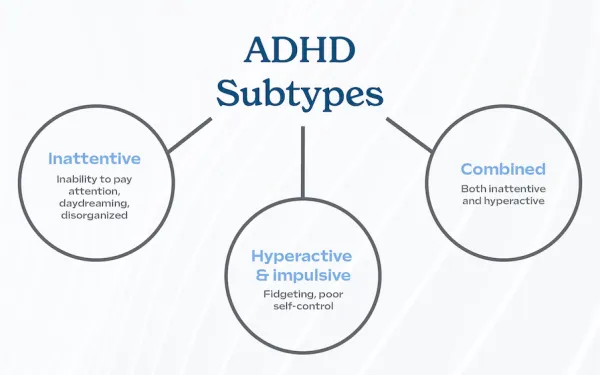
    pharmacolgy and mental nursing quiz

    Pharmacology & Mental health Quiz

    This quiz is for logged in users only.


    Pharmacology & Mental health Quiz Read More »

    Self study questions for nurses and midwives

    Self Study Question For Nurses and Midwives

    PREPARATORY QUESTIONS FOR END OF SEMESTER EXAMINATIONS

    SURGERY

    1a) define the term epistaxis

    b) What are the causes of epistaxis?

    c) Write down the management of a patient presenting with epistaxis

    2a) define a sty

    b) What are the causes of a sty?

    c) Outline the signs and symptoms of a sty

    3 An adult has been admitted to a surgical ward with difficulty in breathing, he requires urgent tracheostomy.

    a) List the indications of tracheostomy

    b) Describe the post-operative management of this patient till discharge

    c) Outline the complications that are likely to occur

    d) Formulate five actual nursing diagnoses and four potential diagnoses from this patient with tracheostomy

    4. Mrs Akello 38years old has presented with nasal polyps and she is to undergo polypectomy

    a) List the causes of nasal polyps

    b) Outline the signs and symptoms of nasal polyps

    c) Give the specific pre and post-operative management of this patient

    d) List four complications of nasal polyps

    5. a) Define tonsillitis

    b) List 6 symptoms and signs of a patient with tonsillitis

    c) Give the specific post-operative management for a patient who has undergone tonsillectomy

    6. Mrs Nabukeera was admitted on a surgical with a diagnosis of adenitis .She is to undergo adenoidectomy

    a) Define adenitis

    b) List the signs and symptoms of adenitis

    c) Describe the specific post-operative management you would give to her till discharge

    7. a) Define burns

    b) What are the causes of burns?

    c) How can burns be classified

    d )Mr. KK has sustained burns on the neck and chest

    >calculate the percentage of the area burnt

    >what specific management do you give to Mr. KK in the first 72hrs of admission

    >give five actual nursing diagnoses Mr KK will have due to the burns

    8a) Define the term electrolyte imbalance

    b) Give the causes of electrolyte imbalance

    c) List the signs and symptoms of electrolyte imbalance

    d) Mention the types of electrolyte imbalance in the body

    e) How can you manage patient with electrolyte imbalance

    9a) Define the term gangrene

    b) What are the causes of gangrene?

    c) Write down the types of gangrene

    d) Mention the signs and symptoms of different types of gangrene

    e) Describe the specific management which is given to this patient with gas gangrene

    10a) Define the term shock

    b) Write down the types/classification of shock

    c) State the clinical features of shock

    d) Write down all possible complications of shock

    e) How can a health worker prevent surgical shock?

    11a) Outline the classifications of wounds

    b) Give the factors that delay wound healing

    c) State five complications of wounds

    d) What advice do you give to a patient about wound care at home who is due for discharge?

    e) Explain the process of wound healing

    12a) Define the term a fracture

    b) Mention the different types of fracture

    c) Describe the management of a closed fracture of a femur

    d) List any 6 complications of a fracture

    13a) Define the term inflammation

    b) List the signs and symptoms of inflammation

    c) Describe the process of inflammation

    d) Explain the specific management of a 12yr old patient with inflammation on the lower limb

    13A 28year old male was admitted on a surgical ward with a diagnosis of tetanus

    a) List five cardinal signs and symptoms this patient would present with

    b) Explain the specific nursing management you would give to this from admission to discharge

    c) Formulate four actual and two potential nursing diagnoses from this patient’s condition

    14a) Define the term immunity

    b)Classify immunity

    c) Explain the factors that affect an individual’s immune system

    15a) Define hemorrhage

    b) Explain the different types of hemorrhage

    c) Explain the mechanism of hemostasis

    d) Outline the specific management of a patient with severe bleeding on the left lower leg

    16a)What is blood transfusion?

    b) Describe five complications that may occur due to blood transfusion

    c) What would cause failure of of a blood drip to run during blood transfusion

    d) Explain the nurse’s responsibility before , during, and after blood transfusion

    17a) Define a cataract

    b) outline the cardinal signs of a cataract

    c)Describe the management of Mr Moses a 40yr old presented to your OPD department with a cataract using a nursing process

    d)list the likely complications of a cataract

    MENTAL HEALTH

    18. Define the following terms

    a)suicide

    b) Suicidal ideation

    c) Attempted suicide

    d) par suicide

    e) paradoxical suicide

    19a) outline the common psychiatric conditions associated with suicidal ideation

    b) Explain the common factors contributing to suicide in the community

    c) Mention the impact of suicide to the family and the community

    d) Describe the management of a patient who intends to commit suicide

    e) Explain the assessment you would carry out on a patient with suicidal ideation

    20a) Define PTSD

    b) Outline four signs and symptoms of a patient with PTSD

    c) Manage an 11yr old girl who presented with PTSD after rape

    21a) Define the term delirium tremens

    b) Identify the causes of delirium tremens

    C) How can you manage the patient with delirium tremens?

    d) Formulate 5 potential nursing diagnoses for a patient with delirium tremens

    22. Madam EKEB a 26yr old is very aggressive on the ward that she cares away fellow patients

    a) Differentiate between aggression and violence

    b) What management do you give to madam EKEB who presents with severe aggression on the ward?

    23a) what is a psychiatric emergency?

    b) List 10 common psychiatric emergencies

    c) Which admission procedure would you follow when admitting a patient presenting with any of the psychiatric emergencies

    23a) Explain standards of care in psychiatry

    b) Who is a class B criminal lunatic?

    c) Mention all the orders used to admit mentally ill patient

    d) Write down and explain all the sections used in discharging a mentally ill patient

    e) Outline the rights of a mentally ill patient

    24. A 30yr old patient has presented in a psychiatric ward with status epilepticus

    a) Define status epilepticus

    b) Manage the patient who presents with status epilepticus on a ward

    c) Formulate four potential and 2actual nursing diagnoses for a patient with status epilepticus

    25aDefine mental retardation

    b) Classify mental retardation

    c) Explain 8 causes of mental retardation

    d) What advice do you give to a family with a mentally retarded child?

    26. ADHD is one of the common psychiatric conditions in children

    a) Outline 6 signs and symptoms of ADHD

    b) Manage an 11yr old boy with ADHD

    c) What specific advice do you give to a family with a child having ADHD?

    27a) Define autism

    b) Explain the common features of autism

    c) Describe the management of the above condition

    28. Depression is one of the common psychiatric conditions

    a) Define depression

    b) Outline the specific management of a patient with severe depression on a psychiatric ward

    c) Make 4 priority nursing diagnoses for a patient with severe depression

    COMMUNITY HEALTH

    29. a) Define PHC

    b) Mention the principles of PHC

    c) Outline components /elements of PHC

    d) What strategies are used to achieve PHC activities in a given community?

    30a) What is community assessment?

    b) Explain how you would identify any health problems in a given community

    c) Outline 9 important information you would find out in a given home during assessment

    31a) Define a home visit

    b) Explain how you apply a nursing process during a home visit

    c) Outline the merits and demerits of a home visit

    32a) Define vital statistics in health

    b) Explain the importance of vital statistics in health

    c) Outline 6 key vital statistics used to determine the health status of a community or country

    33a) Explain the relationship between PHC and CBHC

    b) Explain the role of a community nurse/midwife in implementation and achievement of any 4 of the PHC principles

    c) Outline the advantages of PHC over other specialized medical services

    34a) Define community mobilization

    b) Describe how you would mobilize a community towards implementation of a health education program

    35a) Define school health

    b) Explain the importance of a school health program

    c) Explain the role of a nurse in the provision of a school health program

    d) Outline the components of school health services

    36a) Explain the role of a community in PHC services

    b) Give 8 advantages of community participation in PHC services

    c) Explain the obstacles to effective community participation in PHC programs

    37a) Define community diagnosis

    b) Discuss why community diagnosis is important

    c) Explain the steps in conducting community diagnosis

    38Health promotion are actions related to lifestyles and choices that maintain/enhance population health

    a) Outline any 5 health promotion interventions you would implement in a given a community

    b) Explain 5major steps in community mobilization

    39. Describe the different levels of disease prevention

    40. Appropriate technology is one of the elements of PHC

    a) How is appropriate technology expressed in implementation of PHC services?

    b) Explain the advantages and disadvantages of appropriate technology as an element

    41. a) Define the term epidemics

    b) Explain the factors that contribute to the causes of epidemics

    c) What is the role of a nurse in the management of an epidemic in the community?

    42a) Define community health and community based health care

    b) State the characteristics of CBHC

    c) Describe how you would enter a village in Mityana to implement a community health activity

    TROPICAL MEDICINE

    43a) Define schistomiasis

    b) Explain the different types of schistosomiasis

    c )Give the clinical manifestations of schistosoma mansoni

    d) Describe the lifecycle of schistosomiasis haematobium using a well labelled diagram

    e) Outline the preventive measures of all types of schistosomiasis

    44The current disease burden in Uganda is attributed to communicable diseases

    a) Describe the modes of transmission of communicable diseases in general

    b) Describe the methods/approaches used to prevent and control communicable diseases in the community

    c) Explain the types of water diseases and their examples

    45a) Define diarrhoea

    b) Outline the causes of diarrhoea in Uganda

    c) Discuss the drugs used in the management of diarrhoea in children

    d) Formulate 5 priority nursing diagnoses of this patient

    46a) Define measles

    b) Outline the signs and symptoms of measles basing on the stages

    c) Describe the management of a12yr old child presenting with measles from admission to discharge

    d) List the likely complications of measles

    47. Malaria is one of the communicable diseases affecting most communities of Uganda

    a) Classify malaria

    b) Outline the cardinal signs of complicated malaria

    c) Describe the lifecycle of malaria in both man and the mosquito with the aid of diagrams

    d) How can different communities prevent the spread of malaria?

    e) Make 5 actual and 3 potential diagnoses of malaria

    48a) Describe the life cycle of ackylostomiasis with the aid of diagrams

    b) Explain the preventive measures of hook worm infestation

    c) List the likely complications of neglected worms

    49a) Ebola is one of the hemorrhagic fevers devastating some communities and countries due to known and unknown reasons

    a) Define hemorrhagic fevers

    b) List the different hemorrhagic fevers

    c) Outline the different causes and predisposing factors to hemorrhagic fevers

    d) Describe the management of Mr. X presented to your hospital suspected to be an Ebola patient

    50a) Define rabies

    b) Describe the management of rabbis both at home and in the hospital

    c) Explain the complications of rabies

    51a) Define bacilliary dysentery

    b) State the differences between bacilliary dysentery and amoebic dysentery

    c) Describe the specific management of a 3yr old child with bacilliary dysentery from admission to discharge

    52a) Define typhoid fever

    b) Explain the cardinal signs and symptoms of typhoid fever

    c) Describe the important information you would give to the community concerning prevention of typhoid fever

    53a) Define trachoma

    b) Outline the signs and symptoms of trachoma

    c) Explain the management of 23yr female presenting with trachoma

    d) List the complication

    54. Samuel a 30yr old peasant has been presented to the OPD with all the features of tetanus

    a) Outline the clinical features of tetanus

    b) Describe the management from admission to discharge

    c) List the complications of tetanus

    MIDWIFERY 1 AND 2 AND OBSTETRIC ANATOMY

    55. List the 5 medications used in antenatal and discuss them under

    a) Dose

    b) Indication

    c) Side effects

    56a) Outline the obstetrical causes of anemia in pregnancy

    b) List the five causes of hemolytic anemia

    c) Describe the management of Mrs. mucosal who presents at 36weeks with severe anemia

    57a) Define a cervix

    b) With the aid of a diagram, describe the structure of the cervix

    c) Outline the 6 functions of the cervix

    58a) Define the term good antenatal care

    b) Give the indications of referring a mother to a doctor during this period

    c) How would you manage a mother who comes with lower back pain in antenatal at 32weeks?

    59a) Define normal puerperium

    b) Describe the management of a mother who has had normal delivery up to discharge

    c) List the complication that may occur during this period

    60a) Outline the symptoms of pregnancy

    61a) Explain the characteristics of normal uterine action during first stage of Labour

    b) What is the management of a gravid 3 para 2 mother at term who presents to hospital with history of precipitate Labour on the previous pregnancies?

    62a) Describe a vagina

    b) What information is got on vaginal examination during labor?

    c) Mention four contractions of vaginal examination giving reasons for each

    d) List the complications of vaginal examination

    63a) Define intrauterine fetal death

    b) Outline the causes of IUFD

    c) How is the diagnosis of IUFD made?

    d) What is the management of IUFD in the hospital?

    64a) Describe the pelvic floor

    b) Outline injuries that can occur to the pelvic floor during Labour

    c) Explain how the knowledge of fetal skull can help you as a midwife prevent perineal tears

    65a) Describe the fetal skull

    b) How is fetal wellbeing monitored during pregnancy?

    C) List the indications of ultrasound scan in late pregnancy

    66a) Describe a non-pregnant uterus

    b) Describe the changes that take place in this organ during pueperium

    c) List the likely complication in the first stage of labor

    67a) what is the effect of DM on pregnancy?

    68a) how does pregnancy affect DM?

    b) How would you care for a diabetic mother who has had a caesarean section in the first 48hours of the operation

    69a) Describe the umbilical cord

    b) Describe the different abnormalities of the cord

    70. Malaria is of the conditions contributing affecting pregnancy and contributing factor to increased maternal mortality and morbidity

    a) Explain why pregnant women are more susceptible to malaria

    b)Describe the a primigravida who presents to your maternity center at 34 weeks with severe malaria

    c) Outline the likely complications of malaria on pregnancy

    71. Essential hypertension is one of the hypertensive disorders experienced by pregnant women

    a) Define essential hypertension

    b) Classify hypertensive disorders in pregnancy

    c) Describe the management of Mrs Nangobi a G4P2+1 presenting in antenatal clinic at 32weeks with a diagnosis of essential hypertension

    d) How does hypertension affect pregnancy?

    72a) outline the signs and symptoms of first stage of Labour

    b) Describe the management of a young primigravida in first stage of Labour

    c) List the complications likely to occur during this stage of Labour

    73a) Define hyperemesis gravidarum

    b) Outline the causes of hyperemesis gravidarum

    c) Describe the management of G2P1+0 presenting to your maternity center with hyperemesis gravidarum at 28 weeks of gestation

    d) Explain the likely complications of this condition

    74a) what is preeclampsia

    b) Outline the signs and symptoms of preeclampsia

    c) What are the predisposing factors of this condition?

    d) Outline the nursing of a mother with severe preeclampsia

    e) List the complication of severe preeclampsia

    75a) Describe the placenta at term

    b)Explain the functions of the placenta

    c) Outline the abnormalities that may be found on the placenta

    76a) With the aid of a diagram, describe the structure of the female breast

    b) Explain the physiology of lactation

    c) Explain the factors that promote successful lactation

    77a) Define labor

    b) Explain the physiology of the first stage of Labour

    c) Describe the management of a mother in the second stage of Labour admitted in the hospital

    78a) Outline the changes in the cervix during the first stage of labor

    b) What information is found on the partograph?

    c) A G2P1+0 mother came to a health center in normal labor , what may make you refer?

    79. Most women find it helpful to get further information and support in their own homes.

    a) Give 5 advantages of following up post-partum mothers

    b) Explain postpartum maternal assessment you would carry out during domiciliary care

    c) List the problems that you would identify during domiciliary care

    80a) Describe 6 factors that influence the length of second stage of labor

    b) Explain 3 phases used in conducting 2nd stage of labor

    c) Give immediate assessment of the baby after 2nd stage of labor

    81a) Mention factors that aid in involution of the uterus

    b) Explain how you assess and document uterine involution immediately after delivery to 10days postpartum

    c) Give five complications of sub involution of the uterus

    82a) Explain the antenatal appointment schedules

    b) Give 6 barriers to adherence to goal oriented antenatal visits

    c) Identify 5 complications a pregnant woman is likely to get if no antenatal is attended

    83a) Describe the structure of the ovary

    b) List the functions of the ovary

    c) Describe the menstrual cycle

    MEDICINE I AND 111

    84. Mr. KIBULA known hypertensive has been brought to hospital with suggestive features of hypertensive crisis.

    a) Mention 8 clinical features of hypertension

    b) List 4 causes of HTN and predisposing factors

    c) Explain the specific Nursing Care you will give to Mr. KIBULA from the time of admission to discharge.

    85. Write short notes on the following (definition, causes, signs and symptoms and complications).

    a) Hydrocele

    b) Hodgkin’s disease

    c) Ankylosing spondylitis

    86 a) Define Paget’s disease/Osteitus, deformans?

    b) Explain the pathophysiology and etiology of Paget’s disease

    c) Describe the specific nursing care you would give to Mr. Muwonge with Paget’s disease

    87. Hepatitis B morbidity and mortality is much higher today than before.

    a) What are the factors, contributing to the high prevalence of hepatitis B in the communities

    b) How does a patient with hep.B present?

    c) Give five priority nursing diagnoses for a patient with Hep B infection.

    d) Describe the specific nursing management you would give to a patient with hep B.

    e) Mention the complications of hep B.

    f) Suggest ways how we can prevent hep B infection in the community

    88. Define myocardial infarction. List the clinical features of myocardial infarction.

    Explain the specific Nursing care given to a patient with myocardial infarction within the first 24Hrs of admission.

    89. An adult male patient has presented to OPD with features of pulmonary tuberculosis

    a) Outline five cardinal signs and symptoms of pulmonary tuberculosis.

    b) List five specific investigations that can be done to confirm pulmonary tuberculosis.

    c) Explain the specific nursing care given to this patient from the time of admission until discharge.

    90. Mrs. A, a female patient has been admitted on a medical ward with suspected bronchial pneumonia,

    a) Outline the clinical features of bronchial pneumonia

    b) Describe the specific nursing management you would give to Mrs. X with in the first 72HRS of admission.

    c) Explain five likely complications Mrs. X is likely to get following this condition.

    91. Mr. Lusoke, a 62 yrs. old male is presented at the OPD with features of congestive cardiac failure

    a) Outline the signs and symptoms of congestive cardiac failure.

    b) Mention the causes of congestive cardiac failure.

    c) Describe the specific nursing care / management you will give to Mr. Lusoke from time of admission to discharge.

    92. Outline the signs and symptoms of Parkinson’s disease.

    b) Mention the causes and predisposing factors to Parkinson’s disease.

    c) Describe the specific Nursing management given to a patient with Parkinson’s disease.

    93. Mr. Okello a 28yrs old male presents at OPD with clinical features of urinary tract infection and was admitted.

    a) List 5 causes and 6 signs and symptoms of urinary tract infection.

    b) Describe the specific nursing care you would give to Mr.Okello within the first 48 hours of admission.

    c) Give the measures that can be taken to prevent urinary tract infections.

    94 Define Addison’s disease?

    b) Outline the causes and risk factions that leads to Addison’s disease.

    c) Using the Nursing process, describe the management of a patient with Addison’s disease.

    PEDIATRICS 1 AND 11

    95. Define the term Apgar score

    a) Outline 10 characteristics of a normal new born baby

    b) Describe the care given to the normal new born baby within 72 hours after delivery of the head.

    96. Differentiate between SAM and MAM

    b) Explain the causes of malnutrition in children under 5 years.

    c) Explain the importance of breastfeeding in babies’ up to 2years of age.

    97. Define the term congenital abnormalities

    a) Classify the congenital abnormalities of the heart

    b) Explain ways of preventing congenital abnormalities.

    98. Mention the factors that predispose to neonatal infections in new born babies.

    b) List 8 clinical features of a child with neonatal tetanus.

    c) Describe the specific management of a 3 month old child with tetanus.

    99. Outline the factors that predispose to birth injuries

    Differentiate between a caput succedaneum and a cephalo hematoma.

    c) Describe the specific management you would give to a new born baby who presents with a caput succedaneum.

    100. Brandon a five weeks old neonate is admitted on ward with a history of fast breathing, chest in drawing and stridor.

    b) Explain the specific nursing care you would offer to Brandon in a hospital within the first eight hours of admission.

    101. A five year old child has been bought to OPD in a painful sickle cell crisis.

    a) Outline 5 possible causes of sick cell crisis.

    b. List 4 diagnostic signs and symptoms of sick cell disease in children.

    c) Explain the specific management of this child from admission to discharge.

    102. A 4 months old baby has been admitted on a pediatric ward and diagnosed with pneumonia.

    a) Outline the clinical presentation of this child.

    b) Explain the specific management given to the child with in the first 72 hours.

    103. Define the following terms.

    1) Fracture

    ii)Osteopenia of prematurity

    osteogenesis imperfecta

    Osteomyelitis

    b) Mention 5 signs and symptom of osteomyelitis in children.

    c) Describe the nursing management of 3 years old child with osteomyelitis.

    104. A 8 month old child has been diagnosed with nephrotic syndrome.

    a) List 6 signs and symptoms of nephrotic syndrome in children.

    b) Describe the specific nursing management you world give to this child within the first 72 hours of admission on a pediatric ward.

    c) Outline five complications of nephrotic syndrome.

    105. What are the advantages of breast feeding?

    Compare human milk and cow’s milk

    Outline problems that are faced by mothers during breastfeeding.

    106. List five congenital abnormalities of the G’T and 5 musculoskeletal system

    Outline the causes of congenital abnormalities.

    How do you cause a mother who has delivered a baby with spinal bifida?

    107. List the factors that promote good nutrition in the under-five.

    List five pieces of advice you would give to a prime para with a two year old baby suffering from protein calorie malnutrition.

    List five problems of birth injuries in Uganda.

    Outline the roles of a nurse in prevention of birth injuries in Uganda.

    PHARMACOLOGY 1 AND 111

    108. Define rational drug use

    Outline the medical classification of drugs giving examples of each

    Mention the legal classes of drugs with examples of each.

    109. Define infertility.

    State the common cause of infertility in women

    c) State the indications, side effects and contraindications of clomiphene and Bromocriptine.

    110. Describe the mechanism of action of non-opioid analgesics.

    b) Write briefly about the handling of the class of drugs in a hospital

    c) Define the following:-

    Chemotherapy

    Anti tussive

    111. Mention 4 Four sources of drugs

    b) Write down all routes which can be used for drug administration giving advantages and disadvantages of each.

    c) Write down the factors that affects drugs absorption.

    d) What factors affect drug dosage and action?

    112. State the clinical uses of oxytocin and mention 6 adverse side effects of the drug.

    b) Outline 5(five) contraindications of oxytocin

    c) Describe 10 (ten) Nursing considerations while administering oxytocin.

    113. Define Narcotic drugs and state the types of narcotics.

    b) List down 7 nursing considerations before during and after administrating narcotics on ward.

    c) What are the legal implications of Narcotics according to the Uganda narcotic drugs and psychotropic substance control ACT?

    114. Define immunity and explain the two major types of immunity.

    State the specific side effects, indication and the dosage following drugs:-

    1. Anti D (RHO) Immunoglobulin
    2. B) Rabies vaccine
    3. Pneumococcal Vaccine.

    115. Describe the physiology of erection in males

    b) State the causes of erectile dysfunction

    b) Mention the class, indication, Dosage and side effects of the following drugs.

    i) Sildenafil.

    ii) Tadalafil

    iii) Finesteride.

    GYNAECOLOGY

    1. a) Outline signs of breast cancer.

    b) Explain post operative care after mastectomy.

    c) List possible complications of mastectomy.

    1. . a) Draw a diagram showing possible sites of vaginal fistula.

    b) Outline the 5 major causes of vaginal fistula.

    c) Explain specific nursing care of a woman after VVF repair.

    118. a) Define the different types of Abortion.

    b) Outline causes of missed Abortion.

    c) Explain different methods used in the management of missed abortion.

    d) Outline the 5 elements of PAC.

    1. a) Define ectopic pregnancy.

    b) Outline signs and symptoms of tubal pregnancy.

    c) A mother presents to the medical facility with a tubal pregnancy, describe her management till discharge.

    119. a) List the disorders of menstruation.

    b) Explain the advice and treatment given to a 17 year old girl with dysmenorrhea.

    120 a) Define Hydatidiform mole.

    b) Outline signs and symptoms of hydatidiform mole.

    c) Describe the methods of managing the above condition and list complications that may follow.

    121. Describe pelvic inflammatory disease.

    b) What are the predisposing factors of this condition?

    c) Describe management of PID in the hospital.

    1. a) What is infertility?

    b) Outline causes of infertility.

    c) Explain the different methods that can be used to manage infertility.

    1. a) Draw a diagram of a uterus indicating sites of fibroids.

    b) Differentiate between benign and malignant tumor.

    c) Give the management of the mother after myomectomy within the first 48 hours.

    d) What specific advice would you give this mother on discharge.

    REPRODUCTIVE HEALTH

    1. a) Define STDs?

    b) Explain ten preventive measures against sexually transmitted infections.

    c) Describe the syndromic management of STDs.

    1. a) List 7 components of reproductive health.

    b) Outline the advantages and disadvantages of intergrating reproductive health.

    c) Outline 10 factors that affect women’s reproductive health.

    1. a) Define sexual abuse?

    b) Explain factors that expose adolescent girls to sexual abuse or vulnerability.

    c) Outline 5 clinical features of sexual abuse in an adolescent.

    1. a) Define i) Post Abortion Care

    ii) Comprehensive abortion care.

    b) Explain the Rational for PAC.

    1. a) Who is an adolescent?

    b) Describe Tanner’s stage of development in an adolescent.

    c) List common health problems faced by adolescents.

    1. a) What is safe motherhood?

    b) Outline the 3 delays that can increase maternal mortality.

    c) What is your role as a midwife in reduction of maternal mortality in your community?

    1. Describe syndromic approach of managing STIs.
    2. a) Define domestic violence.

    b) What are the factors that make you suspect that one is a victim of domestic violence?

    c) How would you prevent domestic violence?

    1. Describe manual vacuum aspiration.

    FOUNDATIONS OF NURSING.

    1. a) Define wounds.

    b) Give 5 types of wounds.

    c) Outline the factors that delay wound healing.

    d) Give the specific management for a patient with specific wound.

    e) What specific advice do you give to a patient with a wound prior to discharge.

    f) Describe the process of wound healing.

    1. a) Outline the indications for oxygen administration.

    b) Give the rules to follow before, during and after administration of oxygen.

    c) Define blood transfusion.

    d) Outline the indications of blood transfusion.

    e) Outline the appropriate care of the patient before, during and after blood transfusion.

    f) Give the complications of blood transfusion.

    1. a) Define drug administration.

    b) Outline the different routes of drug administration.

    c) Mention the principles of drug administration including the dos and don’ts in drug administration.

    1. a) Define infection prevention and control.

    b) Define nosocomial infection.

    c) Outline the steps taken to prevent infections of the wound.

    d) What are the advantages of oral route drug administration over the parental route.

    1. a) Outline the indications of Tracheostomy.

    b) Give the specific pre and post operative nursing care for the patient with tracheostomy.

    c) Mention the complications of tracheostomy.

    d) Formulate 4 actual nursing diagnoses for a patient with colostomy.

    1. a) Define lumber puncture.

    b) Outline the indications of lumber puncture.

    c) Explain the specific nursing care given to the patient prior to after the procedure of lumber puncture.

    d) List the complications of lumber puncture.

    1. a) Define abdominal paracentesis.

    b) Outline the indications of paracentesis.

    c) Give the specific care given to the patient before and after abdominal paracentesis.

    d) Mention the complications of abdominal paracentesis.

    1. a) Define tractions.

    b) Explain the different types of tractions.

    c) Outline the specific nursing care given to a patient with tractions.

    d) Formulate 5 actual nursing diagnoses for a patient with tractions.

    e) Outline the likely complications of the patient on traction.

    1. a) Outline the indications of underwater seal drainage.

    b) Give the specific nursing care for a patient on underwater seal drainage.

    c) Formulate four nursing diagnoses for a patient on underwater seal drainage.

    d) List the complications of underwater seal drainage.

    1. a) Outline 6 indications of gastric lavage.

    b) Define colostomy.

    c) Formulate 4 actual nursing diagnoses and 4 potential nursing diagnoses for a patient with colostomy.

    d) Give the specific nursing care to the patient with colostomy.

    1. a) List the indications of Glasgow coma scale.

    b) Describe the Glasgow coma scale.

    ANATOMY AND PHYSIOLOGY II

    1. a) With illustration, describe the formation of flow of CSF.

    b) List the functions of CSF.

    c) Describe the meninges covering the brain and spinal cord.

    1. a) Describe the position and gross structure of the parathyroid glands. Outline the functions of parathyroid hormone and calcitonin.

    b) Explain the disorders of the thyroid gland.

    1. a) Describe the structure of a nephron.

    b) Explain the processes involved in the formation of urine.

    c) Describe how body water and electrolyte balance is maintained.

    1. a) Describe the structure of the ear.

    b) Explain the physiology of hearing.

    c) Explain the functions of the accessory organs of the eye.

    1. a) Explain the role of lymphatic vessels in the spread of infections and malignant disease.
    2. a) Describe the location of the pharynx and relate it’s structure to it’s function.

    b) List the functions of the trachea in respiration.

    c) Explain the main mechanisms by which respiration is controlled.

    d) Describe the common inflammatory and infectious disorders of the upper respiratory tract.

    1. a) Define a neuron.

    b) Outline the 12 cranial nerves of the nervous system.

    c) Describe the transmission of an impulse across a synapse.

    PALLIATIVE CARE NURSING

    150 a) Define palliative care

    b) Explain the principles of palliative care

    c) Give the challenges faced in implementing in palliative care services in Uganda

    151.a) Define pain according to WHO

    b) Explain different types of pain in palliative care

    c) Describe the principles of pain management in palliative care

    d) Describe the steps of breaking bad news

    152.a) Explain 6 roles of palliative care in Uganda

    b) Outline 6 symptoms commonly experienced by terminary ill patients

    153.a) What is grief?

    b) Explain 5 stages of grief experienced by palliative care patients

    c) Explain the HOPE approach to spiritual pain management

    d) Outline the spiritual problems experienced by palliative care patients

    Self Study Question For Nurses and Midwives Read More »

    status epilepticus

    Status Epilepticus

    Status Epilepticus Lecture Notes
    Status Epilepticus Lecture Notes

    Status Epilepticus (SE) is a neurological emergency characterized by prolonged or repetitive seizure activity without full recovery of consciousness between seizures.

    Historically, the definition was fixed at 30 minutes, but more recent understanding emphasizes the need for earlier intervention due to the risk of neuronal injury and treatment refractoriness.

    1. Time-Based Definition:
      • The most widely accepted operational definition, particularly for convulsive SE (CSE), defines it as a seizure lasting longer than 5 minutes, or two or more seizures occurring within a 5-minute period without return to baseline consciousness between them.
      • This "5-minute rule" is crucial for prompt clinical intervention. It is an operational definition, meaning it's designed to prompt action, not necessarily to reflect the exact pathophysiological threshold for neuronal damage.
      • For non-convulsive SE (NCSE), the time threshold is generally considered 10 minutes or more of continuous or intermittent non-convulsive seizure activity.
    2. Physiological/Pathophysiological Definition:
      • This refers to the point at which prolonged seizure activity leads to a failure of the normal mechanisms that terminate seizures, and continuous seizure activity results in long-term neuronal injury.
      • T1 (Clinical Stage): The first time point (e.g., 5 minutes for convulsive SE) at which continuous seizure activity is likely to be prolonged. This is the point at which treatment should be initiated.
      • T2 (Neuronal Injury Stage): The second time point (e.g., 30 minutes for convulsive SE) at which continuous seizure activity may lead to long-term neuronal injury, neuronal death, and/or alteration of neuronal networks (epileptogenesis) and may become resistant to treatment.
    II. Classification of Status Epilepticus

    SE can be broadly classified based on its clinical presentation and electrographic features:

    1. Convulsive Status Epilepticus (CSE):
      • Generalized Convulsive SE: Involves bilateral tonic-clonic motor activity. This is the most common and easily recognizable form of SE and carries the highest risk of systemic complications and mortality. It typically presents as continuous generalized tonic-clonic seizures or a series of such seizures without regaining consciousness.
      • Focal Convulsive SE (or Epilepsia Partialis Continua - EPC): Characterized by continuous or repetitive focal motor activity (e.g., rhythmic jerking of a limb or facial twitching), which may remain localized or secondarily generalize. Consciousness may be preserved or impaired depending on the area of the brain involved.
    2. Non-Convulsive Status Epilepticus (NCSE):
      • Characterized by continuous or fluctuating mental status changes and/or behavioral alterations due to ongoing non-convulsive seizure activity, without prominent motor manifestations. Diagnosis often requires Electroencephalography (EEG).
      • Generalized NCSE (e.g., Absence Status, Atypical Absence Status): Presents as prolonged periods of unresponsiveness, confusion, staring, or subtle automatisms (e.g., lip-smacking). Common in patients with generalized epilepsy syndromes.
      • Focal NCSE (e.g., Complex Partial Status): Can manifest with a wide range of symptoms, including confusion, aphasia, memory disturbances, bizarre behavior, or subtle focal neurological deficits. Often challenging to diagnose clinically without EEG.
      • Subtle SE: A severe form of CSE where the prominent motor activity has subsided due to treatment or exhaustion, but continuous electrographic seizure activity persists, often with only minimal motor signs (e.g., subtle eye deviation, twitching of fingers). This is a particularly dangerous form as the ongoing brain injury may be missed without EEG monitoring.

    This is considered as a complication of grand mal epilepsy rather than a certain type of epilepsy. It is both a medical and psychiatric emergency. This condition is life threatening and getting treatment started fast is vital.

    Pathophysiology of Status Epilepticus

    The pathophysiology of Status Epilepticus (SE) involves an interplay between excitatory and inhibitory neurotransmission, leading to a failure of normal seizure-terminating mechanisms.

    I. Failure of Seizure Termination Mechanisms:

    Normally, a seizure is a self-limiting event. This self-termination is largely mediated by:

    1. GABAergic Inhibition: Gamma-aminobutyric acid (GABA) is the primary inhibitory neurotransmitter in the brain. When GABA binds to GABA-A receptors, it causes chloride influx, hyperpolarizing the neuron and making it less likely to fire. During normal seizures, there is an increase in GABA release and an upregulation of GABA-A receptor sensitivity to terminate the seizure.
    2. Ion Channel Modulation: As a seizure progresses, voltage-gated sodium channels in neurons undergo inactivation, reducing their ability to fire repeatedly. Potassium channels also open, leading to outward potassium current and neuronal hyperpolarization.
    3. Adenosine and Endocannabinoids: These neuromodulators also contribute to seizure termination by decreasing neuronal excitability.

    In SE, these normal termination mechanisms fail or become overwhelmed:

  • GABA-A Receptor Dysfunction:
    • Internalization: Prolonged seizure activity leads to the internalization (endocytosis) of GABA-A receptors from the neuronal cell surface. This means fewer GABA-A receptors are available on the membrane to bind GABA, thus reducing inhibitory tone.
    • Subunit Changes: There may be a shift in GABA-A receptor subunit composition, resulting in receptors that are less sensitive to GABA and benzodiazepines (a common first-line treatment for SE).
    • Reduced GABA Synthesis/Release: In some cases, there may be reduced synthesis or release of GABA.
  • Enhanced Excitatory Neurotransmission:
    • Glutamate Hypersensitivity: Glutamate is the primary excitatory neurotransmitter. During SE, there is a sustained release of glutamate, which binds to N-methyl-D-aspartate (NMDA) and alpha-amino-3-hydroxy-5-methyl-4-isoxazolepropionic acid (AMPA) receptors, leading to excessive calcium and sodium influx into neurons.
    • NMDA Receptor Upregulation/Desensitization Failure: Unlike GABA-A receptors, NMDA receptors may be upregulated or fail to desensitize effectively during prolonged seizures, perpetuating excitotoxicity.
  • II. Stages of Pathophysiological Progression:

    The pathophysiology of SE is often described in stages, highlighting the progressive nature of the failure of compensatory mechanisms and the increasing difficulty of treatment:

    1. Early Stage (Compensated Stage, 0-30 minutes):
      • Seizure Onset: Initial compensatory mechanisms (GABA release, ion channel changes) are working but are overwhelmed by the underlying pathology (e.g., acute brain injury, electrolyte imbalance).
      • Systemic Compensation: The body's autonomic nervous system responds to the increased neuronal activity. This includes increased heart rate, blood pressure, cardiac output, cerebral blood flow, and glucose utilization. Respiratory rate increases to maintain oxygenation.
      • Drug Responsiveness: At this stage, seizures are generally responsive to first-line antiseizure medications, particularly benzodiazepines, which act on GABA-A receptors.
    2. Late Stage (Decompensated Stage, >30 minutes):
    3. Failure of Autoregulation: The initial systemic compensatory mechanisms begin to fail.
      • Cerebral Edema & Ischemia: While initially cerebral blood flow increases, eventually, due to sustained metabolic demand, systemic hypotension, and increased intracranial pressure (from cerebral edema), cerebral blood flow becomes insufficient, leading to ischemia and hypoxia.
      • Systemic Complications: Persistent muscle contractions (in CSE) lead to hyperthermia, lactic acidosis, rhabdomyolysis, respiratory failure, cardiac arrhythmias, and acute kidney injury.
    4. Neuronal Damage: Sustained excitotoxicity (due to excessive glutamate and calcium influx) leads to:
      • Apoptosis and Necrosis: Neuronal cell death.
      • Blood-Brain Barrier Breakdown: Can exacerbate cerebral edema and inflammation.
      • Changes in Gene Expression: Leading to long-term alterations in neuronal excitability and increased risk of future seizures (epileptogenesis).
    5. Drug Refractoriness: Due to the internalization and subunit changes of GABA-A receptors, the brain becomes less responsive to benzodiazepines. Other antiseizure medications (which may work via different mechanisms, e.g., sodium channel blockade) may also become less effective.
    Causes/Etiologies and Risk Factors for Status Epilepticus

    Status Epilepticus (SE) can be caused by a wide variety of underlying conditions, ranging from acute brain injuries and systemic illnesses to chronic neurological disorders.

    Common Etiologies of Status Epilepticus:

    The causes of SE can be broadly categorized into acute, remote/chronic, and progressive, though many cases are multifactorial. The prevalence of different etiologies varies with age.

    A. Acute Symptomatic Causes (Most Common in Adults with First-onset SE):

    These are acute insults to the brain or severe systemic disturbances that directly trigger SE. They often carry a worse short-term prognosis.

    1. Acute Cerebrovascular Events:
      • Stroke (Ischemic or Hemorrhagic): This is the most common cause in older adults.
      • Subarachnoid Hemorrhage, Subdural Hematoma, Epidural Hematoma: Bleeding within or around the brain.
    2. Central Nervous System (CNS) Infections:
      • Meningitis, Encephalitis, Brain Abscess: Inflammation or infection of the brain and its coverings.
    3. Acute Metabolic Derangements:
      • Electrolyte Imbalances: Severe hyponatremia (low sodium), hypocalcemia (low calcium), hypomagnesemia (low magnesium), hypernatremia.
      • Hypoglycemia/Hyperglycemia: Critically low or high blood sugar.
      • Uremia, Hepatic Encephalopathy: Accumulation of toxins due to kidney or liver failure.
      • Thyrotoxicosis: Severe hyperthyroidism.
    4. Traumatic Brain Injury (TBI):
      • Severe head trauma can lead to immediate or delayed seizures.
    5. Toxic/Drug-Related Causes:
      • Drug Withdrawal: Alcohol withdrawal (delirium tremens), benzodiazepine withdrawal, barbiturate withdrawal.
      • Drug Intoxication: Cocaine, amphetamines, tricyclic antidepressants, isoniazid, penicillin, lithium, theophylline, organophosphates.
    6. Hypoxia/Anoxia:
      • Severe oxygen deprivation to the brain (e.g., cardiac arrest, respiratory failure).
    7. Autoimmune and Inflammatory Conditions:
      • Autoimmune Encephalitis: (e.g., NMDA receptor encephalitis, Hashimoto's encephalopathy).
      • Systemic Lupus Erythematosus (SLE), Vasculitis.
    B. Remote/Chronic Symptomatic Causes (Often in Patients with Known Epilepsy):

    These are pre-existing conditions that lower the seizure threshold. SE occurs either due to a breakthrough seizure or withdrawal of anti-seizure medication.

    1. Prior Brain Injury: Remote Stroke, Old TBI, Prior CNS Infection: Scars from previous insults can be epileptogenic.
    2. Developmental Brain Abnormalities: Cortical Dysplasia, Periventricular Heterotopia: Malformations of cortical development.
    3. Brain Tumors: Primary or metastatic brain tumors.
    4. Neurodegenerative Diseases: Alzheimer's disease, Creutzfeldt-Jakob disease (rarely).
    5. Genetic Epilepsy Syndromes: Certain genetic syndromes (e.g., Dravet syndrome, Lennox-Gastaut syndrome) are associated with a high risk of SE, particularly in children.
    C. Idiopathic/Cryptogenic:

    In a significant percentage of cases, especially in children, no specific cause can be identified despite thorough investigation.

    Risk Factors for Status Epilepticus:

    Risk factors predispose an individual to developing SE, either by lowering their seizure threshold or increasing the likelihood of prolonged seizures.

    1. History of Epilepsy: This is the most significant risk factor. Patients with established epilepsy are at higher risk, especially if their seizures are poorly controlled.
      • Non-compliance with Anti-Seizure Medications (ASMs): Abrupt discontinuation or irregular intake of prescribed ASMs is a very common and preventable cause of SE.
      • Subtherapeutic ASM Levels: Due to poor absorption, drug interactions, or increased metabolism.
    2. Age: SE has a bimodal distribution, with the highest incidence in very young children (infants and toddlers) and the elderly.
      • Children: Febrile seizures (prolonged febrile seizures can evolve into SE), CNS infections, hypoxic-ischemic encephalopathy, and genetic syndromes.
      • Elderly: Acute stroke, neurodegenerative diseases, and systemic metabolic derangements are more common.
    3. Previous History of Status Epilepticus: Having experienced SE in the past significantly increases the risk of future episodes.
    4. Brain Pathology: Any pre-existing structural brain lesion (e.g., remote stroke, tumor, malformation) increases susceptibility.
    5. Alcoholism/Drug Abuse: Alcohol withdrawal is a major risk factor, as are intoxications with certain proconvulsant drugs.
    6. Systemic Illnesses: Severe medical conditions (e.g., sepsis, multi-organ failure) can create metabolic environments conducive to SE.
    7. Genetic Predisposition: Certain genetic factors can influence seizure susceptibility and the likelihood of developing SE.
    Clinical Manifestations of Status Epilepticus

    The presentation depends on whether it's convulsive or non-convulsive SE, its focal or generalized origin, and the duration of the activity.

    Convulsive Status Epilepticus (CSE) Manifestations:

    CSE is the most easily recognizable and typically presents with prominent motor activity.

  • Generalized Convulsive Status Epilepticus (GCSE):
    • Continuous or Repetitive Generalized Tonic-Clonic Seizures: This is the classic presentation.
      • Tonic Phase: Sustained muscle contraction (stiffening) of the limbs, trunk, and face. The patient may arch their back, clench their jaw, and emit a cry or groan as air is forced past the vocal cords. Respiratory effort may cease (apnea), leading to cyanosis. Pupils are often dilated and unreactive.
      • Clonic Phase: Rhythmic, jerky movements of the limbs and body, typically symmetrical. Breathing may be labored, and frothing at the mouth (sometimes blood-tinged if the tongue or cheek is bitten) may occur.
      • Lack of Recovery: The defining feature is the absence of a return to baseline consciousness between individual seizures if they are repetitive, or the continuous nature of a single tonic-clonic seizure beyond 5 minutes.
    • Autonomic Symptoms: Profound autonomic activation is common, especially early on:
      • Tachycardia, Hypertension, Tachypnea: Increased heart rate, blood pressure, and respiratory rate.
      • Hyperthermia: Elevated body temperature due to sustained muscle activity.
      • Increased Secretions: Salivation, sweating.
      • Pupil Dilation: Non-reactive pupils.
    • Postictal Period (if seizures eventually terminate):
      • Profound confusion, somnolence, headache, muscle aches, and sometimes transient focal neurological deficits (Todd's paralysis).
  • Focal Convulsive Status Epilepticus (FCSE) / Epilepsia Partialis Continua (EPC):
    • Localized Motor Activity: Continuous or repetitive rhythmic jerking movements affecting only one part of the body (e.g., one limb, one side of the face, a finger). The patient may remain conscious or have impaired awareness depending on whether the seizure spreads.
    • Spread (Secondary Generalization): The focal motor activity can sometimes spread to involve the entire body, becoming secondarily generalized tonic-clonic SE.
    • Aura-like Symptoms (if conscious): Patients may report sensory phenomena (e.g., tingling, visual changes), autonomic symptoms (e.g., epigastric rising sensation), or psychological symptoms (e.g., fear, déjà vu) preceding or accompanying the motor activity if consciousness is preserved.
  • Non-Convulsive Status Epilepticus (NCSE) Manifestations:

    NCSE is often more challenging to diagnose clinically as it lacks the overt motor manifestations of CSE. It presents primarily as altered mental status or behavioral changes. A high index of suspicion and prompt EEG are often required for diagnosis.

    1. Generalized Non-Convulsive SE (e.g., Absence Status):
      • Altered Consciousness: Prolonged periods of staring, blank expression, unresponsiveness, or reduced interaction with the environment.
      • Subtle Motor Automatisms: May include slight eyelid fluttering, repetitive swallowing, lip-smacking, or minor head nodding. These are often brief and easily missed.
      • Confusion/Disorientation: After resolution, patients may be confused or disoriented for a period.
      • Amnesia: Patients may have no recollection of the event.
      • Common in Patients with Generalized Epilepsy: Often seen in those with absence epilepsy.
    2. Focal Non-Convulsive SE (e.g., Complex Partial Status):
      • Fluctuating or Sustained Altered Mental Status: Can range from mild confusion to coma.
      • Behavioral Changes: Bizarre, agitated, or withdrawn behavior. Wandering, picking at clothes.
      • Cognitive Deficits: Aphasia (difficulty with speech), memory disturbances, impaired attention, executive dysfunction.
      • Affective Symptoms: Fear, anxiety, depression, unexplained crying or laughing.
      • Autonomic Symptoms: Piloerection, flushing, heart rate changes.
      • Sensory Symptoms: Persistent paresthesias, visual distortions, olfactory or gustatory hallucinations.
      • Subtle Motor Signs: Twitching, eye deviation, or posturing that may be very minor.
    III. Subtle Status Epilepticus:
  • This is a critical form, particularly in critically ill patients, those who have received initial treatment for CSE but remain comatose, or those with severe brain injury.
  • Minimal Motor Activity: Overt convulsive movements have ceased (due to exhaustion or partial treatment), but continuous electrographic seizure activity persists on EEG.
  • Clinical Signs: May only involve very subtle movements such as:
    • Rhythmic eye twitching or deviation.
    • Nystagmoid eye movements.
    • Facial twitching (e.g., corners of the mouth).
    • Subtle finger or toe movements.
    • Chewing or swallowing movements.
    • Coma, unresponsiveness, or profound encephalopathy.
  • High Risk: This form carries a very poor prognosis and is often difficult to diagnose without continuous EEG monitoring. It represents ongoing brain injury despite the lack of obvious outward signs.
  • IV. Warning Signs of Impending SE:
    • Frequent or Clustering Seizures: Patients with epilepsy who experience an unusually high frequency of seizures over a short period may be at risk for progressing to SE.
    • Prolonged Postictal State: A postictal period that is unusually long or severe after a typical seizure may indicate evolving SE or an underlying acute cause.
    Diagnostic Approach to Status Epilepticus

    The overriding principle is expediency, as delays in diagnosis and treatment worsen outcomes.

    I. Rapid Clinical Recognition and Initial Assessment:
    1. Time is Brain: The immediate priority is to recognize that SE is occurring based on the time-based definition (seizure > 5 minutes, or recurrent seizures without regaining consciousness).
    2. History (if available):
      • Witness Accounts: Crucial for describing seizure semiology (movements, progression, duration, consciousness level), prior seizure history, presence of pre-existing epilepsy, medication adherence, recent illness, trauma, drug/alcohol use, and comorbidities.
      • Emergency Personnel: Information from first responders about seizure duration and initial response to pre-hospital treatment.
    3. General Physical Examination:
      • Vital Signs: Assess for hyperthermia, tachycardia, hypertension (initially), hypotension (later), tachypnea, oxygen saturation.
      • Signs of Trauma: Head trauma, tongue lacerations, limb injuries.
      • Signs of Systemic Illness: Rash, nuchal rigidity (meningitis), signs of liver/kidney disease.
    4. Neurological Examination:
      • Assess level of consciousness (Glasgow Coma Scale), pupillary response, cranial nerve function, motor response (asymmetric weakness, posturing), and reflexes. Look for signs of Todd's paralysis after generalized seizures.
    II. Concurrent Emergency Interventions (often initiated before definitive diagnosis):
    • Airway protection, breathing support, circulation maintenance.
    • Administration of benzodiazepines (first-line treatment).
    • Obtaining intravenous access.
    • Initiating monitoring (cardiac, respiratory, oxygen saturation).
    III. Laboratory Investigations (Rapid and Comprehensive):

    These are critical to identify underlying metabolic causes, assess for complications, and guide further management.

    1. Blood Glucose: ALWAYS the first lab to check due to the immediate need to correct hypoglycemia.
    2. Electrolytes: Sodium, potassium, calcium, magnesium, phosphate.
    3. Renal Function Tests: Blood Urea Nitrogen (BUN), Creatinine.
    4. Liver Function Tests: AST, ALT, Bilirubin (to rule out hepatic encephalopathy or assess liver injury).
    5. Arterial Blood Gas (ABG): To assess for metabolic acidosis (lactic acidosis is common), hypoxia, and hypercapnia.
    6. Full Blood Count (FBC): Look for signs of infection (leukocytosis), anemia, or thrombocytopenia.
    7. Toxicology Screen: For illicit drugs, alcohol, and potentially proconvulsant medications.
    8. Antiepileptic Drug (AED) Levels: If the patient is on chronic AEDs, check plasma levels to assess for subtherapeutic levels or non-adherence.
    9. Serum Creatine Kinase (CK): Elevated in rhabdomyolysis due to prolonged muscle activity.
    10. Lactate: Often elevated in convulsive seizures.
    IV. Electroencephalography (EEG): The Gold Standard for Diagnosis:
    1. Confirms SE: EEG definitively identifies continuous epileptiform activity. It is essential for diagnosing non-convulsive SE (NCSE), subtle SE, and for differentiating SE from non-epileptic seizures or other encephalopathies.
    2. Monitors Response to Treatment: Helps to determine if seizure activity has truly ceased, especially in patients who remain comatose after treatment.
    3. Prognostic Value: Certain EEG patterns (e.g., burst suppression) can indicate severity and help predict outcome.
    4. Types of EEG:
      • Routine EEG: A standard recording (typically 20-30 minutes), often used as an initial assessment, but may miss intermittent activity.
      • Continuous EEG (cEEG): Crucial in patients with altered mental status, unexplained coma, or when there is suspicion of NCSE or subtle SE. It allows for prolonged monitoring to capture seizure activity that might otherwise be missed.
    V. Neuroimaging (Urgent, guided by clinical suspicion):

    Used to identify structural lesions or acute processes that are causing SE.

    1. Non-contrast Head CT:
      • Often the first neuroimaging study performed, especially in the emergency setting.
      • Rapidly identifies acute intracranial hemorrhage (stroke, trauma), large tumors, hydrocephalus, or signs of acute cerebral edema.
      • May be normal in many cases of SE, especially those due to metabolic causes or remote lesions.
    2. Brain MRI with and without contrast:
      • More sensitive than CT for detecting subtle structural lesions (e.g., cortical dysplasia, small tumors, encephalitis, remote ischemic injury) that may be the underlying cause of SE.
      • Often performed after initial stabilization and if CT is non-diagnostic.
      • Can show transient changes (e.g., T2/FLAIR hyperintensities) in cortical regions actively involved in prolonged seizure activity.
    VI. Lumbar Puncture (LP):
    • Considered if there is suspicion of CNS infection (meningitis, encephalitis) or autoimmune encephalitis, especially if fever, nuchal rigidity, or altered mental status are prominent and other causes are ruled out.
    • Should be performed after neuroimaging has excluded intracranial mass lesions or signs of increased intracranial pressure that would contraindicate LP.
    VII. Other Investigations (as indicated):
    • Cardiac Monitoring: To detect arrhythmias.
    • Chest X-ray: To assess for aspiration pneumonia or pulmonary edema.
    • Electrocardiogram (ECG): To rule out cardiac causes of syncope or evaluate for effects of electrolyte imbalances.
    Emergency Management and Treatment of Status Epilepticus

    The emergency management of Status Epilepticus (SE) follows a structured, time-dependent approach often referred to as a "SE protocol."

    Aims of Management

    The goal is to terminate seizure activity as quickly as possible, identify and treat the underlying cause, and prevent complications.

    I. General Principles of SE Management: The "Time is Brain" Approach
  • 0-5 Minutes (Initial Stabilization & Recognition):
    • Recognize SE: Seizure lasting > 5 minutes or recurrent seizures without regaining consciousness.
    • Ensure Safety: Protect the patient from injury.
    • ABCs: Airway, Breathing, Circulation – immediate priorities.
    • Establish IV Access: Crucial for medication administration.
    • Initial Monitoring: Vital signs, SpO2, cardiac rhythm.
    • STAT Glucose Check: Treat hypoglycemia if present.
  • 5-20 Minutes (First-Line Therapy):
    • Administer rapid-acting benzodiazepines.
  • 20-40 Minutes (Second-Line Therapy):
    • If seizures persist, initiate non-benzodiazepine antiseizure drugs (ASDs).
  • > 40 Minutes (Refractory SE & Third-Line Therapy):
    • If seizures continue, consider continuous EEG and transfer to ICU for aggressive third-line therapies (general anesthesia).
  • II. Step-by-Step Emergency Management:
    A. 0-5 Minutes: Stabilization Phase
    1. Safety and Positioning:
      • Move patient to a safe environment if possible.
      • Protect head and extremities. Do NOT restrain. Do NOT insert anything into the mouth.
      • Turn patient to the side (recovery position) to prevent aspiration if vomiting occurs.
    2. Airway Management:
      • Assess airway patency. Clear secretions.
      • Provide supplemental oxygen (e.g., non-rebreather mask at 10-15 L/min).
      • Prepare for intubation if airway is compromised, respiratory depression occurs, or prolonged SE is anticipated.
    3. Breathing:
      • Monitor respiratory rate and effort. Assess for hypoventilation or apnea.
      • Bag-valve-mask (BVM) ventilation if needed.
    4. Circulation:
      • Monitor heart rate, blood pressure, cardiac rhythm. Treat hypotension/hypertension as appropriate.
      • Establish 2 large-bore IVs immediately.
    5. Rapid Assessment & Investigations:
      • STAT Finger-stick Glucose: Administer 50 mL of D50W (dextrose 50%) IV if hypoglycemic (e.g., < 60 mg/dL). In children, give D25W (2-4 mL/kg) or D10W.
      • Collect Blood Samples: For electrolytes, CBC, LFTs, renal function, toxicology, AED levels, ABG, lactate, CK.
    B. 5-20 Minutes: First-Line Pharmacological Therapy (Benzodiazepines)
  • Mechanism: Benzodiazepines enhance GABAergic inhibition by increasing the frequency of chloride channel opening, leading to hyperpolarization and reduced neuronal excitability.
  • Administration:
    • Lorazepam (Ativan): 0.1 mg/kg IV (max 4 mg) infused over 2-5 minutes. Can be repeated once in 5-10 minutes if seizures persist. Preferred IV benzodiazepine due to longer duration of action compared to diazepam.
    • Diazepam (Valium): 0.15-0.2 mg/kg IV (max 10 mg) at 5 mg/min. Can be repeated once. Shorter duration of action than lorazepam, so often followed by a longer-acting AED.
    • Midazolam (Versed): 0.2 mg/kg IM (max 10 mg) or intranasal/buccal (0.2-0.5 mg/kg, max 10 mg). Useful in pre-hospital or when IV access is not yet established.
  • Side Effects: Respiratory depression, sedation, hypotension.
  • C. 20-40 Minutes: Second-Line Pharmacological Therapy (Non-Benzodiazepine ASDs)
  • If seizures persist despite two doses of benzodiazepines. These drugs load slowly but provide sustained seizure control.
  • Mechanism: Varies by drug (e.g., sodium channel blockade, modulation of neurotransmitters).
  • Options:
    • Levetiracetam (Keppra): 1000-3000 mg IV (typically 20-60 mg/kg, max 4500 mg) infused over 10-20 minutes. Minimal drug interactions, generally well-tolerated.
    • Fosphenytoin (Cerebyx): 15-20 mg PE (phenytoin equivalents)/kg IV at 100-150 mg PE/min. Prodrug converted to phenytoin. Less risk of local irritation and hypotension than phenytoin.
    • Valproate Sodium (Depakote): 20-40 mg/kg IV infused over 15-30 minutes. Contraindicated in liver disease or urea cycle disorders.
    • Lacosamide (Vimpat): 200-400 mg IV infused over 15-30 minutes.
  • Monitor: Cardiac rhythm (especially with fosphenytoin/phenytoin), blood pressure, respiratory status.
  • D. > 40 Minutes: Refractory Status Epilepticus (RSE) - Third-Line Therapy
  • SE persisting despite adequate doses of benzodiazepines and a second-line ASD. This constitutes a medical emergency requiring aggressive management in an Intensive Care Unit (ICU).
  • Goals: Induce burst suppression pattern on continuous EEG and maintain it for 12-24 hours.
  • Options (Continuous IV Infusions):
    • Midazolam (Versed): Continuous IV infusion, titrate to EEG burst suppression.
    • Propofol (Diprivan): Continuous IV infusion, titrate to EEG burst suppression. Requires intubation and mechanical ventilation due to profound respiratory depression. Risk of Propofol Infusion Syndrome with prolonged high doses.
    • Pentobarbital/Phenobarbital: Continuous IV infusion, titrate to EEG burst suppression. Long half-life, significant hypotension, respiratory depression, and prolonged sedation.
  • Continuous EEG Monitoring: Absolutely essential for titrating anesthetic agents and confirming cessation of electrographic seizures.
  • Intubation and Mechanical Ventilation: Almost always required for RSE management.
  • Vasopressors: Often needed to maintain blood pressure due to vasodilatory effects of anesthetic agents.
  • Consider Underlying Etiology: Intensive search for and treatment of reversible causes of RSE (e.g., autoimmune encephalitis, severe metabolic derangement, missed infection).
  • E. Super-Refractory Status Epilepticus (SRSE):
    • SE that continues for 24 hours or more after starting anesthetic therapy, or recurs after anesthetic withdrawal.
    • Management often involves further escalation of therapies, including ketamine, inhaled anesthetics, therapeutic hypothermia, immunotherapy (for suspected autoimmune causes), ketogenic diet, magnesium, or even surgical interventions (e.g., vagal nerve stimulator, resective surgery) in specific cases.
    III. Management of Complications:
    • Hyperthermia: Cooling blankets, antipyretics.
    • Rhabdomyolysis/AKI: Aggressive IV fluids, monitor renal function.
    • Aspiration Pneumonia: Antibiotics if indicated.
    • Metabolic Acidosis: Correct underlying cause, consider bicarbonate (rarely needed).
    • Cerebral Edema: Osmotic agents (mannitol, hypertonic saline) if indicated.
    Nursing Diagnoses (Acute/Immediate Concerns)
    1. Risk for Ineffective Airway Clearance related to decreased level of consciousness, excessive secretions, tongue obstruction, and inability to clear airway as evidenced by noisy breathing, gurgling, snoring, or cyanosis.
    2. Risk for Ineffective Breathing Pattern related to neuromuscular impairment, central nervous system depression from seizure activity and/or antiepileptic medications, as evidenced by bradypnea, tachypnea, irregular breathing, shallow respirations, or apnea.
    3. Risk for Injury (Physical Trauma) related to uncontrolled motor activity during seizure, falls, or environmental hazards, as evidenced by potential for head trauma, lacerations, fractures, or aspiration.
    4. Risk for Decreased Cardiac Output related to altered electrical activity of the heart, increased metabolic demands, and/or adverse effects of antiepileptic medications, as evidenced by tachycardia, bradycardia, hypotension, or arrhythmias.
    5. Risk for Inadequate Fluid Volume related to hyperthermia, inadequate oral intake, increased metabolic rate, and medication effects, as evidenced by altered skin turgor, dry mucous membranes, changes in urine output, or electrolyte imbalances.
    II. Secondary Nursing Diagnoses (Monitoring & Prevention):
    1. Acute Confusion / Impaired Thought Processes related to ongoing seizure activity, postictal state, cerebral edema, and/or adverse effects of medications, as evidenced by disorientation, altered attention span, memory deficits, or impaired decision-making.
    2. Risk for Ineffective Cerebral Tissue Perfusion related to cerebral edema, increased intracranial pressure, systemic hypotension, or prolonged cerebral vasoconstriction, as evidenced by changes in neurological status, pupillary response, or motor function.
    3. Hyperthermia related to increased metabolic rate, sustained muscular activity, and hypothalamic dysfunction, as evidenced by elevated body temperature.
    4. Risk for Inadequate protein energy nutritional intake related to hypermetabolic state, decreased level of consciousness, and prolonged NPO status, as evidenced by potential for weight loss, muscle wasting, or inadequate caloric intake.
    5. Risk for Impaired Skin Integrity related to immobility, incontinence, hyperthermia, and prolonged pressure, as evidenced by potential for pressure ulcers, rashes, or skin breakdown.
    6. Excessive Anxiety (Patient/Family) related to the life-threatening nature of the condition, uncertain prognosis, lack of control, and complex medical environment, as evidenced by expressed concerns, restlessness, agitation, or questions about care.
    Specific Nursing Interventions for a Patient with Status Epilepticus

    Nursing interventions for a patient with Status Epilepticus (SE) are immediate, systematic, and continuous, reflecting the urgency and complexity of the condition..

    I. Immediate & Life-Sustaining Interventions (First 5-20 Minutes):
    • Stay calm and speak calmly if you are to give instructions or when reassuring bystanders
    • Remove the person from danger or vice versa if the patient is safe, don’t move them.
    • Note the time the seizure starts and continue checking if it does not stop in 5 minutes, call for an ambulance.
    • Loosen ties, necklaces or any cloth around the neck that may make it hard to breathe
    • Support the head with a soft flat material under like a folded jacket so as to protect it from injury during jerking
    • Clear space to and minimise any form of crowdness such that the patient receives fresh air.
    • As soon as the fit stops, Make the patient lie down in a lateral position so as to ensure he does not choke on his own saliva
    • Check that breathing is returning to normal if their breathing sounds difficult after the seizure has stopped call for an ambulance
    • Check gently to see that nothing is blocking their airway such as false teeth.
    • Stay with the patient until when the patient is fully awake
    • After recovery, reorient the patient and reassure incase he is embarrassed
    1. Maintain Patent Airway & Ensure Adequate Oxygenation:
    • Positioning: Turn patient to the side (recovery position) to prevent aspiration and allow secretions to drain.
    • Suctioning: Have suction readily available and clear the airway of secretions, vomit, or blood as needed.
    • Oxygen Administration: Apply high-flow oxygen (e.g., non-rebreather mask at 10-15 L/min) immediately.
    • Airway Adjuncts: Insert a nasopharyngeal or oropharyngeal airway if feasible and tolerated, but never force anything into the mouth during a tonic-clonic seizure.
    • Prepare for Intubation: Have intubation equipment (laryngoscope, endotracheal tubes, Ambu bag, suction) at the bedside, anticipating the need for advanced airway management if respiratory compromise occurs or prolonged SE develops.
    2. Ensure Patient Safety & Prevent Injury:
    • Environmental Safety: Pad side rails, remove restrictive clothing, move furniture or objects away from the patient.
    • Protection during Seizure: Gently support the head; do not restrain limbs during convulsive activity.
    • Monitoring Environment: Maintain constant observation, either directly or via continuous monitoring.
    3. Establish Intravenous Access & Administer Medications:
    • IV Access: Insert two large-bore IV catheters immediately for rapid fluid and medication administration.
    • First-Line Medications: Administer prescribed benzodiazepines (e.g., lorazepam IV, diazepam IV/PR, midazolam IM/intranasal/buccal) as ordered, observing for therapeutic effects and adverse reactions (especially respiratory depression).
    • Second-Line Medications: Prepare and administer prescribed non-benzodiazepine Antiepileptic Drugs (ASDs) if SE persists.
    • Document: Meticulously record medication administration times, dosages, and patient response.
    4. Initiate Monitoring & Rapid Assessments:
    • Vital Signs: Continuous cardiac monitoring, pulse oximetry, blood pressure, and respiratory rate/effort.
    • Neurological Assessment: Frequent assessment of level of consciousness (GCS), pupillary response, and motor activity.
    • Seizure Activity: Document onset, duration, type of seizure, and any progression. Note exact start/end times.
    • Capillary Blood Glucose: Perform STAT blood glucose check and administer D50W if hypoglycemic.
    • Collect Blood for Labs: Obtain blood samples for all ordered labs (electrolytes, CBC, AED levels, toxicology, etc.).
    II. Ongoing & Supportive Interventions (After Initial Stabilization):
    5. Continuous Neurological Monitoring:
    • Continuous EEG (cEEG): Facilitate and monitor cEEG in collaboration with neurology, especially for suspected Non-Convulsive SE (NCSE) or Refractory SE (RSE). Ensure electrodes remain intact and alerts are promptly addressed.
    • Serial Neurological Assessments: Continue frequent assessments to detect subtle changes in mental status, new focal deficits, or recurrence of seizure activity.
    6. Thermoregulation:
    • Monitor Temperature: Regularly assess core body temperature.
    • Manage Hyperthermia: Implement cooling measures if hyperthermic (e.g., antipyretics, cooling blankets, removal of excess clothing).
    7. Maintain Fluid and Electrolyte Balance:
    • IV Fluids: Administer IV fluids as prescribed to maintain hydration and electrolyte balance.
    • Monitor I&O: Accurately record intake and output.
    • Monitor Labs: Review daily electrolyte and renal function labs and notify provider of abnormalities.
    8. Skin Care & Prevention of Complications of Immobility:
    • Pressure Injury Prevention: Implement a turning schedule (every 2 hours), use pressure-relieving devices (specialty mattresses), and maintain meticulous skin hygiene.
    • Range of Motion: Perform passive range of motion exercises to prevent contractures once stable.
    • DVT Prophylaxis: Apply sequential compression devices (SCDs) or administer subcutaneous heparin/LMWH as prescribed.
    9. Gastrointestinal Management:
    • Gastric Protection: Administer stress ulcer prophylaxis (e.g., proton pump inhibitors) as ordered.
    • Nutrition: Once stable and seizure-free, assess readiness for oral intake. If prolonged NPO, anticipate need for enteral or parenteral nutrition.
    10. Psychosocial Support:
    • Patient: Provide reorientation and calm reassurance once consciousness returns.
    • Family: Provide clear, concise, and frequent updates to family members. Allow family presence at the bedside as appropriate. Offer emotional support, address concerns, and explain procedures. Refer to social work or spiritual care as needed.
    11. Documentation:
    • Maintain thorough and accurate documentation of all assessments, interventions, medication administration, patient responses, and communication with the healthcare team. This is crucial for continuity of care and legal purposes.
    III. Education (Once Stable):
    12. Patient and Family Education:
    • Disease Process: Explain SE, its causes, and management.
    • Medications: Review prescribed ASDs, dosage, administration, side effects, and importance of adherence.
    • Seizure Precautions: Discuss safety measures for future seizures.
    • Follow-up Care: Emphasize the importance of neurology follow-up.
    • When to Seek Emergency Care: Review signs and symptoms that warrant immediate medical attention.
    Education of caretakers and persons with status epilepticus

    The following should be taught to the patient and the community at large

    • Status epilepticus is an illness just like any other illness and on treatment a person gets better
    • People with status epilepticus should be encouraged to enjoy as much as possible
    • Isolating, stigmatizing and labelling an epileptic patient is very traumatizing to the patient, family and clan members so they should be avoided
    • Children with status epilepticus are encouraged to attend school
    • Teachers, school children and other school personnel should be educated about the illness so that they are enlightened
    • Adults with status epilepticus can marry and should be encouraged to do so
    • Persons with epilepsy should avoid dangerous activities such as driving, climbing height, operating heavy machines, swimming
    • People have to be taught that Status epilepticus is not contagious so patients should be treated fairly like other people
    • Epileptic seizures can effectively be controlled if drugs are taken as prescribed.
    Status epilepticus becomes an emergency only when;
    • The person has never had a seizure before
    • The person has difficulty breathing or walking after the seizure
    • The seizure lasts longer than 5 minutes
    • The person has another seizure soon after the first one
    • The person is hurt during the seizure
    • The seizure happens in water
    • The person has a health condition like diabetes, heart disease or is pregnant
    Prevention of Status epilepticus
    • Prevent head injury by wearing seat belts and bicycle helmets.
    • Seek medical help Immediately after suffering a first seizure.
    • Mothers should be encouraged to get good prenatal care to prevent brain damage to a developing fetus
    • Treatment of hypertension
    • Avoid excess alcohol abuse and alcohol intake
    • Treating high fevers in children
    • Treatment of any infections and proper nutrition including adequate vitamin intake

    Status Epilepticus Read More »

    Want notes in PDF? Join our classes!!

    Send us a message on WhatsApp
    0726113908

    Scroll to Top
    Enable Notifications OK No thanks