Nurses Revision

Applied Research and Teaching Methodology

CHAPTER THREE METHODOLOGY

METHODOLOGY

Chapter Three: Methodology

Chapter three (3) shall be structured as follows:

  • 3.0 Introduction: It should introduce the summary of this Chapter in one paragraph.
  • 3.1 Study design: which must include the rationale;
  • 3.2 Study setting: which must include the rationale;
  • 3.3 Study population;
  • 3.4 Sample size determination and its justification (Use simple scientific methods);
  • 3.5 Sampling method/procedure which must include the rationale;
  • 3.6 Inclusion and exclusion criteria;
  • 3.7 Study variables;
  • 3.8 Research instruments/tools;
  • 3.9 Data collection method /procedure;
  • 3.10 Data management and analysis;
  • 3.11 Quality Assurance: Validity and Reliability;
  • 3.12 Ethical considerations;
  • 3.13 Limitations to the Study;
  • 3.14 Dissemination of study findings;

3.1 Study Design

Study or Research design defines the approaches, methods, and the rationale of picking that appropriate research design.

  • Example: descriptive cross-sectional design.
  • Approaches can be Quantitative/qualitative or both.
  • Note: It is advisable to use one of these at our level.
  • The design is the structure of the study. This is the framework for the methodology to be applied while collecting data, sampling, analyzing data, etc.
  • The function of a study or research design is to ensure that the evidence obtained enables us to answer the initial question as unambiguously as possible. In other words, when designing research we need to ask:
    • Given this research question/problem, what type of evidence is needed to answer the question in a convincing way?
  • You should always state the reason/rationale for using that particular design (why that particular design).

Example: “The study will use a cross-sectional descriptive study design enables the researcher to collect data from many participants at a single point in time, saving both time and resources.”

3.2 Study Setting

Also called the study area.

  • It helps the reader to locate where your study is to be done from.
  • Direct the reader in terms of location (Where are you going to do the study from?).
  • Why that setting? (State the rationale for using that setting).

Example: “Study will be carried out at ART clinic of Kayunga Hospital in Kayunga district, which is located in the central part of Uganda. ART clinic operates daily from Monday to Friday from 8 am to 4 pm. It has a total of 10 nurses, 2 laboratory technicians, 2 clinical officers, and 1 medical officer. This clinic receives on average a number of 150 patients on every clinic day. The study setting was chosen because the ART clinic serves a big population of about 4500 HIV/AIDS infected people.”

3.3 Study Population

Explain the population from which your sample will be collected.

  • This is the population that the results will be generalized to.
  • Give the rationale for the selected population.
  • Population: This is the total of items or events in a set; with relevant characteristics that a researcher needs (It is the total number of potential subjects/respondents for a study).
  • The population should be clearly defined before a decision is taken on how to sample it.
  • Sampling is not necessary if the population is small.

Example: “This study will be carried out among HIV-infected clients attending Kayunga ART clinic and who are on first-line ART regimens for at least three years. Kayunga ART clinic has a total of 4791, of which 2728 are on 1st-line ART regimen. The clinic usually receives about 50 clients who are on 1st-line ART regimen per day and therefore a total of 250 clients on 1st-line ART will be available for data collection within 5 days of data collection.”

3.4 Sample Size Determination

Sampling is the process of selecting a subset (sample) from a large group of people (population).

Steps in sampling:

  • Define the population.
  • Identify the sampling frame (i.e., list of participants from which a sample can be selected).
  • Select a sampling procedure; this could be probability or non-probability sampling.
  • Determine the sample.
  • Draw the sample.
  • Give justification.
  • State the standardized method you will use to estimate the sample size.

Example: “Using Krejcie and Morgan (1970)’s table, when a population is 250, a total sample size of 150 respondents is supposed to be sampled.”

3.5 Sampling Procedure

This refers to the way you select your participants to include in your study. It can be Probability or non-probability sampling.

  • Probability sampling involves:
    • Simple random sampling.
    • Systemic sampling.
    • Stratified sampling.
    • Cluster sampling.
  • Non-probability sampling involves:
    • Convenience sampling.
    • Purposive/judgmental sampling.
    • Snowball sampling.
    • Quota sampling.
  • Explain how the subjects will be selected during sampling.

Example: “For example, a proportionate quota sampling method will be used to sample representative clients on the different first-line ART regimens.”

State the reason (rationale) why you have decided to use that particular procedure.

3.6 Inclusion and Exclusion Criteria

This gives a narration of which people among the selected population will qualify to participate in your study. Those who do not qualify are excluded from your study.

  • Inclusion criteria: are characteristics that the prospective subjects must have if they are to be included in the study.
  • Inclusion criteria may include factors such as age, sex, race, ethnicity, stage of disease, the subject’s past treatment history, etc.

Example: “For participants to be included in this study, they have to be clients on 1st line-ART regimen for at least 3 years and are attending ART clinic at Kayunga Hospital during the time of data collection. They must also be 18 years of age and above, since 18 years of age is the consent age according to the Ugandan constitution.”

3.7 Study Variables

  • Definitions of Variables: A measurable characteristic that assumes different values among the subjects. It’s a value of interest to the researcher.
  • Basically, variables can be:
    • Dependent
    • Independent
    • Intervening
  • Let the reader know what (define) your dependent variable and independent variables of the study are.

Example: “The dependent variable of this study is the virological outcome (level of viral load). In this study, the level of viral load means the amount (measure) of Plasma HIV-1 RNA. Viral load is measured in ml/copies. A viral load of >5000 copies/ml at 12 months of antiretroviral treatment will be taken as an indication for virological failure (similar to WHO recommendation in resource-limited countries).”

3.8 Research Instruments

This refers to the tools you are going to use to answer your objectives. They include:

  • Questionnaires
  • Interviews
  • Checklists
  • Standardized tests

Explain the instruments that will be used to collect data.

Example: “The researcher will use a questionnaire which consists of both open and close-ended questions written in simple language and will be filled by the researcher himself and his assistant by use of patient’s files and interview of clients. The questionnaire written by the researcher will be pretested to adjust for any ambiguity or errors and corrections will be made.”

I. Questionnaires

This mainly involves the use of pre-determined answers to gather information from participants. It mainly has two forms: Self-administered and Researcher administered. Questions can be closed-ended or open-ended.

Comparison of Questionnaire Types

Self-Administered Questionnaires Researcher-Administered Questionnaires
Advantages:
  • Convenience: Participants can complete at their own pace.
  • Privacy: Respondents have privacy for sensitive questions.
  • Time Flexibility: Participants can choose when to complete.
  • Cost-Effective: No researcher presence reduces data collection costs.
  • Large Sample Size: Suitable for reaching a larger, spread sample.
  • Reduced Researcher Bias: Participants may provide candid responses.
Advantages:
  • Clarity: Researchers can clarify questions for better understanding.
  • Motivation: Higher motivation can lead to improved response rates.
  • Probing: Allows probing to ensure thorough and accurate responses.
  • Control: Researchers can control the survey environment.
  • Data Quality: Offers control over data quality and completeness.
  • Clarification: Offers the ability to probe and clarify ambiguous answers.
Disadvantages:
  • Non-Response Bias: Response rates might be lower, potentially biased.
  • Misinterpretation: Participants might misunderstand questions.
  • Incomplete Responses: Respondents may skip or provide incomplete answers.
  • Low Control: Researchers have limited control over survey environment.
  • Limited Probing: Researchers cannot probe further for clarification.
Disadvantages:
  • Time-Consuming: Due to researcher presence.
  • Researcher Influence: Presence of a researcher can influence responses.
  • Costly: Due to resources needed for administration.
  • Limited Anonymity: Might affect the honesty of responses.
  • Geographical Constraints: Limit participant availability.

II. Interviews

These are mainly used to get responses for qualitative data. They could be used as:

  • Interview guides.
  • Focus Group discussion interviews - of 5 to 10 members.

III. Checklists

Also called observation forms. Researcher ticks responses on observation of what has been done or not. In many studies, rating is done thereafter.

IV. Standardized tests

These are tools used to score all populations across the board. For example, when scoring IQ levels of children, cognitive tests.

3.9 Data Collection Procedures

This involves the use of the selected tool/tools to gather information from the participants.

  • It explains how the selected data tool will collect the information.
  • These are selected depending on the design and approach selected.
  • Here, you explain the whole procedure of data collection.

Example: “A letter obtained from the research committee will be taken to the management of Kayunga Hospital and to the ART clinic to allow the researcher to carry out data collection among HIV-infected clients on 1st line ART regimens. One clinician will be identified from the ART clinic and will be trained as a research assistant to help in filling in the questionnaires. A verbal and written consent will be obtained from respondents before data collection and an appreciation in form of thanks will be told to clients.”

3.10 Data Management

This involves the cleaning of data to correct any missing errors.

  • It involves pre-cleaning before actual data entry to eliminate wrong data entry.
  • Explain how data will be managed.

Example: “After data collection, every questionnaire will be checked for completeness and any gaps will be filled immediately before the client leaves the clinic. The questionnaire will be kept under key and lock only accessible to the researcher and his assistant on request, then it will directly be entered into SPSS software package for social science version.”

3.11 Data Analysis

After data has been cleaned, it is then analyzed and interpreted to make meaningful statements.

  • This is then followed by making interpretations of findings before the actual generalization of the research findings.
  • Explain how data will be analyzed.

Example: “Data will be entered directly into SPSS 17 for data analysis and will be analyzed starting with the demographic data and then the other objectives. The analyzed data will then be presented in form of percentages and frequencies in tables, pie charts, and graphs.”

3.12 Ethical Considerations

This looks at the ethics of your research (Protection of Human Subjects).

  • Informed consent
  • Confidentiality
  • Ethics committees
  • Privacy
  • Explain how you will meet the ethical guidelines of research.

Example: “Research proposal will be submitted to the Research and Ethical Committee at Makerere University for approval. A letter from the Committee will be taken to Mulago Hospital management and ART clinic to seek permission to pre-test the Questionnaire. The same letter will be taken to Kayunga District hospital management and ART clinic where data collection will be done to seek permission to carry on data collection among HIV-infected clients on 1st —line ART regimens.”

3.13 Limitations to the Study

These are anticipated challenges imposed by methods, period, and location of research.

  • The researcher may not have control over them and therefore the need to identify them so that possible solutions can be planned before beginning the study.
  • They also help in predicting the necessary help needed and the feasibility of the research.
  • Explain the constraints you are likely to meet and how you will overcome them.

Example: “The researcher expects to encounter time constraints in the course of study, balancing the research study and other demanding work. The researcher will overcome this limitation by drawing up a timetable that will be strictly followed.”

3.14 Dissemination of Study Findings

Research findings must be shared with the relevant concerned bodies who might be interested in your findings.

  • It can also be published as reports, journals, CMEs, posters in conferences, etc.
  • Dissemination helps other scholars know what has been done.
  • List how and where you will communicate your results.

Example: “Information from the study will be compiled into a research report and four copies of the research report will be made. A copy will be submitted to; Makerere University, Kayunga Hospital ART clinic, Research Supervisor, and the Researcher.”

METHODOLOGY Read More »

LITERATURE REVIEW

LITERATURE REVIEW

CHAPTER TWO: LITERATURE REVIEW

Literature review refers to the collection of scholarly information about any research problem/topic.

  • It is a systematic gathering of information, analysing and reviewing documents from written or done by other scholars that have a relation to your problem being investigated.
  • It is a requirement for any researcher to do a preliminary background search of information about a problem so that one discovers what has been done and what the gap in the field of study is.

This is one of the most important sections of the research proposal. It provides a discussion of literature that is related and relevant to the study. This section provides the researchers comprehensive perspective of all studies associated to the study at hand.

While writing your literature review section, always do a brief review of the existing literature, not a whole or comprehensive or full report. This section must be brief and on point.

While writing this section, you should always refer to the original source of literature, therefore if you find something of interest in a quotation, endeavor to find the original publication, by doing this you will minimize any forms of interpretation and reporting errors.

This chapter contains only one item, i.e. literature review.

Purpose of literature review

  • To identify what is already known in your area of study.
  • To justify why you need to study the problem you are interested in since it identifies the gaps.
  • To orient the reader on how the research will be used to make discussion of the findings.
  • To know what has been reported so that you report on what needs to be reported on.
  • Forms part of the research process.

Classification of the Sources of Literature

The sources discussed above are classified into 3 main categories. These include;

  1. Primary Sources; these are publications by the researcher that conducted the research. This is where we get the data from the first hand information especially the people who existed, observed and witnessed the occurrence of a certain event. For example Dissertation and Thesis, Conference papers among others.
  2. Secondary Sources; these are publications by authors who are reporting the works of other researchers. These publishers did not directly participate in the research. This is where we get the literature from second hand information like published data, articles books, etc written by people/Authors who were not present when these events were happening.

Main Sources of Literature include

  1. Conference papers, these are scholarly research papers presented in conferences.
  2. Text books, researchers may use a computer based catalogue or a card catalogue to find a book of their choice. The catalogue is usually alphabetically indexed by Author, Subject and Title.
  3. Dissertations and Thesis, this is original research work produced by a Doctor of Philosophy (PhD) or Master's degree candidate in partial fulfillment of the requirements for an award. These publications are of great value to a researcher.
  4. Periodicals, this includes; magazines, newspapers and journals among other periodically published information.
  5. Government Documents, these include government research reports, ministerial policy frameworks and policy papers among other documents of government.
  6. The Internet or computer search, this entails the use of computers and other such facilities to browse the web and get the latest literature of interest.
  7. Abstracts, these provide a list of journal articles with a summary of the document or text.
  8. Reference Section of the library, this is a source of Literature where all books classified as reference material are catalogued in the same way within a library. This is done for easy access by researchers and scholars.

Importance of Reviewing Literature

  1. The researcher develops a more comprehensive understanding of the study area, specifically the research problem and other variables.
  2. It shows the relevance of earlier research to the present study.
  3. It helps the researcher to avoid duplication.
  4. It helps to reveal the contributions, weaknesses and gaps to be filled.
  5. It helps in the identification and recognition of those who have already worked on the problem at hand.
  6. Reviewing literature justifies the researcher's project.
  7. Helps in discovering new variables relevant to the study.
  8. Adequate literature review is a symptom of scholar or researcher academic maturity.
  9. Reviewing literature as well helps the researcher to vividly know all the research projects related to his/her current project. The researcher will know all completed projects and those in the pipeline but this will only be limited to reported projects alone.
  10. Reviewing literature equips the researcher with better explanations, theories, methods and ideas of research that are credible in studying and formulating the problem.
  11. Reviewing literature provides alternative approaches to the research project.
  12. Reviewing of literature helps to synthesizing facts about a given research area.

Main focus while reviewing literature

Researchers should always focus on the following 10 areas;

  1. Self-Study Review, the researcher should ensure that the research work exhibits his/her high levels of familiarity with the research area. If well done, this will increase the confidence of both the researcher and the reviewer.
  2. Actual Reviews, while reviewing literature the researcher should highlight specific arguments and doctrines in his/her current study through illustrating what has been done in the field, gaps (areas that need further study) and as well as weaknesses. The researcher should endeavor to organize this information "objective by objective".
  3. Theoretical Reviews, while reviewing literature, the researcher should as well illustrate how different theories address an issue over time.
  4. Historical Reviews, in the process of reviewing literature, the researcher should concentrate on tracing the developments of the research issue overtime.
  5. Methodological Reviews, the research should ensure that his/her literature review sections illustrate how the methodology he/she has used varies with regards to the study.
  6. Conceptual Reviews, the literature review section should as well illustrate the previous researcher's opinions and operationalization of your study variables.
  7. Ongoing Reviews, your literature review section should be a discussion of current issues on the study area or what is known at that point in time. Avoid outdated literature.
  8. Synopsis Review, your literature review must only provide a brief summary of the previous studies and must as well be concluded with a summary of literature you have reviewed.
  9. Organizational Review, the researcher must review how other scholars have organized their literature and "pick a leaf" most especially if the institution your writing for does not have vivid guidelines.
  10. Empirical Review, the researcher should ensure that he/she demonstrates thoroughness in the field of study by critically reviewing factual studies that have been done in similar or related studies.

The Literature Review Process

The process of reviewing literature and ultimately generating a literature review section is not linear in nature as many researchers think. This is usually one of the most cumbersome stages in the research process. However, if well understood, it may as well be one of the most interesting stages of the researcher process.

I have developed a simple model referred to as the FEM Literature Review Model to enable researchers appreciate the process of reviewing literature. In this model some of the connectors between phases are curved-upwards, downwards, side-ways and while as others are linear (Horizontal and Vertical). This is meant to show the researcher that the process of effectively reviewing literature is not as direct as most scholars presume. Therefore researchers that will persistently follow this model will actually find this process fascinating than cumbrous.

The FEM Literature Review Model

STEP 1: State your topic and list the key words or concepts or variables or constructs.

At this point the researcher is expected to have a research topic. Therefore, you state the title of your research, from the title you then identify the key words that will support in the process of searching for current valid literature. The variables of the study must as well be considered while stating the key words.

STEP 2: Search for current material related to your topic and constructs

After clearly stating your topic and key words in step 1 above, then conduct an exhaustive search for current, relevant and related literature. Use all possible sources of literature to get the necessary material. Scholars may use books, articles, abstracts, dissertations and reports among other documents in your areas of study.

Ensure that you plan for how long you expect to review literature or for the time you expect to utilize while reviewing literature.

Note, literature search should be based on topics and constructs but organized objective by objective.

STEP 3: Extract important fragment from the available material

Based on the material generated in step 2 above, then you should review the Books, Articles, Journals and abstracts among others that were collected in the previous stage. As you review these documents, any information found relevant should be captured immediately while citing the source of the information or author.

While reviewing documents focus on;

  1. Definitions of terms by different scholars.
  2. Findings, conclusions and recommendations of others scholars.
  3. Areas for further studies, relevant to this cause.
  4. Gaps in the literature (these may be directly observable or indirectly observable).
  5. Any form of disagreements about the researcher constructs.
  • Note; These fragments generated in this step will be preserved either by typing them or hand writing.
  • Note; These fragments should be organized objective by objective.

STEP 4: Chronologically compile your literature.

After all the 3 steps above, the researcher then starts organizing his or her literature in order of time of publication for example 2016 comes before 2012. And in order of relevancy implying that literature will as well be arranged in order of important and relatedness of information will as well be considered.

Note: This should be done objective by objective.

STEP 5: Scrutinize your literature

This step encourages the researcher to review the generated literature in Step 4 above, this is to ensure that the literature is free of technical and non-technical errors including errors attributed to citation.

STEP 6: Draft the literature review section

At this level, the researcher compiles the entire literature review section and ensures that you have a draft version of this section.

STEP 7: Synopsize the literature review section.

The researcher should now generate a brief summary of his/her literature review section. This summary should reflect the gaps in the reviewed literature, controversial agreements and as well as any key lessons learnt.

STEP 8: Consolidate your Literature Review section

This is the final step and at this level the researcher is expected to harmonize the entire section and probably combining this section with other completed sections of the research proposal.

Note that: The final version of this section must be arranged objective by objective.

Types of Reviews

  1. Theoretical Review. This entails the review of the theory (ies) that underpin the study. The researcher will elucidate the theory and illustrate how other scholars have used the theory or theories underpinning the study.
  2. Procedural review. This entails the researcher analyzing how methodology varies by studies and this definitely guides the methodology to be adopted by the current research/ study.
  3. Historical review. Adopting this form of review enables the researcher to trace the advancement of an issue or research problem over time. The researcher will therefore keenly review how a given phenomenon has evolved over a given period of time. A comprehensive historical review will enable the researcher to generate a good justification, problem statement and historical background of the study.
  4. Self-boost review. This form of review is specifically done to boost the researcher's comprehension, familiarity and knowledge about his/her research study. Therefore this form of study upgrades the researcher's self-confidence specifically about the study.
  5. Conceptual review. This is done by the researcher to find out or discover more about his or her study variables. Conducting this form of review will support the researcher to develop a good conceptual background and the content scope of the study. This must as well be directly linked to the conceptual framework of the study.
  6. Contextual review. This form of review enables the researcher to vividly understand the case of the study or unit of analysis. You will understand "What" or "Who" is being studied and why this specific unit and the history of the problem in this chosen unit of analysis. This form of review will support the researcher in the development of the contextual review section and the geographical scope of the study.

Writing the Chapter Two Section

(Note: The title "CHAPTER TWO: LITERATURE REVIEW" should not be included in your Chapter Two text itself, but as a researcher you should know that under this section you start the actual review of literature objective by objective.)

The sub-headings under this Section should be based on the number of specific objectives of the study. Therefore each sub-heading must be given a title that represents the independent variable and dependent variable of the study.

This section should highlight specific arguments, gaps, weaknesses and contributions by earlier researchers and as well as ideas in a given combination of variables of the study. Endeavor to discuss relevant, current (not too old literature) and related literature under each of the themes.

This section is only valid if it has more than enough citations in the text. Basing on the policies of the institutions, while citing the researcher must include the author and the year of publication. However, that is incumbent upon the referencing style and policy of the institution. According to UHPAB, include a minimum of 20 references.

2.1 Specific Objective 1 (One) - "Restated as a title"

Under this section, specific objective 1 (one) should be restated as a title in the form "Independent Variable 1 and the Dependent Variable" (IV1 & DV). Therefore the title of this section should be "2.1 Hospital related challenges that affect performance of diploma student nurses and midwives in clinical practice."

Discuss literature on the subject with the motive of bringing to light the contributions made by other researchers, gaps in existing literature, weaknesses and as well as emerging ideas.

2.2 Specific Objective 2 (Two) - "Restated as a title"

Under this section, specific objective 2 (Two) should be restated as a title in the form "Independent Variable 2 and the Dependent Variable" (IV2 & DV). Therefore the title of this section should be "2.2 Individual student, relate challenges that affect performance of diploma student nurses and midwives in clinical practice."

Discuss literature on the subject with the motive of bringing to light the contributions made by other researchers, gaps in existing literature, weaknesses and as well as emerging ideas.

Note that:

This Chapter shall have 3-5 pages and it shall be arranged as follows;- 2.0 Introduction: This shall not be more than half a page 2.1 Body shall be 3-5 pages

Remember;

  • a) Include a minimum of 20 references (Books, Journals and Articles, websites and other acceptable sources):
  • b) The oldest references should be less than 10 years before the Trainee’s year study;
  • c) The sub-headings of the literature review shall be in line with the specific study objectives.

Whenever you are writing someone’s work, you have to acknowledge the person who did the work, and in research, we call that REFERENCING. This will be covered under References.

LITERATURE REVIEW Read More »

PRINCIPLES OF TEACHING AND LEARNING

PRINCIPLES OF TEACHING AND LEARNING

PRINCIPLES OF TEACHING AND LEARNING

The principles of teaching and learning will assist the teacher to achieve purpose of teaching. It guides the teacher on the elements pertaining teaching such as whom to teach, why teach, where to teach, what to teach, how to teach and when to teach.

  1. Principle of motivation: The best teacher is one who inspires students. This provides an atmosphere of confidence and helps student to develop positive attitude towards the subject
  2. Principle of activity: Teaching should aim at having students active not passive. Teachers should set various tasks which learners should get involved in like discussion, assignment, case presentation e.t.c
  3. Principle of individual difference: Teaching should respect individuality of students by considering each student as unique
  4. Principle of selection: Teachers should select appropriate content, teaching method or aids basing on the level and needs of learners
  5. Principle of division: Teaching should have definite division into steps and sequenced appropriately e.g lesson of cardiac failure can be broken down into definition, types, pathophysiology, clinical feature, diagnosis and management
  6. Principle of correlation or association: The previous knowledge should correlate with present knowledge because our brains were not designed to recall information in isolation e.g teaching medical or surgical nursing requires knowledge of anatomy or foundations of nursing
  7. Principle of creativity: Teaching should allow learners to come up with new ideas or suggestions from the content taught. So the teacher should also set activities allowing room for innovation
  8. Principle of revision and practice: Teaching has to ensure revision or summarizing the content at the end and encourage practice of learned content periodically
  9. Principle of objectives: Teaching has to have well-defined objectives in order to ease content delivery and evaluation
  10. Principle of effect: Behaviour that leads to satisfying outcomes are likely to be repeated whereas those that lead to undesired outcomes are less likely to recur. Teaching activities should lead to the best results so that students can continue practicing them
  11. Principle of connection to real life: Teaching should relate the content taught to real life so that it maintains the learner’s attention span and understanding. For example, teaching in nursing has to be connected to lived experiences and that of the patient.
Nursing Management question approach

LESSONS LEARNED FROM THE PRINCIPLES OF TEACHING

Subject matter must possess meaning, organization, and structure.

  • Meaning: Content becomes more meaningful when learners understand how the subject matter can be applied.
  • Organization: Content should be divided into instructional units that clearly demonstrate the usefulness of what is being taught.
  • Structure: Content must be sequenced in a way that allows learners to see and comprehend the interconnectedness of concepts.

Readiness is a prerequisite for learning.

  • Educators must familiarize themselves with their learners’ interests, aspirations, aptitudes, and prior knowledge.
  • Learners demonstrate their readiness for instruction.
  • Instruction should be tailored to the experiences and contexts that make students willing and capable of learning. This state of readiness is highly valued by many educators.

Learners must be motivated to learn.

  • The finest educators inspire students and foster their active involvement during teaching.
  • Motivation to learn encompasses factors that influence learners to engage in and successfully complete learning activities.
  • Motivation is influenced by personal and environmental factors.

Teaching needs to have well-defined objectives.

  • Teaching activities should be based on predetermined objectives to achieve favorable outcomes.
  • Learners are motivated by clearly established learning goals.
  • Objectives guide the selection of content, delivery methods, and evaluation.

Success is a motivating force.

  • Learners are motivated when they acquire new knowledge and skills.
  • Educators should create learning activities where attainable success is achievable through proper instruction and supervision. Unrealistic standards for assessments should be avoided.

Learners are motivated when they are challenged.

  • Tasks should present a level of challenge where success is attainable but not guaranteed.
  • Educators must acknowledge that what is achievable for one learner might be unrealistic or uninteresting for another.
  • Instructional material should cater to various difficulty levels and encompass a range of activities.

Learners must receive feedback on their learning progress.

  • Feedback should encompass both strengths and weaknesses in a learner’s academic performance.
  • Feedback mechanisms can be individual or group-based.
  • Behaviors that are reinforced (rewarded) are more likely to be learned.
  • Reinforcement should be perceived as rewarding by the learner and not solely by the educator.

Criticism should be used cautiously as research shows a negative relationship with that and academic achievement.

  • Negative feedback should always be accompanied by instruction on how to correct errors.
  • Reinforcement should follow the desired behavior as promptly as possible and be clearly linked to the student’s actions.

Directed learning is more effective than undirected learning.

  • Directed learning involves ensuring that both educators and learners comprehend what is transpiring and why.
  • Directed learning necessitates strategic instructional planning and skillful supervision.
  • Learning should involve inquiry rather than strict instruction in the subject matter.
  • Active learning is superior to passive learning.

Problem-oriented approaches enhance learning.

  • Problem-oriented approaches ensure that all learners can actively participate in instruction.
  • Revision and practice are crucial.
  • Teachers must summarize content and encourage students to practice.
  • Learning results from practiced actions.
  • Proper technique practice with feedback is essential for success.

Content should be connected with real life.

  • Retention of learning is increased when it is applied in real-life scenarios and quickly utilized after acquisition.
  • Practice should closely mirror the real-life context in which behavior, skills, or attitudes are utilized.

Teaching should be correlated.

  • Content must correlate with previous or related knowledge, offering learners a comprehensive understanding of the subject matter.
  • Generalizations, rules, or formulas aid knowledge retention.

Individual differences should be considered.

  • The teacher should recognize the uniqueness of each student and pay attention to individual differences.
QUALITIES/CHARACTERISTICS OF GOOD TEACHING

QUALITIES/CHARACTERISTICS OF GOOD TEACHING

Good teaching involves the following:

  1. Recognizes individual differences: It should consider every student as unique.

  2. It should cause learning to take place: It allows change in behavior, i.e., they should be able to do or know something they did not know.

  3. It involves guiding learning: It helps to develop desirable learning habits to achieve a desired aim, i.e., it should have well-defined objectives.

  4. It provides an opportunity for activity: It should keep students as active learners but not passive.

  5. It’s kind and sympathetic: It should make students comfortable in the presence of a teacher but not be threatened.

  6. It should be flexible and use any teaching method to cater to learners’ different learning.

  7. It should reduce the distance between teacher and student hence enhance teamwork.

  8. It’s democratic: The teacher has to allow students to think and express their ideas freely but should remain in control and guide them appropriately.

  9. It should provide desirable and selective information: The teacher should deliver information that is appropriate to the needs and level of students.

  10. It should help the child to adjust to his/her environment: Making a child able to survive and live a productive life in society.

  11. Consider the level of the student: Teaching should be based on the previous knowledge of the student, level of intelligence, and intellectual maturity.

  12. It should be progressive: Teaching should enhance further development of the student to reach good positions in life.

  13. It should be stimulating/motivating: The teacher must elicit the interest of learners with their enthusiasm for the subject, teaching method, and aid used.

  14. It should be planned: The teacher should take prior time to plan and develop well-defined objectives. Otherwise, it implies if one fails to plan, then they plan to fail.”

  15. It’s diagnostic and remedial: Teaching should find out educational problems of students then come up with remedial measures to address the problems.

  16. It should be correlated: The present knowledge obtained should relate to the previous content, not distinct.

MAXIMS OF TEACHING

These are general rules of conduct to be followed by a teacher while teaching.

  1. Proceed from known to unknown: The teacher should correlate learning with the student’s experience and previous knowledge so that the content starts from what is known and then proceeds to what is unknown.

  2. Proceed from simple to complex: It’s also important to begin with the simplest lessons and then introduce more complex ones later. In other words, teach in increasing order of difficulty.

  3. Proceed from overview to details: Students can easily understand if the teacher first provides an overview of the lesson and then delves into the details of the content.

  4. Proceed from general to specific: General rules are explained first, followed by the delivery of specific information.

  5. Proceed from specific to general: At times, it’s necessary to start with specific facts before presenting them in a general context.

  6. Proceed from easy to more difficult: The content should be taught in increasing order of difficulty.

  7. Proceed from concrete to abstract: Students should grasp new ideas when they are initially taught with simple illustrations (concrete aspects) before moving on to mental reasoning (abstract aspects). Therefore, start with observations and progress to intellectual reasoning.

  8. Proceed from empirical to rational: Empirical knowledge is gained through observation and experience, while rational knowledge is based on scientific principles. Thus, it’s essential to begin with live examples and then advance to scientific reasoning.

  9. Proceed from whole to parts: The whole holds more meaning for students compared to individual parts. Teaching the skeletal system (functions, number of bones) as a whole and later breaking down each bone’s details (e.g., femur, clavicle) allows for better correlation.

  10. Proceed from parts to whole: In some situations, it’s beneficial to start with parts and conclude with the whole to enable students to generalize the content. For instance, teaching the advantages of rectal, oral, and sublingual routes separately before discussing the advantages of enteral routes as a whole.

PRINCIPLES OF TEACHING AND LEARNING Read More »

PHILOSOPHIES OF EDUCATION

PHILOSOPHIES OF EDUCATION

PHILOSOPHIES OF EDUCATION

Philosophy refers to search for wisdom and truth or the study of the principles of human behavior and reasoning

Education is the process of facilitating learning, or the acquisition of knowledge, skills, values, beliefs, and habits.
There are various ways how learners can use to search for the truth of what has been taught.
These philosophies used in education include:
  • Idealism
  • Realism
  • Naturalism
  • Pragmatism
 
philosophies

IDEALISM:

  • It is derived from the term ideals. It is a philosophical approach that believes that ideas are the only true and reality worth knowing.
  • Truth, knowledge and values are simply the conception of the mind or spirit; therefore the mind is the controller and explainer of the phenomenon that we are seeing or have heard e.g things such as planets, legends, plants exist because the mind that perceives them.
  • The physical world can be changed through the ideas or imagination of man. If one believes that the world is round even when he/she has not seen it is the truth. This philosophy is mainly used in religious doctrines.
  • In education, philosophy is mainly applied by junior students where many things taught have not been seen but the mind needs to believe that they exist like the brain, heart, nerve transmission.
Implications of Idealism in education.
  • Education is supposed to be a process of turning the eye from darkness into light.
  • The role of education is to activate the mind, so that through its reasoning, it can discover knowledge. It places importance on question-answer or logical reasoning as the method of acquiring information or gaining knowledge.

IDEALISM MADE SIMPLE:

Idealism is like dreaming about your favorite things. It’s a way of thinking that believes the stuff in our minds is the most important and real. This includes things we know, like how to be good, and things we can’t see, like love.

Imagine you have a superhero friend in your head. This friend helps you understand everything around you – from big stuff like stars and stories, to smaller things like plants. This idea says that because you can think about them, they exist in a special way.

Guess what? Idealism also says that what you think can change the world! For instance, if lots of people imagine the Earth is round, even if they’ve never seen it from space, it becomes a powerful idea.

This way of thinking isn’t just for school, it’s also used in believing things like kindness and hope. Even though you can’t touch these, they’re real because people think about them and act on them.

In school, when you learn about things you can’t see, like your brain or your heart, idealism helps you believe in them. It’s like having faith in things that are real even though you can’t hold them in your hand.

Here’s a cool thought: education, which means learning new things, is like turning on a light in your mind. It helps your brain discover knowledge and answers. Idealism likes when you ask questions and use your brain to figure things out. It’s like being a detective and finding clues to understand the world better.

So, idealism is all about how your thoughts and ideas are super important, and they can make a big difference in the world, even if you can’t see them with your eyes.

REALISM

The term ‘realism’, derived from the word ‘real‘, refers to the theory that whatever knowledge we receive through the senses (sight, touch, smell, etc.) is a true reflection of what really exists. Things we see or perceive are real, and knowledge acquired through senses only is true.

  • This philosophy is applied by most curious learners who will only believe in things they can sense. For example, you can know that fire burns after touching it.
Implications of Realism in Education
  • The arrangement of the world into patterns implies that knowledge is classified according to disciplines or subjects. Hence, the realists suggest that the curriculum should be broad-based and include a variety of subjects, especially science subjects.
  • Therefore, no single subject/discipline can be adequate to express the whole truth of the matter.
  • There are no bright/dull children; they only differ in their rate of grasping knowledge.

REALISM MADE SIMPLE:

Realism is like believing your eyes, ears, and nose. It’s the idea that what you see, feel, or smell is the real deal. Everything you sense is like a true picture of what’s actually there.

Imagine you’re a super-spy using your senses to find clues. Realism says that the things you find with your senses are true and exist. Like, if you touch fire and it burns, that’s real knowledge.

Realism is perfect for curious learners who trust their senses. They believe things when they can see, touch, or experience them.

In school, realism helps us organize knowledge into different parts, like subjects in school. It’s like putting puzzles together to understand everything better. Realists think that schools should teach many different things, especially science, to get a full picture of the world.

Realism also reminds us that every person is like a learning champion. Some people learn fast, and some take more time, but it doesn’t mean anyone is better or worse. We all just learn at our own pace.

So, realism is all about trusting your senses, using them to learn lots of things, and understanding that we’re all amazing learners in our own way.

NATURALISM

NATURALISM:

  • Naturalism views that nature is the source of knowledge.
  • Here the naturalists also believed that the process of growth and development in man was the result of force of energy prevailed in nature.
  • In education, naturalists want educators to focus on things that exist in nature so that learners can connect to real life.
Education Implications of Naturalism:
  • Naturalism considers the child as a gift of nature with potentialities for natural growth according to the laws of nature.
  • The powers of the child should be developed in natural ways by allowing the child to freely interact with nature.
  • The curriculum should provide concrete and real experiences in a natural context, i.e., the child should learn by interacting with nature.
  • Morality and character are learned directly with the help of natural consequences. It advocates learning without tears; this means that in a learning set-up, never punish the child. If there is punishment needed, nature will take its course and punish the child.
  • Inequalities and bad behaviors are a result of the child’s intercourse with the corrupted society.

NATURALISM MADE SIMPLE:

Naturalism is like learning from nature itself. It says that nature is where we find all our knowledge.

Imagine that nature is like a big, powerful force that helps us grow and change. Naturalism believes that the way we become smarter and better is because of the energy from nature.

In school, naturalism tells teachers to focus on things we see in nature. This way, we can learn about things that happen in real life.

What Naturalism Means for School: Think of every child as a special gift from nature. They have their own unique abilities, just like nature intended.

Kids should learn and grow in a way that feels natural. It’s like playing outside and exploring nature – that’s how we learn best.

School subjects should be connected to real things we find in nature. Imagine going on a nature adventure to learn about science and other cool stuff.

When it comes to being good and having good character, nature teaches us. So, teachers don’t need to be too strict. If we make a mistake, nature will show us how to fix it.

Remember, when people do unfair or bad things, it’s often because they’ve been influenced by a not-so-great society.

Naturalism is all about learning from nature, growing the way we’re meant to, and understanding that nature is a powerful teacher that guides us to be our best selves.

PRAGMATISM

PRAGMATISM:

It comes from the Greek word “pragma,” which means work/action. This is a philosophy that judges all things in terms of their practical consequences. It holds the view that for anything to be called knowledge, it should produce a physical observable/tangible change in things.

  • Only those things that are experienced/observed are real.
Education Implications of Pragmatism:
  • The idea of placing children in the most desirable environment for their education.
  • The ideal education as being exposed to many experiences.
  • “Learning by doing,” which encourages the child to learn through activities.

PRAGMATISM MADE SIMPLE:

Pragmatism is like focusing on what works in real life. The word comes from “pragma,” which means action or work. This way of thinking believes that the most important thing is what happens because of what we do.

Imagine if something doesn’t make a real difference – according to pragmatism, it’s not really useful. This philosophy thinks that for something to be considered knowledge, it should actually change things in a noticeable way.

Pragmatism says that only things we can see or experience are truly real.

What Pragmatism Means for School: Think about being in a place where you can learn the best. Pragmatism likes that idea, too. It’s all about making sure students are in an environment that helps them learn well.

Pragmatism also loves the idea of learning from lots of different experiences. It’s like collecting different tools to solve problems.

Remember when you learn best? It’s when you’re doing things, right? Pragmatism agrees. Learning by doing, like hands-on activities, is a big part of this philosophy.

Pragmatism is about focusing on what’s practical and useful, finding the best way to learn, and making sure that what we learn helps us change the world around us.

PHILOSOPHIES OF EDUCATION Read More »

Writing a research proposal

Writing a research proposal

Writing a Research Proposal

A research proposal refers to the description of what the researcher wants to investigate, why it’s important, and how the research will be done. The format of a research proposal varies between fields and from institution to institution.

NOTE: A research proposal is written in the future tense because it tells the reader what the researcher intends to undertake.
Importance of Writing Research Proposals

Writing a research proposal is a critical step in the research process for several reasons:

  • Securing Funding: Research proposals allow nurses to request financial support or grants to conduct their proposed studies. This funding is vital for obtaining necessary resources, such as equipment, materials, and personnel, required for the research.
  • Guiding Research: A research proposal acts as a roadmap for the researcher. It outlines the plan and steps to be followed throughout the research effort, helping nurses stay focused and organized as they conduct their studies.
  • Meeting Certification Requirements: Research committees often require a well-structured proposal before approving studies involving human or animal subjects. Writing a research proposal ensures that the necessary ethical considerations and safeguards are in place before the research begins.
  • Generating New Ideas: The process of writing a research proposal stimulates critical thinking. Nurses often gain deeper insights into their chosen topic and generate new ideas during the proposal-writing stage.
  • Establishing Feasibility: A research proposal forces nurses to consider the practical aspects of their projects. It helps in estimating the time, resources, and effort required, ensuring that the research is feasible within the available constraints.
  • Educational Requirement: Many tertiary education programs in Uganda require students to write research proposals as a prerequisite for embarking on a research project or dissertation. This prepares nurses for the rigorous research process ahead.
  • Anticipating Limitations: Writing a research proposal encourages nurses to identify potential limitations and challenges that may arise during the study. This proactive approach allows for better planning and strategizing to overcome these obstacles.
How to Write a Research Proposal: Contents/Components (UHPAB Guidelines)

The proposal consists of a title/topic, Chapter 1, Chapter 2, Chapter 3, a reference list, and an appendix with a budget schedule and other relevant information such as a questionnaire and a map of the study area. The numbering should reflect the guideline numbering.

Sample of title page

Evaluation of Prevalence of Depression Among HIV/AIDS Patients: A Case Study of Lyamujungu Hospital

By

Jaquez Owino

NSIN: JAN/09/U200/10

Supervisor: Antonio R. Jaqueline

A Research Report Submitted To

Uganda Nurses and Midwives Examinations Board in Partial

Fulfilment of the Requirements for the Award of A Diploma In Nursing

June, 2026

3.4 Outline of a Research Proposal

The proposal shall consist of a Title page, Preliminary Pages, and three Chapters, which include:

    PRELIMINARY PAGES

    Pages that come before the main body, and are numbered in roman numerals except the Title Page which is not numbered

  • Title Page
  • Declaration Page
  • Abstract
  • Copyright Page
  • Authorization Page/Approval page
  • Dedication
  • Preface or Acknowledgement (if applicable)
  • Table of Contents
  • List of Figures
  • List of Tables
  • Definition of terms
  • Abbreviations
DECLARATION

This page confirms the originality of the research work. It is a formal statement by the student that the work is their own and has not been submitted elsewhere.

On this page, the following individuals sign:

  • Student: NURSES REVISION signs and dates.
  • Supervisor: SR. (Supervisor) signs and dates.

I, NURSES REVISION declare that the work present in this proposal is my original work and has not been presented anywhere else before. I therefore present it as a partial requirement for the award of a Diploma in Nursing.

Signature............................................ Date ............................................................

STUDENT'S NAME: NURSES REVISION

Signature ............................................. Date ............................................................

SUPERVISOR: SR. ------------------

APPROVAL

This section signifies the official approval of the research proposal by relevant authorities. It confirms that the proposal meets the required standards and is ready for submission.

On this page, the following individuals sign and provide details:

  • Chairperson IRC: Signa re (Signature), Name: cha Irene, Date.
  • Research Supervisor: Signature, Name: S1 a Florence, Date.
  • Principal: Name: Ms Angujeru DD, Date.
  • Candidate: Signature, Name: `i Julius, Date.

We the undersigned with guidance of the IRC hereby approve the research proposal entitled “determinants of nutritional status among children under five years at Busolwe Hospital, Butaleja district” conducted by . Julius for submission to Uganda Health Professions Assessment Board

Chairperson IRC Research Supervisor
Sign Signature
Name Irene Name: Florence
Date Date
Principal Candidate
Name: Ms Angujeru Signature
Name Name: Julius
Date Date
COMMITMENT BY THE RESEARCH SUPERVISOR

This document formalizes the supervisor's commitment to guide and support the student throughout the research study. It outlines their responsibilities and dedication to the process.

On this page, the following individuals sign:

  • Supervisor: ONG GRACE signs.
  • Principal: The Principal (witnessed by Mr AWIO JUS) signs.

I ONG GRACE hereby agreed to serve as a supervisor of the research study for AKITENG DEBORAH. I pledged to commit myself, devoted time, provided all the necessary guidance, and act professionally throughout the process of the study.

ONG GRACE

(Supervisor)

Signature: ........................................

Witnessed by:

Mr AWIO JUS

(Principal)

Signature: ........................................

LIST OF ABBREVIATIONS/ACRONYMS

This section provides a comprehensive list of abbreviations and acronyms used within the research proposal, along with their full definitions, ensuring clarity and ease of understanding for the reader.

SDG:
Sustainable Development Goals
WHO:
World Health Organization
UNICEF:
United Nations Children's Fund
UDHS:
Uganda Demographic and Health Survey
DHIS:
District Health Information System
MUAC:
Mid Upper Arm Circumference
UNAP II:
Uganda Nutrition Action Action Plan II
UBOS:
Uganda Bereau of Statistics
FAO:
Food and Agricultural Organization
LMIC:
Low and middle income countries
GMP:
Growth monitoring and promotion
DEFINITION OF KEY TERMS

This section defines crucial terms and concepts used throughout the research proposal, ensuring a common understanding and avoiding ambiguity.

Determinants:
Factors that decisively affect the nature of outcome of something.
Nutrition:
The scientific study of food and nourishment, including food composition, dietary guidelines and the role of various nutrients.
Malnutrition:
Is the nutritional imbalance that can be caused by deficiencies
Anthropometry:
Refers to the measurement of human individual
Stunting:
Is when the child's height is below the recommended level for age
Wasting:
Is when the child's weight is below the recommended level for their height

Each chapter presents details as guided below:

    MAIN BODY
  • a) Chapter One - Introduction
  • b) Chapter Two - Literature review
  • c) Chapter Three - Methodology
3.4.1 Chapter One: Introduction

This Chapter shall be structured as follows:

  • 1.0 Introduction: It should introduce the summary of the Chapter in one (1) paragraph.
  • 1.1 Background: It should be concise and precise with a maximum of two (2) pages.
  • 1.2 Problem Statement: This should be half a page.
  • 1.3 Purpose of the study: Clearly state the overall aim of the research.
  • 1.4 Specific objectives: These should be 2-3 SMART objectives.
  • 1.5 Research questions: Questions that the study aims to answer, directly linked to the specific objectives.
  • 1.6 Justification: Rationale for conducting the study. It states the reason(s) why a researcher chooses to focus on the topic in question.
  • 1.7 Significance: This explains the importance or contribution to academic knowledge, especially the impact of the study on a research field. It also highlights who benefits from the research findings and how they benefit.
3.4.2 Chapter Two: Literature Review

This Chapter shall have 3-5 pages and it shall be arranged as follows:

  • 2.0 Introduction: This shall not be more than half a page.
  • 2.1 Body: This section shall be 3-5 pages.
NOTE:
  • a) Include a minimum of 20 references (Books, Journals and Articles, websites, and other acceptable sources).
  • b) The oldest references should be less than 10 years before the Trainee’s year of study.
  • c) The sub-headings of the literature review shall be in line with the specific study objectives.
3.4.3 Chapter Three: Methodology

Chapter three (3) shall be structured as follows:

  • 3.0 Introduction: It should introduce the summary of this Chapter in one paragraph.
  • 3.1 Study design: This must include the rationale (e.g., descriptive, experimental, qualitative).
  • 3.2 Study setting: This must include the rationale (e.g., location, type of facility).
  • 3.3 Study population: Description of the target group for the research.
  • 3.4 Sample size determination and its justification: Use simple scientific methods for calculation.
  • 3.5 Sampling method/procedure: This must include the rationale (e.g., random, stratified, convenience).
  • 3.6 Inclusion and exclusion criteria: Define who will and will not be part of the study.
  • 3.7 Study variables: Identification and definition of the independent and dependent variables.
  • 3.8 Research instruments/tools: Description of questionnaires, interview guides, observation checklists, etc.
  • 3.9 Data collection method/procedure: Detailed steps on how data will be gathered.
  • 3.10 Data management and analysis: How data will be organized, cleaned, and statistically or qualitatively analyzed.
  • 3.11 Quality Assurance: Validity and Reliability measures for the study.
  • 3.12 Ethical considerations: Discussion of informed consent, confidentiality, beneficence, non-maleficence, etc.
  • 3.13 Limitations to the Study: Potential weaknesses or constraints of the research.
  • 3.14 Dissemination of study findings: How the results will be shared (e.g., publications, presentations).
List of references: (use APA, 7th edition format).
3.4.4 Appendices
  • Appendix 1: Work plan
  • Appendix 2: Budget
  • Appendix 3: Consent form
  • Appendix 4: Data collection tools or instruments
  • Appendix 5: Maps showing location of the study area
RESEARCH PROPOSAL APPROVAL PROCESS
  • a) The research proposal shall be developed by the Trainee with the guidance of the allocated Research Supervisor
  • b) The research proposal shall be submitted by the Trainee to the IRC in preparation for the Trainee’s defence meeting and subsequent approval,
  • c) Upon approval, the Chairperson shall together with the Principal, Research Supervisor and Trainee append their signatures in the form prescribed by the UNMEB Academic Research Guidelines. A copy of this form shall be attached to the final report;
  • d) Upon approval of the Trainee’s research proposal, an introductory letter shall be issued to the Trainee by the Principal, which he / she presents to the study area;
  • e) The Introductory letter issued by the Principal should be signed in triplicate (three copies). Where one copy is submitted to the authorities of the study area, one copy is kept on the IRC file and one copy is attached to the final report copy.
Annex 8: Marking guide for Research Report

UGANDA NURSES AND MIDWIVES EXAMINATIONS BOARD
DIPLOMA LEVEL NURSING RESEARCH
MARKING GUIDE FOR RESEARCH REPORT

AREAS OF ASSESSMENT MARKS SCORE COMMENTS
1. Preliminary pages
a) Title page –standard and relevant to the study 01
b) Table of content consistent with page numbers 01
c) List of tables consistent with page numbers 01
d) List of figures consistent with page numbers 01
e) Definition of key operational terms 01
f) List of acronyms /abbreviations 01
g) Abstract with correct subheadings & content 04
Subtotal 10
2. Introduction
a) Background of the study relevant to the study 04
b) Problem statement 04
c) Purpose of study 01
d) Objectives related to title of the study 03
e) Research questions related to objectives 01
f) Justification 02
g) Significance 01
Subtotal 16
3. Literature review
a) Relevant Literature according to the objectives 06
b) Well organised Literature according to the objectives 03
c) Proper citation using APA style 03
Subtotal 12
4. Methodology
a) Description of study design ( include rationale) 03
b) Description of study setting (include rationale ) 02
c) Description of study population 01
d) Inclusions criteria 01
e) Exclusion criteria 01
f) Justified Samples size determination 02
g) Clear sampling procedure 02
h) Clearly defined study variables 02
i) Relevant research instruments/tools 01
j) Quality Assurance 02
k) Description of Data management and analysis 02
l) Ethical considerations 02
m) Plan for Dissemination of study findings 01
n) Study Limitations 01
Subtotal 23
5. Results/ findings
a) Appropriate tables and figures related to study objectives 08
b) Correct interpretation and comments for results 04
Subtotal 12
6. Discussion, Conclusion, Recommendations and implications to Nursing practice
a) Discussion of results or findings in relation to study objectives 06
b) Comparison with supporting or contradicting findings from reviewed literature 03
c) Relating findings to research problem, and purpose of the study 03
d) Conclusion related to study objectives 03
e) Recommendations 02
f) Implications to Nursing practice 02
Subtotal 19
List of References at least 20 02
7. Appendices
a) Applied APA format in the report 02
b) Research instruments copies 01
c) Consent form 01
d) Introduction letter for conducting research 01
e) Approval letter from IRC 01
SUBTOTAL 08
GRAND TOTAL 100%
References
  1. American Psychological Association, (2010). Publication Manual (6th Ed.) Washington DC.
  2. Uganda Nurses and Midwives Examinations Board (2023). Academic Research Guidelines for Diploma Nursing Programs
  3. Uganda Nurses and Midwives Examinations Board (2023). Regulation for the Conduct and Supervision of Nursing and Midwifery Examinations in Uganda.
  4. American Psychological Association. (2020). APA style. https://apastyle.apa.org/
  5. Quinn, S., Brown, L., Coleman, C., Edahl, C., & Grulick, C. (Eds.). (2020). Reading & Writing handbook for the college student (2nd ed.). Hawkes Learning/Quant Systems

Writing a research proposal Read More »

research

Terms Used in Research

Common Terms Used in Research
  • Abstract: A concise summary of a study that communicates the essential information about the study.
  • Assumption: A statement based on logic or reason whose correctness or validity is taken for granted.
  • Data: Units of information.
  • Descriptive research: Non experimental research designed to discover new meanings and to provide new knowledge when there is little known about the phenomena of interest.
  • Hypothesis: A statement of predicted relationship between two or more variables in a research study. An educated or calculated guess by the researcher.
  • Informed consent: Voluntary agreement by a study subject to participate in the research study after being fully informed about the study.
  • Phenomena: Facts or events that can be observed or scientifically described because they are known through senses rather than thoughts or intuition.
  • Reliability: Stability of a measuring item overtime. A measure of the extent to which random variation may have influenced the stability and consistency of results.
  • Validity: Ability of the test item to measure what it is expected to measure. Extent to which research findings represent reality.
  • Variable: An attribute or characteristic that can have more than one value, such as height, weight and blood pressure.
  • Dependent variable: The variable that changes as the independent variable is manipulated by the researcher.
  • Independent variable: The variable that is purposely manipulated or changed by the researcher.
  • Confounding variable: Variable outside the purpose of the study that could influence the study’s results.
  • Qualitative data: Data characterized by words rather than numbers.
  • Quantitative data: Data characterised by numbers.
  • Population: A total group of individual people or things meeting the designed criteria of interest to the researcher.
  • Sample: A smaller part of the population selected to represent the whole population.
More Terminologies with Simple Detail
ABSTRACT

A clear, concise summary of a study, usually found at the beginning of an article in research journals.

Main purposes:
  • To help readers quickly see if the paper is relevant to their own research.
  • To share key findings with those who can't read the full paper.
DATA

Units of information, facts, figures, or knowledge collected during a study. This is also known as processed information.

Data is classified into major categories/scales:

  • Nominal data
  • Ordinal data
  • Discrete data
  • Continuous data
  • Interval data
  • Ratio data
Classifications/Scales of Data

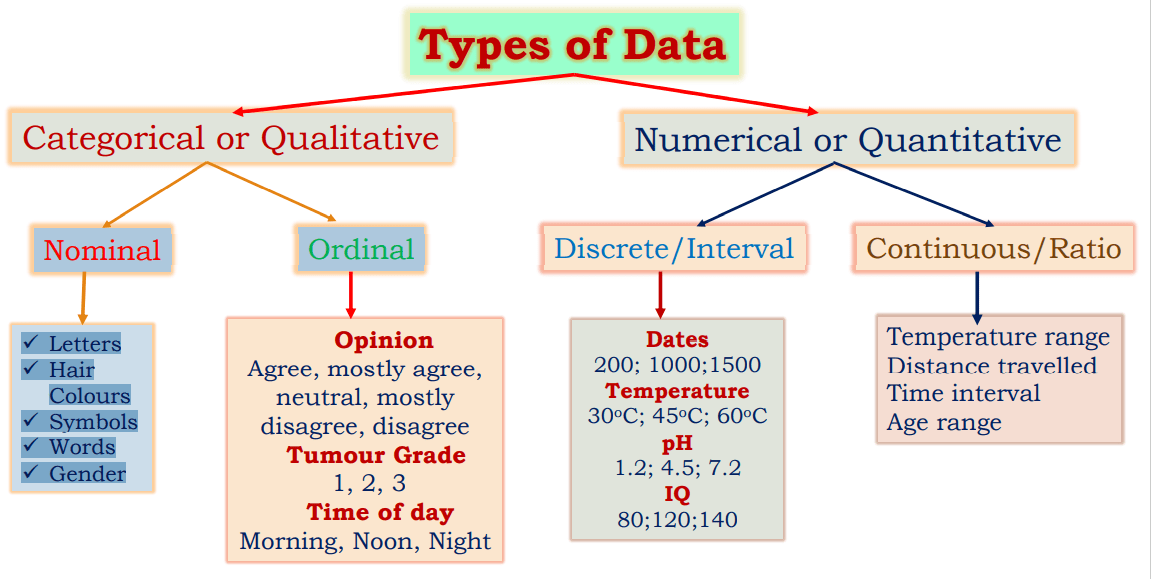
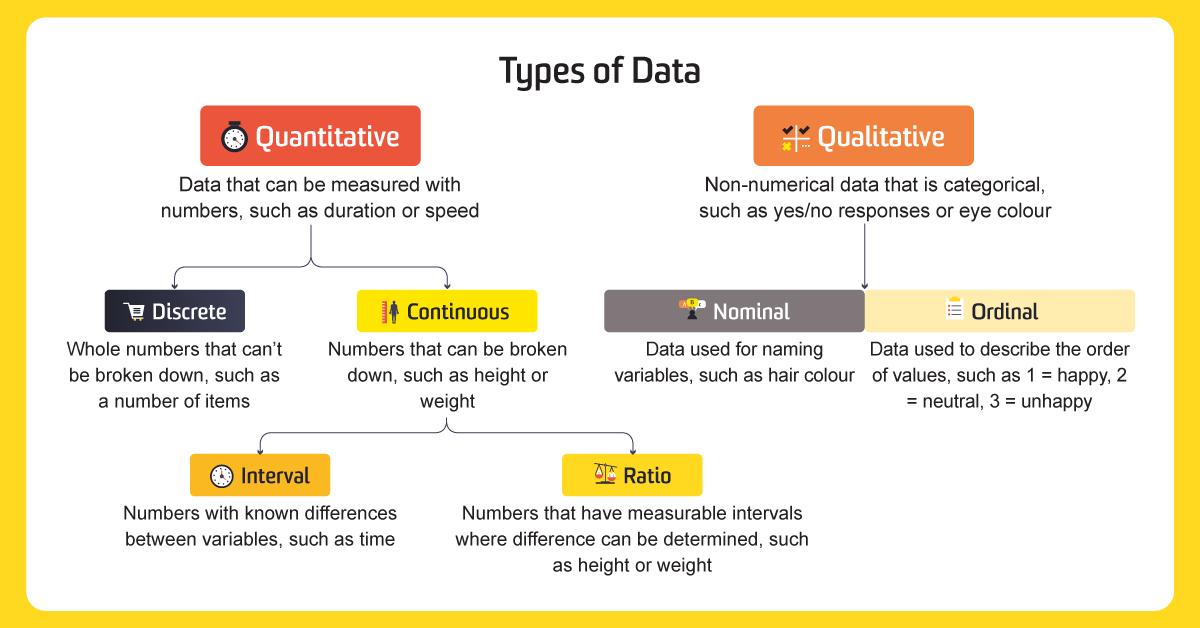
Based on the provided visuals, data can be broadly divided and then further broken down:

I. Categorical or Qualitative Data

Non-numerical data that describes characteristics, such as yes/no responses or eye colour.

  • Nominal Data:
    • Description: Data used for naming variables, without any order or hierarchy.
    • Examples: Hair colour, Gender, Letters, Colours, Symbols, Words.
  • Ordinal Data:
    • Description: Data used to describe the order of values, where categories have a meaningful sequence, but the differences between ranks are not necessarily equal.
    • Examples: Opinion (Agree, neutral, disagree), Tumour Grade (1, 2, 3), Time of day (Morning, Noon, Night), 1 = happy, 2 = neutral, 3 = unhappy.
  • II. Numerical or Quantitative Data

    Data that can be measured with numbers, such as duration or speed.

  • Discrete Data:
    • Description: Whole numbers that can't be broken down, often representing counts.
    • Examples: Number of items, Dates (200; 1000; 1500), Temperature in specific increments (30°C; 45°C; 60°C), pH (1.2; 4.5; 7.2), IQ (80; 120; 140).
  • Continuous Data:
    • Description: Numbers that can be broken down into smaller units, representing measurements along a continuous scale.
    • Examples: Height, Weight, Temperature range, Distance travelled, Time interval, Age range.
  • Interval Data:
    • Description: Numbers with known differences between variables, but without a true zero point (zero doesn't mean the absence of the characteristic).
    • Examples: Time (from the visual's first diagram), Temperature (from the visual's second diagram, also showing as discrete/interval).
  • Ratio Data:
    • Description: Numbers that have measurable intervals and a true zero point (zero means the absence of the characteristic), allowing for meaningful ratios.
    • Examples: Height, Weight (from the visual's first diagram), Distance travelled, Time interval, Age range (from the visual's second diagram, also showing as continuous/ratio).
  • VARIABLES

    Qualities or quantities, properties, or characteristics of people, things, or situations that change or vary. They can have more than one value, such as height or weight.

  • Independent Variable (IV):
    • Variables purposely manipulated or changed by the researcher. Also called a "Manipulative Variable."
    • Example: In "factors influencing the uptake of family planning services," the "factors influencing" are the independent variables (e.g., educational level, access to clinics, cultural beliefs).
  • Dependent Variable (DV):
    • The variable influenced by the independent variable. It's the outcome variable that the researcher aims to understand, explain, or predict.
    • Example: Following the previous example, "uptake of family planning services" is the dependent variable.
  • Extraneous Variable (EV):
    • Undesirable variables that influence the relationship between the independent and dependent variables. They are not the focus of the study but can affect the outcome.
    • Example: In a study examining the effect of a new teaching method on student performance, students' prior knowledge or motivation could be extraneous variables.
  • Confounding Variable:
    • A type of extraneous variable that is related to both the independent and dependent variables, making it difficult to determine the true relationship between the IV and DV.
    • Example: In a study looking at the relationship between coffee consumption and heart disease, smoking could be a confounding variable if coffee drinkers are also more likely to smoke, and smoking itself increases heart disease risk.
  • Intervening Variable:
    • Hypothetical variables that help explain the relationship between the independent and dependent variables but cannot be directly observed or measured. They intervene between the IV and DV.
    • Example: In a study where increased job satisfaction (IV) leads to increased productivity (DV), "motivation" could be an intervening variable. Job satisfaction leads to increased motivation, which in turn leads to increased productivity.
  • Moderating Variable:
    • A variable that influences the strength or direction of the relationship between an independent variable and a dependent variable. It "moderates" the relationship.
    • Example: In a study on the relationship between stress (IV) and job performance (DV), social support could be a moderating variable. The negative effect of stress on performance might be weaker for individuals with high social support.
  • Control Variable:
    • Variables that are kept constant or accounted for by the researcher to minimize their potential effect on the relationship between the independent and dependent variables.
    • Example: In an experiment testing the effectiveness of a new fertilizer on plant growth, factors like sunlight exposure, soil type, and water amount would be controlled variables.
  • Categorical Variable:
    • Variables that can be divided into distinct categories, but do not have a natural numerical order.
    • Example: Gender (male, female, non-binary), blood type (A, B, AB, O), religious affiliation.
  • Continuous Variable:
    • Variables that can take on any value within a given range, and can be measured with infinite precision.
    • Example: Height, weight, temperature, time.
  • Dichotomous Variable:
    • A type of categorical variable that can only take on two values or categories.
    • Example: Yes/No, True/False, Alive/Dead, Pass/Fail.
  • Other Key Research Concepts
    OPERATIONAL DEFINITION

    The specific way a researcher defines and measures variables in a study. It specifies how study variables will be observed or measured in the actual research situation.

    • Example: If "pain" is a variable, its operational definition might be "the score on a 0-10 numerical pain rating scale reported by the patient."
    HYPOTHESIS

    A statement of the predicted relationship between two or more variables in a research study; an educated or calculated guess by the researcher.

    • Example: "Increased nurse-to-patient ratios will lead to decreased patient fall rates."
    LIMITATIONS

    Restrictions in a study that may decrease the credibility and generalizability of the research findings. These are flaws or shortcomings, perhaps due to limited resources, small sample size, or an imperfect methodology. Acknowledging limitations demonstrates honesty and a comprehensive understanding of the topic.

    • Example: "The small sample size of this study (n=30) limits the generalizability of these findings to a broader population of critical care nurses."
    POPULATION

    The entire set of individuals or objects sharing common characteristics, selected for a research study.

    • Target Population:
      • The entire group of individuals (or objects) that the researchers are interested in and to whom they want to generalize their findings.
      • Example: All pregnant women in a specific country.
    • Accessible Population:
      • The subgroup of the target population that is available to the researcher for a particular study.
      • Example: All pregnant women attending a particular antenatal clinic during the study period.
    SAMPLE

    A part or subset of the population selected to participate in the research study.

    • Representative Sample:
      • A sample whose characteristics closely mirror those of the population from which it is drawn. This allows for better generalization of findings.
    SAMPLING

    The act, process, or technique of selecting a representative part of a population (a sample) to determine characteristics of the whole population.

    • Probability Sampling:
      • Selecting subjects or sampling units from a population using a random procedure, ensuring each member has a known chance of selection.
      • Examples: Simple Random Sampling, Stratified Random Sampling.
    • Non-Probability Sampling:
      • Selecting subjects or sampling units from a population using a non-random procedure, where not every member has an equal chance of selection.
      • Examples: Convenience Sampling, Purposive Sampling.
    RELIABILITY

    The degree of consistency or accuracy with which an instrument measures the attributes it is designed to measure. It refers to the stability and consistency of results over time or across different administrations.

    • Example: A blood pressure cuff is reliable if it consistently gives similar readings when taken multiple times in a short period on the same person, assuming the person's blood pressure hasn't changed.
    VALIDITY

    The degree to which an instrument truly measures what it is intended to measure. It refers to the extent to which research findings represent reality.

    • Example: A questionnaire designed to measure anxiety is valid if it actually measures anxiety and not, for example, stress or depression.
    PRE-TESTING

    The stage in research where data collection instruments (like questionnaires) are tested on a small group of people from the target population before the main study. This identifies potential problems.

    • Purpose:
      • To find and solve problems with the data collection instrument.
      • To ensure the tools are valid, leading to reliable results.
      • To check if respondents can and will provide the needed information.
      • To allow the assessor to test solutions to questionnaire problems.
    • Principles:
      • Should mimic the actual data collection conditions as closely as possible.
      • Should involve participants similar to those in the main sample.
      • Careful notes should be taken on problems and potential solutions.
    PILOT STUDY

    A smaller version of a proposed study, conducted to refine the research methodology. It uses similar subjects, settings, treatments, and data collection/analysis techniques as the main study. It aims to test the feasibility of instruments and methods.

    • Example: Before a large study on a new nursing intervention, a pilot study might test the intervention on a small group of patients to ensure the procedures are clear, the data collection tools work, and the study is manageable.
    ANALYSIS

    The method of organizing, sorting, and scrutinizing data to answer research questions or draw meaningful conclusions. It usually follows the presentation and interpretation of research findings.

    • Example: Using statistical software to compare patient recovery times between two treatment groups or reading interview transcripts to identify common themes.
    INFORMED CONSENT

    The ongoing process where participants learn key facts about a study before deciding to participate, and continue to receive information throughout. Doctors, nurses, or researchers explain study details to help individuals make an informed decision.

    COHORT

    In epidemiology, a group of individuals who share a common characteristic or experience.

    • Types:
      • Prospective Cohort: Studies participants from the present into the future.
      • Retrospective Cohort: Studies participants based on their past records or experiences.
    • Example: A group of nurses who graduated from the same university in the same year (a cohort) might be followed for 20 years to study their career progression.
    BIAS

    When a point of view prevents impartial judgment on issues related to that viewpoint. In clinical studies, bias is controlled through methods like blinding and randomization.

    • Example: If a researcher believes a certain drug is superior, they might unconsciously interpret results in a way that favors that drug.
    BLIND

    In a randomized clinical trial, "blind" (or masked) means participants are unaware of which treatment arm (e.g., experimental drug or placebo) they are assigned to.

    • Example: In a "single-blind" study, only the participants don't know their treatment. In a "double-blind" study, neither the participants nor the researchers administering the treatment know.
    SIDE EFFECTS

    Any undesired actions or effects of a drug or treatment. These negative or adverse effects can include headaches, nausea, hair loss, skin irritation, or other physical problems. Experimental drugs are evaluated for both immediate and long-term side effects.

    Terms Used in Research Read More »

    Teaching and Learning process

    TEACHING-LEARNING PROCESS

    Teaching – Learning Process

    Teaching – Learning Process Learning Outcomes.

    By the end of this session, learning will be able to;
    1. Define teaching and learning
    2. State elements that make up a teaching -learning process
    3. List the phases involved in teaching process
    4. Outline the tasks of the teacher
    5. State the phases of learning
    6. Explain factors influencing learning
    7. Mention ways how teachers can use to help students learn
    Definitions
    • Education – is a process through which an individual attains knowledge, skills, attitudes and other abilities required for leading a productive life in the society
    • Teaching: deliberate intervention that involves planning and implementation of instructional activities in order to bring about desired behavioral changes in students.
    • Learning – is the process of acquiring new knowledge skills and attitudes which enable students to do something that they could not do before OR this is a change in an individual’s behavior as a result of receiving instructions.
     

    Teaching-learning process

    This a combined process where an educator assesses learning needs, establishes specific learning objectives, develops teaching and learning strategies, implements plan of work and evaluates the outcome of the instruction.
    • Learning is brought about through teaching. Teaching process is the arrangement of the environment within which the students can interact and study how to learn.
    The process of teaching and learning aims at transmission of knowledge, imparting skills and formation of attitude, values and behavior.

    Elements/components of teaching-learning process

    1. Learner– someone who is going to attain knowledge and skills in order to change behavior
    2.  Teacher– someone who selects and organizes teaching-learning process
    3. Learning objectives– intended learning outcomes which can be observed or measured.
    4. Sequence of stimulus-response stimulation (teaching) -here the teacher starts to direct learning in order to ensure enhancement of student’s cognitive (knowledge), psychomotor (skills) and affective (attitude ) abilities.
    5. Reinforcement of the behavior-there should be an activity which increases the likelihood that some event will occur again. It can involve continuous practice of what has been taught.
    6.  Monitoring, assessment and evaluation-it involves finding out whether the set objectives were achieved.

    TEACHING PROCESS 

    Qualities of a good teacher
    •  Enthusiastic with content to be taught.
    • Organized
    • Good communicator
    • Active listener
    • Empathy
    • Time manager
    • Confident
    • Respectful
    • Counsellor
    • Honesty/ trustworthy
    • Knowledgeable
    • Good teaching ethics
    • Good leader- lead and guide learners
    • Team work
    • Creative /innovative

    The Teaching and Learning Process refers to phases of teaching i.e. steps  taken to achieve effective teaching and learning. Sometimes it is referred to  as The Instruction Process

    They include: 

    1. Planning for teaching: 
    •  Mind about the nature or level of the learners- whom am I going  to teach? 
    •  Prepare teaching objectives-what am I going to teach? ∙ Prepare the teaching method(s)-what appropriate strategy or  strategies am I going to use in teaching? 
    •  Prepare the teacher’s and learners’ tasks-what will I do to involve  my learners in their learning? 
    •  Prepare teaching aids/materials-what do I need to teach/what  tools or equipment will I use in teaching? 
    •  Prepare the assessment and evaluation methods-how will I know  that my learners have achieved the level of ability or competence  I want? 
    •  Research and review the content meant for teaching-am I  confident of what I am going to teach? 

    Remember: failing to prepare for teaching you are preparing to fail  teaching

            2. Implementation of teaching (active phase): 

    •  Creating rapport 
    •  Introducing teaching/learning objectives 
    •  Assessing learners’ prior knowledge 
    •  Giving content and major ideas of the session, 
    •  Implementing the teaching methods.  
    1. Assessment and Evaluation of teaching:  

    Measure the level of acquired skills, attitudes or knowledge (determine the  level of achievement of the objectives of teaching and learning) by: 

    • ∙ Ask one of the learners to summarize  
    • ∙ Ask important questions about what has been taught 
    • ∙ Administer the assessment tool/test 
    • ∙ Score/mark the learners 
    • ∙ Giving feedback about performance of the learners 
    • ∙ Determine or decide the direction to take basing on their  performance

    THE SIX MAJOR TASKS OF A TEACHER

    1.  Planning
    • Decide what students should learn (prepare objectives / tasks)
    • Put the contents in a suitable sequence
    • Allocate amount of time and different learning activities.
    • Select learning activities and teaching methods
    • Choose assessment procedures
    • Identify resources needed
    • Inform the student about the plan
     
            2. Communications

    • Tell, explain, advise
    • Help students to exchange ideas. Students can still learn in your absence
    • Provide students’ thinking
    • Use varied teaching techniques, Be creative
    • Detect whether students understand.
     
             3. Providing Resources

    • Prepare, select or adapt educational materials e.g. handouts, exercises, reference books etc.
    • Arrange learning experiences, especially opportunities to practice skills (visit the wards, Field visit, attachments to clinical areas & projects etc.)
    • Arrange aceess to materials (Such as patients, learning models, libraries, audio visual programs etc)
            4. Counselling

    • Show students that you care.
    • Listen and attempt to understand
    • Help students to identify their options and to make their decisions
    • Provide advice and information that helps students.
     
         5. Assessment

    • Design an assessment that measures how much students have learnt
    • Use the assessment to guide students learning
    • Use the assessment to give feedback that modifies teaching.
    • Use the assessment to decide whether students are competent to provide health care.
    • Encourage students to use self -assessment and peer-assessment.   
         6. Continuous self education

    • Know the subject matter that is taught and where to find relevant information
    • Know the way in which health care is provided locally.
    • Set an example as a continuous learner.
    LEARNING PROCESS

    LEARNING PROCESS

    Learning is defined as a change in an individual’s behaviour caused by experiences or self activity
     

    Types of learning

    Learning involves either physical or mental activities. There are different types of learning which could be classified as:

    1. Depending on the way of acquiring knowledge
    •  Formal learning– it occurs in organized or structured form like school or workplace
    • Informal learning-this is learning that occurs away from structured, formal environment. It happens through self-directed learning or experience like observing,
    • Non-formal learning– it includes various structured learning situation which do not have a curriculum or syllabus e.g swimming, driving, scouting sessions
            2. Depending on the number of individuals
     
    • Individual learning- involves self directed training and instructions
    • Group learning– co-operative learning involving groups of people

    Roles of a learner

     
    1. Attending classes on time
    2. Completing all assignments
    3. Active participation in class and all school activities
    4. Revision or reading on regular basis
    5. Respecting teachers and colleagues
    6. Plan their time
    7. Give feedback to teachers
    8. Maintain discipline in the class
    9. Maintain environment clean and keep school property in good condition
    10. Abide to school rules and regulation
     

    Phases of Learning

    These are steps involved as learning is taking place.
    1.  Motivation phase– the learner must be motivated to learn by expectation that learning will be rewarding. Each learner has their motives and needs in life to achieve.
    2. Apprehending phase– learner stands or pay attention if learning has to take place. It involves understanding or perceiving what is taught.
    3. Acquisition phase – while learner is paying attention, there is attainment of new information or behaviour.
    4. Retention phase– newly acquired information must be transferred from short term to long term memory.
    5. Recall phase – recall previously learned information; to learn to gain access to what has been learned is a critical phase in learning.
    6. Generalization phase – transfer of information to new situations allows application of the learned information in the context in which it was learned.
    7.  Feedback phase – students must receive feedback on their performance after assessment.

    WAYS TEACHERS CAN USE TO HELP STUDENT LEARN (ROLES)

    1. Individualize: Allow for individual differences and abilities.
    • Accept all students as they are, and then start to do a good work in them.
    • Consider students as individuals, engaged each in learning on their own.
    • Vary your teaching.
    • Try to make sure that each student gets what he / she needs.
     
       2. Active learning: Give students some activity to do, e.g. ask questions, set problems, projects, or case studies, etc

    • Students learn by doing these activities.
       3.  Give feedback; Give frequent, early, positive feedback that supports students’ beliefs that they can do well.

    •  Tell students how well they are doing things,
    • What was done poorly and how they could have done better in order to correct their mistakes.

       4. Also encourage students to provide their own feedback

    • Like, how best they need to learn, check their own work for mistakes etc.
       5. Clarity: Make your teaching clear, speak loudly, write neatly, use visual aids and make your teaching meaningful and relevant to the students.
    •   Help students to make sense of what they are learning by showing how it is relevant to them
       6. Ensure mastery: Check that all students know and can do it.
    • Provide plenty of practice and repetition of what they learn
      7. Tell students what they need to do to succeed in your course.
    • Don’t let your students struggle to figure out what is expected of them.
    • Reassure students that they can do well in your course, and tell them exactly what they must do to succeed
       8. Be enthusiastic (love) about your subject.
    • An instructor’s enthusiasım is a crucial factor in student motivation. If you become bored or apathetic, students will too.
       9. Sequence: Organise what is to be learned so that students find it easy and systematic.
    • From easy to difficult
    • From what they know to what they don’t know
      10. Demonstrations: Help students see very clearly what they are trying to learn.
    • – Use illustrations
      11. Vary your teaching methods.
    • Variety reawakens students’ involvement in the course and their motivation.
    • Break the routine by incorporating a variety of teaching activities and methods in your course: ward teaching, role playing, debates, brainstorming, discussion, demonstrations, case studies, audiovisual presentations, or small group work.
    12. Design tests that encourage the kind of learning you want students to achieve
     
    • If you base your tests on memorizing details, students will focus on memorizing facts.
    • If your tests stress the synthesis and evaluation of information, students will be motivated to practice those skills when they study.
      13. Avoid using grades as threats.
    • The threat of low grades may prompt some students to work hard, but other students may resort to academic dishonesty, excuses for late work, and other counterproductive behavior.
      14. Motivation: Help to motivate students, to see that they want to learn
    • Make your teaching interesting, lively, relevant and rewarding.
    Assignment 
    Unfortunately, there is no single magical formula for motivating students. Many factors affect a given student’s motivation to learn. Explain the 10 factors that motivate students to learn.
    1. 1. Relevance and Meaningful Learning: When students can see the relevance of what they are learning to their lives, interests, and future goals, they are more likely to be motivated to engage with the subject matter.

    2. 2. Autonomy and Choice: Allowing students to have some control over their learning, such as selecting projects or topics of interest, can enhance their motivation and sense of ownership in the learning process.

    3. 3. Clear Goals and Expectations: Setting clear and achievable learning goals helps students understand what is expected of them and provides a sense of direction, which can increase their motivation to accomplish those objectives.

    4. 4. Positive Learning Environment: A supportive and positive classroom or learning environment, where students feel respected, valued, and safe, can foster motivation and a willingness to participate actively.

    5. 5. Recognition and Rewards: Acknowledging and rewarding students’ efforts and achievements, both individually and collectively, can boost their confidence and motivation to excel in their studies.

    6. 6. Teacher Enthusiasm and Engagement: Teachers who show genuine enthusiasm for their subjects and actively engage students in the learning process can inspire excitement and curiosity, motivating students to learn.

    7. 7. Peer Interaction and Collaboration: Collaborative learning experiences and positive interactions with peers can create a sense of community and motivation to learn from and with others.

    8. 8. Intrinsic Curiosity and Interest: Cultivating curiosity and encouraging students to explore topics that fascinate them can lead to a natural desire to learn and discover more.

    9. 9 Feedback and Progress: Providing constructive and timely feedback on students’ work helps them understand their strengths and areas for improvement, contributing to their motivation to progress and grow.

    10. 10 Challenging Yet Attainable Tasks: Striking the right balance between challenging students with meaningful tasks and ensuring those tasks are achievable can foster a sense of accomplishment and motivation to take on new challenges.

    TEACHING-LEARNING PROCESS Read More »

    Formulation of research topics

    Formulation of research topics

    Formulation of Research Topics & Objectives
    Formulation of Research Topics & Objectives
    Formulation of Research Topics

    Often, researchers want to define a research topic before fully understanding the underlying problem. However, a strong research topic emerges from identifying issues that require attention and solutions.

    This means a problem should be at hand in order to develop a research topic, which then naturally leads to objectives and questions.

    A research topic (or title) is essentially a central theme or idea around which all aspects of the research will revolve.

    Visualizing Research as a Tree: Imagine the research process as a tree:
    • Root: The research topic acts as the root, anchoring all ideas and ensuring every concept identifies with the topic.
    • Stem: The middle ideas and activities form the stem of the tree, connecting the root to the upper parts.
    • Branches, Leaves, and Fruits: These represent the actual conducting of the research.
    • Fruits: The research findings are the fruits. These should directly relate to the initial "fruit planted" (the topic), meaning the information obtained must have a clear relationship with the topic.

    Example Topic: ‘A study on knowledge and practice among mothers of neonates at Soba village, Jota district.’

    Research Problem

    A research problem is the core interest of a researcher, representing what they aim to discover or study. It can be defined as a statement about an area of concern, a condition to be improved, or a difficulty to be eliminated.

    Sources of a Research Problem

    Research problems can originate from various avenues:

    • Personal Interest and Experience: Researchers often draw from their own observations, professional experiences, or personal curiosity. For example, a nurse might notice a recurring issue in patient care that sparks a desire to investigate.
    • Use of Intellectual Curiosity: Asking fundamental questions like "How?" "Why?" "What if?" "What factors influence...?" can lead to the identification of researchable problems.
    • Prior Research and Recommendations: Reviewing existing literature often reveals recommendations for further studies, unsolved questions, or limitations in previous research that present new problems to explore.
    • Program Evaluation Gaps: During the assessment of a specific program or intervention, a researcher might identify an unaddressed gap or an area needing further investigation to improve effectiveness.
    • Direct Observation of Community Needs (Applied Research): Observing current needs or challenges within a community often gives rise to applied research problems aimed at finding practical solutions. For instance, a health worker might observe a high prevalence of a certain disease in a community, prompting research into its causes or prevention strategies.
    Examples of Research Problems

    A research problem is often framed by asking specific questions:

    1. "What is the cause of the cholera outbreak among people in Katanga?"
      • Here, the researcher is interested in studying or finding out the cause of the cholera outbreak among people in Katanga. This problem identifies a health crisis, a specific population, and a location.
    2. "Which age group is most affected by malaria in Mulago?"
      • Here, the researcher is interested in studying or finding out the age group most affected by malaria in Mulago. This problem identifies a disease, a specific demographic, and a location.
    Themes of Researchable Topics (according to UHPAB Guidelines)

    Trainees should select topics related to Nursing and Midwifery practice. The following are some examples, but Trainees are not limited to those listed below:

    • a) Reproductive health
    • b) Legal aspects in Nursing Practice
    • c) Mental Health
    • d) Management, leadership, and Administration in Nursing
    • e) Child Health
    • f) Older adults and gerontological Nursing
    • g) Neglected / Forgotten diseases and vulnerable groups
    • h) Persons with special needs
    • i) Infectious and Emerging Diseases like Ebola, Marburg virus, swine flu, and others
    • j) Task shifting in Healthcare, skill mixing, and task sharing
    • k) Gender-related issues in the Nursing profession
    • l) Occupational Health Hazards
    • m) Nursing Education
    • n) Nursing Practice
    • o) Genetics and Genomics
    • p) Community and Public Health
    How to Develop a Research Topic/Question

    This process integrates problem identification with narrowing down to a focused question:

    1. Begin by identifying a broader subject of interest that may lead to investigation:
      • Example: Diarrheal diseases.
    2. Do preliminary research on the general topic:
      • Find out what research has already been done and what literature already exists. This helps in understanding the current state of knowledge.
    3. Begin with "information gaps" (What do you already know about the problem?):
      • Example: You might know that studies exist showing the high incidence of diarrheal diseases.
      • What do you still need to know? (e.g., causes of diarrheal diseases, risk factors to diarrheal diseases, effectiveness of specific interventions, etc.).
    4. What are the broad questions?:
      • The need to know about a problem will lead to a few specific questions.
      • Example: What are the primary drivers of diarrheal disease burden in specific communities?
    5. Narrow this to a specific population:
      • Example: Among children less than one year.
    6. Narrow the scope and focus of research:
      • Combine the problem, population, and specific aspect.
      • Example: "Assessment of risk factors to diarrheal diseases among children less than one year in [Specific Region/Village]."
    Qualities of a Good Research Topic

    A good research topic should be FINER (Feasible, Interesting, Novel, Ethical, and Relevant) and therefore should have the following attributes:

    • Relevant to the Nursing profession: Directly addresses issues, practices, or knowledge gaps within nursing and midwifery.
    • Feasible in relation to time, method, material resources, and funds: Can realistically be completed within the given constraints.
    • In line with national development priorities: Contributes to broader health goals or policies of the country (e.g., Uganda).
    • Acceptable by the leadership: Politically, culturally, professionally, and economically viable and supported by relevant stakeholders.
    • Potentially advancing new knowledge in Nursing: Offers the possibility of contributing fresh insights or understanding.
    • Applicable in the Nursing profession: The findings can be used to improve practice, education, or policy in nursing.
    • In the trainee’s interest and appealing to the reader: Keeps the researcher motivated and engages the target audience.
    • Ethically acceptable: Adheres to all ethical guidelines and principles, ensuring participant safety and rights.
    • Reflect a level of innovativeness: Shows some originality or a fresh perspective on an existing problem.
    The FINER Criteria:
    • F: Feasible: The problem must be researchable within practical constraints such as cost, available time, access to respondents/participants, and other resources.
    • I: Interesting: The problem should be interesting enough to sustain the researcher's motivation through the many hurdles and frustrations of the research process. It's also wise to confirm that others (e.g., academic community, stakeholders) also find it interesting, ensuring its relevance.
    • N: Novel: Good research contributes new information. The problem should ideally explore something that is not too common or has not been extensively researched, offering fresh insights.
    • E: Ethical: The study should not pose physical, psychological, social, or financial risks to respondents, nor should it involve an invasion of privacy. Ethical considerations are paramount.
    • R: Relevant or Significant: Consider how the results of addressing this problem might advance scientific knowledge, improve clinical practice, or influence health policy. The problem should have a meaningful impact on society.
    Research Objectives

    A research objective is a clear and summarized statement that provides direction to investigate the variables under study. A clearly defined objective directs a researcher in the right direction. Well-defined objectives are an important feature of a good research study. Without a clear objective, a researcher is aimless and directionless in conducting the study, and without focused objectives, no replicable scientific findings can be expected.

    Why Research Objectives?

    Research objectives are crucial for several reasons:

    • FOCUS: A clearly defined research objective helps the researcher to focus on the study. The formulation of research objectives helps in narrowing down the study to its essentials. It avoids unnecessary findings, which otherwise lead to a wastage of resources.
    • AVOID UNNECESSARY DATA: The formulation of research objectives helps the researcher to avoid unnecessary accumulation of data that is not needed for the chosen problem.
    • ORGANIZATION: The formulation of objectives organizes the study into clearly defined parts or phases. Thus, the objectives help organize the study results into main parts as per the preset objectives.
    • GIVES DIRECTION: A well-formulated objective facilitates the development of research methodology and helps to orient the collection, analysis, interpretation, and utilization of data.
    Characteristics of a Good Research Objective

    A well-stated objective must be “SMART”:

    • S – SPECIFIC: A good research objective should be clear and focused on a specific aspect or goal of the study. It avoids being too broad or vague, so researchers know exactly what they want to achieve.
    • M – MEASURABLE: The objective should be measurable, meaning that there should be a way to determine if the research goal has been achieved. It’s important to use concrete and quantifiable terms to assess the outcomes.
    • A – ATTAINABLE: The research objective should be achievable within the resources, time, and scope of the study. It’s important to set realistic goals that can be accomplished with the available means.
    • R – REALISTIC: A good research objective should be grounded in reality and aligned with what is feasible. Researchers should consider practical constraints and not set impossible goals.
    • T – TIME-BOUND: The objective should have a specific timeframe within which it will be accomplished. Setting a deadline helps researchers stay focused and ensures the study progresses effectively.
    Types of Research Objectives

    Research objectives are generally categorized into two types:

    1. General Objectives

    General objectives are broad goals to be achieved. They state what the researcher expects to achieve by the study in general terms. General objectives are broad and overall goals that the researcher aims to achieve through the study. They provide a big-picture view of what the research intends to accomplish. These objectives are not very detailed and do not specify the exact actions to be taken. Instead, they outline the general direction and purpose of the study.

    • Example: For a nursing research study on patient satisfaction, a general objective could be: “To assess the factors influencing patient satisfaction in a hospital setting.” or “The study will aim at assessing the factors influencing patient satisfaction in a hospital setting”
    2. Specific Objectives

    Specific objectives are short-term and narrow in focus. General objectives are broken into small, logically connected parts to form specific objectives. The general objective is met through meeting the specific objectives stated. Specific objectives clearly specify what the researcher will do in the study, where, and for what purpose the study is done. Specific objectives are more detailed and narrow in focus. They are derived from the general objective and break it down into smaller, manageable parts. These objectives clearly state what the researcher will do, where the study will take place, and the specific purpose of the study.

    • Example: Continuing from the general objective above, specific objectives could be:
      • “The study will aim at identifying individual factors influencing patient satisfaction in a hospital setting.”
      • “The study will aim at finding out health worker related factors influencing patient satisfaction in a hospital setting..”

    In this example, the specific objectives provide clear directions for data collection and analysis. Achieving these specific objectives will contribute to fulfilling the broader, general objective of understanding the factors influencing patient satisfaction.

    Overall, general objectives set the overall direction of the research, while specific objectives break down the research process into smaller, achievable steps, guiding the researcher in accomplishing the broader research goal.

    Example 2: Risk Factors to Diarrheal Diseases Among Children Below 1 Year

    In the example provided, the broad objective and specific objectives can be identified as follows:

    • Broad Objective: The broad objective is the overarching goal of the research study. In this case, the broad objective is: “The study will aim at identifying risk factors to diarrheal diseases among children below 1 year.”
    • Specific Objectives: Specific objectives are the smaller, more focused goals that contribute to achieving the broad objective. In this example, some specific objectives could be:
      • “To assess socioeconomic risk factors to diarrheal diseases among children below 1 year.”
      • “To find out environmental risk factors to diarrheal diseases among children below 1 year”
    How to State Objectives
    • The objective should be presented briefly and concisely.
    • The objective should cover the different aspects of the problem and its contributing factors in a coherent way and in a logical sequence.
    • The objectives should be clearly phrased in operational terms, specifying exactly what the researcher is going to do, where, and for what purpose.
    • The objectives are realistic considering the local conditions.
    • The objectives use action verbs that are specific enough to be evaluated.
    Examples of Action Verbs:
    • Define
    • Describe
    • Draw
    • Identify
    • Label
    • List
    • Match
    • Record
    • Select
    • State
    • Name
    • Outline
    • Point out
    • Quote
    • Read
    • Recite
    • Recognize

    Formulation of research topics Read More »

    Research Ethics

    Ethics in Research

    Research Ethics
    Research Ethics

    Ethics is the discipline of telling good from bad, involving moral duty. It's a set of moral principles that guide behavior and conduct for individuals or groups.

    In research, ethics provides guidelines for responsible conduct, protecting the welfare and rights of participants. It also educates and monitors scientists to ensure high ethical standards.

    History of Research Ethics

    Modern research ethics began because of the need to protect human subjects.

    • The Doctors' Trial (1946-1947): The first major effort to set regulations happened during this trial in Germany after World War II. It was part of the Nuremberg Trials for Nazi war criminals who violated basic ethical principles.
    • The Nuremberg Code: This emerged from the Doctors' Trial, providing ten ethical guidelines that stressed voluntary consent, societal benefits, and avoiding harm. It prohibited research with potential for serious injury or death. This code laid the groundwork for future initiatives.
    • Helsinki Declaration: This initiative built on the Nuremberg Guidelines to promote responsible research involving human subjects.
    • The Belmont Report (1978): Published by the U.S. National Commission, this report further defined key ethical principles in research.
    The Nuremberg Code: Ten Ethical Principles

    The Nuremberg Code outlined ten basic ethical principles that were violated during the Doctors' Trial, and which now guide ethical research:

    1. Voluntary Consent: Research participants must freely agree to participate.
    2. Societal Benefit: Research aims should contribute to the good of society.
    3. Sound Basis: Research must be based on solid theory and prior animal testing.
    4. Avoid Suffering: Research must avoid unnecessary physical and mental suffering.
    5. No Serious Harm: No research projects can proceed if serious injury or death are potential outcomes.
    6. Risk vs. Benefit: The risks to participants cannot outweigh the anticipated benefits of the results.
    7. Proper Environment & Protection: Participants need a safe environment and protection.
    8. Qualified Persons: Experiments can only be conducted by scientifically qualified individuals.
    9. Right to Withdraw: Human subjects must be allowed to stop participating at any time.
    10. Scientist's Responsibility: Scientists must be prepared to stop the experiment if there's reason to believe it will cause harm, injury, or death.
    Major Concerns in Research Ethics

    Two primary ethical concerns in research are plagiarism and authorship:

    PLAGIARISM
  • Definition: The act of presenting someone else’s ideas, thoughts, pictures, theories, words, or stories as your own.
  • Consequence: Plagiarizing undermines the integrity, ethics, and trustworthiness of a researcher's work.
  • Forms of Plagiarism:
    • Intentionally taking a passage word-for-word without proper credit.
    • Unintentionally (or lazily) paraphrasing and piecing together fragmented texts from several works without proper citation.
    • Note: The scientific community does not tolerate any form of plagiarism, including unintentional plagiarism.
  • How to Handle Plagiarism:
    • Cite all ideas and information that are not your own or common knowledge.
    • Use quotation marks when directly using someone else’s exact words.
    • Clearly indicate the origin of paraphrased sections and provide proper citations.
    • At the start of a paraphrased section, state that the information originated from another source.
    • At the end of a paraphrased section, place the proper citation.
  • AUTHORSHIP
  • Definition: The process of deciding whose names should appear on a research paper.
  • Responsible Practices: Research often involves collaboration. Responsible authorship means acknowledging all contributions and determining joint authorship when appropriate.
  • How Authorship is Achieved: Authorship credit should be based on meeting all three of the following conditions:
    • Substantial contributions to the conception and design of the work, or the acquisition of data, or the analysis and interpretation of data; AND
    • Drafting the article or revising it critically for important intellectual content; AND
    • Final approval of the version to be published.
  • What Does Not Justify Authorship: Simply acquiring funding, collecting data, or providing general supervision of the research group alone is not enough for authorship.
  • "Can I be a co-author?" Only if you:
    • Contribute substantially to the research, AND
    • Write or revise all or part of the manuscript, AND
    • Approve the final version of the entire article.
  • Research Misconduct

    Fabrication, falsification, or plagiarism in proposing, performing, or reviewing research, or in reporting research results. Research misconduct does not include honest error or differences of opinion.

    • Fabrication: Making up or recording false data or results.
    • Falsification: Manipulating research materials, equipment, processes, or omitting data to misrepresent the research.
    • Plagiarism: Appropriating another person’s ideas, processes, results, or words without giving appropriate credit.
    General Ethical Principles

    Research involving human subjects requires careful consideration of several ethical principles, crucial for nursing practice. Understanding and applying these principles ensures ethical research, especially in contexts like Uganda:

    1. Respect for Persons
    • Individuals have the right to make their own choices (autonomous decisions), and these choices should be respected. Those who cannot make decisions independently need extra protection.
    • Voluntary participants should receive enough clear information to make an informed decision about joining a study.
    • Example: In a study about informed consent for child patients, nurses must make sure parents or guardians fully understand the study's purpose, risks, benefits, and their right to remove their child at any time.
    2. Informed Consent
  • Research participants must clearly understand the study and willingly agree to take part.
  • Information given to participants must be complete, easy to understand, and adjusted to their language and abilities. Participants should never be forced or pressured to join.
  • Example: Before a study on older patients' pain management experiences, nurses must explain the study's goal, procedures, potential benefits, and risks, so participants can make an informed decision.
  • Requirements for Informed Consent:
    • Information Disclosure: The following must be clearly communicated:
      • Research procedure
      • Purpose of the research
      • Risks and anticipated benefits of participation
      • Alternative procedures (especially in studies involving treatment)
      • A statement confirming participants can ask questions and withdraw at any time.
    • Comprehension: Researchers must adapt information to be understandable for each participant, considering their:
      • Different abilities
      • Intelligence levels
      • Maturity
      • Language needs
    • Voluntariness: Consent must be given freely, without any pressure or coercion. Participants must be able to decide for themselves whether to participate.
  • 3. Privacy and Confidentiality
    • Protecting participants' sensitive information is vital.
    • Participants have the right to control their personal information. Researchers must ensure that all collected data is anonymized (identifiers removed) and stored securely.
    • Example: In a study on mental health stigma, nurses must guarantee that participants’ identities and personal details are kept confidential to protect their privacy and prevent potential harm.
    4. Beneficence
    • "Doing good." This means maximizing potential benefits while minimizing potential harm to research participants.
    • Researchers should aim for studies where the potential benefits clearly outweigh the risks. Participants should not face unnecessary risks or harm. Researchers must be ready to stop a study if it causes harm, and risks should never be out of proportion to expected benefits.
    • Example: When studying a new nursing intervention for wound care, nurses must ensure that the potential benefits for patients outweigh any discomfort or inconvenience they might experience.
    5. Justice
    • Treating people with "fairness."
    • This principle prevents certain populations from being unfairly burdened by research so that others can benefit. Researchers should avoid over-testing vulnerable groups (like marginalized communities, children, pregnant women, or those with mental health conditions) and ensure everyone has fair access to research opportunities.
    • Example 1: In a study on healthcare access in rural areas, nurses should ensure people from underserved communities have an equal chance to participate and benefit from the findings.
    • Example 2: For a study on a new medication for a chronic disease, fairness means including a diverse group of participants (e.g., pregnant mothers, elderly individuals). This ensures the medication's effectiveness is known for a wide range of people who might benefit, rather than only testing it on one group and then expecting everyone to use it.
    Research Oversight: Institutional Review Boards, Committees, Supervisors, and Trainees

    This section looks into the bodies and roles that ensure ethical conduct and quality in research involving human participants, particularly within the Ugandan context for nursing and midwifery students.

    The Institutional Review Board (IRB)

    The Institutional Review Board (IRB), also known as the Research and Ethics Committee (REC), is a crucial body. These committees are mandated by states, institutions, and organizations to review research proposals involving human participants to ensure ethical research practices. In Uganda, researchers, including nursing students, must engage with these committees to ensure ethical research. Prominent institutions in Uganda have Institutional-based Research Ethics Committees (e.g., The Uganda Christian University REC (UCU-REC), Mengo Hospital-REC, etc.).

    • Mandate: Reviews research proposals involving human participants to ensure ethical standards are met.
    • Roles:
      • Balances potential risks and benefits of the research.
      • Protects participants from unnecessary harm.
      • Ensures proportional compensation for participants.
      • Confirms the research is conducted by qualified scientists.
      • Ensures informed consent and other research-related documents are readable, understandable, and promote voluntary participation.
    • Example: As nursing students, when planning a research study involving human participants, it is important to submit the research proposal to the IRB for review and obtain ethical clearance before commencing the study. This ensures that the study adheres to ethical principles and safeguards the welfare of the participants.
    Composition of the Institutional Research Committee (IRC)

    The IRC ensures rigorous oversight of research projects:

    • The IRC shall be composed of five (5) members, of which at least two (2) must be female.
    • All members of the IRC MUST have experience in conducting research and possess a minimum of a Bachelor’s Degree.
    • The members of the IRC shall be appointed by the Governing Council / Board of Directors from the names proposed by the Principal.
    • All IRC members MUST have appointment letters signed by the Chairperson of the IRC.
    • The IRC members shall elect from among themselves a Chairperson and Secretary at their first sitting through a simple Majority vote.
    • The IRC may co-opt non-voting individuals to provide technical/specialized advice to the Committee or Trainee as may be deemed necessary.
    • The IRC may invite non-voting individuals as observers to attend meeting(s) of the IRC.
    • The Principal shall be an Ex-officio member of the IRC.
    Roles of Institutional Research Committee (IRC)

    The IRC plays a vital role in guiding and monitoring research within the institution:

    • Ensure adherence to UHPAB research guidelines by the institution.
    • Evaluate Trainees’ research topics and provide the necessary guidance.
    • Allocate Research Supervisors to each Trainee.
    • Review and approve Trainee’s research proposals in liaison with the Principal within a stipulated time.
    • Advocate for Trainees’ research interests.
    • Develop strategies that support/advance the conduct of academic research and related activities.
    • Provide feedback and guidance to the Trainee, Research Supervisors, Governing Council / Board of Directors.
    Research Supervisor

    A Research Supervisor is a person with a health-related academic background appointed by the IRC to technically guide the Trainee during the conduct of his/her academic research project.

  • Roles of the Research Supervisor:
    • Guide the Trainee during the selection of the research topic and conduct of the research project.
    • Guide the trainee on how to access the required resources for conducting his/her research.
    • Ensure that the Trainee’s topic is approved by the IRC before development of the full proposal.
    • Provide satisfactory advice and guidance on the conduct of the research and preparation of the research report.
    • Ensure that the Trainee complies with the UHPAB Academic Research guidelines.
    • Ensure that the Trainee complies with the stipulated deadlines for all the required stages of conducting his/her research.
    • Encourage the trainee to fully participate in the planning of his/her research and to take personal responsibility for the decisions made.
    • Monitor the progress of the trainee’s research conduct.
    • Provide timely, constructive, and effective feedback to the Trainee regarding his/her research work and overall progress.
    • Promote good research habits by the Trainee, such as guarding against plagiarism.
    • Support the Trainee to perform a plagiarism check of the final report using open source Turnitin software, to ensure adherence to the stipulated similarity index of 30%.
    • Support the Trainee to print a similarity index report and attach it to the final report.
    • Attend trainee’s presentation of the research proposal.
    • Promote a professional relationship with the trainees.
  • Roles of a Trainee

    The Trainee has specific responsibilities to ensure ethical and successful research:

    • Acquire a copy of UHPAB Academic Research Guidelines.
    • Adhere to UHPAB Academic Research Guidelines.
    • Identify a research topic and submit it to the Research Supervisor for guidance.
    • Present and defend his/her research topic to the IRC for guidance and approval.
    • Present and defend his/her research Proposal to the IRC for guidance and approval.
    • Conduct his/her own research and Participate in every step of the research process.
    • Be available / seek guidance from the Research Supervisor.
    • Comply with the research deadlines or stipulated time of every stage of conducting research.
    • Facilitate his/her own research.
    • Avoid any form of plagiarism in the process of conducting research.
    • Perform a plagiarism check of the final report using open source Turnitin software, to ensure adherence to the stipulated similarity index of 30%.
    • Print a similarity index report and attach it to the final report.
    • Submit research reports to the Principal in time for further transmission to UHPAB.

    Ethics in Research Read More »

    Communication and Human relations

    Communication and Human relations

    Communication and Human relations

    Communication is the exchange of information/messages between the  sender and a receiver. Therefore communication means giving and receiving  information. 

    In teaching and learning communication is the exchange of ideas, feelings and knowledge between the teacher and the learner. 

    Communication is effective when the sender of information is well  understood by the audience/receiver. This is the ultimate goal of  communication.  

    Channels/Media of communication: Ways through which information or  messages can be delivered or sent to the receivers. 

    These channels include;

    Channels/MediaDescription
    Face to faceDirect interaction between the teacher and nursing students. This includes in-person lectures, discussions, and demonstrations.
    RadiosUtilizing radio broadcasts to disseminate educational content and information to nursing students.
    TelevisionUtilizing television programs or channels for educational purposes, such as televised lectures or instructional videos.
    Electronic media (e.g., radio, TV)Utilizing electronic media platforms, including radio and television, to deliver educational content to nursing students.
    Print media (newspapers, magazines, journals)Utilizing printed materials like newspapers, magazines, and journals to provide educational information and resources to nursing students.
    Social media (Facebook, WhatsApp, Twitter, YouTube, etc.)Utilizing social media platforms for communication, collaboration, and sharing educational resources among nursing students and instructors.
    Body language (gestures and postures)Non-verbal communication through facial expressions, hand gestures, and body postures that convey meaning and enhance understanding in teaching.
    Phone callCommunicating with nursing students through telephone conversations to provide guidance, clarification, or feedback.
    DrummingUsing rhythmic patterns and beats of drums as a means of communication and engagement in teaching.
    SingingIncorporating songs or musical elements to convey information, facilitate memorization, or create a positive learning environment.
    PostersVisual aids in the form of printed posters with relevant information, diagrams, or illustrations to support learning.
    Drama (acting)Using theatrical techniques, role-playing, or simulated scenarios to enhance understanding, empathy, and critical thinking.
    ChartsVisual representations in the form of diagrams, graphs, or tables to illustrate concepts, processes, or data .
    EmailElectronic communication through email for exchanging information, assignments, feedback, and other educational purposes .

    It includes both traditional and modern methods of communication, taking into account the unique needs of nursing education.

    Types of Communication

    Communication TypeDescription
    Verbal CommunicationCommunication through spoken words, such as speeches, conversations, or reciting poems.
    Body Language CommunicationCommunication through non-verbal cues, including gestures, facial expressions, and body postures.
    Written CommunicationCommunication through written texts, including books, letters, journals, and other written materials.
    Visual CommunicationCommunication through visual elements, such as visual aids, PowerPoint projectors, maps, symbols, or television.

    Factors to Consider in Communication/Components of Communication

    1. Content: The information or message you want to convey is an important factor to consider in communication. It is crucial to ensure that the content is clear, relevant, and easily understandable by the audience.

    2. Nature of Audience: Understanding the characteristics and needs of the audience is essential in effective communication. Consider factors such as age, education level, cultural background, and prior knowledge to tailor your message accordingly and ensure it resonates with the audience.

    3. Channel/Media of Communication: Choosing the most appropriate channel or medium to deliver your message is vital. Consider the nature of your content and the preferences of your audience. Options include face-to-face interactions, written materials, visual aids, electronic media, or social media platforms.

    4. Feedback or Response from the Receiver: Communication is a two-way process, and it is important to consider the feedback or response from the receiver. Pay attention to their reactions, questions, or comments to gauge their understanding and address any concerns or misunderstandings.

    5. Nature of the Sender: The sender’s characteristics and approach can influence the effectiveness of communication. Factors such as credibility, clarity of expression, confidence, and empathy play a role in how the message is received by the audience.

    Barriers to Effective Communication

    1. Language Barrier: When the sender and receiver do not share a common language or have difficulties understanding each other’s language, it creates a barrier to effective communication. Misinterpretation or misunderstanding of messages can occur.

    2. Lack of Interest: If both the sender and receiver lack interest in the communication process, it hinders effective communication. When individuals are not engaged  in the conversation, the message may not be received or understood as intended.

    3. Inappropriate Channel or Communication: Choosing the wrong channel or mode of communication can hinder effective communication. Different situations and messages require different channels, and using an inappropriate one can lead to confusion or misinterpretation.

    4. Environmental Obstacles: Environmental factors such as noise, unpleasant smells, or uncomfortable temperatures can create distractions and hinder effective communication. These obstacles can disrupt concentration and make it difficult for the message to be properly conveyed and understood.

    5. Poor Timing: Timing plays a crucial role in effective communication. Communicating at an inappropriate time, such as when someone is busy or preoccupied, can lead to a lack of attention or receptiveness. It is important to choose the right moment to ensure effective communication.

    6. Perception of the Receiver: The way the receiver perceives the message or the sender can affect communication. Preconceived notions, biases, or prejudices can hinder understanding and lead to misinterpretation or resistance to the message.

    Communication and Human relations Read More »

    Want notes in PDF? Join our classes!!

    Send us a message on WhatsApp
    0726113908

    Scroll to Top
    Enable Notifications OK No thanks